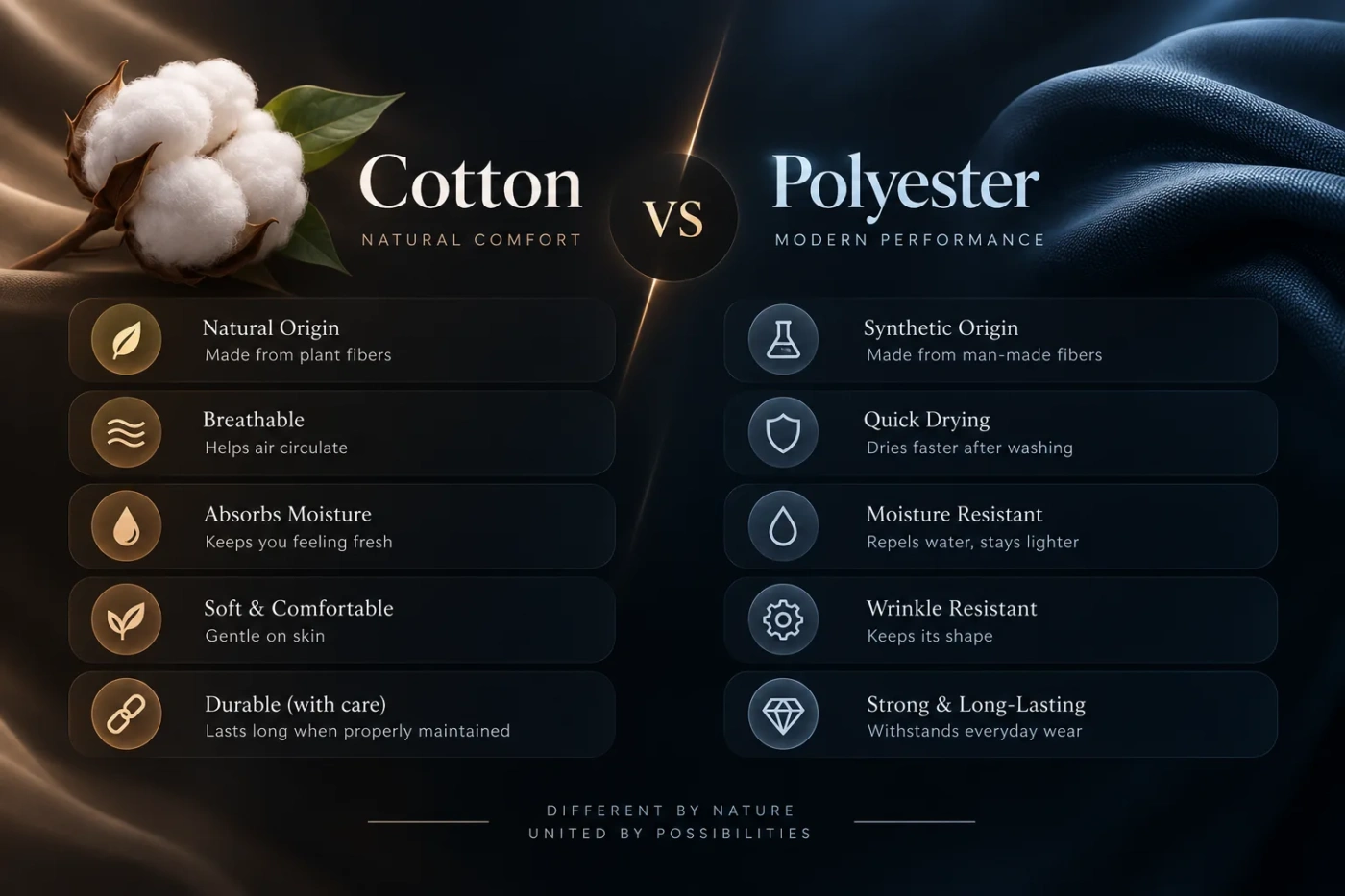
Cotton usually feels softer, handles heat well, and suits people who prioritize breathability and a natural hand feel. Polyester dries faster, resists wrinkles, and generally keeps its shape better through repeated wear. The practical choice changes with the garment: a summer T-shirt, gym top, bedsheet, work uniform, and travel shirt place very different demands on the fabric.
- Absorbing Sweat and Moving Sweat Are Not the Same Thing
- A Hot Day and a Hard Workout Favor Different Properties
- Polyester Handles Laundry With Less Drama
- Durability Depends on the Kind of Wear
- Odor Can Become Polyester’s Weak Point
- Skin Feel Is More About the Fabric Than the Chemical Name
- Cotton and Polyester Blends Change the Trade-Off
- The Better Fiber Changes With the Job
- Pick the Property You Actually Need From the Fabric
| Decision Point | Cotton | Polyester |
|---|---|---|
| Feel against skin | Usually soft with a natural, less slick feel | Varies widely by knit, weave, and finishing |
| Moisture behavior | Absorbs more moisture and can stay wet longer | Absorbs relatively little water and usually dries faster |
| Hot-weather comfort | Often comfortable for casual, low-to-moderate activity | Can work well when engineered for airflow and moisture transport |
| Wrinkle resistance | More likely to crease | Usually holds a smoother appearance |
| Shape retention | May shrink or lose shape depending on construction and care | Generally holds dimensions and shape more consistently |
| Drying after washing | Slower | Faster |
| Odor during active wear | Can feel heavy once saturated but may retain some odors less stubbornly | Dries quickly, though body oils and odor compounds can cling to some polyester fabrics |
| Care convenience | May need more careful drying or ironing | Often easier for frequent washing, travel, and low-ironing routines |
Absorbing Sweat and Moving Sweat Are Not the Same Thing
The biggest practical difference begins with moisture. Cotton is hydrophilic: its fibers readily take up moisture. During light activity, that can feel pleasant because perspiration is absorbed away from the immediate skin surface. Once the fabric becomes heavily damp, though, the stored water adds weight and takes time to evaporate.
Polyester behaves differently. The fiber itself absorbs relatively little water. In sports clothing, manufacturers can structure polyester yarns and fabrics so liquid spreads across a larger surface and moves toward the outside of the garment. This is the mechanism commonly described as moisture wicking.
That distinction explains why a cotton shirt can be comfortable for sitting outside on a warm day yet become clingy during a long run. A suitable polyester performance shirt may feel less saturated and dry much sooner after exercise.
Fabric construction matters: “Polyester” does not automatically mean breathable, and “cotton” does not automatically mean cool. Yarn thickness, fabric weight, knit or weave structure, finishing treatments, garment fit, and airflow can change how either material feels.
A Hot Day and a Hard Workout Favor Different Properties
For relaxed summer wear, cotton remains an appealing option. Its familiar hand feel, moisture absorption, and compatibility with lightweight woven or knitted fabrics make it comfortable in many warm, dry environments. Loose cotton shirts, dresses, and T-shirts can allow plenty of air movement.
Exercise changes the equation. During sustained activity, the priority often shifts from absorbing moisture to getting that moisture away from the body and drying the garment quickly. Polyester frequently performs better here, particularly when the garment is designed as sportswear rather than made from a dense, basic polyester fabric.
Neither material owns the entire “summer” category. A lightweight polyester mesh may feel cooler during a run than a heavy cotton jersey. A loose cotton poplin shirt may feel more pleasant during ordinary daily wear than a tightly woven polyester shirt. The label identifies the fiber, not the full thermal experience.
Polyester Handles Laundry With Less Drama
Repeated washing exposes another clear difference. Polyester generally resists shrinking, dries rapidly, and returns from the wash with fewer wrinkles. That makes it useful for uniforms, travel clothing, school garments, workwear, curtains, and other items that need frequent cleaning without much ironing.
Cotton can require more attention. Depending on how the fabric was manufactured and whether it was preshrunk, heat during washing or drying may change its dimensions. Pure cotton garments can also crease noticeably after laundering.
Those disadvantages do not make cotton fragile. Well-made cotton fabrics can last for years. The issue is convenience rather than a simple durability ranking. Polyester tends to tolerate a low-maintenance routine more easily, while cotton often rewards more controlled washing and drying.
Durability Depends on the Kind of Wear
Polyester fibers are generally strong and abrasion resistant. Garments made for repeated use can benefit from that toughness, especially when rubbing, stretching, frequent laundering, or dimensional stability matters. Polyester also tends to retain its shape well instead of relaxing as quickly under ordinary use.
Cotton ages differently. Repeated friction and washing can gradually wear down cotton fibers, but the way that happens depends heavily on fabric weight and construction. A thick cotton canvas, for example, may withstand demanding use far better than a thin polyester fashion fabric.
Pilling adds another complication. Some polyester garments develop small fiber balls on high-friction areas. Because synthetic fibers are strong, pills can remain attached rather than breaking away easily. Cotton can pill too, particularly in shorter-staple or blended fabrics, but the appearance and persistence vary.
For buyers comparing two actual garments, fiber percentage should therefore be treated as one clue. Fabric density, stitching, yarn quality, reinforcement, and intended use often tell more about lifespan than the words “cotton” or “polyester” alone.
Odor Can Become Polyester’s Weak Point
Fast drying sounds ideal for active clothing, but polyester has a trade-off. Oils from skin can interact with synthetic fabric in ways that allow odor to persist even after the garment feels dry. This is why some frequently worn polyester sports shirts develop a noticeable smell sooner than expected.
Cotton absorbs much more water, which is inconvenient during strenuous exercise, yet its odor behavior can feel more forgiving in some casual applications. Once soaked, however, cotton may remain damp for a long time, and any damp textile can become unpleasant when stored without drying properly.
For gym clothing, washing habits matter almost as much as fiber choice. Leaving a wet shirt compressed inside a bag for hours creates poor conditions for either material.
Skin Feel Is More About the Fabric Than the Chemical Name
Cotton is often associated with softness, but modern polyester covers a wide range of textures. Microfiber polyester can be extremely smooth. Brushed polyester fleece feels very different from a basic polyester lining, while ring-spun cotton differs from coarse cotton canvas.
People who dislike the slightly slick or synthetic sensation found in some polyester fabrics may still prefer cotton for underwear, sleepwear, T-shirts, pillowcases, and other textiles that remain against the skin for long periods. Others value polyester because the garment stays lighter after sweating and does not become as waterlogged.
Sensitive-skin concerns also cannot be decided from fiber name alone. Dyes, textile finishes, detergents, fabric roughness, seams, and retained moisture can all influence irritation. Someone who reacts to one polyester garment has not necessarily established that every polyester textile will feel the same.
Cotton and Polyester Blends Change the Trade-Off
A cotton-polyester blend is not merely a compromise used to reduce manufacturing cost. Blending can deliberately combine properties that are difficult to get from either fiber alone.
Cotton can contribute softness and moisture absorption, while polyester can improve wrinkle resistance, drying speed, shape retention, and resistance to repeated laundering. The resulting fabric may be useful for T-shirts, uniforms, bedding, work clothing, hoodies, and everyday garments where pure cotton would require more care and pure polyester might not provide the preferred feel.
The percentage matters. A garment with a high cotton content will normally behave more like cotton, while one dominated by polyester will lean toward the synthetic fiber’s drying and maintenance characteristics. Yet percentage still does not reveal everything; fabric construction and finishing can change the outcome substantially.
Before buying, check more than the fiber label: look at the cotton/polyester percentage, fabric weight, stretch fiber content, care instructions, intended activity, and whether the garment needs to dry quickly between uses.
The Better Fiber Changes With the Job
For everyday T-shirts: cotton often suits people who prioritize softness and a familiar natural feel. Polyester or a blend becomes more attractive when wrinkle resistance and rapid drying matter.
For running and gym clothing: polyester is usually the stronger match because low water absorption and fast drying are useful during repeated perspiration. Purpose-designed fabric construction remains important.
For travel: polyester has a practical advantage when clothing must be washed in a sink, hung overnight, packed again quickly, or worn without ironing. Cotton may still be worth carrying for comfort-focused pieces that do not need rapid turnaround.
For bedding: preference becomes more personal. Cotton is widely favored for its hand feel and moisture absorption, while polyester and polyester blends can offer easier care, quicker drying, and stronger wrinkle resistance.
For uniforms and work clothing: polyester blends are common for a reason. Frequent washing, shape retention, crease resistance, and long service cycles can matter more than obtaining the feel of pure cotton.
For towels: cotton is generally the more suitable fiber because absorbency is the main task. Polyester may appear in specialized microfiber cleaning textiles, but those products work through a different fabric structure and should not be treated as direct substitutes for conventional cotton bath towels.
Pick the Property You Actually Need From the Fabric
Cotton is the natural choice when softness, absorbency, and a familiar skin feel sit near the top of the list. Its main compromises are slower drying, more wrinkling, and the possibility of shrinkage or shape changes with unsuitable care.
Polyester fits situations where fast drying, wrinkle resistance, dimensional stability, and repeated laundering matter more. Its drawbacks can include a less preferred skin feel in some fabrics, persistent odor in activewear, and the fact that not every polyester textile is breathable simply because it is synthetic.
For many everyday garments, the most practical answer is neither fiber in pure form. A well-designed cotton-polyester blend can retain much of cotton’s comfort while reducing drying time and maintenance. For a relaxed cotton T-shirt, a running top, or a travel uniform, choose according to what the fabric must do after it touches sweat, enters the washing machine, and has to be worn again.