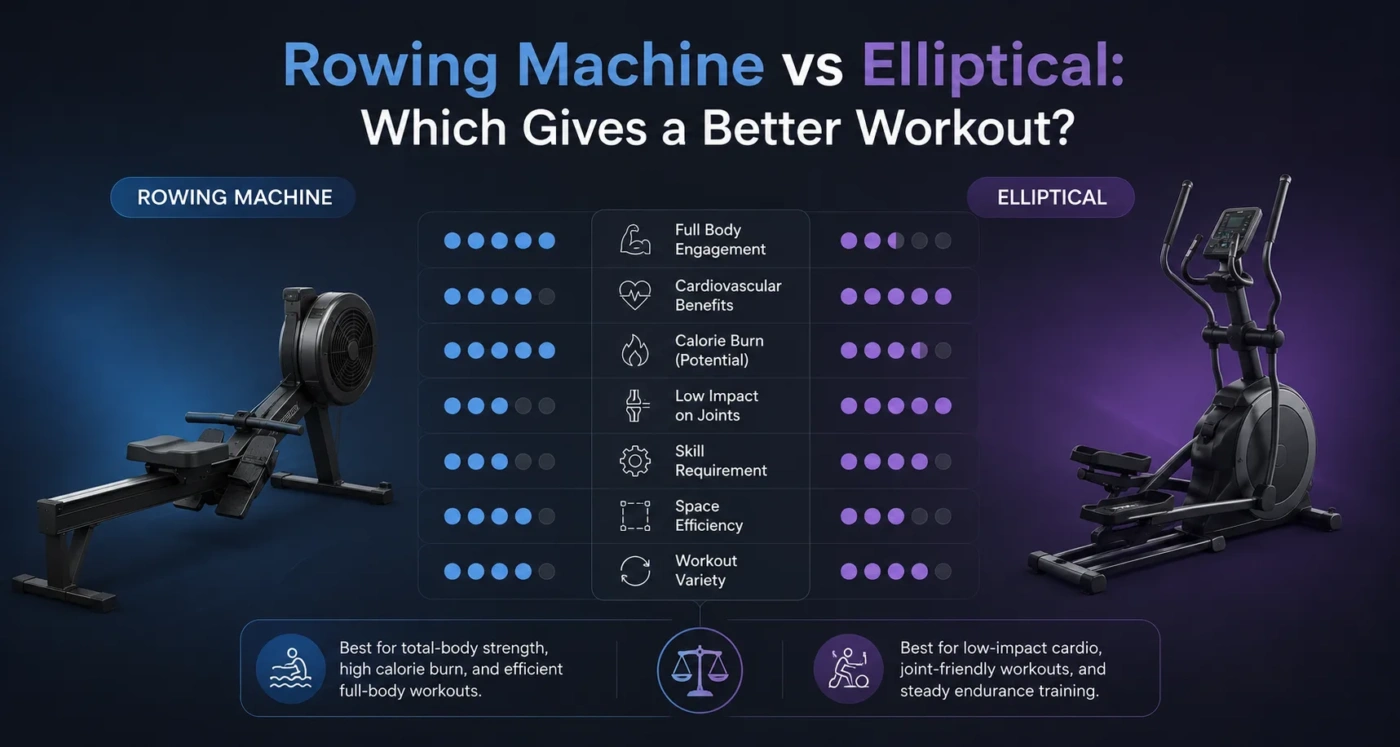
Rowing machines reward powerful, well-timed strokes, while ellipticals make it easier to keep moving through a long, steady session. A rower is usually the stronger fit for people who want demanding intervals and more work from the back, hips, and legs. An elliptical is usually easier to learn, easier to sustain, and better suited to low-impact cardio that does not require close attention to technique. Neither machine is automatically harder, and neither replaces strength training.
- Rowing Demands Sequence; Elliptical Rewards Continuity
- The Muscle Map Is Not the Same
- The Display Cannot Decide Which Burns More
- Low Impact Does Not Mean Joint Neutral
- Home Space Favors Different Machines
- Which One Fits Your Training Pattern?
- Choose a Rowing Machine for Technique-Driven Conditioning
- Choose an Elliptical for Repeatable, Upright Cardio
- Using Both Solves the Variety Problem
- Make the Decision Before Comparing Extra Features
Rowing Demands Sequence; Elliptical Rewards Continuity
A rowing stroke is a coordinated sequence. You drive through the legs, open the hips, finish with the arms, then reverse the order during recovery. When the timing is clean, the movement feels connected and powerful. When it is rushed, the arms tire early, the lower back may take over, and much of the machine’s full-body value disappears.
The elliptical asks less of your timing. Your feet stay on the pedals, the path is guided, and resistance can usually be changed without interrupting the session. That makes it easier to settle into a consistent pace, listen to audio, watch a screen, or complete a longer aerobic workout without thinking about every repetition.
This difference changes adherence. A person who enjoys practising movement may find rowing more engaging. Someone who wants to start moving immediately may use an elliptical more often. The better workout is the one performed with enough effort, enough consistency, and good enough form to repeat next week.
The Muscle Map Is Not the Same
Both machines can involve the upper and lower body, but they distribute the work differently. Rowing combines leg drive with hip extension, trunk control, and a pulling action from the upper back and arms. The glutes, thighs, hamstrings, back, and core all contribute, although the exact balance changes with technique and resistance.
An elliptical places most of the work on the legs. Models with moving handles add an upper-body component, yet the handles do not guarantee balanced effort. Many users push and pull lightly while the legs do nearly all the work. Increasing resistance, using the handles deliberately, and maintaining an active posture can make the session more demanding.
Rowing therefore feels more “full body” for many users, but that phrase can be misleading. It does not mean every muscle receives equal training, and it does not make the rower a complete gym by itself.
The Display Cannot Decide Which Burns More
Calorie estimates often become the deciding point, even though the machine type alone does not determine energy use. Body size, resistance, stroke rate or cadence, session length, fitness level, and actual effort all change the result. A relaxed rowing session can demand less energy than a hard elliptical climb; a strong rowing interval can feel far more taxing than an easy elliptical pace.
For short, forceful intervals, a rower makes it easy to produce bursts of power. The elliptical is often more comfortable for continuous moderate work, especially when a user wants to stay upright and avoid repeated sitting and standing. Both can support interval training, steady-state cardio, warm-ups, and recovery sessions. The workout design matters more than the label on the equipment.
Low Impact Does Not Mean Joint Neutral
Ellipticals are often chosen because the feet remain in contact with the pedals, reducing the landing impact found in running. That can be useful for people who dislike pounding or want a lower-impact cardio option. Still, the guided path may not suit every body. Stride length, pedal spacing, step height, and handle position can affect the knees, hips, ankles, and lower back.
Rowing is also low impact, but it loads the body in a different way. Repeated knee bending, hip flexion, and trunk movement can be uncomfortable when mobility is limited or technique breaks down. Pulling too early with the back, collapsing at the catch, or reaching farther than the hips allow can turn a controlled stroke into repeated strain.
Previous injuries change the decision. An elliptical may feel better for someone who prefers an upright, guided motion. A rower may feel better for someone who wants seated exercise and can maintain a stable spine through the stroke. Anyone returning from injury should test the exact machine and follow medical or rehabilitation advice specific to the condition.
Home Space Favors Different Machines
An elliptical usually occupies a fixed floor area and also needs overhead clearance because the pedals raise the user above the floor. The moving handles add front-to-back and side clearance. Compact models exist, but a short frame can also change stride feel.
A rower is long during use, yet many models can be stored upright, separated, or folded. Storage claims need a closer look: some machines still require a wide turning area, and certain water or air models remain bulky even when standing. Floor-level seating can also be inconvenient for users who find it difficult to sit low or rise from the rail.
Noise depends on the design rather than the category alone. Air rowers usually produce a noticeable fan sound. Water rowers create a softer rushing sound, while magnetic rowers are often quieter. Ellipticals can be quiet, though joints, rails, or drive systems may develop squeaks if assembly or maintenance is poor.
| Decision Point | Rowing Machine | Elliptical |
|---|---|---|
| Body Fit | Check rail length, footplate adjustment, handle reach, and seat height. | Check stride length, pedal spacing, step-up height, and handle reach. |
| Room Fit | Measure full operating length and the space needed to store or rotate it. | Measure floor footprint, moving-handle clearance, and ceiling height. |
| Workout Control | Confirm resistance type, adjustment method, and whether the monitor shows useful stroke data. | Confirm resistance range, incline behaviour, pedal feel, and how quickly settings can be changed. |
Which One Fits Your Training Pattern?
Choose a Rowing Machine for Technique-Driven Conditioning
A rower suits people who enjoy measurable effort, full-stroke coordination, and intense intervals. It is especially appealing when pulling movements are missing from the rest of a home cardio routine. It can also provide a compact training setup when the model stores vertically and the room has enough length for use.
It is a weaker fit when you want completely mindless cardio, dislike low seating, or cannot maintain comfortable hip and spinal movement. The first few sessions may feel awkward. That learning period is not a defect, but it is part of ownership.
Choose an Elliptical for Repeatable, Upright Cardio
An elliptical suits users who want to step on, select resistance, and keep moving. It works well for longer aerobic sessions, gradual interval work, and households with several users who may not want to learn rowing mechanics. The upright position can also make it easier to use entertainment during training.
It becomes less attractive when space is tight, ceiling clearance is limited, or the fixed stride does not match the user. A machine that looks smooth during a brief test can feel restrictive after twenty minutes, so testing the actual stride is worth more than relying on a specification sheet alone.
Using Both Solves the Variety Problem
These machines can be alternatives for a single cardio purchase, but they also work well together. Rowing can handle short power intervals, technique sessions, and posterior-chain conditioning. The elliptical can cover easier aerobic days, longer sessions, or workouts performed when fatigue makes precise rowing less appealing.
Alternating them also spreads repetitive stress across different movement patterns. That does not guarantee injury prevention, yet it can make a weekly routine less monotonous and reduce the temptation to force every workout through the same joints and muscles.
Make the Decision Before Comparing Extra Features
Start with the movement. Test whether you can row with a stable trunk and coordinated sequence, or whether the elliptical’s stride feels natural through the knees and hips. Then measure the room in operating position, not just storage position. Finally, decide whether your normal session is likely to be short and intense or long and steady.
For demanding intervals, a more involved pull-and-drive motion, and a stronger emphasis on the back and hips, the rowing machine is the better fit. For approachable, upright, low-impact cardio that is easier to sustain without technique practice, the elliptical makes more sense. Buy the rower for a stroke you want to master; buy the elliptical for a pace you know you will keep.


