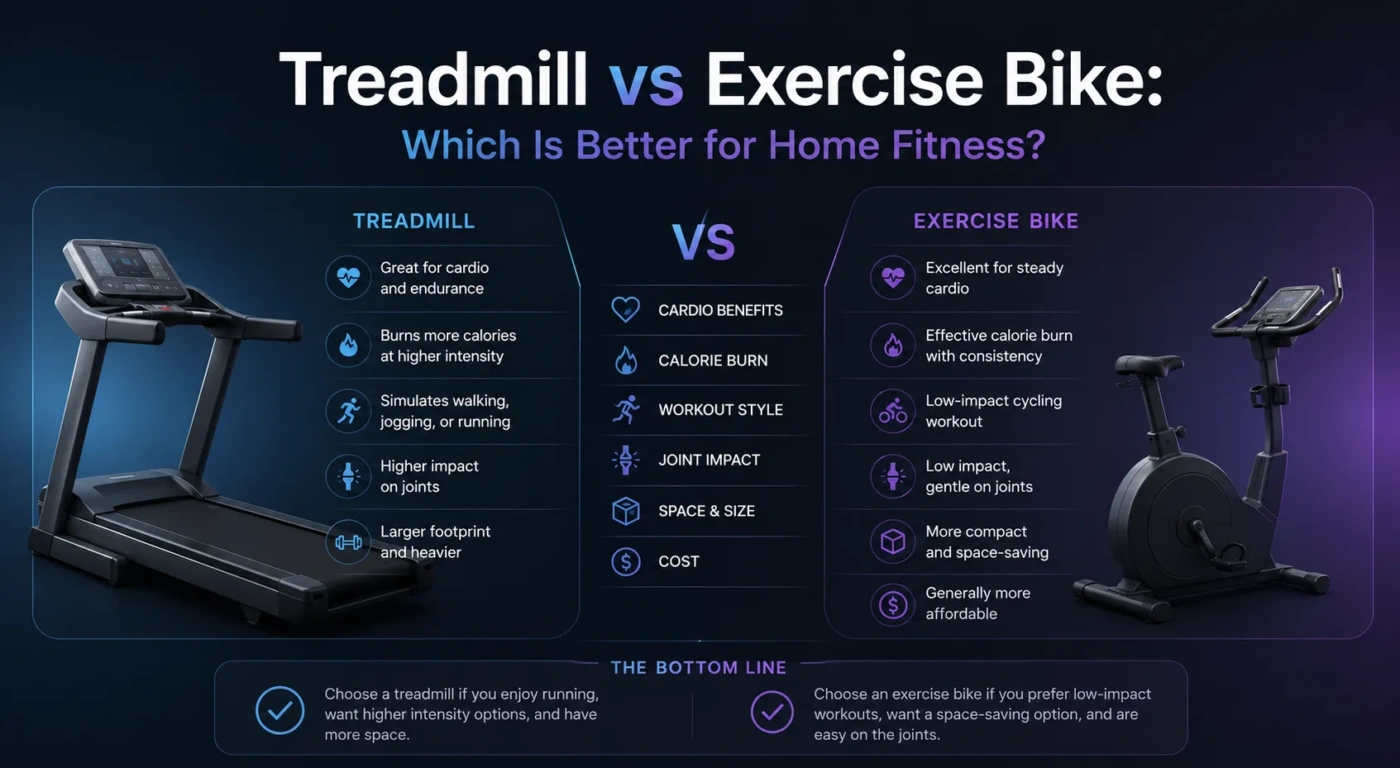
A treadmill is the stronger match when walking, jogging, or running is the activity you want to improve. An exercise bike usually suits homes where lower-impact training, quieter sessions, compact placement, and easier recovery matter more. Neither machine guarantees better fitness on its own. The more useful option is the one that lets you train at a suitable intensity several times a week without creating pain, noise complaints, or a storage problem.
- The First Difference You Feel Is How Your Body Carries the Work
- Running Demands More From Space, Noise, and Recovery
- Treadmill Ownership Friction
- Exercise Bike Ownership Friction
- Cycling Makes Consistency Easier for Many Homes
- Calorie Burn Is Not a Machine Property
- The Machine You Can Progress On Matters More Than the Screen
- Treadmill Progression
- Exercise Bike Progression
- Room Size and Floor Structure Can Decide Before Fitness Goals Do
- A Bike Can Complement Running Instead of Replacing It
- Match the Machine to the Workout You Will Repeat
The First Difference You Feel Is How Your Body Carries the Work
A treadmill keeps you upright and weight-bearing. Your feet repeatedly contact a moving belt while your legs support and move your body. Walking can be gentle, but running adds repeated impact and places greater demands on the feet, ankles, knees, hips, balance, and trunk control.
An exercise bike supports part of your body weight through the saddle. Your feet remain on the pedals, and the motion is guided through a repeated circular path. This usually produces less impact than treadmill running and may make longer cardio sessions more manageable for people who become uncomfortable during repeated foot strikes.
Lower impact does not mean effortless or completely free of joint stress. An unsuitable saddle height, excessive resistance, poor knee tracking, or an awkward reach to the handlebars can cause discomfort. A correctly adjusted bike can feel smooth; a badly fitted one can irritate the knees, hips, back, neck, or hands.
Either machine can produce a demanding workout. Effort changes with speed, incline, resistance, cadence, session length, fitness level, and exercise technique. Compare sessions performed at similar levels of personal effort rather than assuming one machine always burns more energy.
Running Demands More From Space, Noise, and Recovery
A treadmill affects the room before the workout begins. Even folding models need enough floor area for the deck, safe access from the sides, and open space behind the belt. The machine may also be heavy and awkward to move. Folding the deck reduces its stored footprint, but it does not automatically make the unit easy to roll through narrow doors or lift over thresholds.
Noise comes from two sources: the treadmill itself and the person using it. Motor sound varies by model and speed, while footsteps can travel through floors and walls. Running creates more vibration than walking. In an upstairs apartment, footfall may become the deciding issue even when the motor sounds quiet inside the room.
Exercise bikes generally occupy less floor space and produce less structural vibration. Magnetic-resistance models can be especially quiet, although pedals, flywheels, fans, chains, covers, and worn bearings may still create sound. Fan bikes are a notable exception because air resistance becomes louder as effort rises.
Treadmill Ownership Friction
- Larger operating area
- More difficult delivery and relocation
- Footstep vibration during running
- Belt alignment and lubrication requirements on some models
- Greater recovery demand after hard running sessions
Exercise Bike Ownership Friction
- Saddle comfort can limit session length
- Adjustment range may not suit every rider
- Indoor cycling does not train walking or running mechanics
- Low-cost frames may move during hard efforts
- Long sessions can create hand, neck, or lower-back discomfort
Cycling Makes Consistency Easier for Many Homes
Exercise bikes often reduce the number of obstacles between deciding to exercise and starting the session. You can pedal without preparing for repeated impact, and the seated position may feel less intimidating for beginners, older adults, heavier users, or anyone returning after a long period of inactivity.
They also work well for steady cardio while watching a program, listening to audio, or following an instructor-led workout. Reading is possible on some upright and recumbent bikes, though posture should not collapse toward the display or book.
The trade-off is specificity. Cycling develops cycling endurance and leg power within a supported movement pattern. It does not fully prepare your feet, calves, connective tissues, balance, or running technique for long walks and runs. Someone training for a walking holiday, a road race, or a job that involves long periods on foot may need regular weight-bearing activity even if cycling supplies most of the weekly cardio.
A treadmill has a direct advantage here: the exercise closely resembles outdoor walking and running. Speed settings make pace repeatable, while incline allows harder sessions without requiring running speed. For users who dislike outdoor darkness, traffic, heat, cold, or uneven surfaces, that predictability can be enough to make training more regular.
Calorie Burn Is Not a Machine Property
Claims that one machine automatically burns more calories are too broad. A hard cycling interval session can demand more energy than a relaxed treadmill walk. Fast running may exceed moderate cycling, but many people cannot or should not sustain fast running for long periods.
Body size, efficiency, resistance, incline, pace, workout duration, and actual effort all alter the result. Displayed calorie estimates should also be treated as approximations. Machines may calculate them from limited information and cannot measure every personal variable.
For fat loss, the practical advantage belongs to the machine that supports enough weekly activity without driving excessive fatigue, pain, or skipped sessions. A theoretically demanding workout has little value when it is repeated only once and avoided for the rest of the week.
Some riders select very low resistance and pedal without raising their effort enough to challenge the cardiovascular system. Some treadmill users hold the rails while walking at an incline, which can reduce the intended demand and alter posture. The settings matter, but movement quality and honest effort matter too.
The Machine You Can Progress On Matters More Than the Screen
Treadmill Progression
Treadmill training can progress through longer walking sessions, faster pace, short jogging intervals, sustained running, or added incline. These variables give beginners several ways to advance without jumping directly from easy walking to continuous running.
Incline walking is especially useful for users who want harder cardio without the impact and technique demands of faster running. Steeper settings still place demands on the calves and lower legs, so increases should be gradual.
Exercise Bike Progression
Bike workouts can progress through resistance, cadence, duration, intervals, or standing efforts on models designed for that technique. Resistance quality matters. A bike with usable adjustment steps lets you find a manageable starting level and add difficulty in small amounts.
Heavy resistance is not automatically better. Grinding the pedals at a very low cadence may overload the knees or cause technique to deteriorate. Faster pedalling with almost no resistance can also produce little training stimulus. A controlled combination of cadence and resistance usually works better.
Room Size and Floor Structure Can Decide Before Fitness Goals Do
Measure the usable workout area, not only the machine dimensions listed on a product page. A treadmill needs safe clearance, ceiling height for the user standing on the raised deck, and enough space to step on and off comfortably. Incline raises the user farther from the floor, which matters in low-ceiling rooms.
For a bike, check the full range of saddle and handlebar positions. The listed footprint may not include the space needed behind the saddle for a tall rider or beside the machine for mounting. Recumbent bikes often require more floor length than upright bikes, despite their easier entry and supported seating.
- The machine’s operating dimensions rather than folded dimensions alone
- User height and weight limits
- Step-up height, ceiling clearance, and mounting access
- Floor strength, vibration transfer, and downstairs neighbours
- Power outlet location and cord routing
- Saddle, handlebar, speed, incline, and resistance adjustment ranges
- Delivery route through doors, stairs, corners, and elevators
- Warranty terms for the frame, motor, electronics, and labour
- Maintenance instructions and availability of replacement parts
Test the actual movement whenever possible. A treadmill belt may feel too narrow or short for your stride. A bike may place the pedals too far forward, limit knee clearance, or provide a saddle that becomes uncomfortable after ten minutes. Fit problems are difficult to judge from a feature list.
A Bike Can Complement Running Instead of Replacing It
These machines do not have to compete for the same role. Runners often use indoor cycling for additional aerobic work with less impact. The bike can support recovery days, interval sessions, or cardio during periods when repeated running feels excessive. The treadmill then remains available for pace practice, incline walking, and movement specific to running.
The reverse arrangement also works. A person who prefers cycling can use a treadmill for short walking sessions that add weight-bearing activity and break up long periods of sitting. Outdoor walking can provide the same role without requiring a second machine.
Persistent joint pain, dizziness, balance problems, recent surgery, chest symptoms, or a condition that affects exercise tolerance should be discussed with an appropriate healthcare professional. A lower-impact machine may feel easier, but equipment choice does not replace individual medical or rehabilitation advice.
Match the Machine to the Workout You Will Repeat
For general home cardio, an exercise bike is often easier to place, recover from, and use several days per week. It is particularly practical for beginners, mixed fitness routines, apartments, and households where impact noise would reduce training opportunities.
A treadmill earns its larger footprint when walking or running is the activity you want to practise, when indoor pace control keeps you consistent, or when incline walking will be a regular part of your routine. Buy the bike for repeatable seated cardio; buy the treadmill when becoming better on your feet is the actual objective.


