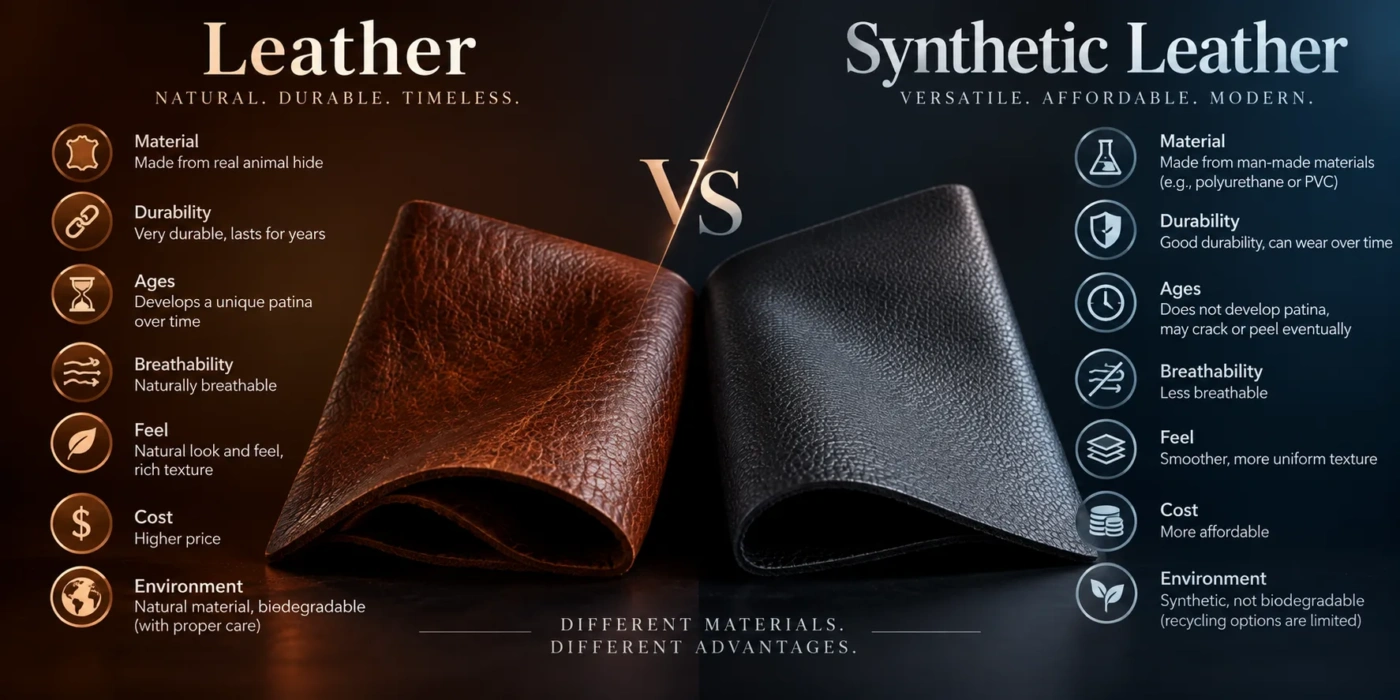
Leather and synthetic leather can look nearly identical on a new chair, jacket, bag, or car seat, yet they tend to age very differently. Real leather usually costs more, develops a changing surface over time, and can often be conditioned or repaired. Synthetic leather offers easier cleaning, more consistent appearance, and usually a lower purchase price, but peeling or cracking can become difficult to reverse once the surface layer starts failing.
- The Biggest Difference Appears After the Surface Starts Wearing
- Real Leather Does Not Stay Looking New
- Heat, Moisture, and Friction Change the Choice
- For Frequently Used Seating
- For Bags, Shoes, and Jackets
- For Wet or Messy Environments
- Breathability Depends on More Than the Label
- Cleaning Is Easier With Synthetic Leather, but Damage Is Different
- “Genuine Leather” and “Faux Leather” Tell You Less Than You Might Expect
- Lower Purchase Price Does Not Always Mean Lower Cost Per Year
- Animal Use Is Only One Part of the Material Question
- Match the Material to How Long You Expect to Keep the Item
The better material therefore depends less on how either one looks in a showroom and more on what will happen after months or years of friction, moisture, sunlight, cleaning, and everyday use.
| Decision Point | Leather | Synthetic Leather |
|---|---|---|
| Surface composition | Animal hide that has been processed and finished | Fabric or other backing covered with a manufactured surface, commonly polyurethane or PVC-based |
| Initial cost | Usually higher | Usually lower |
| Appearance over time | Can soften, crease, darken, and develop patina | Usually aims to retain a uniform appearance until wear becomes visible |
| Routine cleaning | Needs more care with moisture and cleaning products | Often easier to wipe clean |
| Repair potential | Many scratches, dry areas, and worn finishes can be treated or refinished | Peeling coatings and delamination are usually harder to restore permanently |
| Consistency | Natural grain, marks, and texture can vary | Color and texture can be manufactured very consistently |
| Animal-derived material | Yes | Usually no, although the full product composition should still be checked |
The Biggest Difference Appears After the Surface Starts Wearing
New leather and good synthetic leather can both feel smooth, flexible, and visually convincing. Wear is where their construction becomes much more important.
Leather is fibrous throughout much of its structure. A scratch may change the finish or expose a slightly different tone without causing the entire material to separate into layers. With suitable products and enough remaining material, many leather surfaces can be cleaned, conditioned, recolored, or professionally refinished.
Synthetic leather is usually a layered material. A textile backing provides structure while a polymer surface provides the leather-like texture, color, and resistance to spills. That construction works well while the coating remains bonded to the backing. Once repeated flexing, heat, abrasion, or age causes the coating to crack or separate, flakes may begin lifting away from the underlying fabric.
Ownership difference: worn leather often looks aged before it becomes unusable. Worn synthetic leather can remain visually tidy for years, but coating failure may progress quickly after peeling begins.
This does not mean every leather item lasts longer than every synthetic one. Leather grade, hide section, tanning method, finish thickness, stitching, construction, and maintenance all matter. Synthetic materials also range from inexpensive coated fabrics to higher-grade polyurethane and microfiber constructions designed for demanding use.
Real Leather Does Not Stay Looking New
Leather buyers sometimes expect durability to mean an unchanged surface. That is not normally how leather ages.
Creases around frequently flexed areas, gradual softening, small scratches, tonal variation, and patina can appear with use. On a leather wallet or jacket, those changes may be desirable. On a bright, perfectly uniform sofa, the same behavior may be unwanted.
Synthetic leather provides greater control over texture and color. Manufacturers can produce large sections with very similar grain patterns and shades, which is useful for furniture, automotive interiors, restaurant seating, fashion accessories, and products where uniformity matters.
Someone who dislikes patina may therefore prefer synthetic leather even when budget is not the deciding issue. Someone who wants a material that becomes more individual as it ages may prefer leather for exactly the opposite reason.
Heat, Moisture, and Friction Change the Choice
A material used on a decorative bag does not face the same conditions as an office chair used eight hours a day.
For Frequently Used Seating
Office chairs, dining chairs, car seats, and sofas experience repeated compression and rubbing. Body heat, skin oils, clothing friction, and cleaning also act on the surface. Material quality matters more here than a simple leather-versus-synthetic label.
Good leather can handle long-term use well when it is appropriate for the application and receives reasonable care. Synthetic leather may be easier to clean after spills, but heavily used contact areas such as seat edges and armrests are often where coating wear first becomes visible.
For Bags, Shoes, and Jackets
Leather works especially well when flexibility, repairability, and graceful aging are desirable. Scratches may blend into an already developing patina, particularly on less heavily coated finishes.
Synthetic leather can make more sense for fashion items that are used occasionally, need consistent color, or are likely to be replaced before long-term surface deterioration becomes relevant. It can also offer a leather-like appearance without using animal hide.
For Wet or Messy Environments
Synthetic leather often has a practical advantage when frequent wiping is expected. Many coated surfaces resist brief contact with spills better than absorbent or lightly finished natural leather.
Real leather should not automatically be treated as fragile, though. Some finished leathers have protective surface coatings. The correct cleaning method depends on the specific finish, so aggressive household cleaners should not be assumed safe for either material.
Breathability Depends on More Than the Label
Real leather is often described as more breathable, but the finished product can behave differently from an untreated hide. Pigments, protective coatings, sealers, backing materials, foam, and product construction can all affect heat and moisture transfer.
Synthetic leather generally relies on manufactured layers, and some versions can feel warmer or less breathable during prolonged skin contact. More advanced polyurethane and microfiber materials may improve comfort compared with basic vinyl-like surfaces.
For a handbag, this difference may barely matter. For shoes, a jacket, an office chair, motorcycle clothing, or vehicle seating used in hot weather, it deserves more attention.
Do not judge comfort from the material name alone. If prolonged skin contact is expected, examine the specific upholstery or garment construction rather than assuming that every leather product breathes well or every synthetic product feels hot.
Cleaning Is Easier With Synthetic Leather, but Damage Is Different
Routine ownership often favors synthetic leather. Dust and ordinary spills can commonly be removed with a damp cloth and a product approved by the manufacturer. The surface does not normally need traditional leather conditioner.
Leather requires more restraint. Excess water, unsuitable soaps, alcohol, solvents, and aggressive scrubbing can affect finishes or dry the material. Depending on the leather type, occasional conditioning may help maintain flexibility.
The trade-off appears when something goes wrong.
A dry or scratched leather surface may still provide repair options. Specialists can sometimes fill damage, recolor worn areas, replace finishes, or condition material that has become stiff. Results depend heavily on the type and extent of damage.
With synthetic leather, a small cut may be patchable, but widespread peeling usually involves failure of the coating itself. Applying color over loose material does not rebuild the original bond between the coating and backing. For upholstery, replacement of the affected panel may eventually be more practical than repeated cosmetic repairs.
“Genuine Leather” and “Faux Leather” Tell You Less Than You Might Expect
Shopping terminology can make this comparison unnecessarily confusing.
Leather is a broad category rather than one fixed quality level. Full-grain, top-grain, corrected-grain, split leather, heavily pigmented leather, and other constructions can differ in feel, appearance, durability, and price.
Synthetic leather is equally broad. PU leather commonly refers to polyurethane-based artificial leather, while PVC-based materials use a different coating system. Microfiber synthetic leather can use a denser engineered structure intended to imitate some properties of natural leather more closely.
Bonded leather deserves special attention. It is not simply another name for either full natural leather or ordinary synthetic leather. Bonded materials typically contain processed leather fibers combined with binders and surface layers. The leather content and construction can vary, so a shopper expecting the aging behavior of a solid leather hide should check the product specification rather than relying on the word “leather.”
Likewise, labels such as vegan leather describe the absence of conventional animal leather more clearly than they describe the material itself. A product sold under that term may use polyurethane, PVC, plant-derived components, recycled material, or another composite construction. The exact composition matters when durability, environmental preferences, or end-of-life disposal affect the purchase.
Lower Purchase Price Does Not Always Mean Lower Cost Per Year
Synthetic leather often wins on initial price. For dining chairs, fashion accessories, office furniture, automotive trim, and other products, manufacturers can achieve a leather-like surface without the cost associated with processing large pieces of animal hide.
That can make synthetic leather the logical option for occasional-use products or situations where replacement after several years is acceptable.
Long-term value becomes less predictable with heavily used items. A more expensive leather product that remains structurally sound and can be repaired may outlast multiple lower-cost replacements. Yet paying for leather does not automatically produce that result. Poor construction, thin leather sections, weak stitching, inexpensive cushioning, or an unsuitable finish can shorten the life of an otherwise genuine leather product.
For budget decisions, evaluate the whole item. Upholstery material cannot compensate for a weak chair frame, and premium leather does not make poorly constructed shoes durable.
Animal Use Is Only One Part of the Material Question
For buyers who want to avoid animal-derived upholstery or clothing, conventional leather may be excluded immediately. Synthetic leather provides many alternatives without requiring animal hide.
Environmental comparisons are less simple. Natural leather involves livestock supply chains, tanning, finishing chemicals, water use, and waste considerations. Synthetic leather can involve fossil-derived polymers, coatings, solvents, mixed-material construction, and products that are difficult to recycle.
Newer alternatives may incorporate recycled polymers or plant-derived ingredients, but a plant reference in the product name does not necessarily mean the entire material is plant-based or biodegradable. Checking the actual composition is more useful than relying on a broad category label.
Match the Material to How Long You Expect to Keep the Item
For a jacket, briefcase, quality shoes, long-term sofa, or other product you intend to keep and maintain, good leather can justify its higher cost. Its ability to crease, soften, and change should be considered part of the ownership experience rather than automatically treated as deterioration.
For a dining chair that faces frequent spills, a fashion item used for a few seasons, rental furniture, or a product where a uniform finish is preferred, synthetic leather can be the more practical material. Paying more for natural leather may add little value when its aging characteristics and repair potential are not features you plan to use.
Before buying either one, check the actual material specification, the areas where it is used, cleaning instructions, warranty terms, and construction quality. For synthetic upholstery, look beyond the phrase “faux leather” and identify the coating or material type when possible. For leather, determine what kind of leather and finish you are buying rather than treating every product labeled leather as equivalent.
The most useful dividing line is ownership time: choose good leather when you want a material that can age, be maintained, and potentially be restored; choose good synthetic leather when predictable appearance, simple cleaning, lower upfront cost, or avoiding animal hide is the higher priority.