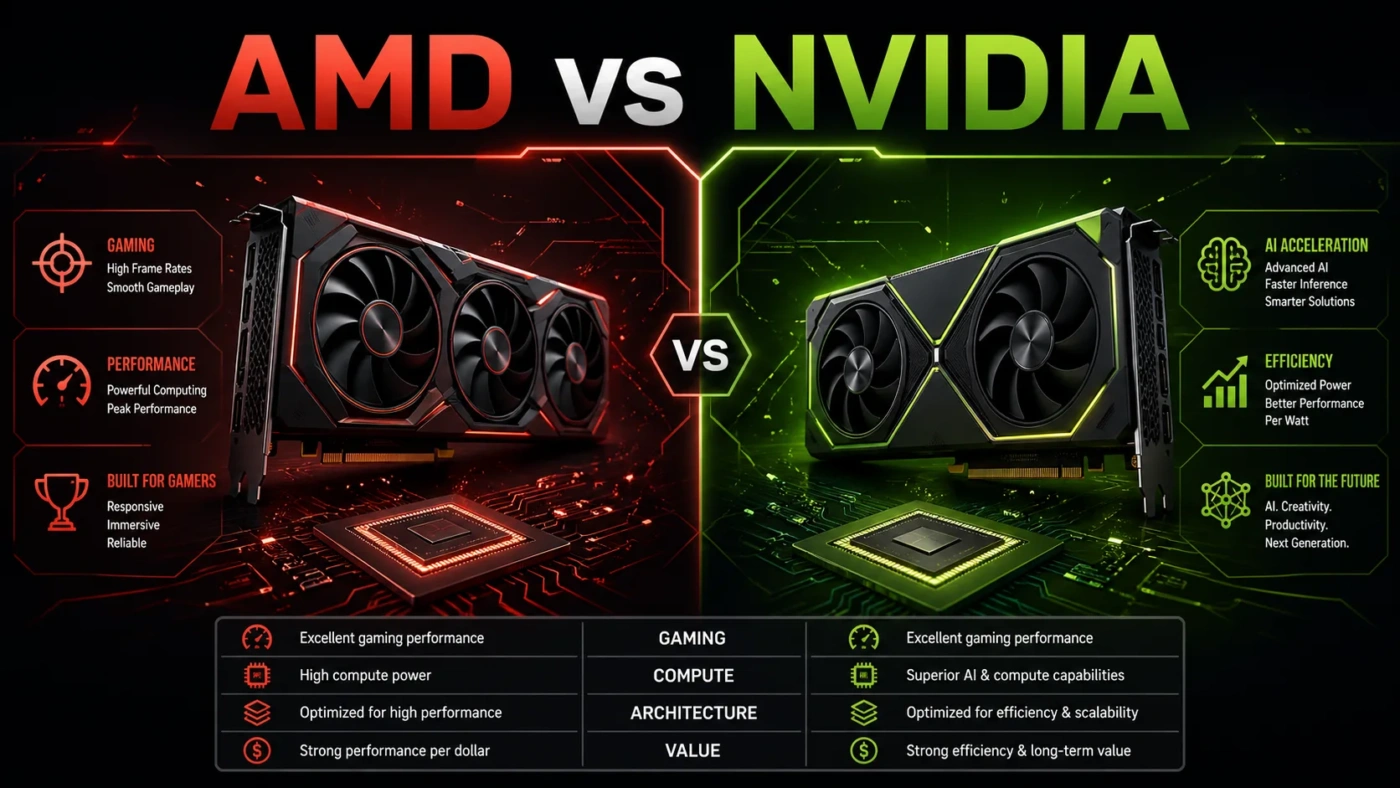
The question of AMD vs NVIDIA comes up every time someone builds or upgrades a PC — and in 2026, the answer is less obvious than it used to be. NVIDIA still leads at the top end, AMD wins on value at the mid-range, and the gap in software is narrowing faster than most people realize. Both brands make genuinely good graphics cards today, which is exactly why picking the right one matters.
| Feature | AMD (Radeon) | NVIDIA (GeForce RTX) |
|---|---|---|
| Latest Architecture | RDNA 4 | Blackwell (RTX 50-series) |
| Upscaling Technology | FSR 4 (open, works on any GPU) | DLSS 4 (AI-based, NVIDIA-only) |
| Ray Tracing Performance | Improved, but behind NVIDIA | Industry-leading with dedicated RT cores |
| Mid-Range VRAM | 16GB (RX 9070 XT) | 12GB (RTX 5070) / 16GB (RTX 5070 Ti) |
| AI & Compute Ecosystem | ROCm 7.0 (open, improving) | CUDA (mature, industry standard) |
| Price / Performance (Mid-Range) | Better value per dollar | Higher cost for comparable raster FPS |
| Flagship Option (2026) | RX 9070 XT (~$599) | RTX 5090 (~$1,999) |
| Game Streaming (NVENC) | Solid encoder | Best-in-class NVENC encoder |
| Linux Driver Support | Excellent (open-source stack) | Good, but less open |
| Resale Value | 40–50% of original price (2–3 yrs) | 50–60% of original price (2–3 yrs) |
What Actually Separates These Two Brands
At the hardware level, the biggest split is in how each brand handles AI-driven graphics and light simulation. NVIDIA’s Blackwell RTX 50-series cards carry dedicated Tensor Cores and RT Cores that are specifically built for DLSS 4 and ray tracing workloads. AMD’s RDNA 4 architecture brings its own matrix math accelerators and updated RT hardware, which close the gap meaningfully — but NVIDIA still holds the performance ceiling in heavy path-traced scenes.
The ecosystem gap is the other major divide. CUDA, NVIDIA’s parallel computing platform, has been deeply embedded in creative software, scientific workflows, and AI training pipelines for over a decade. AMD’s ROCm 7.0 is now production-ready and supports popular frameworks like vLLM, but for most professional tools — Adobe Premiere, Blender’s OptiX renderer, DaVinci Resolve — NVIDIA is still the default.
Then there’s the value question. AMD’s RX 9070 XT ships with 16GB of GDDR6 memory for around $599. The NVIDIA RTX 5070, with 12GB of GDDR7, runs about $599–$649. The RTX 5070 Ti bumps to 16GB but typically costs more. That 4GB gap on the mid-range NVIDIA card is a real-world consideration for anyone planning to keep a GPU for three or four years.
What Is AMD (Radeon)?
AMD’s Radeon GPU lineup is built around the RDNA architecture, with RDNA 4 powering the current RX 9000 series. AMD designs these cards with a clear philosophy: maximize rasterization performance per dollar. In games that don’t lean heavily on ray tracing, AMD cards routinely match or trade blows with more expensive NVIDIA alternatives.
The RX 9060 XT (around $299–$419) brings 16GB of VRAM to the budget segment — an unusual move that makes it a strong long-term buy. The RX 9070 sits at $549, and the RX 9070 XT at $599 is widely considered the best-value GPU in the entire 2026 market for pure gaming. AMD’s FSR 4 upscaling now uses machine learning to improve image quality and supports 85+ DirectX 12 titles. It doesn’t match DLSS 4’s output quality frame-for-frame, but for most players at 1440p, the gap is hard to notice in motion.
One area AMD has genuinely earned praise is open-source support. Linux users and developers who prefer non-proprietary stacks benefit from AMD’s open driver architecture. FSR itself is an open standard — it runs on NVIDIA cards too, which gives AMD’s technology a wider reach than DLSS.
What Is NVIDIA (GeForce RTX)?
NVIDIA’s GeForce RTX 50-series (Blackwell) defines the premium end of the consumer GPU market in 2026. The flagship RTX 5090 retails at $1,999 and sits in a category of its own — AMD currently has no high-end competitor above the RX 9070 XT tier. The RTX 5080 lands around $999, the RTX 5070 Ti around $749–$799, and the RTX 5070 around $599–$649.
DLSS 4 is the feature that most separates NVIDIA cards in practice. It uses AI-based transformer upscaling and multi-frame generation to dramatically multiply output frame rates in supported games — now over 125 titles. The RTX cards also carry NVENC, NVIDIA’s hardware video encoder, which remains the reference standard for streamers. At equivalent settings, it produces cleaner streams with less CPU overhead than AMD’s encoder.
For professional users, NVIDIA’s CUDA ecosystem is the primary reason to pay the premium. The combination of CUDA support in creative applications, NVIDIA’s NVLink interconnect for multi-GPU rendering, and broader AI tool compatibility makes RTX a default for studios and researchers alike. If your workflow touches Stable Diffusion locally, machine learning model training, or 3D rendering in Blender, NVIDIA gets you there faster — and more reliably — today.
When AMD Is the Right Pick
AMD makes the most sense if raw gaming frames per dollar is what you’re optimizing for. At 1080p and 1440p, an RX 9070 or 9070 XT will deliver 90–95% of the performance you’d get from a similarly priced NVIDIA card, and in some rasterization-heavy titles it matches or leads. The 16GB VRAM on mid-range AMD cards also gives them a natural advantage as textures and game assets grow heavier through 2026 and beyond.
AMD is also the better choice if you’re on Linux. The open-source driver stack is more straightforward to work with, and compatibility across distributions is more consistent. Budget builders pairing an AMD CPU with an AMD GPU get a unified software experience through Adrenalin, AMD’s driver suite, without any functional advantage — but it’s a clean, single-vendor stack.
If you don’t use ray tracing (and many competitive gamers deliberately turn it off for higher frame rates), AMD removes a meaningful reason to overpay for NVIDIA hardware. In Apex Legends, Counter-Strike 2, Valorant, and similar titles, the cards trade blows or AMD leads — often at a lower price.
When NVIDIA Is the Right Pick
NVIDIA is the clear answer if your gaming priority is ray tracing or path tracing in modern AAA titles. In games like Cyberpunk 2077 with RT Ultra enabled, NVIDIA cards hold higher frame rates and more stable performance than AMD equivalents. At 4K with ray tracing on, the RTX 5090 averages around 142 FPS in demanding scenes where the RX 9070 XT sits closer to 118 FPS. That difference shows up in games where lighting and shadow simulation put sustained load on RT hardware.
Content creators should almost always lean toward NVIDIA. CUDA acceleration is baked into the render engines of Adobe Premiere Pro, DaVinci Resolve, and Blender’s OptiX backend. NVENC gives streamers higher-quality output at a lower bitrate, and NVIDIA Broadcast’s AI-powered noise cancellation and background removal run natively on RTX hardware. If your PC does double duty as a workstation, NVIDIA’s software support justifies the cost.
Gamers who want the absolute highest performance ceiling — no compromise — will find that NVIDIA’s RTX 5080 and 5090 have no AMD competitor in 2026. AMD has not announced high-end RDNA 4 cards to challenge that tier, so if you need flagship-tier output right now, NVIDIA is the only path.
The Biggest Misconceptions About AMD and NVIDIA
AMD drivers are still unreliable. This was true in the early RDNA days. In 2026, AMD’s driver situation has improved substantially. Stability issues are rare on current RDNA 4 hardware, and the software stack is competitive. Holding AMD to a reputation from three or four years ago isn’t useful anymore.
DLSS always makes NVIDIA cards faster. DLSS 4 is genuinely impressive, but it only helps in the 125+ titles that support it. Outside of supported games, you’re on native rendering — where AMD’s raw rasterization performance often competes closely. DLSS is a real advantage, not a marketing claim, but it doesn’t apply everywhere.
More VRAM always means a better GPU. AMD shipping 16GB on mid-range cards is a meaningful advantage for high-texture 4K gaming and future-proofing, but raw VRAM doesn’t determine overall performance. An RTX 5070 with 12GB outperforms an older card with 16GB in almost every scenario. VRAM matters most when you’re already pushing the card hard at high resolutions.
FSR works exactly the same as DLSS. FSR’s biggest advantage is that it’s open and runs on any GPU — including NVIDIA cards. But DLSS 4’s AI-based approach produces less ghosting, cleaner edges, and better output at the “Performance” quality preset. For most players at “Quality” or “Balanced” FSR settings, the difference is minor. At aggressive scaling modes, NVIDIA’s upscaling holds up better.
NVIDIA is always worth the premium. At the mid-range, this is hard to defend in 2026. Paying $100–$150 more for an NVIDIA card that delivers similar rasterization performance isn’t automatically the right call. The premium makes sense when specific features — DLSS, CUDA, NVENC, ray tracing — are actually part of your regular usage.
Which One Should You Actually Buy?
The answer depends almost entirely on how you use your GPU, not on which brand has the better logo.
If you game at 1080p or 1440p on a budget and don’t care about ray tracing: the AMD RX 9060 XT (~$299–$419) or RX 9070 XT (~$599) are hard to beat. You get 16GB of VRAM, solid rasterization performance, and a price that leaves room in your budget for storage, RAM, or a better monitor.
If you stream, create content, or want the best upscaling tech: go NVIDIA RTX 5070 (~$599–$649) or RTX 5070 Ti. The NVENC encoder alone justifies the choice for streamers, and DLSS 4’s multi-frame generation gives you tangible FPS headroom in supported titles.
If ray tracing is a priority and you game heavily in Cyberpunk 2077, Alan Wake 2, or other path-tracing titles: NVIDIA wins at this specific use case, and the gap is real rather than theoretical.
If you’re a developer, researcher, or run local AI workloads: NVIDIA, because CUDA compatibility still reaches further than ROCm 7.0 across most tools and frameworks.
If you’re on Linux or prefer open ecosystems: AMD, without much hesitation.
At the very high end (above $800): only NVIDIA competes today. AMD has no product in that tier as of early 2026.
For the majority of PC builders in 2026 — people gaming at 1440p, working with creative apps occasionally, and watching their budget — AMD’s RX 9070 XT offers the most performance for the price. If ray tracing, streaming, or professional compute workflows are central to your daily use, the NVIDIA tax buys something real. Neither brand is wrong; the choice is about what you actually do at the desk.