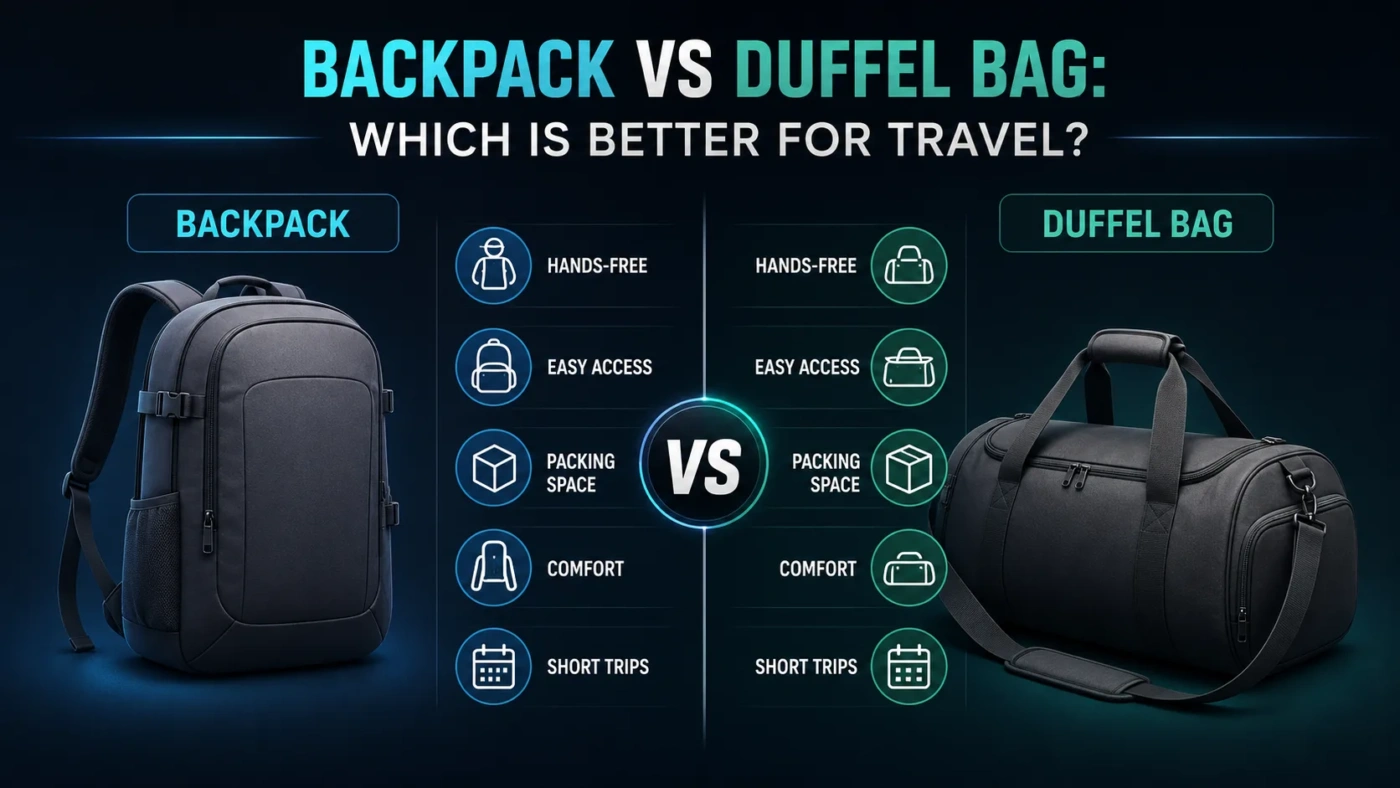
A backpack is usually better for travel when you need hands-free movement, easier walking, and better organization across airports, train stations, city streets, and short hikes. A duffel bag is usually better when you want a simple wide opening, flexible packing space, and easy access in cars, hotels, gyms, or short weekend trips. The better choice depends less on style and more on how you move while traveling.
- Main Differences
- What A Backpack Offers
- What A Duffel Bag Offers
- Choose A Backpack If
- Choose A Duffel Bag If
- Comfort And Carrying
- Packing And Access
- Cabin Travel And Size
- Durability And Maintenance
- Decision Tree
- Common Misunderstandings
- A Duffel Bag Is Not Always Bigger
- A Backpack Is Not Only For Hiking
- A Duffel Bag Is Not Always Worse For Travel
- More Compartments Are Not Always Better
- Best Choice By Traveler Type
- Price And Value
- Compare More Options
- FAQ
- Is A Backpack Better Than A Duffel Bag For Flying?
- Is A Duffel Bag Good For Long Trips?
- Which Bag Is Better For Clothes?
- Which Is Better For A Weekend Trip?
- Can A Duffel Bag Be Used As A Personal Item?
- The Better Travel Choice
| Feature | Backpack | Duffel Bag |
|---|---|---|
| Best For | Flights, public transport, walking-heavy trips, solo travel | Road trips, weekend stays, gym travel, flexible packing |
| Carrying Comfort | Better weight distribution across both shoulders | Can strain one shoulder or hand when heavy |
| Packing Access | Good with compartments, but some models open narrowly | Wide opening makes clothes and bulky items easy to reach |
| Organization | Usually stronger for laptops, chargers, documents, and small items | Often simpler, with fewer built-in sections |
| Mobility | Easier through stairs, crowds, narrow streets, and transit | Better for short carries from car to room |
| Clothing Care | Can compress clothes if overpacked | Often easier for folded clothing and soft layers |
| Security | Needs attention in crowded places because pockets sit behind you | Easier to keep in sight, but less comfortable to hold for long periods |
| Cabin Travel | Often easier to fit under seats if sized correctly | Soft shape can fit overhead bins well, but may sag when packed unevenly |
Main Differences
The main difference between a backpack and a duffel bag is how the weight is carried. A backpack spreads weight across your shoulders and back, which makes it easier to move through long airport corridors, stairs, bus stops, and uneven sidewalks. A duffel bag usually places most of the load on one hand or one shoulder, so it can feel tiring when packed heavily.
The second difference is access. A duffel bag opens wide and works well when you want to see most of your clothes at once. A backpack is usually better for separating items into compartments, especially if you carry a laptop, passport, headphones, chargers, snacks, and travel documents.
The third difference is travel style. Backpacks favor movement. Duffel bags favor packing freedom. If your trip involves walking between places, a backpack feels more natural. If your trip is mostly door-to-door, a duffel can be simpler and faster to pack.
What A Backpack Offers
A travel backpack is designed around movement. It keeps the load close to your body and leaves both hands free for tickets, phones, drinks, children, handrails, or another bag. This matters most when your trip includes airports, rail stations, hostel check-ins, walking tours, or transfers between neighborhoods.
Backpacks also tend to offer better item separation. Many travel backpacks include a laptop sleeve, front pocket, bottle pocket, hidden pocket, and internal dividers. That makes them useful for travelers who want to reach essentials without opening the whole bag in public.
The tradeoff is packing shape. Some backpacks are tall and narrow, so folded clothing may need packing cubes or careful rolling. If the backpack opens only from the top, items at the bottom can be harder to reach. A clamshell-style travel backpack solves much of this problem because it opens more like a suitcase.
What A Duffel Bag Offers
A duffel bag is built around open space. It is easy to pack, easy to load into a car, and friendly to bulky items such as jackets, shoes, towels, sportswear, or soft layers. For short trips, it can feel faster than a backpack because you can place everything into one main compartment and close it.
Duffels also work well in hotel rooms because the wide opening lets you see the contents quickly. If you do not carry many electronics or small travel accessories, the simpler layout can be a benefit.
The tradeoff is carrying comfort. A duffel can become awkward when heavy, especially if it has thin handles or a basic shoulder strap. For longer walks, the load may pull on one side of the body. Some duffels include backpack straps, which can help, but they still may not carry as comfortably as a purpose-built travel backpack.
Choose A Backpack If
Choose A Duffel Bag If
Comfort And Carrying
Comfort is where the backpack usually wins. Two shoulder straps help balance the load, and padded straps reduce pressure during longer carries. A good travel backpack may also include a sternum strap, padded back panel, and waist support. These features matter when the bag is heavy or when you need to walk more than a few minutes.
A duffel bag can be comfortable for short carries, especially if it is lightly packed. The problem appears when the bag gets heavy. One-sided carrying can pull on the shoulder, wrist, or neck. A padded shoulder strap helps, but it does not distribute weight as evenly as a backpack.
Travel Comfort Note: If you expect to carry the bag for long periods, choose the option that keeps weight close to your body and does not force one shoulder to do most of the work.
Packing And Access
A duffel bag is usually easier to pack quickly. Its main compartment accepts folded clothes, rolled clothes, shoes, laundry bags, and odd-shaped items without much planning. This is useful for relaxed trips where you do not need strict organization.
A backpack needs more thoughtful packing, but it can be better organized once packed. Small pockets keep essentials easy to reach, and laptop sleeves protect electronics from clothes and shoes. Packing cubes can make a backpack much easier to use because they turn a narrow space into separate sections.
For travelers who unpack at the destination, the difference may not matter much. For travelers who live out of the bag, access becomes more important. A duffel lets you search quickly. A clamshell backpack can offer a similar experience with better carrying comfort.
Cabin Travel And Size
Both backpacks and duffel bags can work for carry-on travel, but size and shape matter more than the bag category. A soft backpack can often slide under a seat if it is not overpacked. A soft duffel can fit overhead spaces well because the sides compress, but it may become bulky if filled without shape control.
For flights, the best choice is a bag that meets the airline’s size rules and stays manageable when full. A backpack may be easier during boarding because it leaves your hands free. A duffel may be easier to place into an overhead bin because the top opening and soft body are simple to handle.
Fit Note: Published cabin size limits vary by airline and ticket type. Check the current size rules before travel, especially when using the bag as a personal item.
Durability And Maintenance
Durability depends on fabric quality, stitching, zippers, handles, and stress points. A backpack has more straps, panels, and pockets, so there are more parts that can wear over time. A duffel has a simpler structure, but its handles and shoulder strap attachment points take a lot of strain when the bag is heavy.
For wet weather, neither type is automatically waterproof. Some bags resist light rain, but zippers and seams may still allow moisture in. If you travel in rainy places, look for water-resistant fabric, covered zippers, or a rain cover. For either bag, avoid dragging it on rough ground and do not overload weak seams.
Decision Tree
Common Misunderstandings
A Duffel Bag Is Not Always Bigger
Duffels often feel roomier because they have one open compartment, but capacity depends on the actual volume and dimensions. A travel backpack with the same capacity may hold a similar amount, especially when packed with cubes.
A Backpack Is Not Only For Hiking
Many backpacks are made for urban travel, business trips, and flights. A travel backpack can look cleaner and open more like luggage than a school or hiking pack.
A Duffel Bag Is Not Always Worse For Travel
A duffel can be the better option for short stays, road trips, sports travel, and travelers who prefer simple packing. The issue is not the bag type itself, but whether you need to carry it far.
More Compartments Are Not Always Better
Too many small pockets can waste space if you mostly pack clothing. Organization helps when you carry electronics and accessories, but open space helps when your items are bulky.
Best Choice By Traveler Type
| Traveler Type | Better Choice | Reason |
|---|---|---|
| One-Bag Traveler | Backpack | Works as luggage and walking bag in one. |
| Weekend Traveler | Duffel Bag | Fast to pack and easy to use for short stays. |
| Business Traveler | Backpack | Better for laptops, chargers, documents, and airport movement. |
| Road Trip Traveler | Duffel Bag | Flexible shape fits cars and hotel rooms well. |
| Public Transport User | Backpack | Hands-free carrying is easier in crowds and stations. |
| Sports Or Gym Traveler | Duffel Bag | Open space suits shoes, towels, and gear. |
Price And Value
Backpacks and duffel bags both range from budget options to higher-priced travel models. A backpack may cost more when it includes padded laptop protection, structured back support, weather-resistant materials, and many compartments. A duffel may offer better value if you mainly need simple space for clothing and short-distance carrying.
Value depends on use. Paying more for a backpack makes sense if comfort, organization, and daily movement matter. Paying more for a duffel makes sense if the bag has strong handles, durable zippers, reinforced stitching, and a comfortable shoulder strap.
Compare More Options
FAQ
Is A Backpack Better Than A Duffel Bag For Flying?
A backpack is often better for flying if you move through airports, carry electronics, or want your hands free. A duffel can also work well as a carry-on if it fits the airline’s size limits and is not packed too heavily.
Is A Duffel Bag Good For Long Trips?
A duffel bag can work for long trips if you do not need to carry it far. For walking-heavy long trips, a backpack or wheeled luggage is usually easier to manage.
Which Bag Is Better For Clothes?
A duffel bag is often easier for folded clothes and bulky layers because it has a wide opening. A backpack can work well for clothes too, especially with packing cubes.
Which Is Better For A Weekend Trip?
A duffel bag is usually better for a simple weekend trip, especially by car. A backpack is better if the weekend trip includes flights, train travel, or a lot of walking.
Can A Duffel Bag Be Used As A Personal Item?
Sometimes, but it depends on the airline’s size rules and how full the bag is. A soft duffel may compress under a seat, but overpacking can make it too large.
The Better Travel Choice
Choose a backpack if your trip involves movement, public transport, airports, electronics, or one-bag travel. It is the better all-around choice for travelers who need comfort and organization while moving.
Choose a duffel bag if your trip is short, simple, and mostly door-to-door. It is the better choice for easy packing, bulky clothing, sports gear, and road trips. If you are unsure, pick a travel backpack for flexibility; if you know you will carry the bag only short distances, a duffel may feel simpler.