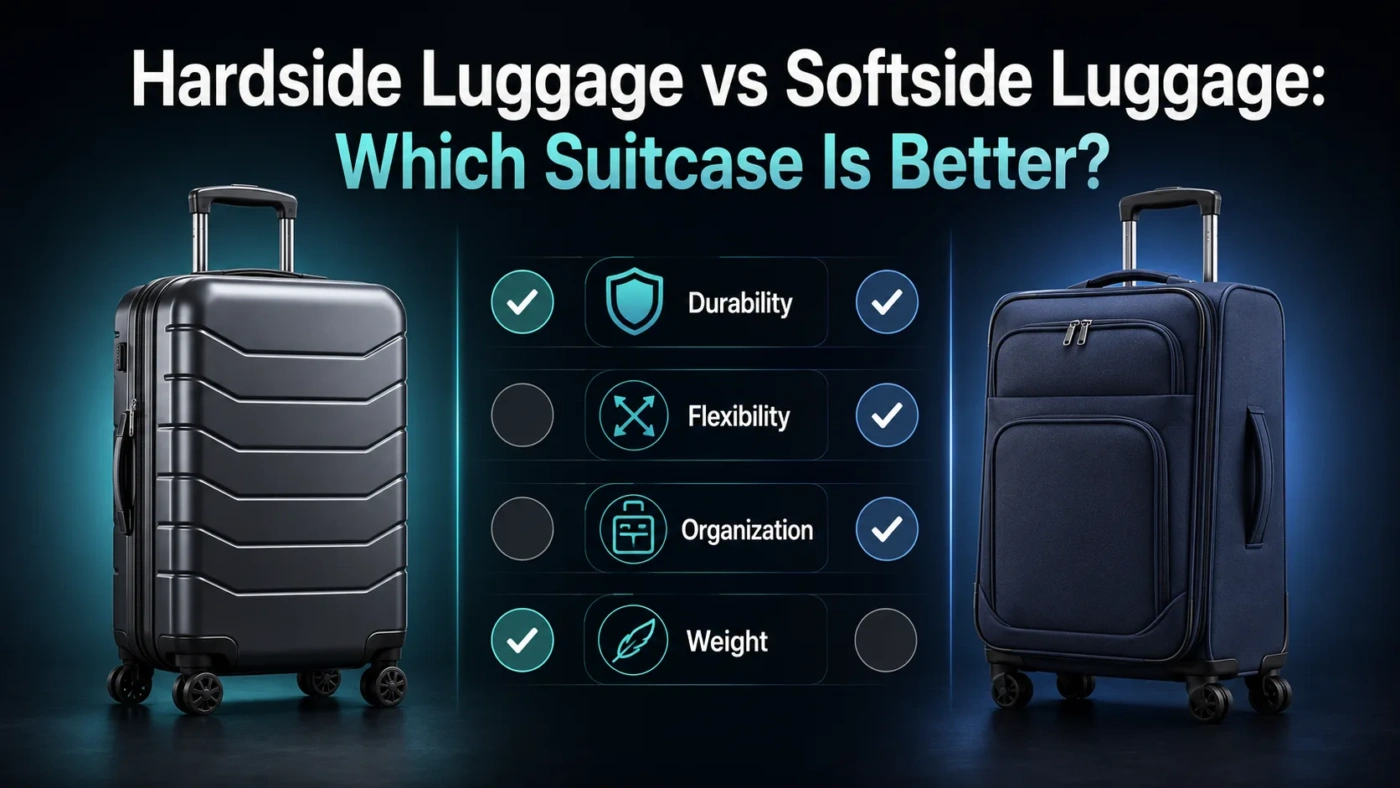
Hardside luggage is usually better for travelers who want stronger impact protection, a cleaner look, and better resistance against light rain. Softside luggage is usually better for travelers who want flexible packing, exterior pockets, easier squeezing into tight spaces, and lighter handling. The better suitcase depends less on which material looks tougher and more on how you pack, where you travel, and how much flexibility you need during a trip.
- Main Differences
- What Hardside Luggage Offers
- What Softside Luggage Offers
- Choose Hardside Luggage If
- Choose Softside Luggage If
- Protection and Durability
- Packing Space and Organization
- Carry-On Travel
- Checked Luggage
- Weather and Cleaning
- Price and Long-Term Value
- Decision Path
- Common Misunderstandings
- Hardside Luggage Is Not Always Stronger Overall
- Softside Luggage Is Not Automatically Less Durable
- Hardside Luggage Is Not Fully Waterproof
- Expandable Space Can Lead to Weight Problems
- Best Choice by Traveler Type
- Which Suitcase Is Better?
- Compare More Options
- FAQ
- Is Hardside Luggage Better Than Softside Luggage?
- Which Type Is Better For Checked Bags?
- Which Type Is Better For Carry-On Travel?
- Does Hardside Luggage Crack Easily?
- Is Softside Luggage Good For International Travel?
| Feature | Hardside Luggage | Softside Luggage |
|---|---|---|
| Best For | Fragile items, checked bags, neat packing | Flexible packing, carry-ons, frequent access |
| Protection | Better shell protection against pressure and bumps | Good cushioning, but fabric can compress |
| Packing Flexibility | Structured space, usually split into two equal halves | More forgiving when slightly overpacked |
| Exterior Pockets | Usually limited or not available | Often includes front pockets for documents and small items |
| Weather Resistance | Better against light rain and spills | Depends on fabric coating and zipper design |
| Scratch and Scuff Marks | Shows scratches more easily | Hides scuffs better, but can stain or fray |
| Storage at Home | Keeps its shape and needs fixed space | Can compress slightly in closets or car trunks |
| Long-Term Wear | Shell may crack if low quality or heavily stressed | Fabric, seams, and corners may wear over time |
| Best Overall Choice | Better if protection and clean organization matter most | Better if access, expansion, and flexibility matter most |
Main Differences
The main difference is structure. Hardside luggage uses a rigid outer shell, often made from plastic-based materials such as polycarbonate, polypropylene, or ABS. Softside luggage uses woven fabric, usually with padding, lining, zipper compartments, and reinforced corners.
That one design choice changes almost everything: how the suitcase protects items, how it opens, how much it can expand, how easily it fits into small spaces, and how it looks after repeated trips.
What Hardside Luggage Offers
Hardside luggage is built around a firm shell. That shell helps protect the contents from outside pressure, which can be useful when bags are stacked, checked, or handled roughly. It also creates a clean packing layout because most hardside suitcases open like a clamshell, with one compartment on each side.
This style works well for travelers who like packing cubes, folded outfits, shoes in separate sections, and items that need a more stable case. It is also easier to wipe clean after a trip. If the outside gets dust, mud, or a drink spill, a damp cloth usually handles it.
The trade-off is flexibility. A hardside suitcase does not squeeze much when it is full. If it is slightly too thick for an overhead bin, car trunk, or luggage rack, the shell will not help you cheat the space. It may also show surface scratches, especially in glossy finishes.
What Softside Luggage Offers
Softside luggage is built around fabric panels, flexible walls, and stitched compartments. It often includes outside pockets, which can be very useful for boarding documents, chargers, books, light jackets, toiletries, or items you want before reaching your hotel.
The biggest advantage is practical flexibility. A softside suitcase can expand, compress, and adjust to awkward spaces more easily than a rigid shell. This is helpful for carry-on travelers, road trips, train travel, and anyone who tends to bring home extra items.
The trade-off is protection. Fabric luggage can cushion items, but it does not create the same hard barrier against outside pressure. It may also absorb stains more easily, and fabric corners can wear if the suitcase is dragged, scraped, or heavily checked over many trips.
Choose Hardside Luggage If
Choose Softside Luggage If
Protection and Durability
Hardside luggage protects better against pressure. If your suitcase is checked, stacked, or placed under heavier bags, the shell gives your items a stronger outer barrier. This does not make it unbreakable. Lower-quality shells can crack, and even stronger shells can dent, scuff, or split under heavy stress.
Softside luggage protects in a different way. It absorbs some bumps and can bend instead of cracking. A good fabric suitcase with reinforced corners can last for years, especially for carry-on use. The weak points are usually fabric abrasion, zipper stress, seams, handles, and wheels.
Practical note: suitcase durability is not only about hardside versus softside. Wheel quality, zipper strength, handle construction, corner reinforcement, and interior stitching often matter just as much as the outer material.
Packing Space and Organization
Hardside suitcases often open into two equal halves. This is neat and balanced, but it needs floor or bed space to open fully. If you are staying in a small room, that clamshell design can feel less convenient.
Softside suitcases often have one deep main compartment with a lid section. This layout can be easier when you want to open the suitcase on a luggage rack or reach one item without spreading both sides open. Many softside models also include expandable zippers, which gives them an edge for return trips.
Carry-On Travel
For carry-on travel, softside luggage has a real convenience advantage if you use the front pockets. You can keep a tablet, documents, earbuds, or a small pouch within reach. The softer body can also help when overhead-bin space is tight.
Hardside carry-ons are better if you want a compact, tidy suitcase that protects the contents and rolls cleanly through airports. They are also easier to wipe down after being placed on airport floors, shuttle storage areas, or hotel luggage racks.
Checked Luggage
For checked luggage, hardside usually makes more sense if protection is the main concern. The rigid shell can reduce pressure on the contents, and the smooth surface is less likely to snag on belts or other bags.
Softside checked luggage still works well for clothing-heavy trips. It can be a better choice if you pack bulky items, want outer pockets, or need an expandable bag. For fragile items, use padding either way. No suitcase replaces careful packing.
Weather and Cleaning
Hardside luggage usually handles light rain better because the shell does not absorb water the way fabric can. Zippers can still let moisture in, so it should not be treated as waterproof unless the suitcase is specifically built for that purpose.
Softside luggage may resist light moisture if the fabric has a protective coating, but it can still soak, stain, or hold odors more easily. Cleaning also takes more effort because dirt can settle into textured fabric.
Price and Long-Term Value
Both types can be affordable or expensive. Hardside luggage often costs more when it uses lighter, more flexible shell materials. Softside luggage can also cost more when it has stronger fabric, better stitching, reinforced corners, and smoother wheels.
For value, focus on the parts that fail first: wheels, telescoping handles, zippers, seams, and corner protection. A cheap hardside suitcase with weak wheels may be less useful than a well-built softside suitcase. A strong hardside suitcase may be worth paying more for if you check bags often.
Decision Path
Common Misunderstandings
Hardside Luggage Is Not Always Stronger Overall
A hard shell protects well against pressure, but the suitcase still depends on wheels, handles, zippers, and shell material. A rigid case with weak parts can fail faster than a well-made fabric suitcase.
Softside Luggage Is Not Automatically Less Durable
Good fabric luggage can handle frequent travel well. It may show wear differently, but reinforced corners and strong stitching can make a softside suitcase very dependable.
Hardside Luggage Is Not Fully Waterproof
The shell may resist water, but zippers and seams can still allow moisture inside. For rainy travel, use inner pouches for electronics, documents, and clothing that must stay dry.
Expandable Space Can Lead to Weight Problems
Softside luggage often gives you more room, but more room can make it easier to exceed weight limits. Expansion is convenient, but it should be used with care.
Best Choice by Traveler Type
| Traveler Type | Better Fit | Reason |
|---|---|---|
| Business Traveler | Hardside or Softside | Hardside looks clean and protects neatly folded items; softside is better if exterior pockets are needed. |
| Carry-On Traveler | Softside | Easier access and more flexibility in overhead bins. |
| Checked-Bag Traveler | Hardside | Better shell protection when the suitcase is handled and stacked. |
| Family Traveler | Softside | Exterior pockets and expandable space help with last-minute items. |
| Minimalist Traveler | Hardside | Structured compartments encourage cleaner packing and limit overstuffing. |
| Road Trip Traveler | Softside | More forgiving when packed into car trunks with other bags. |
Which Suitcase Is Better?
Choose hardside luggage if your main priorities are protection, clean organization, light rain resistance, and a suitcase that keeps its shape. It is the better fit for checked travel, fragile items, and travelers who like a structured packing system.
Choose softside luggage if your main priorities are flexibility, exterior pockets, easier access, and a suitcase that can adapt to tight spaces. It is the better fit for carry-on travel, road trips, family packing, and travelers who often need a little extra room.
For most people, the simplest rule is this: hardside is better when the suitcase needs to protect what is inside; softside is better when the suitcase needs to adapt to how you travel.
Compare More Options
FAQ
Is Hardside Luggage Better Than Softside Luggage?
Hardside luggage is better for protection, structure, and easier cleaning. Softside luggage is better for flexibility, outside pockets, and tight storage spaces. Neither is better for every traveler.
Which Type Is Better For Checked Bags?
Hardside luggage is usually better for checked bags because the rigid shell offers more protection when bags are stacked or handled during transit.
Which Type Is Better For Carry-On Travel?
Softside luggage is often better for carry-on travel because it usually has exterior pockets and can fit tight overhead-bin spaces more easily. Hardside carry-ons are better if you want more structure and protection.
Does Hardside Luggage Crack Easily?
Quality and material matter. Some hard shells can crack under heavy stress, while better materials are more flexible and impact resistant. Wheels, zippers, and handles should also be checked before buying.
Is Softside Luggage Good For International Travel?
Yes. Softside luggage can be very practical for international travel, especially if you need exterior pockets, flexible packing, and easier storage. For fragile items or frequent checked baggage, hardside may be a better match.