Garment bags and suitcases solve different business-travel problems. A garment bag is built around keeping jackets, trousers, dresses, and shirts in wearable condition. A suitcase is built around carrying an entire trip in one protected container. For a short trip centered on formal meetings, wrinkle control may outweigh storage flexibility. For a longer trip with laptops, spare shoes, casual clothing, and changing weather, a suitcase usually makes packing easier.
- The First Question Is What Must Arrive Ready to Wear
- A Garment Bag Protects Shape; a Suitcase Protects the Whole Trip
- Cabin Rules Can Reverse the Decision
- Walking Through Airports Changes the Appeal
- The Rest of the Packing List Usually Decides the Winner
- One-Night Meeting
- Three-to-Five-Day Schedule
- Formal Events Across Several Days
- Frequent Transfers
- Wrinkle Control Depends on Packing, Not Only the Bag
- Using Both Can Be More Efficient Than Forcing One Bag to Do Everything
- Check the Trip Before Buying the Bag
The First Question Is What Must Arrive Ready to Wear
A business traveler carrying one suit for a presentation has a different priority from someone packing for five days of meetings, dinners, workouts, and airport transfers. The first traveler needs clothing to retain its shape. The second needs efficient use of limited luggage space.
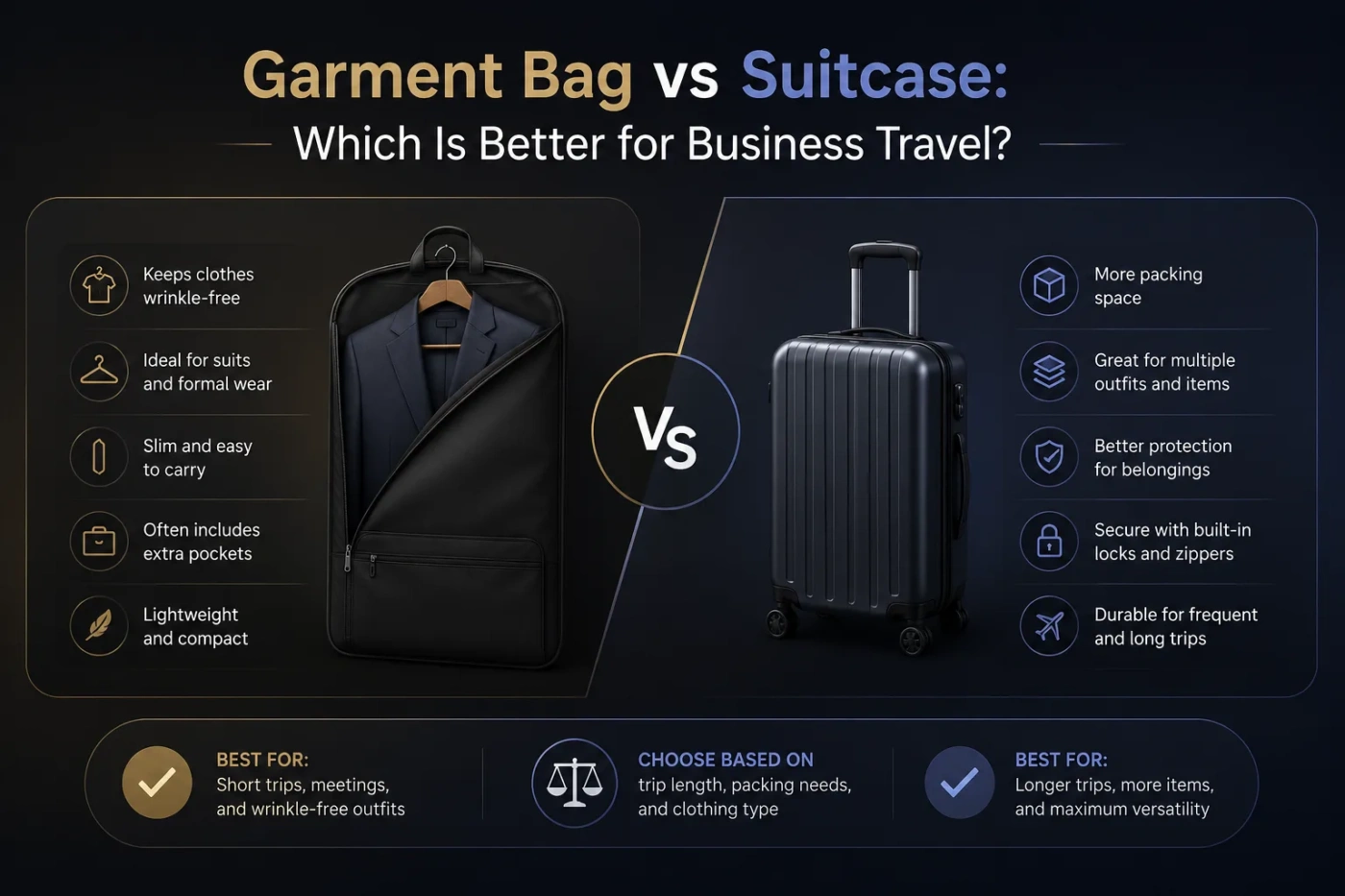
A garment bag lets tailored clothing hang at close to its normal length before the bag is folded or carried. This reduces the number of hard folds placed across jacket panels, trouser legs, and structured dresses. It does not guarantee wrinkle-free arrival, especially after the bag has been compressed in an overhead compartment, but it usually gives formal clothing more room than a tightly packed suitcase.
Suitcases rely on folding, rolling, packing folders, or compression cubes. These methods work well for knitwear, casual shirts, underwear, and many wrinkle-resistant fabrics. Structured garments are less forgiving. A suit folded into a crowded case can arrive with pressure marks around the lapels, shoulders, or trouser creases.
A Garment Bag Protects Shape; a Suitcase Protects the Whole Trip
Most garment bags are relatively shallow. That shape suits hanging clothes, but it leaves less room for bulky objects. Shoes, toiletry cases, chargers, folders, and spare layers may fit in pockets or lower compartments, yet every added item increases pressure on the clothing inside.
A hard-shell suitcase handles mixed contents more effectively. Its shell can shield electronics, toiletry containers, shoes, and other objects from external pressure. Soft-sided suitcases offer slightly more flexibility and may include accessible exterior pockets, though they provide less rigid protection.
| Travel Requirement | Garment Bag | Suitcase |
|---|---|---|
| Tailored clothing | Keeps garments closer to their hanging shape | Requires careful folding or a packing folder |
| Shoes and bulky layers | Limited space; may press against clothing | Easier to separate and organize |
| Laptop and work accessories | Varies widely; some lack protected compartments | More capacity, but laptop access may be inconvenient |
| Airport movement | Can become tiring if carried by hand or shoulder strap | Wheeled models move more easily through terminals |
| Storage at the destination | Can often be opened and hung immediately | Usually needs unpacking to prevent creases |
The suitcase has another advantage: separation. Packing cubes, shoe bags, document sleeves, and toiletry pouches can create defined zones. A traditional garment bag has fewer compartments, so small items may collect around the folded base unless the model is designed as a garment duffel or wheeled garment case.
Cabin Rules Can Reverse the Decision
A garment bag may look slim, but airline acceptance is based on its dimensions and handling rules, not its appearance. Some folding models fit normal cabin limits. Full-length bags, wheeled garment cases, and heavily packed garment duffels may be treated as standard carry-on luggage or may need to be checked.
Do not assume cabin crew will place a garment bag in an onboard closet. Closet space may be unavailable, reserved, or too small. The bag may need to lie flat in an overhead bin, where other passengers can place luggage on top of it. A garment bag bought mainly for hanging storage loses part of its advantage if it must be folded tightly and compressed.
A compact suitcase has a more predictable shape. It may still be gate-checked on a full flight, but its rigid structure generally handles stacking better than a lightly padded garment carrier. Frequent flyers who move through several airports in one trip may value that predictability more than the slight reduction in clothing creases.
Walking Through Airports Changes the Appeal
The difference becomes obvious during a long connection. A shoulder-carried garment bag can pull unevenly, slide against the body, and occupy one hand when boarding trains or climbing stairs. It is manageable for a direct overnight trip. Across several terminals, it can become an ownership annoyance.
Four-wheel suitcases roll beside the traveler and place little weight on the arm. Two-wheel models track well over rougher surfaces but need to be pulled. Either design is usually easier than carrying formal clothing over a long distance.
Wheeled garment bags sit between the two categories. They offer hanging storage with suitcase-style movement, though they are often heavier, thicker, and less space-efficient than simple garment carriers. They make the most sense for travelers who regularly transport several formal outfits and are willing to dedicate most of their luggage capacity to clothing.
The Rest of the Packing List Usually Decides the Winner
A single suit is rarely the whole trip. Business travel can also involve presentation equipment, casual evening clothes, medication, a second pair of shoes, workout clothing, coats, chargers, and printed documents. Once these items enter the calculation, the suitcase becomes easier to justify.
One-Night Meeting
For a direct trip with one formal outfit, a compact garment bag can work well. A shirt, suit, belt, and small toiletry kit may be enough. The laptop can remain in a separate personal item, provided the airline permits both pieces.
Three-to-Five-Day Schedule
A cabin suitcase is usually more practical. It can hold interchangeable shirts, casual clothing, sleepwear, spare shoes, and weather layers without placing every item against a suit. A packing folder can keep formal pieces relatively neat, while hotel steaming or light ironing can handle minor creases.
Formal Events Across Several Days
A wheeled garment case or a garment bag paired with another piece becomes more appealing when the schedule requires multiple suits, dresses, uniforms, or ceremonial clothing. In this situation, the bag is not merely protecting one outfit. It is carrying the main working wardrobe.
Frequent Transfers
For routes involving trains, taxis, stairs, and repeated hotel changes, mobility often wins. A suitcase that rolls well and closes securely is easier to manage than a long bag that must be carried, folded, and repositioned throughout the day.
Wrinkle Control Depends on Packing, Not Only the Bag
A poorly packed garment bag can crease clothing more than a carefully packed suitcase. Empty space allows garments to shift. Overfilling creates pressure. Heavy shoes placed against a jacket can flatten its structure, while unprotected hangers may move or detach during handling.
Inside a suitcase, folding technique matters. Jackets can be folded with the shoulders nested together, trousers can follow their existing crease, and shirts can be placed near the top rather than under shoes. A packing folder adds light compression without crushing the fabric. Plastic dry-cleaning film between layers may reduce friction, though garments should not remain sealed in non-breathable material for long-term storage.
Fabric changes the result as well. Wool blends, textured materials, and many travel-focused fabrics recover more easily than linen or crisp untreated cotton. A traveler wearing wrinkle-resistant separates may gain little from carrying a dedicated garment bag.
Using Both Can Be More Efficient Than Forcing One Bag to Do Everything
Garment bags and suitcases are not always direct substitutes. On trips with checked luggage, a lightweight garment sleeve can sit inside a suitcase to keep formal clothing grouped and reduce contact with shoes or toiletries. It will still be folded, but unpacking becomes faster and the outfit remains organized.
Another arrangement is a small rolling suitcase plus a foldable garment bag. The suitcase carries dense items; the garment bag carries the meeting outfit. This setup works only when baggage allowances permit two pieces or when one item qualifies as a personal item. Otherwise, the extra convenience can create gate-check fees or force last-minute repacking.
Garment duffels offer a hybrid layout: clothing wraps around a central compartment used for shoes and smaller items. They can serve short trips well, but their curved packing shape may still crease jackets, and access to the central compartment can be awkward once the garment section is closed.
Check the Trip Before Buying the Bag
For most business travelers taking multi-day trips, a compact wheeled suitcase is the more flexible single-bag solution. It carries formal clothing well enough when packed carefully and handles everything else with fewer compromises.
A garment bag earns its place when presentation clothing is the main cargo, the route is simple, and the outfit needs to be wearable soon after arrival. Travelers who regularly carry several tailored pieces may benefit from a wheeled garment case, while occasional suit wearers can often manage with a suitcase and a good folding method.
Pack around the meeting schedule: use the garment bag when clothing condition drives the trip, and use the suitcase when the trip demands more than the clothing.