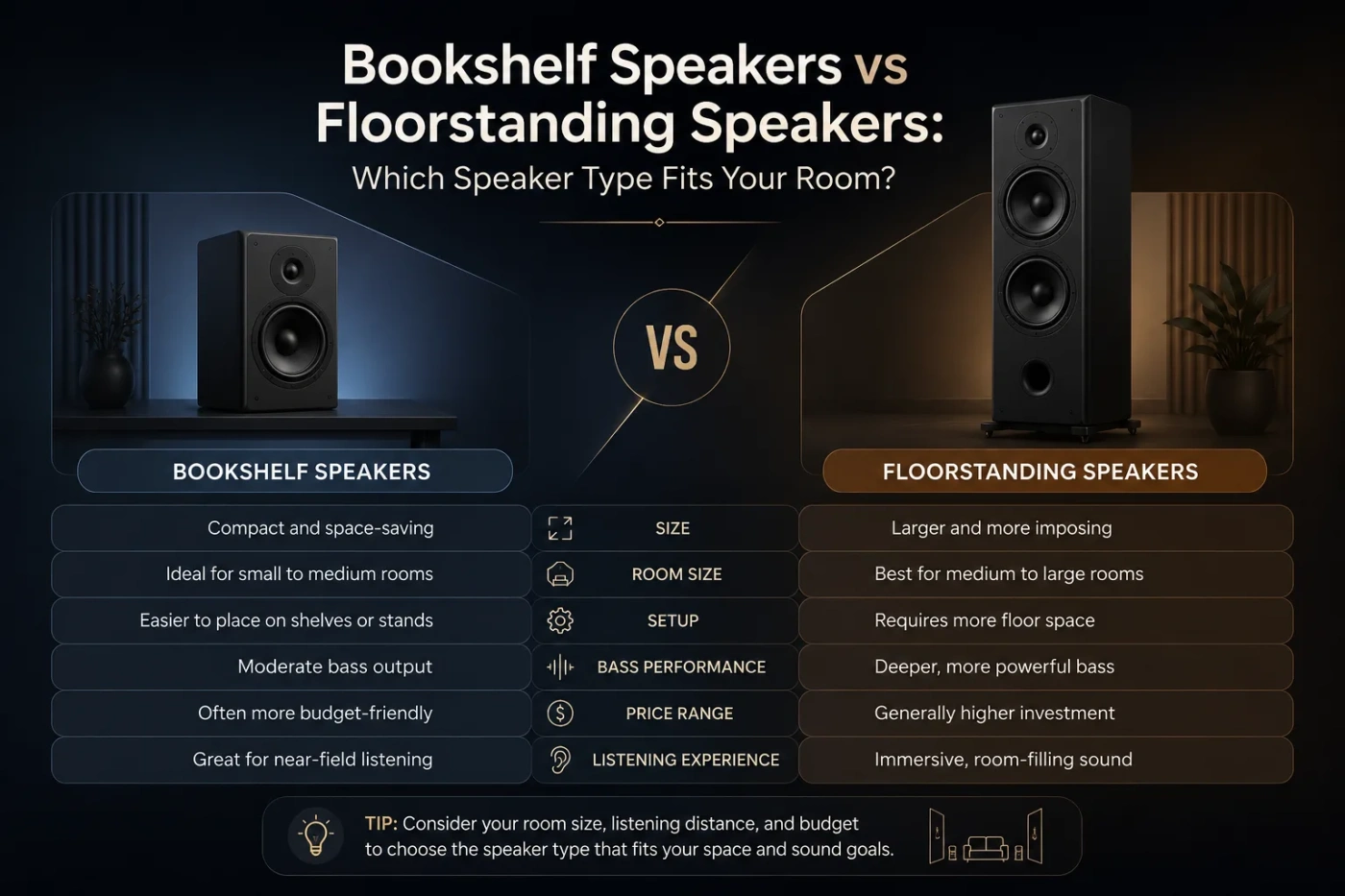
Bookshelf speakers and floorstanding speakers can both deliver excellent sound, but they are built for different rooms, budgets, and listening habits. Choose bookshelf speakers if you want flexible placement, lower cost, and strong sound in a small or medium room. Choose floorstanding speakers if you have more space, want deeper bass, and prefer a fuller sound without relying as much on a subwoofer.
- Main Differences
- What Bookshelf Speakers Offer
- What Floorstanding Speakers Offer
- Sound Quality And Bass
- Room Size And Placement
- Price And Long-Term Value
- Choose Bookshelf Speakers If
- Choose Floorstanding Speakers If
- Music, Movies, And Gaming
- Setup And Daily Use
- Common Misunderstandings
- Bigger Does Not Always Mean Better
- Bookshelf Speakers Still Need Space
- A Subwoofer Changes The Decision
- Towers Are Not Always Better For Apartments
- Best Choice By User Type
- Speaker Terms Worth Knowing
- Compare More Options
- FAQ
- Are Floorstanding Speakers Better Than Bookshelf Speakers?
- Do Bookshelf Speakers Need A Subwoofer?
- Can Bookshelf Speakers Fill A Living Room?
- Are Floorstanding Speakers Too Much For A Small Room?
- Which Speaker Type Should Most People Choose?
| Feature | Bookshelf Speakers | Floorstanding Speakers |
|---|---|---|
| Best For | Small to medium rooms, desks, apartments, compact home theater setups | Medium to large rooms, dedicated listening spaces, fuller stereo systems |
| Size | Compact, but usually needs stands or a shelf | Tall cabinet that sits directly on the floor |
| Bass Output | Limited compared with larger speakers; often pairs well with a subwoofer | Stronger low-end response because of larger cabinets and more drivers |
| Soundstage | Can image very well when placed on proper stands | Often creates a larger, more room-filling presentation |
| Placement Flexibility | Easier to move and adjust | Needs more floor space and careful positioning |
| Amplifier Demands | Varies by model; many work well with modest receivers | May benefit from stronger amplification, especially in larger rooms |
| Price Range | Usually more affordable at the same product level | Usually costs more because of larger cabinets and extra drivers |
| Best Overall Choice | Better for value, flexibility, and smaller spaces | Better for scale, bass, and large-room listening |
Main Differences
The main difference is cabinet size. A bookshelf speaker uses a smaller enclosure, usually with a tweeter and one mid-bass driver. A floorstanding speaker uses a taller cabinet and may include multiple woofers, midrange drivers, and a tweeter. That extra cabinet volume helps floorstanding speakers move more air, which usually means stronger bass and more effortless volume.
Bookshelf speakers are easier to place, easier to upgrade around, and often cheaper. Floorstanding speakers feel more complete on their own, especially for music listeners who want weight and scale without adding a subwoofer.
What Bookshelf Speakers Offer
Bookshelf speakers are compact stereo speakers designed to sit on stands, shelves, desks, or media furniture. Despite the name, placing them inside a cramped bookshelf is not always ideal. They usually sound better when pulled forward from walls, set at ear height, and given some open space around them.
Their biggest strength is efficiency of space and budget. A well-designed bookshelf speaker can deliver clear vocals, accurate imaging, and detailed music playback without needing a large cabinet. For apartments, bedrooms, home offices, and smaller living rooms, they are often the smarter choice.
What Floorstanding Speakers Offer
Floorstanding speakers, also called tower speakers, are larger speakers that stand directly on the floor. Their taller cabinets give speaker designers more room for extra drivers and larger internal volume. This can make the sound feel fuller, wider, and more powerful.
They are especially useful in rooms where small speakers sound thin or strained. If you listen from a sofa across the room, play music at higher volume, or want stereo speakers that can handle movies without sounding small, floorstanding speakers have a clear advantage.
Sound Quality And Bass
Sound quality is not decided by size alone. A high-quality bookshelf speaker can sound clearer, more balanced, and more precise than a cheap floorstanding speaker. Driver quality, cabinet design, crossover tuning, room acoustics, and placement all matter.
That said, physics still matters. Floorstanding speakers usually have more bass capability because they use larger cabinets and more driver surface area. This helps with kick drums, bass guitar, cinematic effects, and orchestral weight. Bookshelf speakers can still sound excellent, but they often need a subwoofer if deep bass is a priority.
Listening Note: Bigger speakers do not automatically mean better speakers. A speaker that fits the room and is placed correctly will usually sound better than a larger speaker squeezed into the wrong space.
Room Size And Placement
Room size should heavily influence the choice. In a small room, floorstanding speakers can sometimes produce too much bass, especially if they sit close to walls or corners. This can make the sound boomy instead of balanced.
Bookshelf speakers are easier to position in tight spaces. When placed on proper stands, they can create a focused stereo image with less bass overload. In a large room, however, bookshelf speakers may struggle to fill the space unless they are supported by a subwoofer.
Price And Long-Term Value
Bookshelf speakers usually cost less than floorstanding speakers from the same brand and product line. However, the full system cost can change once stands, a subwoofer, cables, and amplifier needs are included.
Floorstanding speakers cost more upfront, but they may reduce the need for a subwoofer in a music-only setup. For movies, gaming, and modern home theater, a subwoofer is still useful even with tower speakers because low-frequency effects are often handled separately.
| Cost Area | Bookshelf Speakers | Floorstanding Speakers |
|---|---|---|
| Speaker Price | Usually lower | Usually higher |
| Stands | Often needed for best sound | Not needed |
| Subwoofer | Often recommended for deep bass | Optional for music, useful for home theater |
| Amplifier | Many models work well with modest power | Some models benefit from stronger amplification |
| Upgrade Path | Easy to expand with subwoofer or surround speakers | Strong stereo base, but larger investment upfront |
Choose Bookshelf Speakers If
- You have a small or medium room.
- You want a clean stereo setup without large cabinets.
- You listen at moderate volume.
- You plan to add a subwoofer later.
- You need speakers for a desk, bedroom, apartment, or compact media area.
- You prefer spending more on speaker quality rather than speaker size.
Bookshelf speakers are also a strong choice for beginners because they are easier to place, easier to move, and easier to build around. A good pair can stay useful for years, even if the system later grows into a larger home theater setup.
Choose Floorstanding Speakers If
- You have a larger room or open-plan living space.
- You want stronger bass from the main speakers.
- You listen to music at higher volume.
- You prefer a fuller stereo sound without relying heavily on a subwoofer.
- You have enough floor space for proper placement.
- You want a more powerful front speaker setup for home theater.
Floorstanding speakers make more sense when the room can support them. They need breathing space. If they are pushed into corners or placed too close to walls, the extra bass can become less controlled.
Music, Movies, And Gaming
For music, floorstanding speakers often feel more complete because they can reproduce more low-end energy on their own. This works well for rock, electronic music, jazz, classical recordings, and live albums where scale matters.
For movies, the best answer depends on whether a subwoofer is included. Bookshelf speakers with a good subwoofer can outperform floorstanding speakers without one for explosions, low-frequency effects, and cinematic impact. For gaming, bookshelf speakers are often enough for nearfield setups, while floorstanding speakers suit couch-based systems in larger rooms.
| Listening Style | Better Fit | Reason |
|---|---|---|
| Desktop Music | Bookshelf Speakers | Compact size and close-range clarity |
| Large-Room Stereo | Floorstanding Speakers | More scale and stronger bass output |
| Home Theater With Subwoofer | Either | The subwoofer handles the deepest bass |
| Apartment Listening | Bookshelf Speakers | Easier volume control and less bass spread |
| Two-Channel Music Without Subwoofer | Floorstanding Speakers | Fuller low-end response from the main speakers |
Setup And Daily Use
Bookshelf speakers are not always “plug and forget.” They need stable placement. For best results, the tweeters should sit near ear height, the speakers should be spaced evenly, and each speaker should have some distance from the rear wall.
Floorstanding speakers remove the need for stands, but they demand more open floor space. They can also be heavier and harder to move. Once positioned well, they offer a strong, tidy stereo setup with fewer visible support pieces.
Common Misunderstandings
Bigger Does Not Always Mean Better
Floorstanding speakers can play bigger and deeper, but quality still depends on design, drivers, crossover tuning, and room match.
Bookshelf Speakers Still Need Space
They are compact, but placing them deep inside a shelf can reduce clarity and bass control.
A Subwoofer Changes The Decision
Bookshelf speakers plus a subwoofer can be excellent for movies, games, and full-range music playback.
Towers Are Not Always Better For Apartments
Strong bass travels through walls and floors more easily. Smaller speakers may be easier to manage in shared buildings.
Best Choice By User Type
| User Type | Best Choice | Reason |
|---|---|---|
| Beginner | Bookshelf Speakers | Lower cost, easier setup, flexible placement |
| Apartment Listener | Bookshelf Speakers | Less intrusive size and easier bass control |
| Music-First Listener | Floorstanding Speakers | Fuller stereo sound and stronger low-end response |
| Movie Fan | Either With Subwoofer | A subwoofer matters more for deep movie effects |
| Small Desk Setup | Bookshelf Speakers | Better fit for close listening |
| Large Living Room | Floorstanding Speakers | More output and wider room coverage |
Speaker Terms Worth Knowing
Compare More Options
FAQ
Are Floorstanding Speakers Better Than Bookshelf Speakers?
Not always. Floorstanding speakers usually offer more bass and scale, but a high-quality bookshelf speaker can sound cleaner and more accurate than a lower-quality tower speaker.
Do Bookshelf Speakers Need A Subwoofer?
They do not always need one, but a subwoofer helps if you want deep bass for movies, gaming, electronic music, or larger rooms.
Can Bookshelf Speakers Fill A Living Room?
Yes, in many small and medium living rooms. For large rooms or high-volume listening, floorstanding speakers or a subwoofer-supported setup may work better.
Are Floorstanding Speakers Too Much For A Small Room?
They can be. If the room is small and the speakers sit near walls or corners, bass may become boomy. Bookshelf speakers are often easier to balance in tight rooms.
Which Speaker Type Should Most People Choose?
Most people should choose bookshelf speakers for small to medium rooms, apartments, and value-focused setups. Floorstanding speakers are the better choice for larger rooms, stronger bass, and a more room-filling stereo experience.