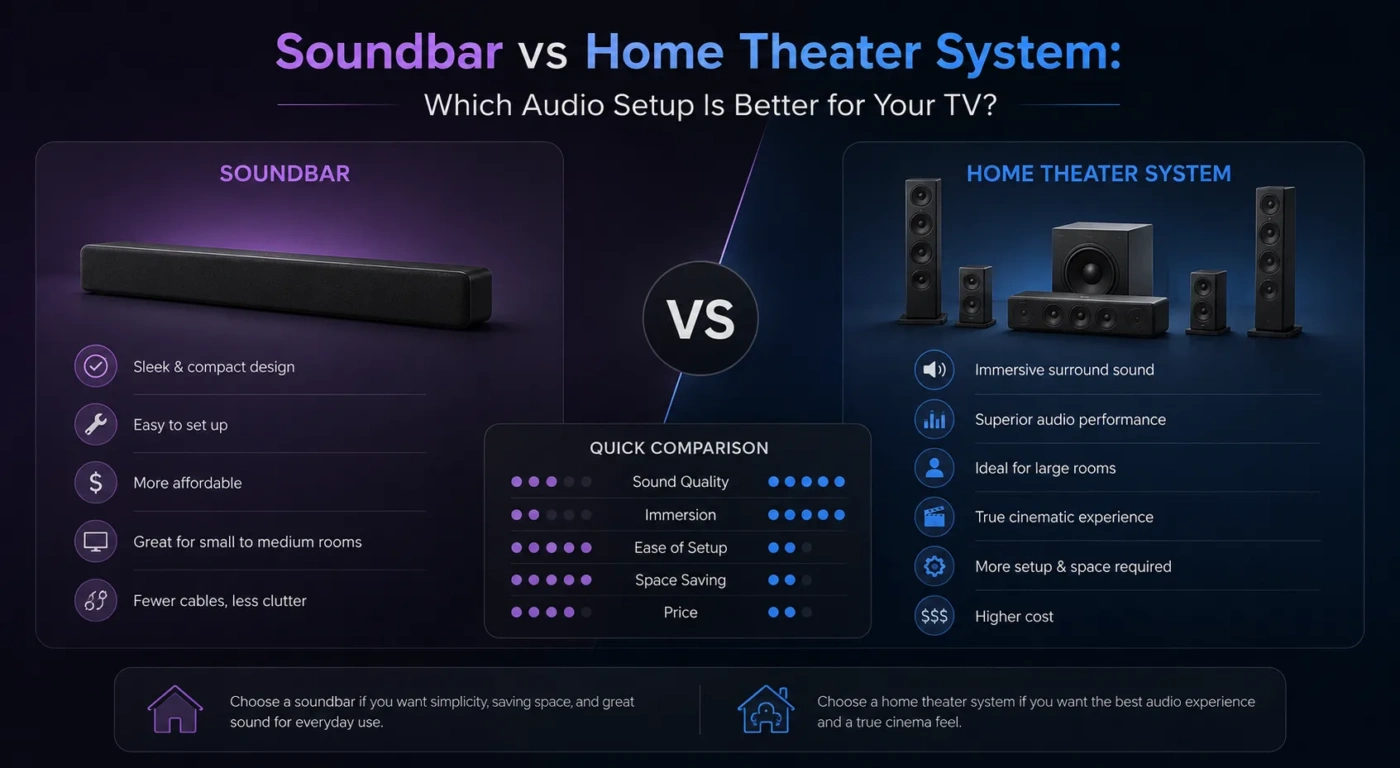
A soundbar is usually the better choice if you want cleaner TV sound, simple setup, fewer cables, and a living-room-friendly design. A home theater system is the better choice if you want stronger surround sound, deeper bass, wider speaker separation, and a more cinema-like experience. The right choice depends less on which one is “better” and more on your room size, patience for setup, budget, and how much you care about true surround effects.
- Main Differences
- Soundbar Strengths
- Home Theater Strengths
- What A Soundbar Offers
- What A Home Theater System Offers
- Sound Quality And Surround Effect
- Setup And Daily Use
- Price And Long-Term Value
- Choose A Soundbar If
- Choose A Home Theater System If
- Decision Tree
- Room Size And Placement
- Gaming, Movies, Music, And TV
- For Movies
- For Gaming
- For Music
- For Everyday TV
- Common Misunderstandings
- Useful Terms
- Best Choice By User Type
- Which One Should You Choose?
- Compare More Options
- FAQ
- Is A Soundbar Better Than A Home Theater System?
- Can A Soundbar Replace A Home Theater System?
- Do I Need Rear Speakers With A Soundbar?
- Is A Home Theater System Hard To Install?
- Which Is Better For A Small Room?
| Feature | Soundbar | Home Theater System |
|---|---|---|
| Best For | Casual TV, movies, streaming, apartments, simple upgrades | Movie rooms, gaming setups, larger spaces, immersive audio |
| Setup | Simple: usually one bar, one cable, optional subwoofer | More involved: multiple speakers, receiver, wiring, placement |
| Surround Sound | Can simulate surround; some models include rear speakers | True surround when speakers are placed around the room |
| Bass | Good with a separate subwoofer, limited without one | Usually stronger and easier to scale with a dedicated subwoofer |
| Room Fit | Better for small and medium rooms | Better for medium and large rooms |
| Cable Management | Cleaner and easier to hide | More cables unless wireless rear speakers are used |
| Upgrade Path | Limited, unless it supports add-on subwoofers or rear speakers | Easier to upgrade speakers, receiver, subwoofer, or channels |
| Cost | Often cheaper at entry and mid-range levels | Can cost more, especially with receiver and multiple speakers |
| Best Overall Choice | Best for convenience | Best for immersion |
Main Differences
The biggest difference is speaker placement. A soundbar places most of the audio in one long cabinet under the TV. A home theater system spreads speakers around the room, so sound can come from the front, sides, and behind the listener.
This changes the experience. A soundbar improves clarity and volume quickly, especially compared with thin TV speakers. A home theater system creates more direction, distance, and impact, especially in movies and games mixed for surround sound.
Soundbar Strengths
- Easy to install
- Cleaner look under the TV
- Good for apartments and shared spaces
- Often enough for streaming, sports, and casual movies
- Less equipment to manage
Home Theater Strengths
- More realistic surround effects
- Stronger room-filling sound
- Better speaker separation
- More upgrade options
- Better fit for dedicated movie or gaming rooms
What A Soundbar Offers
A soundbar is a compact speaker system designed to sit below or near a TV. Most soundbars connect through HDMI ARC, HDMI eARC, optical audio, Bluetooth, or Wi-Fi, depending on the model. Many include built-in amplification, so you usually do not need a separate receiver.
Entry-level soundbars mainly improve dialogue and volume. Mid-range models often add a wireless subwoofer for better bass. Higher-end models may support Dolby Atmos, DTS:X, upward-firing drivers, room correction, wireless rear speakers, or multi-room audio.
What A Home Theater System Offers
A home theater system uses separate speakers placed around the room. A typical setup may include front left, center, front right, surround speakers, and a subwoofer. More advanced systems can add height channels for Dolby Atmos or DTS:X.
The center speaker handles dialogue, the front speakers carry music and action, the surround speakers create movement around the listener, and the subwoofer adds low-frequency impact. Because each speaker has a dedicated role, a well-placed home theater system can feel wider, deeper, and more precise than a single-bar setup.
Sound Quality And Surround Effect
A soundbar can sound very good, especially in a small or medium room. Dialogue becomes clearer, bass improves with a subwoofer, and virtual surround processing can make the front soundstage feel wider. Some premium soundbars also bounce sound off the ceiling or walls to create height and side effects.
A home theater system has a physical advantage: real speaker separation. When rear speakers are behind you, the sound does not need to be simulated. This matters most in action films, live concerts, modern games, and Blu-ray or high-bitrate streaming content with surround mixes.
Setup And Daily Use
A soundbar is much easier for everyday use. You connect it to the TV, place it below the screen, pair the subwoofer if included, and adjust a few settings. Many people can finish the setup without changing furniture or running cables across the room.
A home theater system asks for more planning. Speaker height, distance, angle, cable routing, receiver settings, and room calibration all affect the result. The reward can be much better sound, but the process takes more effort.
Price And Long-Term Value
Soundbars often give better value for people who only want a cleaner TV experience. You can get a noticeable upgrade without buying a receiver, speaker stands, long cables, or extra components. A soundbar with a wireless subwoofer can be enough for many living rooms.
A home theater system can become more expensive because the total cost includes speakers, receiver, subwoofer, cables, mounts, stands, and sometimes professional installation. However, it can also last longer as a system because individual parts can be replaced or upgraded.
Choose A Soundbar If
- You want a simple upgrade from built-in TV speakers.
- You live in an apartment or smaller home.
- You dislike visible cables and speaker stands.
- You mostly watch streaming shows, sports, YouTube, news, or casual movies.
- You want one remote-friendly system that works with the TV.
- You prefer convenience over full surround accuracy.
- You want better dialogue without tuning a receiver.
Choose A Home Theater System If
- You want a cinema-like soundstage at home.
- You have space for speakers around the room.
- You play games where directional audio matters.
- You watch movies with surround or object-based audio tracks.
- You want stronger bass and more dynamic sound.
- You enjoy adjusting, upgrading, and fine-tuning equipment.
- You want a system that can grow over time.
Decision Tree
Room Size And Placement
Room size can change the decision. In a small room, a large multi-speaker system may be harder to place properly and may feel excessive. A soundbar can sit neatly under the TV and still deliver a clear upgrade.
In a larger room, the soundbar may struggle to create convincing width and rear effects unless it is a higher-end model with rear speakers. A home theater system can fill the room more naturally because speakers are physically spread across the space.
| Room Type | Better Fit | Reason |
|---|---|---|
| Small Bedroom | Soundbar | Compact size, easy placement, less bass overload |
| Apartment Living Room | Soundbar | Cleaner setup and easier volume control |
| Medium Family Room | Depends | Premium soundbar or compact surround system can both work |
| Large Living Room | Home Theater System | Better speaker spread and stronger room coverage |
| Dedicated Movie Room | Home Theater System | Best match for surround placement and subwoofer performance |
Gaming, Movies, Music, And TV
For Movies
A home theater system is usually better for movie immersion, especially with surround mixes. A soundbar is still a strong choice if you want a clean setup and mainly stream movies in a regular living room.
For Gaming
Gamers who care about directional sound may prefer a home theater system or a soundbar with real rear speakers. For casual console gaming, a good soundbar can still improve explosions, dialogue, and background effects.
For Music
Traditional stereo speakers within a home theater setup often sound more natural for music than many soundbars. However, soundbars are convenient for playlists, TV music apps, and casual listening.
For Everyday TV
A soundbar is often the better daily-use choice. It improves speech clarity without forcing the viewer to manage multiple components.
Common Misunderstandings
Useful Terms
Best Choice By User Type
| User Type | Better Choice | Why |
|---|---|---|
| Beginner | Soundbar | Simpler setup and fewer settings |
| Apartment Viewer | Soundbar | Cleaner, smaller, and easier to control |
| Movie Fan | Home Theater System | Better surround placement and stronger impact |
| Casual Streamer | Soundbar | Enough improvement for shows, sports, and films |
| Serious Gamer | Home Theater System | More accurate direction and larger soundstage |
| Design-Focused User | Soundbar | Minimal equipment and fewer visible cables |
| Upgrade Enthusiast | Home Theater System | More room to change speakers, receiver, and subwoofer |
Which One Should You Choose?
Choose a soundbar if you want the smarter everyday upgrade: better dialogue, stronger TV audio, simple setup, and a clean look. It is the safer choice for most bedrooms, apartments, and regular living rooms.
Choose a home theater system if sound is a main part of the experience. It is the better option for movie lovers, serious gamers, larger rooms, and anyone who wants real surround sound rather than a compact simulation.
The easiest rule is this: pick the soundbar for convenience, pick the home theater system for immersion. If you want both, look at a premium soundbar package with a wireless subwoofer and rear speakers.
Compare More Options
FAQ
Is A Soundbar Better Than A Home Theater System?
A soundbar is better for convenience, space-saving, and simple setup. A home theater system is better for surround sound, bass, and a more immersive movie experience.
Can A Soundbar Replace A Home Theater System?
For many users, yes. A good soundbar can replace a basic home theater setup for everyday TV and streaming. It may not replace a well-placed multi-speaker system for serious movie watching.
Do I Need Rear Speakers With A Soundbar?
You do not need them for basic TV sound, but rear speakers help if you want more convincing surround effects. A soundbar with rear speakers is often the middle ground between simplicity and immersion.
Is A Home Theater System Hard To Install?
It can be more difficult than a soundbar because it may require speaker placement, wiring, receiver setup, and calibration. The result can be worth it if the room allows proper placement.
Which Is Better For A Small Room?
A soundbar is usually better for a small room because it takes less space and is easier to control. A full home theater system can work, but only if the speakers can be placed correctly.