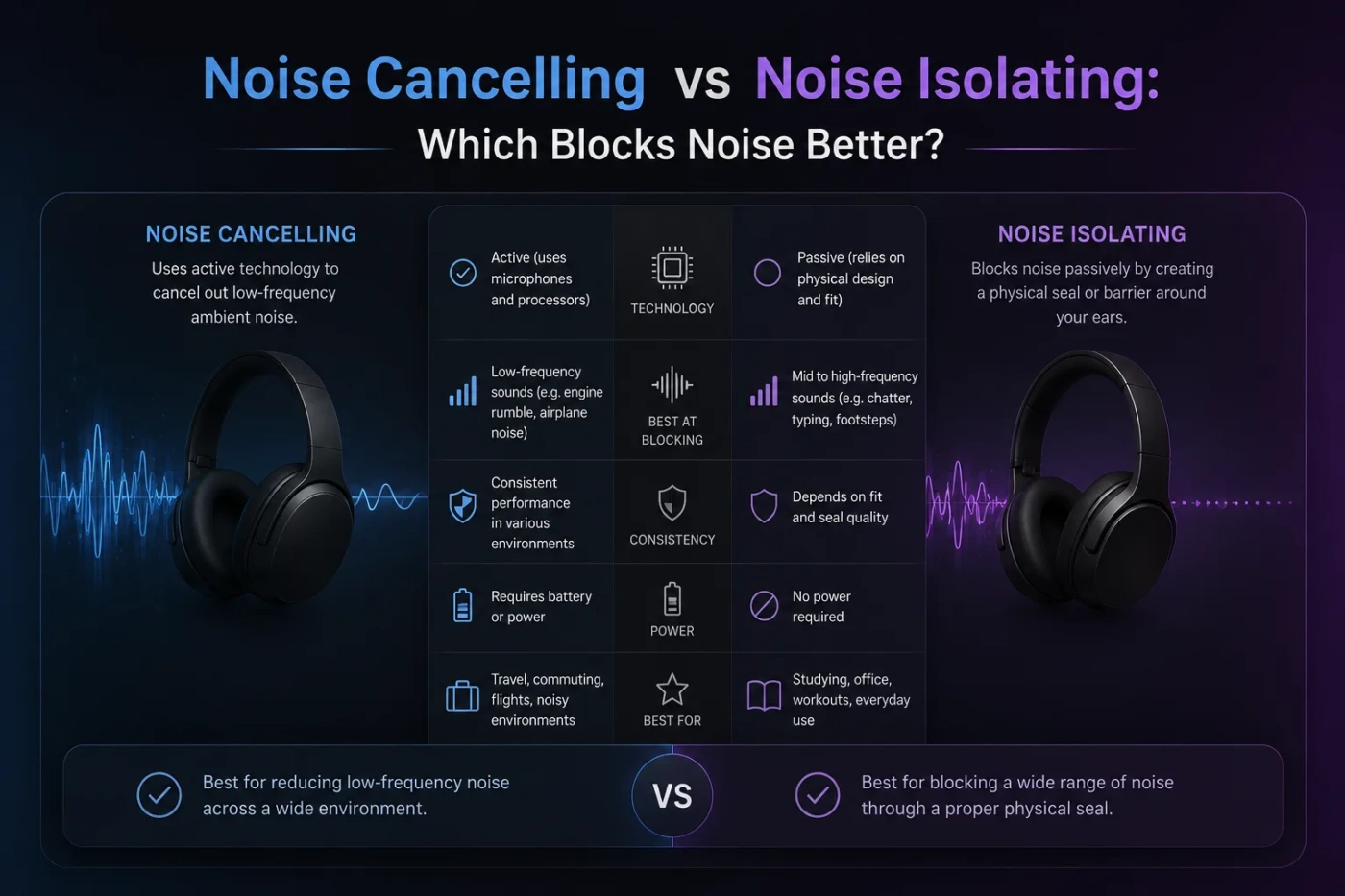
Noise cancelling and noise isolating both reduce unwanted sound, but they do it in very different ways. Noise cancelling is best when you want electronics to reduce steady background noise such as engines, fans, trains, and office hum. Noise isolating is best when you want a physical seal that blocks outside sound without batteries, microphones, or active processing. For most travelers and commuters, noise cancelling feels more convenient. For musicians, careful listeners, budget buyers, and anyone who wants passive reliability, noise isolating can be the smarter choice.
- Main Differences
- What Noise Cancelling Offers
- What Noise Isolating Offers
- Performance In Real Environments
- Comfort And Long Listening Sessions
- Sound Quality And Listening Detail
- Score And Fit Comparison
- Choose Noise Cancelling If
- Choose Noise Isolating If
- Decision Tree
- Price And Long-Term Value
- Common Misunderstandings
- Glossary
- Best Choice By User Type
- Safety And Awareness
- FAQ
- Is Noise Cancelling Better Than Noise Isolating?
- Do Noise Isolating Earbuds Protect Hearing?
- Can Noise Cancelling Work Without Music?
- Which Is Better For Sleeping?
- Which Is Better For Office Voices?
- Compare More Options
| Feature | Noise Cancelling | Noise Isolating |
|---|---|---|
| How It Works | Uses microphones and processing to reduce external noise | Uses ear tips, ear cups, padding, and seal to block sound physically |
| Best Against | Low, steady noise such as aircraft cabin sound, traffic rumble, AC units, and train noise | A wider mix of sounds when the fit is tight, including voices and sharper noises |
| Power Needed | Yes, active noise cancelling needs battery power | No power required |
| Sound Quality Impact | Can slightly change sound tone depending on the model | Usually depends more on driver quality and fit than electronic processing |
| Comfort | Often comfortable for long travel, especially over-ear models | Can feel more secure, but deep in-ear seals may bother some users |
| Call Quality | Often better for calls if microphone noise reduction is included | Depends heavily on microphone placement and environment |
| Price Range | Often costs more because of chips, microphones, and battery systems | Can be very affordable, though premium in-ear monitors can be expensive |
| Best Fit | Frequent travelers, commuters, office workers, remote workers | Musicians, students, budget users, people who want passive blocking |
Main Differences
The main difference is simple: noise cancelling fights sound electronically, while noise isolating blocks sound physically. Noise cancelling headphones listen to outside noise through small microphones, then create an opposite sound wave to reduce what reaches your ears. Noise isolating headphones or earbuds do not “cancel” noise in that active sense. They reduce sound by sealing your ear canal or covering your ears with dense padding.
This difference changes how each option feels in real use. Noise cancelling is very good against constant low-frequency noise, such as airplane cabin rumble. Noise isolating depends on fit, but a good seal can reduce many everyday sounds without needing battery power.
What Noise Cancelling Offers
Noise cancelling usually means active noise cancelling, often shortened to ANC. It uses microphones, chips, and software to reduce outside sound. This makes it useful in places where the background noise stays fairly consistent: planes, buses, trains, offices, cafes, and rooms with fans or air conditioners.
Good ANC can make music easier to hear at lower volume because you are not fighting as much background noise. It can also make podcasts, calls, and silence more comfortable in loud spaces. The trade-off is that ANC needs power. If the battery runs out, some models still play audio passively, but the active noise reduction stops.
What Noise Isolating Offers
Noise isolating headphones and earbuds reduce sound by creating a physical barrier. In-ear models use silicone, foam, or custom tips. Over-ear models use thick ear pads and closed-back cups. The better the seal, the more outside sound is blocked.
Noise isolation has a major advantage: it works without batteries. It can also be very effective for people who dislike the pressure sensation some ANC headphones create. Musicians and stage performers often use isolating in-ear monitors because they need secure fit, controlled sound, and passive blocking in loud environments.
Performance In Real Environments
| Situation | Better Choice | Reason |
|---|---|---|
| Airplane Cabin | Noise Cancelling | ANC is very effective against steady engine and cabin rumble. |
| Train Or Bus Commute | Noise Cancelling | It reduces low, repeating travel noise and makes listening easier. |
| Studying In A Library | Noise Isolating | A passive seal can reduce nearby movement and small distractions without battery use. |
| Open Office | Depends | ANC helps with hum and HVAC noise; isolation may help more with nearby voices if the seal is strong. |
| Exercise | Noise Isolating | Secure fit and passive seal can matter more than maximum cancellation. |
| Calls In Public | Noise Cancelling | Many ANC models also include microphone noise reduction for clearer calls. |
| Battery-Free Listening | Noise Isolating | Passive isolation works anytime, even with wired earbuds or monitors. |
Comfort And Long Listening Sessions
Comfort depends on design as much as the noise technology. Over-ear noise cancelling headphones can feel soft and relaxed during long trips, but they may feel warm after several hours. In-ear noise isolating earbuds can be compact and secure, but some people dislike pressure inside the ear canal.
ANC can also create a mild “cabin pressure” feeling for some users. This is not the same as actual pressure, but the sensation can be noticeable. Noise isolating options avoid that electronic effect, although deep tips can still feel intrusive if the size is wrong.
Sound Quality And Listening Detail
Noise cancelling can improve the listening experience because it lowers background noise. That does not always mean it produces better sound quality. Some ANC systems slightly affect bass, treble, or spatial feel when active processing is on. Higher-end models handle this better, but budget ANC can sometimes sound processed.
Noise isolating headphones often rely more directly on the driver, ear tip, and seal. This is one reason many wired in-ear monitors use passive isolation instead of ANC. When the fit is right, isolation can help preserve detail because outside sound is reduced without electronic cancellation.
Score And Fit Comparison
Choose Noise Cancelling If
Choose Noise Isolating If
Decision Tree
Price And Long-Term Value
Noise cancelling models often cost more because they include batteries, microphones, chips, sensors, and software features. They may also include companion apps, transparency mode, adaptive ANC, multipoint Bluetooth, and call controls. These features can be worth paying for if you use them every day.
Noise isolating options can be cheaper and more durable over time, especially wired earbuds and simple closed-back headphones. There are fewer electronic parts to age, and passive isolation keeps working as long as the tips or pads still seal properly. The hidden cost is fit: you may need different ear tips or replacement pads to get the best result.
Common Misunderstandings
| Misunderstanding | More Accurate View |
|---|---|
| Noise cancelling blocks all noise. | It reduces some noise very well, especially steady low-frequency sound, but it does not create total silence. |
| Noise isolating is always weaker. | A strong physical seal can be very effective, especially with foam tips or closed-back designs. |
| ANC always means better sound. | ANC can improve listening comfort, but audio quality still depends on tuning, drivers, fit, and codec support. |
| Bigger headphones always isolate better. | Ear pad seal, clamp, cup design, and glasses can change isolation more than size alone. |
| In-ear isolation is uncomfortable for everyone. | Some users dislike it, but others find the right tip size very comfortable and secure. |
Glossary
Best Choice By User Type
| User Type | Best Choice | Why |
|---|---|---|
| Frequent Traveler | Noise Cancelling | Best match for aircraft, train, and bus noise. |
| Student | Noise Isolating | Affordable, simple, and useful for study sessions. |
| Remote Worker | Noise Cancelling | Better for calls, background hum, and switching between work and listening. |
| Musician | Noise Isolating | Secure in-ear isolation is common for monitoring and controlled listening. |
| Budget Buyer | Noise Isolating | Good passive reduction is available without paying for ANC electronics. |
| Casual Listener | Noise Cancelling | More convenient for everyday mixed use, especially with wireless features. |
Safety And Awareness
Both options can reduce awareness of your surroundings. This matters when walking near traffic, cycling, running outdoors, or moving through stations and airports. Noise cancelling headphones with transparency mode can help, but they still require attention. Noise isolating earbuds can also block important sounds when the seal is strong.
FAQ
Is Noise Cancelling Better Than Noise Isolating?
Noise cancelling is better for steady background noise, especially during travel. Noise isolating is better if you want passive blocking, lower cost, and no battery dependence. The better choice depends on where you listen most.
Do Noise Isolating Earbuds Protect Hearing?
They can help you listen at lower volume because they reduce outside noise. However, they are not automatically hearing protection unless they are rated for that purpose. Volume habits still matter.
Can Noise Cancelling Work Without Music?
Yes, many ANC headphones can reduce noise even when no music is playing. The headphones still need battery power for active cancellation.
Which Is Better For Sleeping?
Noise isolating soft earbuds may be more comfortable for side sleepers, while noise cancelling headphones can be bulky in bed. Some people prefer dedicated sleep earbuds or low-profile passive earplugs.
Which Is Better For Office Voices?
Neither option removes voices fully. Noise isolating can reduce speech if the seal is strong. Noise cancelling helps more with office hum, fans, and low background noise. Some users combine ANC with low-volume music or white noise.
Compare More Options
If the main problem is travel noise, commuting, or office hum, noise cancelling is usually the better everyday choice. If the priority is value, simplicity, passive blocking, or music monitoring, noise isolating is often the better fit. The smartest choice is not the one with the louder marketing claim; it is the one that matches the type of noise you deal with most.