Earbuds and headphones solve the same problem in different ways: they let you listen privately, take calls, block outside noise, and enjoy music without speakers. The better choice depends less on which one is “better” and more on where you listen, how long you wear them, how much sound isolation you need, and whether portability or comfort matters more.
- Earbuds vs Headphones: The Main Difference
- What Are Earbuds?
- What Are Headphones?
- Sound Quality: Which One Sounds Better?
- Choose Earbuds For Sound If:
- Choose Headphones For Sound If:
- Comfort: Ear Pressure vs Head Pressure
- Noise Cancellation and Isolation
- For Commuting
- For Flights and Long Travel
- Battery Life and Charging
- Calls, Meetings, and Voice Use
- Workouts and Outdoor Use
- Gaming, Movies, and Editing
- Price and Value
- When Should You Choose Earbuds?
- When Should You Choose Headphones?
- Common Misunderstandings About Earbuds and Headphones
- “Headphones Always Sound Better”
- “Earbuds Are Always More Comfortable”
- “Noise Cancellation Works the Same on Both”
- “Wireless Means Worse Sound Every Time”
- “More Bass Means Better Sound”
- Earbuds vs Headphones for Different Users
- Which One Should You Choose?
| Feature | Earbuds | Headphones |
|---|---|---|
| Best For | Travel, workouts, commuting, calls, casual listening | Long listening, gaming, editing, focused work, richer sound |
| Portability | Very easy to carry; fits in a pocket | Bulkier; better for bags, desks, and home setups |
| Comfort Over Time | Depends on ear shape and tip fit | Usually better for longer sessions if the headband and ear pads fit well |
| Sound Quality | Good to excellent, especially in premium models | Often fuller, wider, and more natural because of larger drivers |
| Bass Feel | Can be strong, but depends heavily on seal | Usually more physical and spacious |
| Noise Cancellation | Strong in many wireless models, but fit-sensitive | Often more stable because ear cups cover the ear |
| Call Quality | Convenient, especially outdoors and on the move | Good in quiet rooms; larger models may feel less natural for quick calls |
| Battery Life | Shorter per charge, extended by the case | Usually longer per charge |
| Exercise Use | Usually better, especially sweat-resistant models | Less practical for running and intense movement |
| Heat Build-Up | Lower; ears stay open to air | Can get warm during long use |
| Price Range | Wide range; good wireless models often start around $30–$80 | Wide range; quality wireless or studio-style models often start around $50–$150 |
| Best Choice If You Want | Small size, easy carrying, workouts, daily convenience | Comfort, fuller sound, longer battery life, stronger focus |
Earbuds vs Headphones: The Main Difference
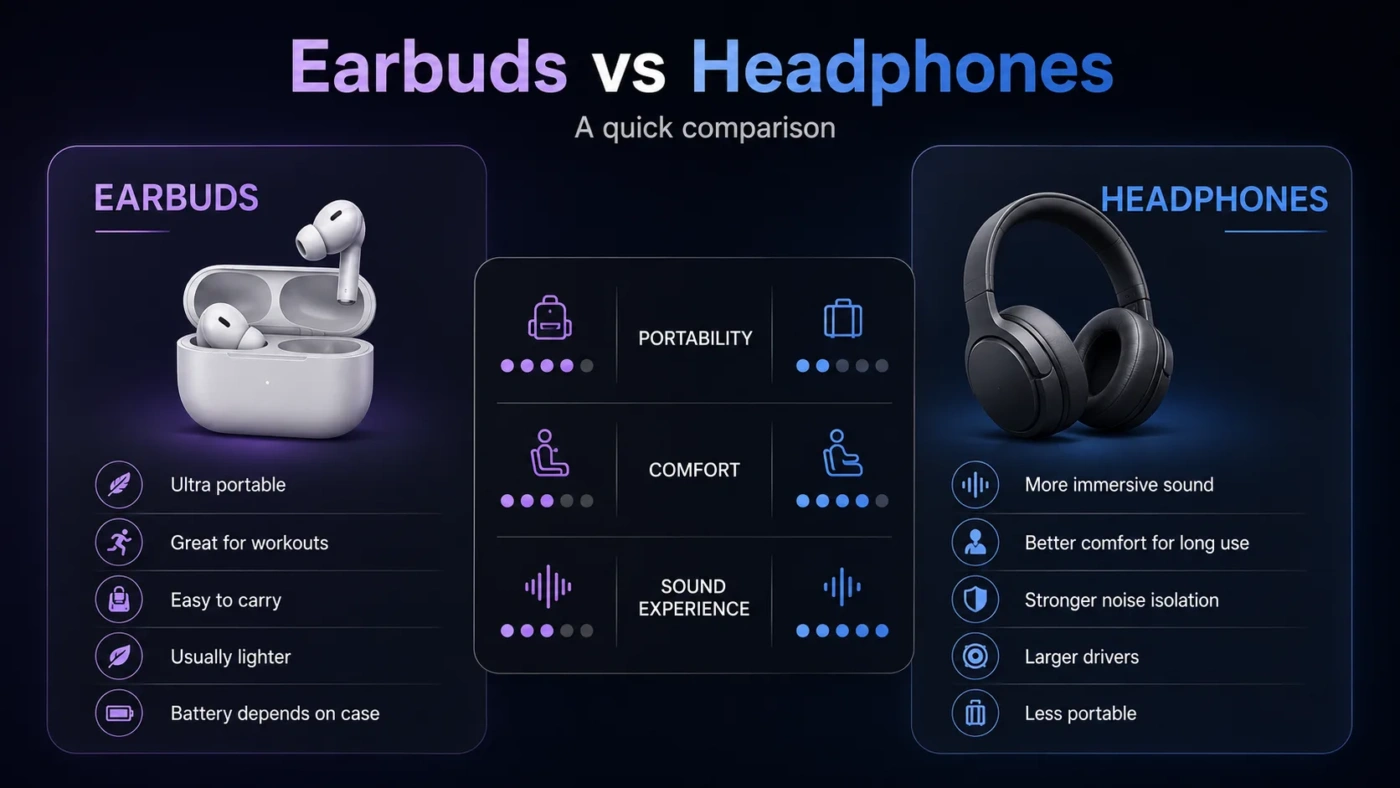
The main difference is how they sit on your body. Earbuds sit inside or just at the entrance of the ear canal, while headphones sit on or around the ears. That one design difference affects almost everything: comfort, sound, isolation, bass, battery life, and daily use.
Earbuds are smaller and more convenient. They are easy to put in a pocket, wear during a walk, use at the gym, or carry all day without thinking about them. Headphones are larger, but they usually offer a more relaxed fit, better sound space, and longer listening time before the battery runs out.
For most people, the decision comes down to this: choose earbuds for movement and convenience; choose headphones for longer sessions and better listening comfort.
What Are Earbuds?
Earbuds are small audio devices designed to sit in or near the ear canal. Most modern earbuds are wireless, come with a charging case, and include microphones for calls. Many also offer active noise cancellation, transparency mode, touch controls, voice assistant support, and water resistance.
There are two common types:
- In-ear earbuds: These use silicone or foam tips to create a seal inside the ear canal. They usually provide better bass and better noise isolation.
- Open-fit earbuds: These rest near the ear opening without sealing the canal. They feel lighter, but they usually let in more outside noise.
Earbuds work best when the fit is right. A poor seal can make music sound thin, weaken noise cancellation, and cause the earbuds to feel loose. This is why ear tip size matters more than many buyers expect.
What Are Headphones?
Headphones are larger audio devices worn over the head with ear cups that sit either on the ears or around them. They can be wired or wireless, casual or studio-focused, lightweight or padded for long use.
The two main types are:
- Over-ear headphones: The ear cups surround the ears. These usually offer the best comfort, sound space, and isolation.
- On-ear headphones: The ear cups sit directly on the ears. These are smaller, but they can create pressure during long sessions.
Headphones often feel more stable for desk work, gaming, music production, and long listening. Their larger drivers can move more air, which helps create a fuller sound and a wider sense of space. That does not mean every headphone sounds better than every earbud, but the design gives headphones a natural advantage in many listening situations.
Sound Quality: Which One Sounds Better?
Headphones usually have the edge in sound quality, especially for people who care about detail, instrument separation, bass texture, and a wider soundstage. Larger ear cups and drivers can make music feel less compressed and more open.
Earbuds can still sound very good. Premium earbuds now offer strong tuning, adaptive EQ, noise cancellation, and high-quality wireless codecs. For casual music, podcasts, calls, and streaming, many users will be satisfied with good earbuds.
The difference becomes clearer when listening for longer periods or comparing more layered audio. Headphones often make vocals, drums, bass lines, and background details easier to separate. Earbuds feel more direct and close, which some people actually prefer.
Choose Earbuds For Sound If:
- You mostly listen while moving.
- You prefer a compact device.
- You listen to podcasts, pop, electronic music, audiobooks, or casual playlists.
- You value convenience more than a wide soundstage.
Choose Headphones For Sound If:
- You want fuller bass and more space.
- You listen for long sessions.
- You edit audio, play games, or watch films.
- You notice small differences in clarity and detail.
Comfort: Ear Pressure vs Head Pressure
Comfort is personal. Earbuds can disappear in the ear when they fit well, but they can also cause pressure or irritation if the shape is wrong. Some people dislike the feeling of silicone tips inside the ear canal. Others find earbuds lighter and easier than anything worn over the head.
Headphones spread weight across the head and around the ears. A good over-ear pair can be comfortable for hours, especially with soft pads and moderate clamping force. The downside is heat. Closed-back headphones can make ears warm, especially in summer or during long sessions.
For 20–60 minutes: earbuds are usually fine and very practical.
For several hours: over-ear headphones often feel better, provided they are not too tight or heavy.
Noise Cancellation and Isolation
Both earbuds and headphones can reduce outside noise, but they do it differently.
Earbuds rely heavily on the ear tip seal. If the tips fit well, in-ear earbuds can block a lot of passive noise before active noise cancellation even starts. If the seal is weak, noise cancellation becomes less effective.
Headphones cover the ear, so they usually create a more consistent barrier. Over-ear noise-canceling headphones are often better for planes, buses, offices, and other steady-noise environments. They also tend to feel less dependent on tiny fit adjustments.
For Commuting
Earbuds are easier to carry and use quickly. They are better when you need to switch between listening, talking, walking, and storing them.
For Flights and Long Travel
Headphones are usually more comfortable and provide stronger long-session noise reduction. They also offer longer battery life, which matters on longer routes.
Battery Life and Charging
Earbuds usually have shorter battery life per listening session. The charging case makes up for this by adding extra charges, but you still need to place them back in the case when they run low.
Headphones often last much longer on a single charge. Many wireless headphones can run through several workdays of normal use before needing a cable. This makes them easier for desk setups, travel, and people who forget to charge small devices.
There is also a practical difference: earbuds have more small parts to manage. Two earbuds plus a case means more chances to misplace something. Headphones are harder to lose, but harder to carry.
Calls, Meetings, and Voice Use
Earbuds are usually more convenient for calls because they are small, quick to wear, and less visually distracting. Many people use one earbud at a time for short calls, voice notes, or online meetings.
Headphones can be better in quiet rooms, especially if they have a good microphone system or a boom mic. For gaming, teaching, podcasting, or frequent video meetings, headphones with a dedicated mic can sound clearer than tiny earbud microphones.
For everyday phone calls, earbuds win on convenience. For longer voice work, headphones can be more stable and comfortable.
Workouts and Outdoor Use
Earbuds are the better choice for most workouts. They are lighter, less sweaty, and easier to secure with the right tips or ear hooks. Many models also include water or sweat resistance, which matters for running, cycling, gym training, and walking in light rain.
Headphones can work for light exercise, but they are less practical for intense movement. They can slip, trap heat, and feel bulky. Sweat can also wear down ear pads over time.
If exercise is part of your main use case, choose earbuds with a secure fit and a suitable water-resistance rating.
Gaming, Movies, and Editing
Headphones usually make more sense for gaming, films, and editing. The wider sound helps with direction, distance, and detail. Over-ear headphones also feel more immersive without needing high volume.
Earbuds can still work for mobile gaming, handheld consoles, tablets, and quick video watching. They are especially useful when you do not want a bulky setup. Still, for longer sessions, headphones usually feel more natural and less tiring.
Price and Value
Both categories have cheap, mid-range, and premium options. The better value depends on what you need.
Budget earbuds can be very useful for calls, commuting, and casual listening. Good entry-level wireless earbuds often cost around $30–$80. Premium models cost more because they add better noise cancellation, stronger microphones, app controls, adaptive sound, wireless charging, and improved fit options.
Headphones often offer better sound per dollar if portability is not your main concern. Around $50–$150, many buyers can find comfortable wireless headphones or wired studio-style models with good sound. Higher-end models may add stronger active noise cancellation, better materials, longer battery life, and more refined tuning.
If you want one small device for everything, earbuds may feel like better value. If you care about sound, comfort, and longer use, headphones often give more for the money.
When Should You Choose Earbuds?
Choose earbuds if your listening happens while life is moving. They are better for short sessions, outdoor use, exercise, commuting, and phone calls throughout the day.
- You want something pocket-sized.
- You work out or walk often.
- You take many quick calls.
- You prefer lightweight audio gear.
- You do not want anything over your head.
- You need a charging case that extends use during the day.
Earbuds are also better if you often switch between listening and talking to people. Transparency mode on many models makes this easier, though the quality varies.
When Should You Choose Headphones?
Choose headphones if you listen for longer periods or want a fuller sound. They are better for desk work, gaming, movies, study sessions, travel, and focused listening.
- You listen for hours at a time.
- You want stronger soundstage and fuller bass.
- You need long battery life.
- You work in a noisy office or shared space.
- You play games or watch films often.
- You dislike the feeling of earbuds inside your ears.
Over-ear headphones are usually the safest pick for comfort if you are buying for home, office, or long travel use.
Common Misunderstandings About Earbuds and Headphones
“Headphones Always Sound Better”
Not always. A well-made pair of earbuds can sound better than cheap headphones. Fit, tuning, driver quality, codec support, and noise control all matter. Still, when comparing products at a similar quality level, headphones often have a natural sound advantage.
“Earbuds Are Always More Comfortable”
Only if they fit your ears. Ear shape varies a lot. Some people can wear earbuds all day; others feel pressure after 20 minutes. Trying different ear tip sizes can change the experience.
“Noise Cancellation Works the Same on Both”
It does not. Earbuds depend more on seal. Headphones depend more on cup coverage and microphone processing. For steady background noise, over-ear headphones often feel more consistent.
“Wireless Means Worse Sound Every Time”
Wireless audio can be very good for daily use. Wired options still make sense for low latency, studio work, gaming, and people who want to avoid charging. For most casual listeners, the convenience of wireless is worth it.
“More Bass Means Better Sound”
Strong bass can be fun, but too much bass can cover vocals and detail. Better sound is about balance, clarity, comfort, and how well the device matches your listening style.
Earbuds vs Headphones for Different Users
| User Type | Better Choice | Reason |
|---|---|---|
| Gym User | Earbuds | Lighter, more secure, less heat build-up |
| Office Worker | Headphones | Better comfort and stronger focus for long sessions |
| Student | Depends | Earbuds for campus movement; headphones for study sessions |
| Traveler | Headphones | Better battery life and more stable noise cancellation |
| Runner | Earbuds | Smaller, lighter, and easier to secure |
| Gamer | Headphones | Better sound direction and comfort |
| Podcast Listener | Earbuds | Convenient for short listening and daily movement |
| Music Lover | Headphones | Fuller sound and wider presentation |
Which One Should You Choose?
Choose earbuds if you want the most practical option for daily movement. They are easier to carry, better for workouts, quick to use for calls, and more convenient when you are outside the house.
Choose headphones if you care more about comfort, battery life, sound quality, and focus. They are the better pick for long listening, work, travel, gaming, and anyone who dislikes putting tips inside the ear canal.
For many people, the best setup is not one or the other. Earbuds work well as the everyday carry option, while headphones work better at a desk, at home, or during long travel. If you only want to buy one, match it to your most common use: movement favors earbuds; long sessions favor headphones.