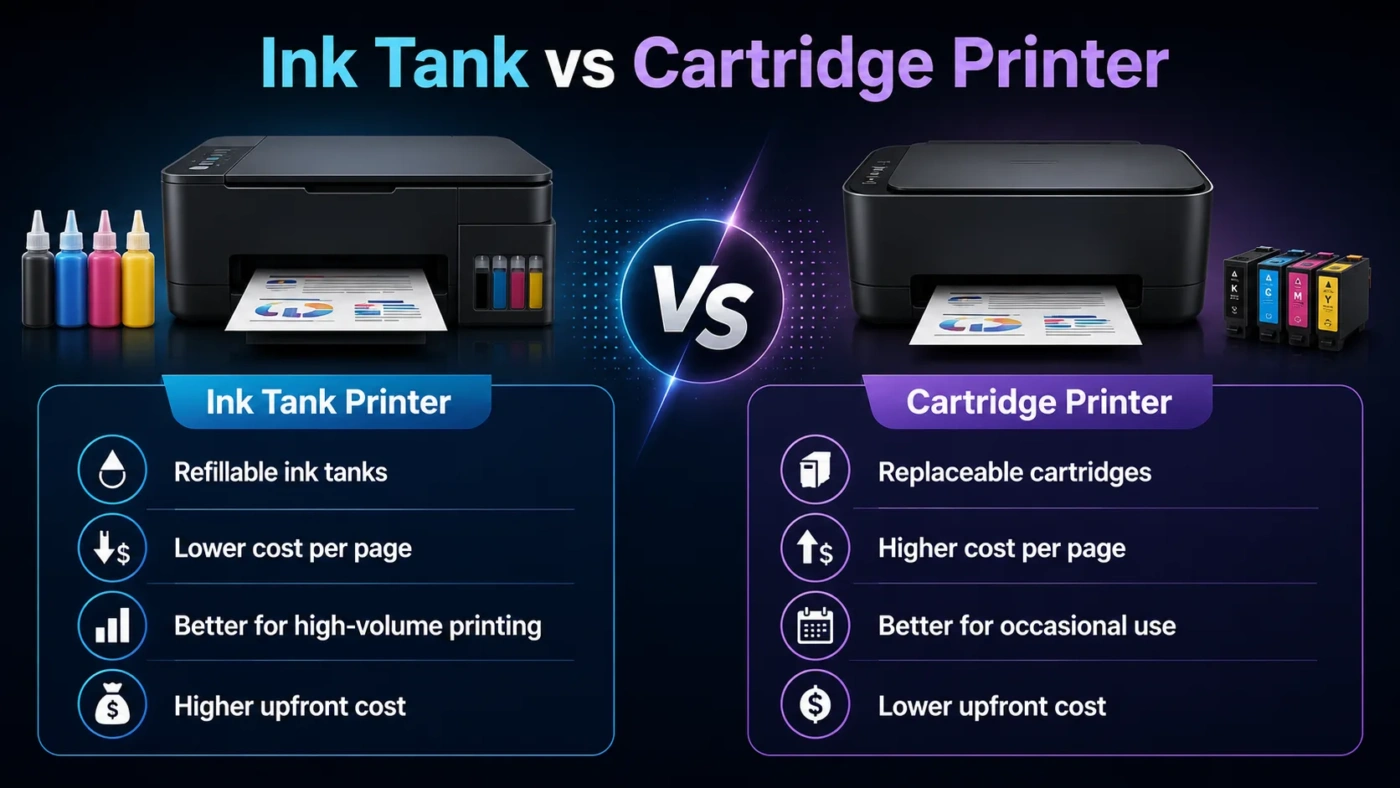
Choosing between an ink tank printer and a cartridge printer is mostly a question of how often you print. An ink tank printer usually costs more when you buy it, but it can become much cheaper over time because it uses refillable ink bottles. A cartridge printer is usually cheaper upfront and simpler for light use, but replacement cartridges can raise the real cost if you print often. So the better choice is not “which printer is better?” The better question is: how many pages will you print, how often, and what kind of documents matter most?
- Ink Tank vs Cartridge Printer: The Main Difference
- What Is an Ink Tank Printer?
- How Ink Tank Printers Work
- Why Ink Tank Printers Cost More Upfront
- What Is a Cartridge Printer?
- How Cartridge Printers Work
- Why Cartridge Printers Can Become Expensive
- Cost Per Page: Where The Choice Becomes Clear
- When Ink Tank Printers Save Money
- When Cartridge Printers Cost Less Overall
- Print Quality: Documents, Photos, And Everyday Color
- Document Printing
- Photo Printing
- Speed And Workflow: Which Feels Better Day To Day?
- Maintenance: The Part Many Buyers Forget
- Ink Tank Maintenance
- Cartridge Printer Maintenance
- Ink Tank Printers Are Best When You Print Often
- You Should Choose an Ink Tank Printer If:
- Cartridge Printers Are Best When You Print Rarely
- You Should Choose a Cartridge Printer If:
- Common Misunderstandings About Ink Tank And Cartridge Printers
- Misunderstanding 1: Ink Tank Printers Are Always Better
- Misunderstanding 2: Cartridge Printers Are Always Bad Value
- Misunderstanding 3: All Ink Tank Printers Have The Same Quality
- Misunderstanding 4: Page Yield Means You Will Always Get That Exact Number
- Misunderstanding 5: Cheap Printers Are Always Cheaper
- Ink Tank vs Cartridge Printer For Home Use
- Ink Tank vs Cartridge Printer For Students
- Ink Tank vs Cartridge Printer For Small Offices
- Ink Tank vs Cartridge Printer For Photos And Creative Projects
- Price And Value: How To Think About The Real Cost
- The Simple Buying Rule
- Final Decision: Which One Should You Choose?
| Feature | Ink Tank Printer | Cartridge Printer |
|---|---|---|
| Ink System | Uses refillable ink reservoirs filled with bottled ink. | Uses replaceable ink cartridges with built-in or cartridge-fed ink supply. |
| Upfront Cost | Usually higher, especially for all-in-one models with Wi-Fi, duplex printing, and scanners. | Usually lower, making it easier to buy for occasional home use. |
| Running Cost | Much lower per page for regular document printing and color printing. | Higher per page because cartridges hold less ink and often cost more per milliliter. |
| Best Print Volume | Best for moderate to heavy printing: schoolwork, home office files, invoices, worksheets, forms, and frequent color pages. | Best for very light printing: a few pages per month, occasional labels, tickets, or basic documents. |
| Ink Replacement | Refill bottles last a long time and usually produce thousands of pages. | Cartridges run out faster, especially with color pages, images, and mixed documents. |
| Print Quality | Very good for documents and everyday color prints; photo quality depends on model and ink set. | Can be excellent for photos on some models, especially dedicated photo printers with extra ink colors. |
| Maintenance | Needs regular use to keep ink flowing well; printhead care matters. | Also needs regular use, but replacing a cartridge may solve some ink delivery issues more easily. |
| Convenience | Less frequent ink buying, fewer interruptions, better for families or small offices. | Easy to install new cartridges, but replacements may be needed more often. |
| Waste | Usually creates less plastic waste because bottles replace small disposable cartridges. | Creates more cartridge waste over time, depending on how much you print. |
| Best Choice For | People who print often and want low long-term cost. | People who print rarely and want a low purchase price. |
Ink Tank vs Cartridge Printer: The Main Difference
The main difference is the ink delivery system. An ink tank printer stores ink in built-in reservoirs. You refill those tanks with bottles when the ink level gets low. A cartridge printer uses sealed cartridges that you remove and replace.
That one design choice affects almost everything: cost per page, refill frequency, storage, waste, maintenance, and the kind of user each printer suits best.
Ink tank printers are designed around low running cost. They make the most sense when you print often enough to use the ink before it sits too long. Cartridge printers are designed around lower entry cost and simple replacement. They make more sense when you only need a printer now and then.
What Is an Ink Tank Printer?
An ink tank printer is an inkjet printer with refillable ink tanks built into the machine. Instead of buying small cartridges, you buy bottles of black, cyan, magenta, and yellow ink. Some photo-focused models may include extra colors such as gray, red, or photo black.
The biggest reason people choose this type is simple: one set of ink bottles can often print far more pages than standard cartridges. That makes the cost per page much lower for everyday printing.
How Ink Tank Printers Work
The ink sits in reservoirs and feeds the printhead through internal channels. The printer then sprays tiny droplets onto the paper. This is still inkjet printing, so the usual inkjet behavior applies: the printer should be used regularly, paper choice affects results, and printhead cleaning may be needed if the machine sits unused for too long.
Modern tank printers are much cleaner to refill than older third-party continuous ink systems. Most current models use keyed bottles or spill-resistant bottle tips, which helps prevent mixing colors or overfilling tanks.
Why Ink Tank Printers Cost More Upfront
Ink tank models often include a larger ink supply in the box. You are paying for more usable ink at purchase, not just the printer body. That is why a tank printer can look expensive next to a low-cost cartridge printer on the shelf.
But the shelf price can be misleading. A cheaper cartridge printer may become more expensive after several rounds of replacement cartridges. The real comparison should include printer price + ink cost over time.
What Is a Cartridge Printer?
A cartridge printer is an inkjet printer that uses replaceable ink cartridges. Some printers use two cartridges: one black and one tri-color cartridge. Others use separate cartridges for black, cyan, magenta, and yellow. Photo models may use more cartridges for better color control.
Cartridge printers are popular because they are easy to buy, easy to set up, and often cheaper at the start. For someone who prints a boarding pass, a return label, or a short document once in a while, that lower purchase price can be enough.
How Cartridge Printers Work
The cartridge supplies ink to the printhead. In some designs, the printhead is part of the cartridge itself. In others, the printhead stays inside the printer and the cartridge only supplies ink.
This matters because a cartridge with an integrated printhead can sometimes help recover from dried ink problems by replacing the cartridge. With fixed-printhead designs, cleaning cycles and maintenance become more important.
Why Cartridge Printers Can Become Expensive
Cartridges hold less ink than tank bottles. They are also packaged as small replaceable units, which adds cost. If you print color documents, school projects, images, recipes, forms, or shipping labels often, cartridge replacement can become the most expensive part of owning the printer.
There is another practical issue: some tri-color cartridges must be replaced when one color runs out, even if the other colors still have ink left. Separate color cartridges reduce that problem, but they can still cost more over time than bottled ink.
Cost Per Page: Where The Choice Becomes Clear
Cost per page is the easiest way to compare long-term value. The simple formula is:
Cost per page = ink replacement cost ÷ estimated page yield
For real-life use, the number changes based on document type. A black text page uses far less ink than a full-color photo or a page with large graphics. Draft mode also uses less ink than high-quality mode. Still, the pattern is clear: ink tank printers usually win for frequent printing.
When Ink Tank Printers Save Money
An ink tank printer starts to make financial sense when you print regularly. This can include:
- School worksheets and homework pages
- Home office documents
- Invoices, forms, checklists, and reports
- Color charts, calendars, planners, and handouts
- Shipping labels and small business paperwork
- Family use where several people share one printer
If the printer is used every week, the higher upfront price is easier to justify. You buy ink less often, and each refill usually produces many more pages than a cartridge set.
When Cartridge Printers Cost Less Overall
A cartridge printer can still be the better value if you barely print. If you print only a few pages per month, it may take a long time for an ink tank printer to recover its higher purchase price.
For example, a person who prints a form every few weeks may not need the long-term savings of bottled ink. In that case, a lower-cost cartridge printer can be a practical choice, especially if space is limited and color printing is rare.
Print Quality: Documents, Photos, And Everyday Color
Both ink tank and cartridge printers can produce sharp text and good color output. The difference is not only “tank vs cartridge.” The actual print quality depends on the printer model, printhead design, paper type, ink type, and print settings.
Document Printing
For black text, both types can do well. A good ink tank printer can print clean schoolwork, office documents, PDFs, and forms at a low cost. A good cartridge printer can also print sharp documents, but the cost rises faster if you print often.
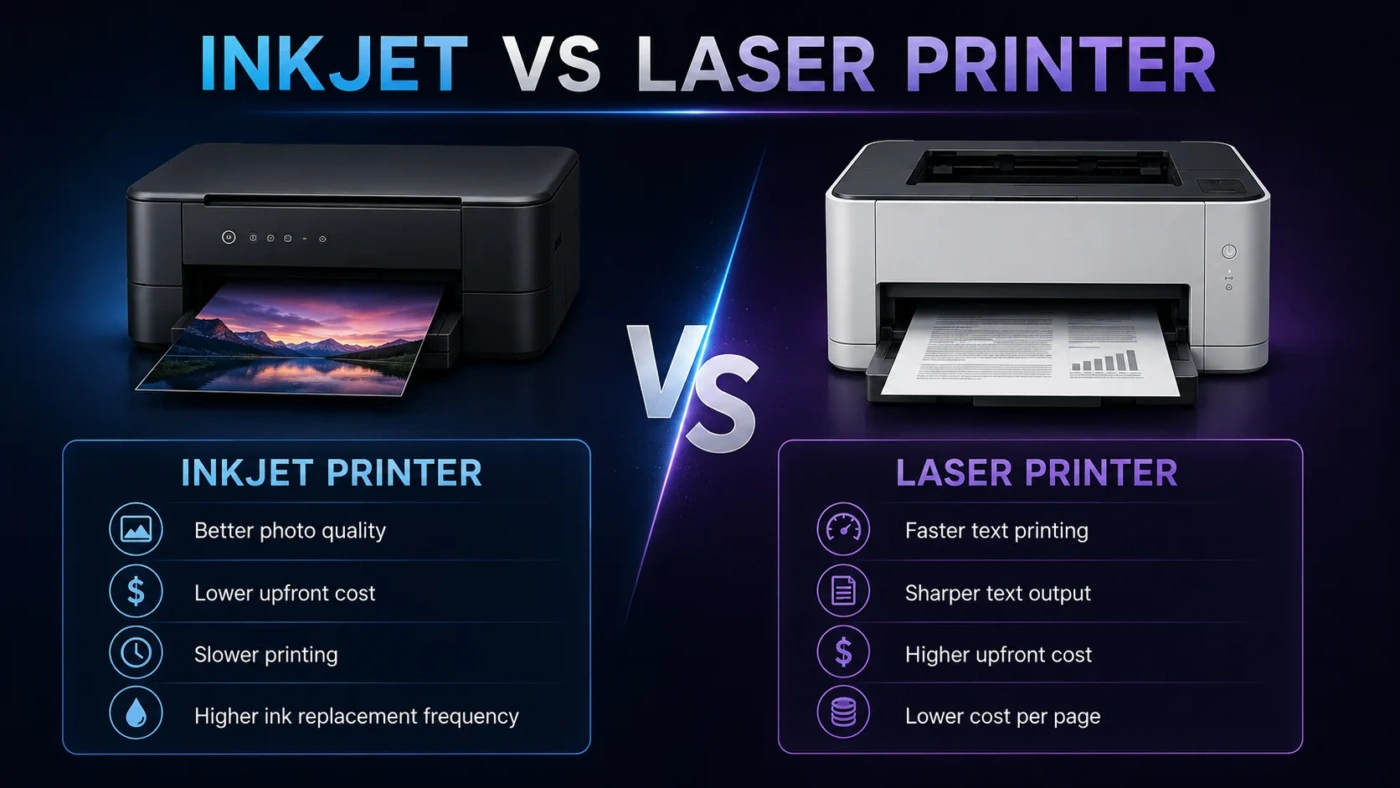
If most of your printing is plain text, also compare inkjet printers with laser printers before buying. A monochrome laser printer can be a better fit for heavy black-and-white document printing, while tank and cartridge inkjets make more sense when color is needed.
Photo Printing
Photo printing is more model-dependent. Some cartridge photo printers use extra ink colors and can produce smoother gradients and better skin tones on photo paper. Some ink tank photo printers also do very well, especially models built for photo output rather than basic office use.
If photos matter, do not choose only by ink system. Look for borderless printing, supported photo paper sizes, ink color count, maximum resolution, and whether the printer is designed for casual documents or photo-heavy use.
Speed And Workflow: Which Feels Better Day To Day?
Print speed varies by model, but the daily experience often comes down to interruptions. An ink tank printer may feel easier for busy households because it does not need new ink as often. A cartridge printer may feel simpler for occasional users because replacement is quick and familiar.
For a home office, the best printer is not only the one with the cheapest ink. Look for features that reduce friction:
- Automatic duplex printing for two-sided pages
- Automatic document feeder for scanning or copying multi-page documents
- Wi-Fi and mobile printing for phones, laptops, and tablets
- Paper tray capacity if several people print from the same device
- Replaceable maintenance box on some models for easier long-term upkeep
A cheap printer without duplex printing or a proper paper tray may cost less, but it can become annoying if you print often.
Maintenance: The Part Many Buyers Forget
Both printer types need care. Inkjet ink can dry if the printer sits unused for long periods. Dust, low-quality paper, and long idle time can also affect print quality.
Ink Tank Maintenance
Ink tank printers work best when used regularly. Printing a few pages every week helps keep ink moving through the printhead. If a tank printer sits unused for months, cleaning cycles may use extra ink, and clogged nozzles can appear.
Tank printers may also have ink charging during setup. This means some ink is used to fill the internal system before the first normal print. That is normal, but it is one reason included starter ink yield can differ from replacement bottle yield.
Cartridge Printer Maintenance
Cartridge printers also dislike long idle periods. Cartridges can dry out, especially in warm or dusty rooms. If the printer uses cartridges with built-in printheads, replacing the cartridge may solve some print quality problems. If the printhead is fixed inside the printer, cleaning cycles may be needed.
For very rare printing, a cartridge printer can be less risky only if you accept that cartridges may still dry before they are fully used. Occasional printing does not always mean zero waste.
Ink Tank Printers Are Best When You Print Often
Choose an ink tank printer if you print enough that ink cost matters. This is the cleaner decision for families, students, teachers, remote workers, and small offices that print weekly or daily.
You Should Choose an Ink Tank Printer If:
- You print more than a few pages per week.
- You print color documents often.
- You dislike buying cartridges frequently.
- You want a lower cost per page over the life of the printer.
- You share one printer with family members or coworkers.
- You print school materials, forms, planners, worksheets, or business documents.
- You are comfortable paying more upfront to save later.
An ink tank printer is the better long-term choice when the printer is part of your routine. It rewards regular use.
Cartridge Printers Are Best When You Print Rarely
Choose a cartridge printer if you want the lowest entry price and only print occasionally. It is a better match for someone who does not want to spend more upfront and does not expect to print many pages.
You Should Choose a Cartridge Printer If:
- You print only a few pages per month.
- You want the cheapest printer that can handle basic tasks.
- You do not print many color pages.
- You prefer simple cartridge replacement.
- You have limited space and need a compact printer.
- You only need occasional forms, labels, tickets, or short documents.
A cartridge printer can be perfectly fine for light use. The mistake is buying one for heavy printing just because the printer itself is cheap.
Common Misunderstandings About Ink Tank And Cartridge Printers
Misunderstanding 1: Ink Tank Printers Are Always Better
They are not always better. They are usually better for people who print often. If you print rarely, the higher purchase price may not pay off. Also, an unused tank printer can still develop printhead issues over time.
Misunderstanding 2: Cartridge Printers Are Always Bad Value
Not always. A cartridge printer can be sensible for very light use. It can also be a good short-term option when the budget is tight. The problem starts when a low-cost cartridge printer is used like a high-volume office machine.
Misunderstanding 3: All Ink Tank Printers Have The Same Quality
No. Basic tank printers are made for everyday documents. Photo-focused tank printers may use more ink colors and better media handling. Office-focused tank printers may offer faster speeds, larger paper trays, Ethernet, fax, or better scanning features.
Misunderstanding 4: Page Yield Means You Will Always Get That Exact Number
Page yield is an estimate based on controlled test patterns. Real output depends on what you print. A page with a small text paragraph uses little ink. A full-page color design uses much more. For fair comparison, use page yield as a guide, not a promise.
Misunderstanding 5: Cheap Printers Are Always Cheaper
A low purchase price can hide a higher ownership cost. A printer that costs less today may require several cartridge purchases within a year. That does not make it wrong, but it changes the math.
Ink Tank vs Cartridge Printer For Home Use
For a shared home printer, ink tank usually makes more sense if multiple people print. Families often print a mix of school pages, return labels, recipes, forms, coloring pages, planners, and occasional photos. That mixed use can drain cartridges quickly.
For a single person who prints rarely, a cartridge printer may be enough. The main risk is dried cartridges. To reduce that risk, keep the printer in a clean room, use it occasionally, and avoid leaving it unplugged for long periods if the manufacturer recommends standby maintenance.
Ink Tank vs Cartridge Printer For Students
Students often benefit from ink tank printers if they print lecture notes, assignments, worksheets, drafts, or color diagrams. The savings become clearer during busy school periods.
A cartridge printer may still fit a student who submits most work online and prints only a few forms. In that case, paying extra for a tank model may not be needed.
Ink Tank vs Cartridge Printer For Small Offices
Small offices usually lean toward ink tank printers when color printing is part of daily work. Invoices, handouts, forms, product sheets, menus, appointment sheets, and internal documents can add up fast.
But offices should compare more than ink cost. Look for duty cycle, recommended monthly page volume, paper capacity, network support, scan speed, duplex scanning, and warranty terms. A low-end tank printer may not be enough for a busy office, even if the ink is cheap.
Ink Tank vs Cartridge Printer For Photos And Creative Projects
For casual color projects, either type can work. For better photo printing, focus on the exact model. A photo-oriented cartridge printer with extra ink colors may beat a basic four-color tank printer. A photo-oriented tank printer can also be a strong choice if you print many photos and want lower ink cost.
If you print photos often, check these before buying:
- Number of ink colors
- Supported photo paper types
- Borderless printing options
- Color accuracy reviews
- Replacement ink cost
- Print size support
For creative users, the best answer may be a photo-focused ink tank printer, not a basic tank printer or a budget cartridge model.
Price And Value: How To Think About The Real Cost
Printer pricing changes often, but the value pattern stays stable. Cartridge printers usually win on the first purchase. Ink tank printers usually win after enough pages.
Before buying, estimate your monthly print volume:
- Under 20 pages per month: cartridge printer may be enough.
- 20 to 100 pages per month: compare total cost carefully; either type can work.
- Over 100 pages per month: ink tank printer usually becomes the stronger value.
- Frequent color printing: ink tank becomes more attractive faster.
Also consider the cost of mistakes. If a cheap cartridge printer leads to frequent ink purchases, it may feel frustrating. If an expensive tank printer sits unused, it may feel like wasted money. Match the printer to your real habits, not your best-case plan.
The Simple Buying Rule
Pick an ink tank printer if you print often, print in color, or want low long-term ink cost. Pick a cartridge printer if you print rarely, want a lower upfront price, and do not mind paying more per page when you do print.
Here is the cleanest decision:
- Best for regular printing: ink tank printer
- Best for low upfront cost: cartridge printer
- Best for families: ink tank printer
- Best for students who print often: ink tank printer
- Best for occasional forms and labels: cartridge printer
- Best for frequent color documents: ink tank printer
- Best for rare emergency printing: cartridge printer
Final Decision: Which One Should You Choose?
If you are buying for a home, school, or small office where printing happens every week, an ink tank printer is usually the smarter choice. It costs more upfront, but the lower ink cost, longer refill intervals, and better value over time make it easier to live with.
If you only print a few pages now and then, choose a cartridge printer. It keeps the purchase price low and gives you enough function for basic tasks.
The practical answer is simple: choose ink tank for regular use and cartridge for rare use. That single rule will guide most buyers to the right printer.