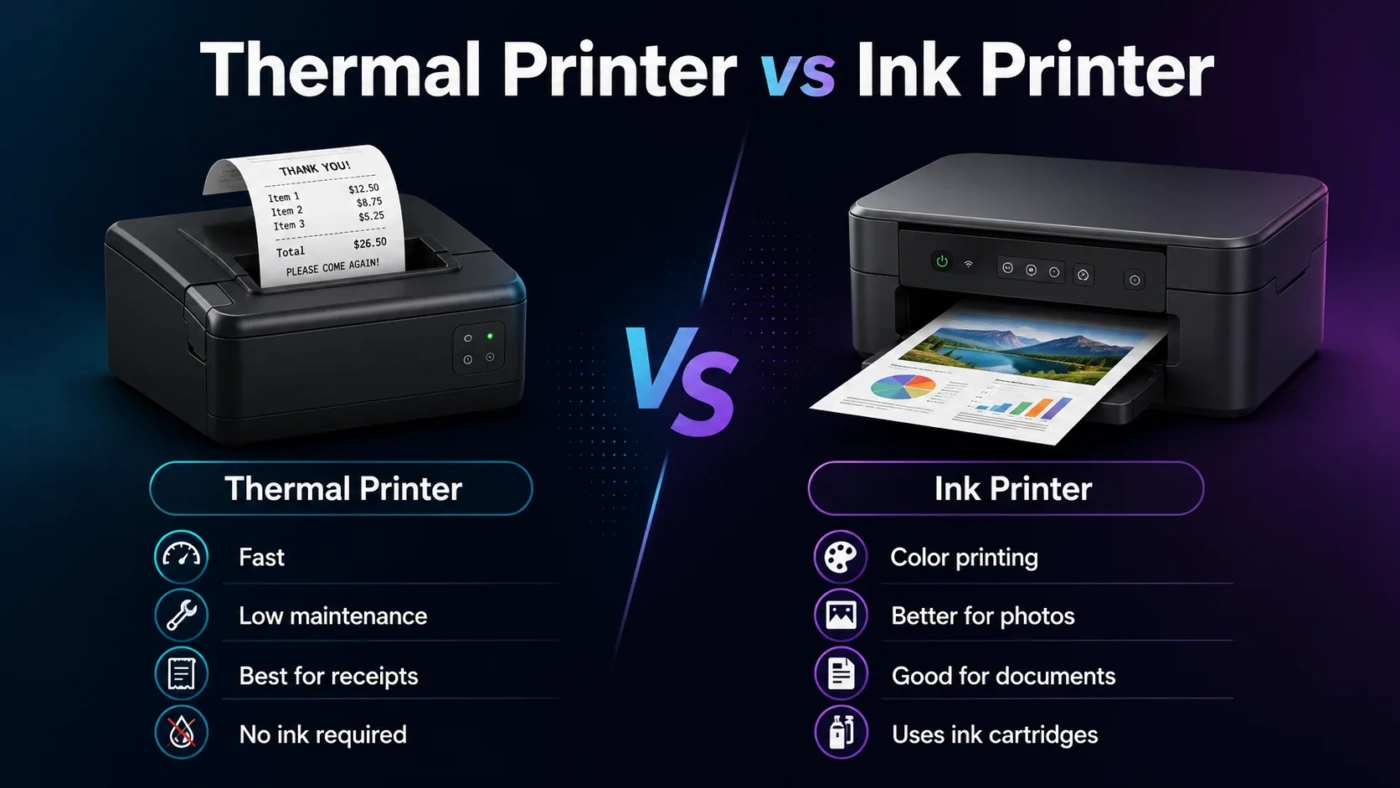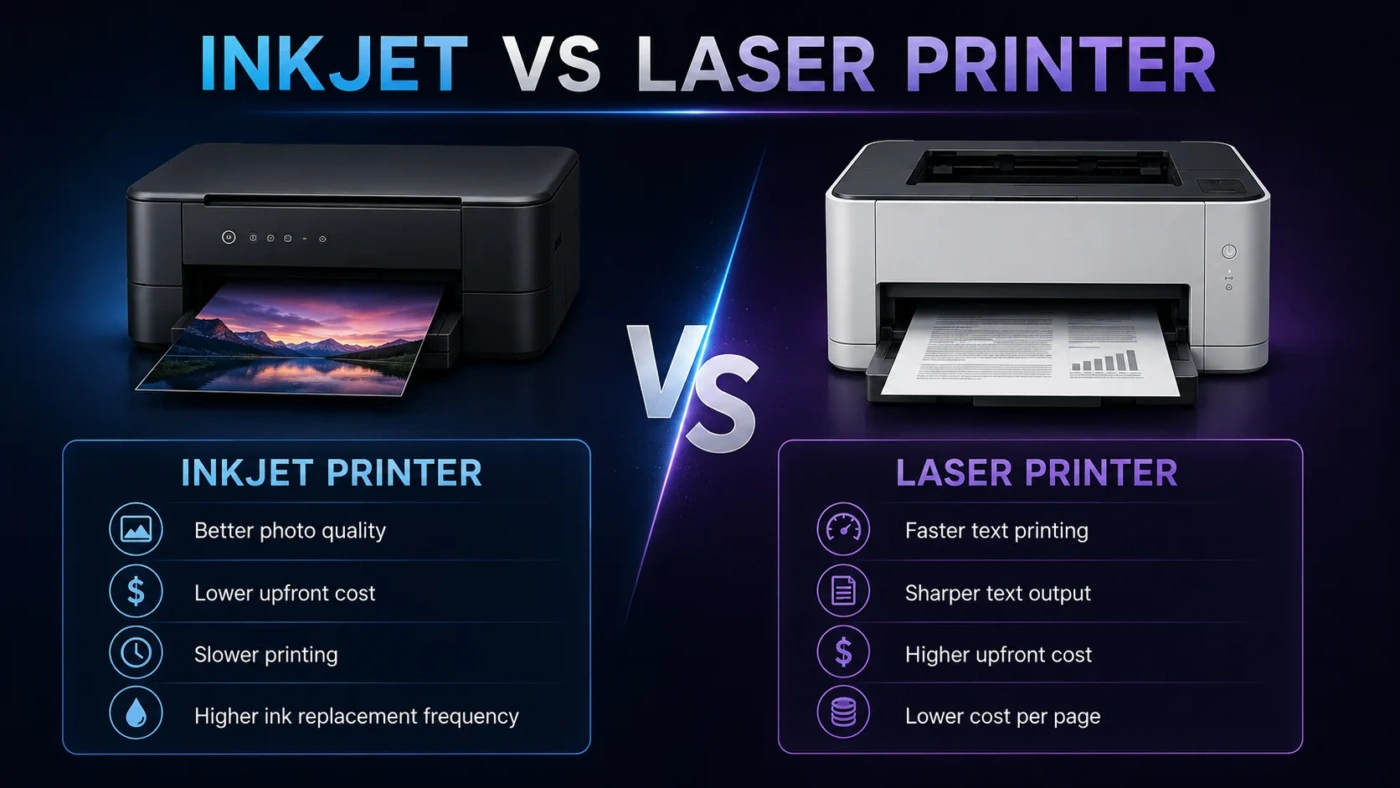
Choosing between an inkjet printer and a laser printer is mostly about what you print, how often you print, and how much patience you have for replacement ink or toner. An inkjet printer is usually the better fit for color photos, mixed schoolwork, creative projects, and occasional home printing. A laser printer is usually the better fit for sharp text, long documents, office paperwork, shipping labels, and higher monthly page volume. The confusing part is that both can be “good” printers, but they solve different problems.
- Inkjet vs Laser Printer: The Main Difference
- What Is an Inkjet Printer?
- Where Inkjet Printers Perform Best
- Where Inkjet Printers Can Be Frustrating
- What Is a Laser Printer?
- Where Laser Printers Perform Best
- Where Laser Printers Can Be Limiting
- Print Quality: Photos, Text, and Everyday Documents
- Speed and Volume: Which One Handles More Pages?
- Cost Comparison: Upfront Price vs Long-Term Cost
- Inkjet vs Laser for Home Use
- Inkjet vs Laser for Students
- Inkjet vs Laser for Small Offices
- When Should You Choose an Inkjet Printer?
- When Should You Choose a Laser Printer?
- Common Misunderstandings About Inkjet and Laser Printers
- “Inkjet Printers Are Always Cheaper”
- “Laser Printers Cannot Print Color”
- “Ink Tank and Cartridge Inkjet Printers Are the Same Deal”
- “Toner Is Expensive, So Laser Printers Cost More to Run”
- “A Color Laser Printer Is the Best Upgrade From an Inkjet”
- Real-World Examples: Which Printer Fits Which User?
- Inkjet vs Laser Printer: Which One Should You Choose?
- Best Decision by Printing Habit
| Feature | Inkjet Printer | Laser Printer |
|---|---|---|
| Best For | Photos, color graphics, home use, school projects, light mixed printing | Text documents, office work, shipping labels, forms, high-volume printing |
| Printing Method | Sprays liquid ink through tiny nozzles onto paper | Uses toner powder, static charge, and heat to fuse print onto paper |
| Text Quality | Good, but can look less crisp on plain paper | Very sharp, clean, and consistent for black text |
| Photo Quality | Usually better, especially with photo paper and color-focused models | Acceptable for charts and graphics, weaker for real photo detail |
| Speed | Slower for long documents and large batches | Faster for multi-page documents and repeated office jobs |
| Upfront Price | Often lower for cartridge models; tank models cost more at purchase | Usually higher for color models; monochrome models can be affordable |
| Running Cost | Can be high with cartridges; much lower with refillable ink tank models | Often low for black-and-white documents, but color toner can be costly |
| Idle Use | Ink may dry or clog if the printer sits unused for weeks | Toner does not dry like liquid ink, so it handles idle periods better |
| Maintenance | May need printhead cleaning, alignment, or nozzle checks | Less frequent cleaning, but toner, drum, or fuser parts may matter over time |
| Paper Handling | Often flexible with photo paper, labels, envelopes, and creative media | Better for plain paper, office paper, labels, forms, and steady document output |
| Best Choice If You Print Rarely | Only if you need color photos or can print regularly enough to keep ink flowing | Usually safer, especially for black-and-white documents |
| Best Overall Fit | Home users who care about color, photos, and flexible printing | Students, remote workers, offices, and anyone printing many text pages |
Inkjet vs Laser Printer: The Main Difference
The main difference is simple: inkjet printers use liquid ink, while laser printers use dry toner powder. That single difference affects almost everything else: print speed, page cost, photo quality, maintenance, and how well the printer behaves after sitting unused.
Inkjet printers are usually better when color detail matters. They can blend ink smoothly, which helps with photos, illustrations, colorful worksheets, greeting cards, and image-heavy pages. Laser printers are usually better when clean text matters. They produce crisp letters, handle long print jobs well, and often feel more predictable for daily document work.
So the real question is not “Which technology is better?” It is: What kind of pages will you actually print most of the time?
What Is an Inkjet Printer?
An inkjet printer is a printer that places tiny droplets of liquid ink onto paper. Most home inkjets use black, cyan, magenta, and yellow ink. Some photo-focused models use extra colors to create smoother tones and better image detail.
There are two common inkjet types:
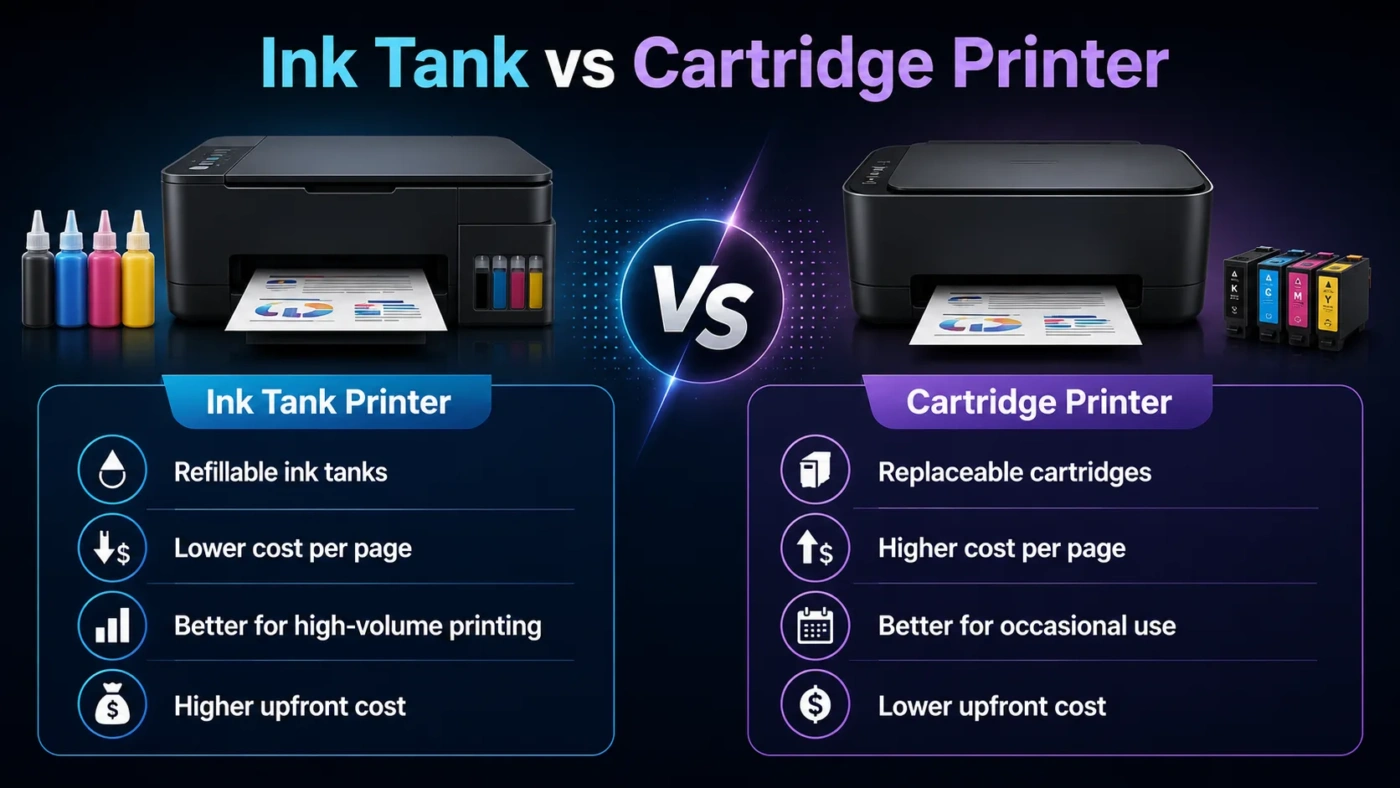
- Cartridge inkjet printers: These are often cheap to buy, but replacement ink can become expensive if you print often.
- Ink tank printers: These cost more upfront, but use refillable ink bottles and can be cheaper over time for people who print color regularly.
This distinction matters. A low-cost cartridge inkjet and a refillable tank inkjet can feel like two different ownership experiences. One may be attractive because the printer is cheap on day one. The other may be attractive because the ink lasts longer and the cost per page can be much lower.
Where Inkjet Printers Perform Best
Inkjet printers are strongest when print quality depends on color blending. Photos, graphics, classroom materials, craft templates, family documents, and occasional color pages usually look better on a good inkjet than on an entry-level laser printer.
They also tend to support more media types. If you want to print on glossy photo paper, thicker creative paper, stickers, or borderless photo sizes, inkjet models usually give you more options.
Where Inkjet Printers Can Be Frustrating
The weakness is maintenance. Liquid ink can dry, especially when the printer sits unused. Printheads may clog, colors may fade unevenly, and the printer may use ink during cleaning cycles. That means a printer can appear “full enough” but still print badly until it runs a cleaning process.
For someone who prints once every few months, this can be annoying. For someone who prints photos, schoolwork, and color documents every week, it may not be a major issue.
What Is a Laser Printer?
A laser printer uses toner powder instead of liquid ink. The printer creates an image on a drum using electrical charge, applies toner to that image, then uses heat to fuse the toner onto paper.
This process is why laser printers are known for sharp text, fast printing, and steady document output. They are common in offices because they handle repeated black-and-white printing well. Many home users also choose monochrome laser printers because they want something simple for forms, labels, invoices, PDFs, and school notes.
Where Laser Printers Perform Best
Laser printers are excellent for text. Letters look clean, edges are sharp, and pages usually come out dry and ready to handle. If you print long PDFs, business reports, contracts, shipping labels, tax documents, or worksheets, a laser printer often feels faster and less fussy.
They also handle idle time better. Toner does not dry out the way ink does. If you print only a few times per month, a laser printer may be easier to live with than a cartridge inkjet.
Where Laser Printers Can Be Limiting
Laser printers are not always the best choice for color images. Color laser models can print charts, basic graphics, and presentation pages, but they usually do not match inkjet photo quality. They also cost more to buy and maintain than monochrome laser models.
Another point: toner cartridges can feel expensive when you replace them. The page yield is often high, so the cost per printed page may still be reasonable, but the checkout price for a full set of color toner can surprise people.
Print Quality: Photos, Text, and Everyday Documents
If you mainly print text, choose a laser printer. It produces cleaner black letters on plain office paper and usually handles small fonts better. This matters for resumes, contracts, study notes, invoices, labels, and any document where readability comes first.
If you mainly print photos or colorful designs, choose an inkjet printer. Inkjet models can produce smoother gradients, richer photo tones, and better detail on glossy or coated paper. A laser printer can print color, but it is usually better for business graphics than true photo printing.
For everyday mixed printing, the decision depends on volume. If you print a little bit of everything and want color flexibility, an inkjet makes sense. If you print mostly documents and only rarely need color, a monochrome laser plus occasional outside photo printing may be the better setup.
Speed and Volume: Which One Handles More Pages?
Laser printers usually win on speed. They warm up, print long documents quickly, and are built for repeated page output. If you print 20, 50, or 100 pages at a time, laser is usually more comfortable.
Inkjet printers can be fast enough for casual home use, but they may slow down on high-quality color pages, duplex printing, or photo settings. They can also pause for maintenance if the printhead needs cleaning.
A useful way to think about volume:
- Under 20 pages per month: Laser is safer if you print mostly text and leave the printer unused for long periods.
- 20–100 pages per month: Either can work; choose based on color needs.
- 100+ pages per month: Laser is better for text-heavy use; ink tank is worth considering for color-heavy use.
- High color volume: A refillable ink tank printer may offer better value than a color laser for many home users.
Cost Comparison: Upfront Price vs Long-Term Cost
Printer pricing can be misleading because the cheapest printer is not always the cheapest printer to own. The purchase price, ink or toner price, page yield, maintenance parts, and printing habits all matter.
| Cost Area | Inkjet Printer | Laser Printer |
|---|---|---|
| Basic Printer Price | Many cartridge models start around $60–$150 | Many monochrome models start around $100–$250 |
| Color Model Price | Color is standard on most inkjets | Color laser models often start higher, commonly around $250–$600+ |
| Ink or Toner Replacement | Cartridges may cost less per purchase but need replacement more often | Toner costs more per cartridge but usually lasts longer |
| Low-Cost Printing Option | Refillable ink tank models can lower color printing cost | Monochrome laser models can lower text printing cost |
| Hidden Cost Risk | Cleaning cycles, dried ink, and frequent cartridge replacement | Color toner sets, drum units, or higher upfront cost |
For black-and-white documents, a laser printer is often the better long-term value. For frequent color pages, especially in a home or school setting, a refillable ink tank printer may beat both cartridge inkjets and color lasers on running cost.
For very light users, the math changes again. A cheap inkjet may look tempting, but dried ink can make it less practical. A monochrome laser may cost more on day one, yet sit quietly for weeks and still print when needed.
Inkjet vs Laser for Home Use
For a typical home, the better choice depends on whether the printer is for color creativity or simple paperwork.
Choose an inkjet printer for home use if you print family photos, colorful school projects, recipes, planner pages, greeting cards, or visual documents. A compact all-in-one inkjet can also scan and copy, which is useful in a household.
Choose a laser printer for home use if you print forms, return labels, tax papers, study materials, work documents, and black-and-white PDFs. A small monochrome laser printer is often the easiest choice for people who want fewer surprises.
Inkjet vs Laser for Students
Students usually need a printer for notes, essays, assignments, PDFs, slides, and forms. In that case, a monochrome laser printer is often the practical choice. It prints fast, handles text well, and does not punish the user as much for leaving it unused during breaks.
An inkjet is better for students in design, photography, art, architecture, education, or any program that needs color visuals. If color printing is frequent, an ink tank printer is worth considering because cartridge ink can become expensive during busy semesters.
Inkjet vs Laser for Small Offices
Small offices usually print more documents than photos. That makes laser printers a strong fit. A monochrome laser printer is good for invoices, reports, forms, shipping labels, and internal paperwork. A color laser printer can work well for charts, basic marketing sheets, and client-facing documents where photo quality is not the main goal.
Inkjet printers still have a place in small offices. They make sense when the office prints color samples, visual drafts, product photos, or occasional creative materials. A business-class ink tank or high-capacity inkjet can also be a smart fit when color pages are common but photo perfection is not required.
When Should You Choose an Inkjet Printer?
Choose an inkjet printer if your printing needs are color-heavy, visual, and flexible. It is the better match when print quality depends on smooth color and image detail.
- You print photos or image-heavy pages.
- You want borderless photo printing or glossy paper support.
- You print school projects, craft pages, invitations, or colorful worksheets.
- You need a low upfront price and only print occasionally.
- You want an all-in-one printer for scanning, copying, and casual home use.
- You print enough color pages to justify a refillable ink tank model.
The best inkjet buyer is not always the person who prints the least. It is often the person who prints the right kind of pages: color pages, photos, and mixed media.
When Should You Choose a Laser Printer?
Choose a laser printer if your printing needs are text-heavy, frequent, or office-oriented. It is the better match when you want fast, clean, predictable document printing.
- You print mostly black-and-white documents.
- You print long PDFs, forms, contracts, labels, or reports.
- You want sharp text on plain paper.
- You may leave the printer unused for days or weeks.
- You print in batches rather than one page at a time.
- You want lower running cost for regular monochrome printing.
The best laser buyer is someone who wants a printer that behaves more like an office tool and less like a color craft machine.
Common Misunderstandings About Inkjet and Laser Printers
“Inkjet Printers Are Always Cheaper”
They are often cheaper to buy, but not always cheaper to own. Cartridge ink can raise the long-term cost. Ink tank models fix much of that problem, but they cost more upfront.
“Laser Printers Cannot Print Color”
They can, but color laser printers cost more than monochrome models. They are good for charts, reports, and business graphics, but they are usually not the best choice for glossy photo printing.
“Ink Tank and Cartridge Inkjet Printers Are the Same Deal”
They use similar printing technology, but ownership cost can be very different. A cartridge inkjet may be cheap at purchase, while an ink tank printer is designed around refillable bottles and lower ink cost over time.
“Toner Is Expensive, So Laser Printers Cost More to Run”
A toner cartridge can be expensive, but it usually prints many pages. For black-and-white text, laser printers often have a lower cost per page than cartridge inkjets.
“A Color Laser Printer Is the Best Upgrade From an Inkjet”
Not always. If you print photos, a better inkjet or ink tank printer may be a better upgrade. A color laser printer is more useful when you need fast color documents, not photo-lab style output.
Real-World Examples: Which Printer Fits Which User?
| User Type | Better Choice | Reason |
|---|---|---|
| Remote Worker Printing Forms and PDFs | Laser Printer | Sharper text, faster document printing, better for idle periods |
| Family Printing Photos and School Projects | Inkjet Printer | Better color output and more flexible paper support |
| Student Printing Notes and Essays | Laser Printer | Lower stress for text-heavy, batch-style printing |
| Small Business Printing Invoices and Labels | Laser Printer | Fast, clean, and reliable for repeated document jobs |
| Teacher Printing Color Worksheets | Ink Tank Printer | Better value when color pages are printed often |
| Occasional User Printing Every Few Months | Monochrome Laser Printer | Toner handles long idle periods better than liquid ink |
| Hobby Photographer | Photo Inkjet Printer | Better tone, detail, and paper compatibility for images |
Inkjet vs Laser Printer: Which One Should You Choose?
Choose an inkjet printer if you care more about color, photos, creative projects, and paper flexibility. It is the better choice for visual output, especially if you print often enough to keep the ink system active. If you print many color pages, look closely at refillable ink tank models instead of cheap cartridge models.
Choose a laser printer if you care more about text, speed, low-maintenance document printing, and long-term reliability for paperwork. For many homes, students, and small offices, a monochrome laser printer is the most practical printer type because it does one job very well: it prints clean black-and-white pages without much fuss.
If you are still unsure, use this simple rule: buy inkjet for color and photos; buy laser for text and volume. That one sentence solves most buying decisions.
Best Decision by Printing Habit
- Mostly text, forms, labels, PDFs, and reports: Choose a monochrome laser printer.
- Mostly photos, crafts, colorful schoolwork, and creative pages: Choose an inkjet printer.
- Lots of color pages but not always photos: Choose an ink tank printer.
- Small office with steady paperwork: Choose a laser printer.
- Rare printing with long gaps between jobs: Choose a laser printer unless color photos are the main need.
- One printer for a family with scanning and copying: Choose an all-in-one inkjet or ink tank model if color matters; choose an all-in-one laser if text matters more.
The safest pick for document-heavy users is a monochrome laser printer. The safest pick for color-heavy home users is an inkjet printer, preferably an ink tank model if printing is regular. The wrong choice is not about brand or model first. It is about buying a photo-friendly machine for office paperwork, or a document-focused machine for photo printing.