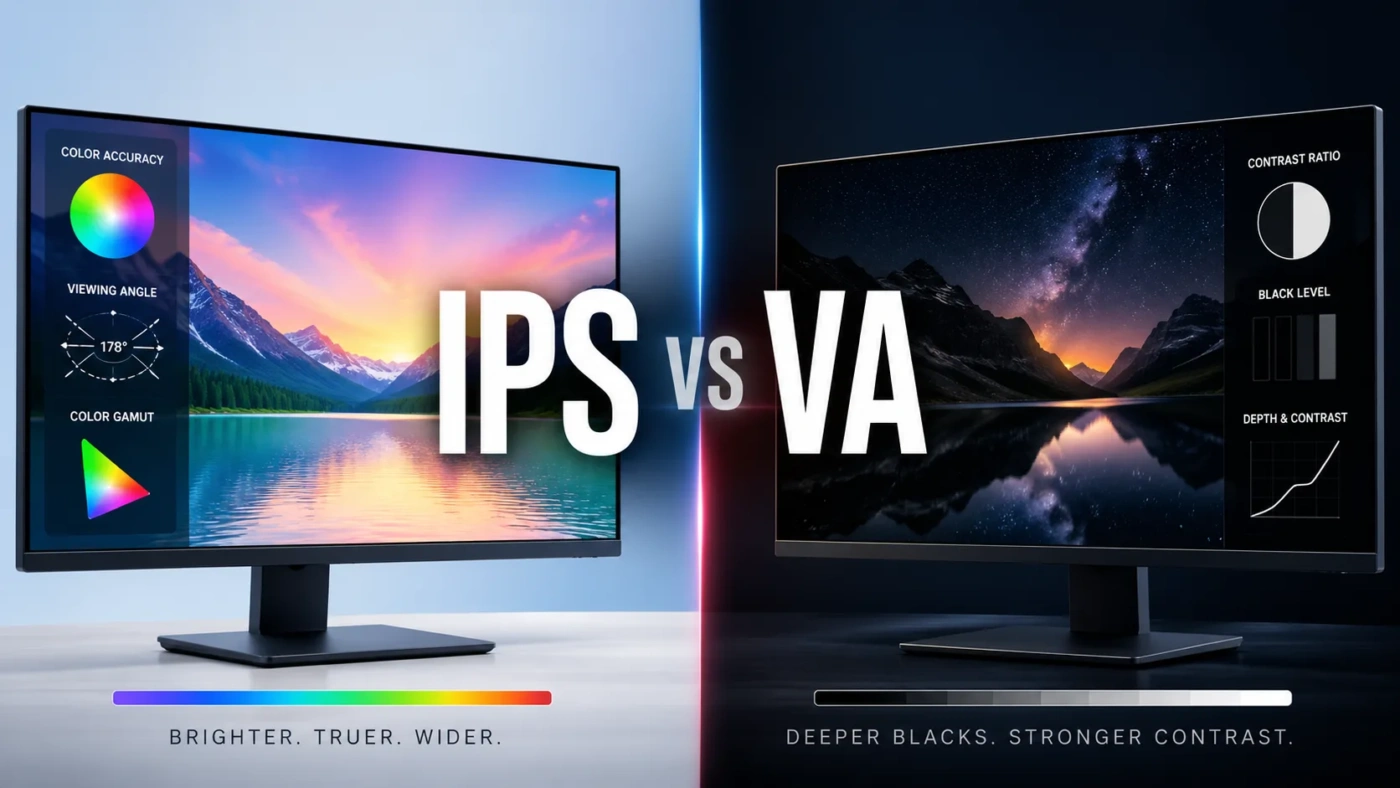
Picking between an IPS and a VA panel feels straightforward until you actually sit down and compare them. Both are LCD technologies, both use a backlight, and both look perfectly fine in a store. But put them side by side in your actual environment — gaming late at night, editing photos in a bright room, or staring at spreadsheets for hours — and the differences become hard to ignore.
- How These Two Panel Types Actually Differ
- What Is an IPS Panel?
- What Is a VA Panel?
- When IPS Is the Better Choice
- When VA Is the Better Choice
- The Misconceptions Worth Clearing Up
- VA Response Times Are Fine for Gaming
- IPS Glow Is a Defect
- VA Panels Have Poor Color Accuracy
- Higher Contrast Always Means Better Picture Quality
- Making the Final Call
| Feature | IPS | VA |
|---|---|---|
| Panel Technology | In-Plane Switching LCD | Vertical Alignment LCD |
| Contrast Ratio | 1,000:1 – 2,000:1 (typical) | 3,000:1 – 6,000:1 (typical) |
| Black Levels | Lighter blacks, noticeable IPS glow | Deeper blacks, better dark-room performance |
| Viewing Angles | 178°/178°, very consistent color | 178°/178° rated, but color shifts off-axis |
| Response Time | 1–5 ms GtG (fast) | 4–12 ms GtG (slower, smearing risk) |
| Motion Clarity | Better — less ghosting | Can exhibit smearing in dark transitions |
| Color Accuracy | Excellent, very consistent | Good, but can vary by panel quality |
| Color Gamut | sRGB to wide DCI-P3 coverage | Good sRGB, varies by model |
| Best Lighting Environment | Bright rooms, mixed lighting | Dark or dim rooms |
| Burn-In Risk | None | None |
| Typical Price Range | $100 – $1,500+ | $80 – $800+ |
| Best For | Color work, productivity, competitive gaming | Movies, dark-room gaming, budget buyers |
How These Two Panel Types Actually Differ
Both IPS and VA are LCD panels, meaning both rely on liquid crystals and a backlight. The difference lies in how the liquid crystal molecules are oriented and how they move to control light transmission.
In an IPS panel, the crystals align horizontally (in-plane) and rotate within that plane to let light through. This geometry produces stable, predictable color output at wide angles. In a VA panel, the crystals align vertically — perpendicular to the glass — and tilt to allow light passage. That vertical resting position blocks light far more effectively, which is why VA panels produce much deeper blacks when pixels are dark.
Neither approach is a technical shortcut. Each trades something meaningful to gain something else. Understanding what each gives up is what actually helps you choose.
What Is an IPS Panel?
IPS (In-Plane Switching) was developed in the mid-1990s as a direct response to the poor viewing angles and color shifting of older TN (Twisted Nematic) panels. The technology has evolved considerably — modern variants include Nano IPS, Fast IPS, and IPS Black — but the underlying principle remains the same.
The biggest practical advantage of IPS is color consistency. The image looks virtually the same whether you’re sitting directly in front of the screen or viewing it at a 45-degree angle. This matters enormously for photographers, designers, and anyone who works in a color-managed environment. It also matters in multi-monitor setups, where visual consistency across displays is harder to achieve with panel types that shift at angles.
Response times on IPS panels are genuinely fast. Most modern IPS monitors achieve 1–4 ms GtG in practice, and some gaming-focused models push even lower. Combined with support for high refresh rates (144Hz, 165Hz, 240Hz, and beyond), IPS has become the dominant panel type for competitive and fast-paced gaming. The ghosting and trailing that plagued early IPS panels have largely been engineered out of modern units.
The known weakness is contrast. A typical IPS panel delivers around 1,000:1 native contrast, and even premium models rarely exceed 2,000:1. In a dark room, this means blacks appear more as a deep gray, and IPS glow — a backlight bloom visible in corners and around bright objects on dark backgrounds — is a characteristic limitation of the technology. Some users barely notice it; others find it genuinely distracting.
IPS Black panels (a relatively recent category, led by LG) improve native contrast to roughly 2,000:1 while maintaining the viewing angle and color accuracy advantages of traditional IPS. They don’t close the gap with VA entirely, but they reduce it.
What Is a VA Panel?
VA (Vertical Alignment) panels take a different approach to the contrast problem — and solve it convincingly. With native contrast ratios typically between 3,000:1 and 6,000:1, and some curved VA panels reaching even higher, VA displays produce blacks that IPS simply cannot match without Mini-LED local dimming.
This makes VA an excellent choice for dark-room viewing. Movies with letterbox bars look genuinely black rather than gray. Dark game environments have shadow detail without that hazy, washed-out quality that appears on lower-contrast displays. If you watch a lot of film content or play atmospheric, story-driven games in dim lighting, VA’s contrast advantage translates directly into a better experience.
VA panels also tend to offer better uniformity across the full panel surface compared to IPS — less backlight bleed in corners, and a more even brightness distribution overall. This is partly why VA has become the dominant panel type for large curved gaming monitors and ultrawide displays, where panel uniformity across a wide surface matters.
The trade-offs are real, though. VA panels have slower pixel response times than IPS, and this shows up in a specific way: dark-to-dark transitions (pixel transitions between two dark shades) can exhibit smearing or “black smearing” artifacts. Fast-moving objects against dark backgrounds — think a spaceship moving through a dark sky — can show a visible trail. Manufacturers address this with overdrive settings, but aggressive overdrive introduces inverse ghosting (a bright halo ahead of moving objects), so there’s a balancing act.
Viewing angles are technically rated similarly to IPS, but in practice VA panels show more color and gamma shift when viewed off-axis. Sitting squarely in front of a VA monitor is fine; viewing it from the side or at a sharp angle reveals a noticeable shift in contrast and color saturation. For a single-user desk setup this is rarely a problem, but in situations where multiple people view the same screen simultaneously, IPS holds an advantage.
When IPS Is the Better Choice
IPS makes the most sense when color accuracy, motion clarity, or consistent viewing angles are priorities. Specific situations where IPS is the stronger pick:
- Photo editing, graphic design, video color grading, or any work requiring accurate, stable color reproduction
- Competitive gaming — fast response times and minimal ghosting matter more than deep blacks in fast-paced titles
- Bright room use where ambient light reduces the perceptible contrast advantage of VA anyway
- Multi-monitor setups where visual consistency across displays matters
- Shared displays viewed by multiple people from different angles simultaneously
- General productivity work — the color consistency makes long sessions more comfortable
When VA Is the Better Choice
VA earns its place when contrast quality and dark-room performance take priority, especially at a given price point. Situations where VA is the practical answer:
- Movie watching and streaming content, particularly in dim or dark rooms
- Immersive, story-driven gaming with dark environments (RPGs, horror, atmospheric games)
- Large curved monitors and ultrawides, where VA’s uniformity and contrast shine
- Budget-conscious buyers who want better contrast than entry-level IPS without stepping up to OLED pricing
- Home theater PC setups where the display doubles as a TV alternative
- Users who primarily sit centered in front of their display and don’t need wide off-axis consistency
The Misconceptions Worth Clearing Up
VA Response Times Are Fine for Gaming
This depends heavily on the game type. For slower-paced games — strategy, RPGs, simulators, anything that isn’t fast and competitive — VA response times are perfectly acceptable and most players won’t notice the difference. Where it shows up is in fast-paced first-person games with dark environments. If you play a lot of competitive shooters at high refresh rates, IPS is the safer choice.
IPS Glow Is a Defect
IPS glow isn’t a defect — it’s a characteristic of the panel technology. Some units show more glow than others (and returning a unit for excessive glow can be frustrating), but a moderate amount is expected and normal. It’s most visible in a completely dark room with dark on-screen content. In typical mixed-lighting use, most people stop noticing it quickly.
VA Panels Have Poor Color Accuracy
Lower-end VA panels can be inconsistent, yes. But higher-quality VA displays — particularly those used in premium curved gaming monitors — offer genuinely good color accuracy within the sRGB color space. The gap between a well-calibrated VA and a similarly priced IPS is smaller than it used to be. The off-axis color shift is a real limitation, but straight-on color performance has improved considerably.
Higher Contrast Always Means Better Picture Quality
Contrast ratio matters a lot in dark content. In a bright room with ambient light, the perceptible contrast difference between an IPS at 1,000:1 and a VA at 4,000:1 shrinks considerably — ambient light raises the black floor of both panels. The VA advantage is most visible and most meaningful in controlled, dim lighting. In a sunlit office, it’s largely wasted.
Making the Final Call
Go with IPS if you need reliable color accuracy for professional work, you play fast competitive games, you use your monitor in a well-lit environment, or you value viewing angle consistency for shared or angled viewing situations. IPS is also the better bet if you want a panel that performs predictably across a wide variety of tasks without managing trade-offs.
Go with VA if you watch a lot of movies or TV, you play immersive games in a dark or dim room, you want better contrast than IPS can offer without the price of OLED, or you’re shopping for a large curved display where VA’s uniformity and depth give you more for the money.
For mixed-use buyers — gaming, productivity, and some movie watching — the answer often comes down to lighting. Bright room with varied use? IPS. Controlled lighting with a focus on immersive content? VA. Neither panel type is universally better; they just optimize for different things. Match the panel to how you actually use your display, not how you imagine you might use it.