When you’re standing in front of a wall of TVs at a store, OLED and QLED both look stunning. The demo content is optimized, the lighting is controlled, and both technologies put on an impressive show. The real question isn’t which one looks better in that moment — it’s which one performs better in your living room, with your lighting, your content, and your habits.
- The Fundamental Difference Between These Two Technologies
- What Is OLED?
- What Is QLED?
- When OLED Makes More Sense
- When QLED Makes More Sense
- Common Misconceptions Worth Addressing
- QLED Is “Almost as Good as OLED” Now
- OLED Always Burns In
- QD-OLED Means QLED and OLED Are Now the Same
- More Nits Always Means Better Picture
- Choosing Between Them: A Practical Summary
| Feature | OLED | QLED |
|---|---|---|
| Panel Technology | Self-emissive organic pixels | LCD with quantum dot color filter |
| Backlight | None — each pixel is its own light source | LED backlight (often Mini-LED on premium models) |
| Black Levels | True black (pixel fully off) | Very dark gray (backlight always on) |
| Contrast Ratio | Infinite (pixel-level control) | High, but limited by backlight bleed |
| Peak Brightness | 1,000–2,000+ nits (HDR highlights) | 1,500–4,000+ nits (sustained and peak) |
| Sustained Brightness | Dims on large bright areas (ABL) | Maintains high brightness across full screen |
| Color Volume | Excellent — wide and accurate | Excellent — quantum dots boost saturation |
| Viewing Angles | Near-perfect from any angle | Narrower — color shifts off-axis |
| Response Time | Under 1 ms | 2–8 ms (varies by model) |
| Burn-In Risk | Yes — with prolonged static content | No burn-in risk |
| Screen Sizes Available | 42–97 inches (limited range) | 43–98+ inches (wider availability) |
| Typical Price Range (55″) | $1,200 – $3,500+ | $500 – $2,500+ |
| Best For | Dark-room viewing, gaming, movies | Bright rooms, sports, HDR highlights |
The Fundamental Difference Between These Two Technologies
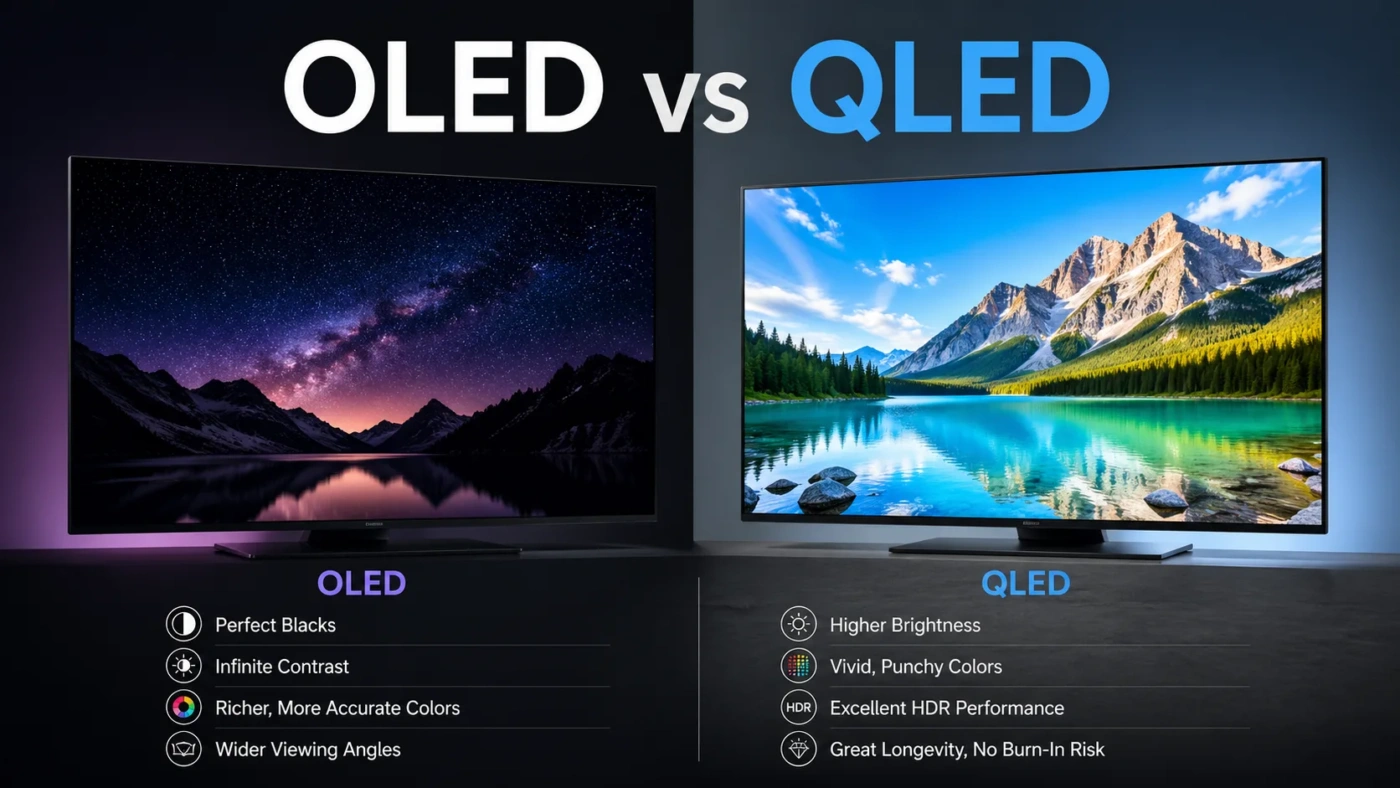
OLED and QLED are not competing versions of the same technology — they work in fundamentally different ways. OLED (Organic Light-Emitting Diode) is a self-emissive panel: every pixel generates its own light and can switch off completely. QLED is an LCD panel enhanced with a quantum dot filter layer that sits in front of an LED backlight to improve color purity and brightness output.
That structural difference explains almost every practical distinction between them. OLED’s pixel-level light control gives it infinite contrast and perfect blacks. QLED’s powerful backlight gives it higher sustained brightness across the full panel. Everything else — viewing angle performance, burn-in risk, price — follows from this core architectural gap.
One important note on terminology: Samsung originated and trademarked the QLED name, but other manufacturers (TCL, Hisense) also produce quantum dot LCD displays under similar branding. At the premium end, Samsung’s Neo QLED lineup uses Mini-LED backlighting with hundreds of local dimming zones, which closes some of the contrast gap with OLED — though not entirely.
What Is OLED?
OLED displays use organic compounds that emit light when electrical current passes through them. Because each pixel is independently lit and controllable, the display can produce a completely black pixel simply by turning it off. No light leaks from adjacent bright pixels. No backlight creates a uniform glow behind dark scenes.
The result is an effectively infinite contrast ratio — and in real-world viewing, that shows. Dark scenes in films have genuine depth. Star fields look three-dimensional. Shadow detail in HDR content appears with a clarity that backlit displays struggle to match. This is why OLED has become the reference standard for home theater enthusiasts and is widely used in high-end smartphone screens, laptop displays, and professional monitors.
Modern OLED TV panels come in two main variants. WOLED (White OLED with color filters), used by LG and several other brands, creates color by filtering white OLED light. QD-OLED, developed by Samsung Display and used in Samsung and Sony’s premium models, combines OLED’s self-emissive structure with a quantum dot color conversion layer — producing higher peak brightness and a wider color volume than standard WOLED panels.
OLED’s motion handling is exceptional. Sub-millisecond response times mean pixel transitions complete almost instantaneously, making fast-moving content — sports, action sequences, gaming — appear sharp and clear without trailing or smearing artifacts.
The practical limitations are burn-in and brightness. Permanent image retention can develop when the same static elements (channel logos, navigation bars, game HUDs) display for thousands of cumulative hours. Manufacturers have introduced pixel-shifting, automatic brightness limiting (ABL), and screensaver timers to mitigate this, and modern panels are substantially more resistant than early OLED units. Still, the risk exists and is worth understanding before buying. On the brightness side, OLED dims automatically when large portions of the screen display bright content — a protection mechanism for the organic compounds — which means it can appear less punchy than QLED in bright, high-key scenes viewed in a well-lit room.
What Is QLED?
QLED is Samsung’s branding for LCD televisions that use a quantum dot enhancement film (QDEF) in their optical stack. Quantum dots are semiconductor nanocrystals that emit precise wavelengths of light when energized by the backlight. By converting the backlight’s blue LED output into purer red and green wavelengths, quantum dots allow QLED panels to achieve wider color gamuts and higher color purity than standard LED-LCD displays.
The key advantage of QLED over OLED is sustained peak brightness. Because there’s no organic material to protect, a QLED panel can blast the full panel at high brightness indefinitely. Premium Neo QLED models reach sustained brightness figures of 2,000–4,000 nits — numbers OLED cannot match for full-screen content. In a bright living room flooded with sunlight, this translates directly into a more watchable, impactful image.
Quantum dot technology also contributes to excellent color saturation and volume. QLED displays cover a wide DCI-P3 color gamut and can reproduce vivid, saturated colors at high brightness levels — a combination that makes HDR content with bright, colorful highlights look especially impressive.
Mini-LED backlighting (used in Samsung’s Neo QLED lineup and competitor products from LG, TCL, and Hisense) divides the backlight into hundreds or thousands of independently dimmable zones. This improves local contrast dramatically — halos around bright objects on dark backgrounds shrink considerably — though they don’t disappear entirely the way they do on OLED. Entry and mid-range QLED models use standard edge-lit or direct-lit backlights with far fewer dimming zones, and their dark-scene performance reflects that.
Viewing angles are a notable limitation. Standard QLED panels use VA-type LCD substrates, which show color and contrast shifts when viewed off-axis. Sitting directly in front of the screen is fine; viewing from the side reveals a perceptible change in image quality. Some manufacturers address this with optical diffusion layers, but the improvement is partial.
When OLED Makes More Sense
OLED earns its price premium in specific, well-defined situations. It’s the better choice when:
- Your viewing environment is dim or dark — a dedicated home theater room, a basement, or any space where you control ambient light
- You watch a lot of cinematic content — films, prestige TV, streaming with HDR — where contrast and black levels shape the experience
- Gaming is a priority, especially single-player, story-driven titles with dark environments and detailed shadow work
- You sit directly in front of the screen (OLED’s viewing angle advantage matters less if only one person ever watches)
- You want the best possible motion clarity for fast content without artifacts
- Budget allows — OLED costs more, but the image quality in the right environment justifies it for many buyers
When QLED Makes More Sense
QLED is the stronger practical choice in a wider range of everyday scenarios:
- Bright living rooms with large windows or overhead lighting that washes out contrast advantages
- Sports viewing — high sustained brightness makes fast action look vivid and punchy even in daylight conditions
- Households where the TV runs for extended hours with static content (news channels, cooking shows, game overlays), where burn-in caution is relevant
- Larger screen sizes on a tighter budget — QLED offers 75–85 inch panels at prices significantly below comparable OLED sizes
- Family rooms where viewers sit at various angles and distances
- Buyers who want strong HDR performance without the OLED price point
Common Misconceptions Worth Addressing
QLED Is “Almost as Good as OLED” Now
Mini-LED QLED has genuinely closed the gap in many areas — local dimming zones reduce blooming, peak brightness is exceptional, and color performance is excellent. But the contrast gap remains real. In a controlled dark room, the difference between true black and a very dark gray is still visible to most viewers. “Almost as good” is accurate for bright-room use; less so for dedicated dark-room cinema viewing.
OLED Always Burns In
Burn-in on modern OLED TVs requires specific, sustained abuse — displaying the same static image at high brightness for thousands of hours. Casual TV watching, gaming variety, and streaming content rarely produce it. The risk is real for someone who leaves a news channel on for 8+ hours daily. For typical mixed use, most OLED owners never encounter it. It’s a legitimate concern to factor in, not an inevitable outcome.
QD-OLED Means QLED and OLED Are Now the Same
QD-OLED (used in Samsung’s S90D/S95D series and Sony’s Bravia XR OLED A95L) combines quantum dot color conversion with an OLED emissive layer. It achieves higher brightness and wider color volume than standard WOLED. But it is still an OLED panel at its core — self-emissive, capable of true black, subject to burn-in considerations. It is not a QLED product, despite sharing “QD” in the name. The naming can be genuinely confusing.
More Nits Always Means Better Picture
Peak brightness matters — but context determines whether it’s visible. In a dark room, an OLED at 800 nits can look more impressive than a QLED at 2,000 nits because the contrast ratio amplifies perceived image quality. Nit counts on their own don’t tell the full story without knowing viewing conditions and content type.
Choosing Between Them: A Practical Summary
Choose OLED if: you have control over your viewing environment, you prioritize cinema-quality contrast and black levels, you game or watch movies as your primary use case, and your budget stretches to the higher price point. QD-OLED models (starting around $1,200–$1,500 for 55 inches) offer the best of both approaches for those who can spend accordingly.
Choose QLED if: your room is bright and light control is limited, you watch a lot of live sports or daytime content, you want a larger screen size for less money, or you prefer not to think about burn-in precautions. A Neo QLED with Mini-LED at $800–$1,200 for 65 inches delivers genuinely excellent picture quality for the price and the environment.
The honest truth is that both technologies produce outstanding images — better than almost any display available five years ago. The decision comes down to your room, your content, and your budget. Match those three variables correctly and either choice will serve you well for years.