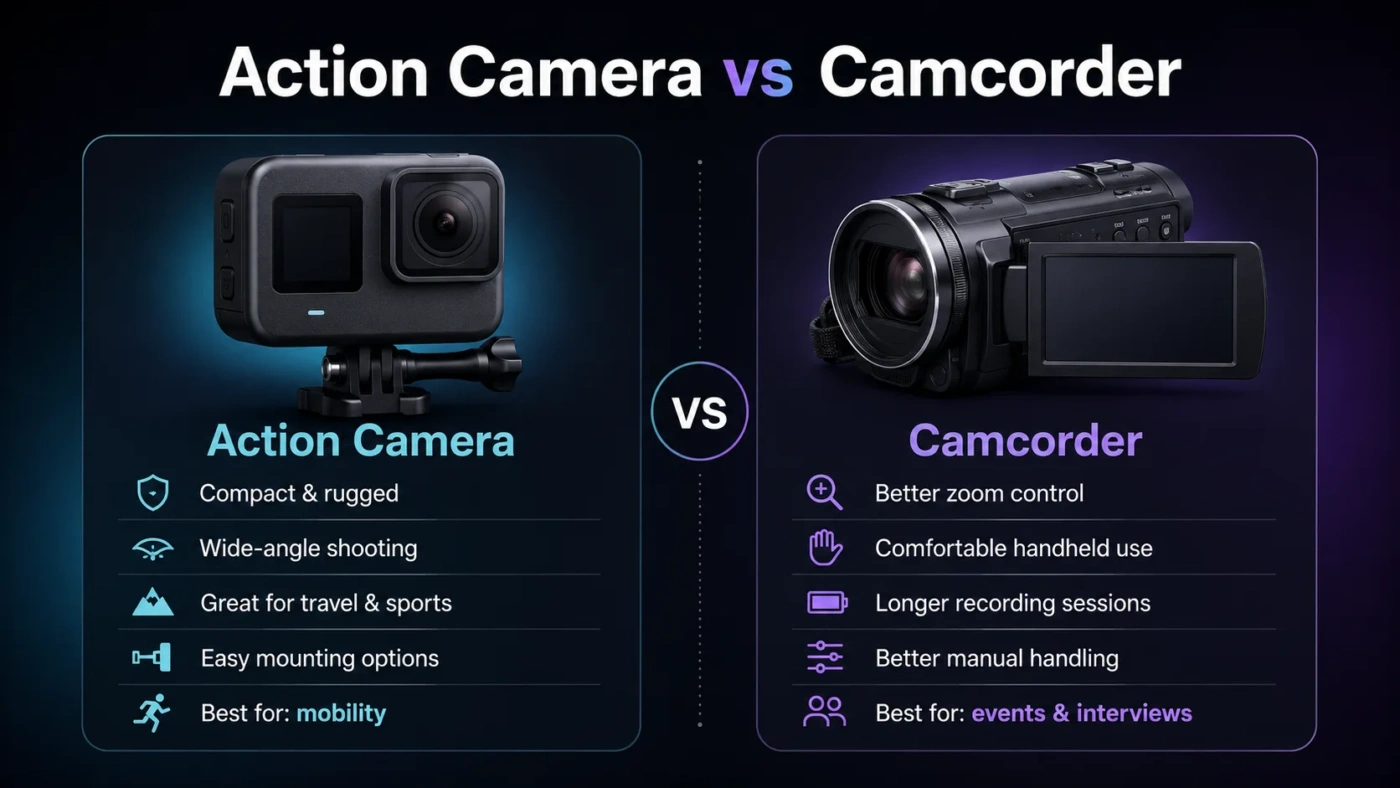
An action camera and a camcorder can both record video, but they are built for different habits. Choose an action camera if you want compact, rugged, mountable footage for travel, cycling, hiking, water activities, POV clips, or social media. Choose a camcorder if you want longer recording sessions, smoother zoom, easier handheld filming, better audio control, and a more traditional video camera feel.
- Main Difference Between an Action Camera and a Camcorder
- What Is an Action Camera?
- What Is a Camcorder?
- Video Quality: Sharpness Is Not the Whole Story
- Action Camera Video Strengths
- Camcorder Video Strengths
- Zoom and Framing
- Stabilization and Movement
- Better Stabilization Choice by Scenario
- Audio Quality
- Battery Life and Long Recording
- Portability and Mounting
- Low-Light and Indoor Use
- Price and Value
- Typical Buying Logic
- When an Action Camera Is the Better Choice
- When a Camcorder Is the Better Choice
- Common Misunderstandings
- “4K Means Both Will Look the Same”
- “An Action Camera Can Replace a Camcorder for Every Event”
- “Camcorders Are Outdated”
- “Action Cameras Are Only for Extreme Sports”
- Action Camera vs Camcorder for Different Users
- For Travel
- For Family Videos
- For YouTube
- For Sports Recording
- For Interviews
- For School or Community Events
- Which One Should You Choose?
| Feature | Action Camera | Camcorder |
|---|---|---|
| Best For | Sports, travel, POV footage, outdoor recording, mounting on helmets, bikes, cars, or tripods | Family events, school programs, interviews, lectures, weddings, stage recordings, long-form video |
| Size and Weight | Very small and light | Larger, but easier to hold for long periods |
| Durability | Usually better for impact, dust, rain, and water use | More delicate and less suitable for rough conditions |
| Lens Style | Wide-angle lens, often with a fixed focal length | Optical zoom lens with better framing control |
| Zoom Quality | Limited; digital zoom can reduce image quality | Much better; optical zoom keeps detail cleaner |
| Stabilization | Very strong electronic stabilization for movement | Good optical or hybrid stabilization, especially for handheld zoom shots |
| Recording Time | Shorter per battery; heat can matter during long 4K recording | Usually better for longer sessions |
| Audio | Usable for casual clips, but wind and distance can be a problem | Better built-in microphone placement and more options for external audio |
| Screen and Controls | Small screen; many settings depend on touch menus or apps | Larger flip-out screen, physical zoom controls, easier operation while recording |
| Low-Light Video | Acceptable in newer models, but small sensors still have limits | Often better for indoor events, especially with larger sensors and controlled zoom |
| Typical Price Range | About $100–$500 for most consumer models | About $250–$1,500+ depending on zoom, sensor, audio, and pro features |
| Better Choice If You Want | Hands-free, rugged, wide, stabilized footage | Longer, cleaner, easier event recording |
Main Difference Between an Action Camera and a Camcorder
The main difference is how the camera is meant to be used. An action camera is built to be placed somewhere: on a helmet, chest mount, handlebar, dashboard, selfie stick, backpack strap, or small tripod. A camcorder is built to be held, aimed, zoomed, monitored, and operated during a longer recording session.
An action camera favors durability, stabilization, portability, and wide-angle capture. A camcorder favors control, zoom, audio handling, comfort, and recording length. That difference affects almost everything: lens design, battery life, screen size, microphone quality, file handling, and how natural the footage looks.
What Is an Action Camera?
An action camera is a compact video camera designed for movement and outdoor use. It usually has a wide-angle lens, strong electronic image stabilization, a tough body, simple controls, and mounting accessories. Many models are water-resistant or waterproof without a large protective case.
Action cameras are popular for:
- Bike, motorcycle, and car footage
- Hiking, skiing, surfing, diving, and travel videos
- POV recording
- Social media clips
- Vlogging in places where a larger camera feels awkward
- Time-lapse and hyperlapse shots
The trade-off is that an action camera often gives you a wide view whether you want it or not. It can make rooms look stretched, faces look less natural at close range, and distant subjects look small. That is fine for motion and scenery, but not always ideal for speeches, stage shows, school events, or interviews.
What Is a Camcorder?
A camcorder is a dedicated video camera designed for continuous recording. It usually has a built-in zoom lens, a flip-out screen, comfortable grip, longer battery options, and controls made for video rather than quick clips.
Camcorders are still useful because they solve problems that phones and action cameras often struggle with:
- Recording a full event without constant handling
- Zooming in on a person across a room
- Keeping the camera comfortable in the hand
- Monitoring audio and framing more easily
- Using external microphones on better models
- Following a subject smoothly during a long take
A camcorder is not as pocketable or rugged as an action camera, but it is often easier to trust for a long, important recording.
Video Quality: Sharpness Is Not the Whole Story
Both devices can record sharp 4K video, but video quality is not only about resolution. A 4K action camera can look excellent in daylight, especially during movement. A camcorder may look less dramatic at first, but it can give cleaner framing, better zoom, steadier handheld shots at distance, and more natural-looking footage for people and events.
Action Camera Video Strengths
- Very stable footage while walking, riding, or moving fast
- Wide field of view that captures more of the scene
- Strong daylight performance
- Good slow motion options on many models
- Easy vertical or social media-friendly clips on newer models
Camcorder Video Strengths
- Better optical zoom for distant subjects
- More natural perspective for people
- Easier focus and exposure control during events
- Better long-take reliability
- More practical handling for one-person recording
If your subject is close and moving, the action camera usually feels better. If your subject is far away and you need to follow it for a long time, the camcorder usually wins.
Zoom and Framing
This is one of the clearest differences. Most action cameras use a fixed wide-angle lens. Some offer digital crop modes such as wide, linear, narrow, or horizon-leveling modes, but they do not replace a true optical zoom lens.
A camcorder is much better when you need to zoom in without losing as much detail. For example, recording a school performance from the back of a hall is much easier with a camcorder. An action camera would capture the whole stage, but the child or speaker may appear too small.
Choose a camcorder for zoom. Choose an action camera when being close to the action is part of the shot.
Stabilization and Movement
Action cameras are made for unstable situations. Their electronic stabilization can make walking, biking, running, and handheld travel footage look much smoother. Some models also offer horizon leveling, which helps keep the image straight even when the camera tilts.
Camcorders often use optical or hybrid stabilization. This works well for handheld filming, especially when zoomed in. It is not usually as aggressive as action camera stabilization during fast movement, but it can look more natural for events and interviews.
Better Stabilization Choice by Scenario
- Walking tour: Action camera
- Bike ride: Action camera
- Stage performance from a seat: Camcorder
- Interview on a tripod: Camcorder
- Family vacation clips: Action camera for movement, camcorder for longer memories
Audio Quality
Audio is where many buyers notice the difference after purchase. Action cameras are small, sealed, and often used in wind, water, traffic, or movement. Their microphones can be useful for ambient sound, but they are not ideal for a speaker several meters away.
Camcorders usually give better audio control. Even consumer models can be easier to aim toward the subject, and higher-end models may include microphone inputs, headphone monitoring, wind reduction settings, or XLR audio support.
If speech matters, a camcorder is usually safer. If the video is mainly about motion, scenery, or action, an action camera is enough.
Battery Life and Long Recording
Action cameras are small, so their batteries are small. They can record impressive footage, but high-resolution modes, high frame rates, stabilization, GPS, Wi-Fi, and small bodies can create heat and battery drain. For short sessions, this is fine. For a full event, it can be annoying.
Camcorders are better suited to longer recording. They are easier to power externally, easier to hold, and often designed with long sessions in mind. A camcorder is the better pick for ceremonies, conferences, lessons, interviews, school events, religious services, or sports matches recorded from one position.
Portability and Mounting
An action camera is much easier to carry. It fits in a pocket, attaches to a mount, and can be used in places where a camcorder would feel too large. This makes it better for travel, outdoor activities, and casual creators who want to record without carrying a camera bag.
A camcorder is portable in a different way. It may not fit in a pocket, but it is easier to hold steadily for a long time. The grip, zoom rocker, flip screen, and larger body help when you need to record with attention rather than simply start the camera and move.
Low-Light and Indoor Use
Action cameras work best in good light. Newer models have improved low-light modes, but small sensors and wide lenses still have limits. Indoor footage can show noise, soft detail, or motion blur, especially in dim rooms.
Camcorders can also struggle in poor light, especially cheaper models with small sensors. Still, many camcorders handle indoor events better because they offer more controlled framing, better zoom behavior, and more practical exposure handling. Models with larger sensors and wider apertures perform better, but they cost more.
For daylight travel and outdoor clips, an action camera is often enough. For indoor ceremonies, speeches, and stage recordings, a camcorder is usually the safer choice.
Price and Value
An action camera can be a better value if you need ruggedness, portability, and stabilized footage. A good consumer model often costs less than a higher-quality camcorder and includes features such as waterproofing, slow motion, app control, and mounting support.
A camcorder becomes better value when you record long events or need optical zoom. Paying for a camcorder makes sense when missed audio, weak zoom, short battery life, or overheating would ruin the recording.
Typical Buying Logic
- Under $200: Budget action cameras are common, but quality varies. Cheap camcorders may feel outdated.
- $250–$500: Strong action camera options are available; camcorders in this range are useful for casual events.
- $600–$1,500: Camcorders become much more serious, especially for zoom, audio, and long recording.
- $1,500+: Camcorders and pro video cameras are usually aimed at advanced users, creators, schools, churches, and event work.
When an Action Camera Is the Better Choice
Choose an action camera if your footage involves movement, outdoor use, travel, water, mounting, or short-form clips. It is the better choice when the camera needs to be small, tough, and easy to place almost anywhere.
- You want to record cycling, hiking, skiing, diving, driving, or walking footage.
- You need a camera that can handle rain, dust, splashes, and rough handling.
- You prefer wide-angle footage with strong stabilization.
- You want something small for travel.
- You plan to mount the camera instead of holding it.
- You mostly record short clips rather than full events.
An action camera is also a good second camera. Many people use one as a wide shot while another camera records the main subject.
When a Camcorder Is the Better Choice
Choose a camcorder if you need to record people, events, speeches, performances, or long sessions. It is better when you need control more than ruggedness.
- You record school programs, family ceremonies, conferences, or stage performances.
- You need real optical zoom.
- You want better audio options.
- You need longer recording without constant battery swaps.
- You prefer a flip-out screen and physical zoom control.
- You record from a fixed position or tripod.
A camcorder is also easier for users who do not want to manage tiny screens, phone apps, mounts, adapters, and action camera accessories.
Common Misunderstandings
“4K Means Both Will Look the Same”
Not really. Resolution is only one part of video quality. Lens type, sensor size, stabilization, bitrate, processing, audio, lighting, and camera position all affect the final result.
“An Action Camera Can Replace a Camcorder for Every Event”
It can record an event, but it may not record it well. If the subject is far away, the wide lens becomes a weakness. The footage may show the whole room while the important person looks tiny.
“Camcorders Are Outdated”
Camcorders are less fashionable than phones and action cameras, but they still solve real video problems. Zoom, ergonomics, long recording, and audio control still matter.
“Action Cameras Are Only for Extreme Sports”
They are useful for everyday travel, cooking overhead shots, car footage, walking tours, family trips, and behind-the-scenes clips. Their small size makes them practical beyond sports.
Action Camera vs Camcorder for Different Users
For Travel
An action camera is usually better for travel because it is light, rugged, and fast to use. It works well for walking, beaches, mountains, city clips, and quick handheld shots. A camcorder only makes sense if you plan to record long tours, performances, or guided events from a distance.
For Family Videos
For short family clips, an action camera is easy and fun. For birthdays, graduations, school shows, and ceremonies, a camcorder is better because it can zoom, record longer, and capture speech more reliably.
For YouTube
It depends on the channel style. Action cameras are better for POV, travel, outdoor, fitness, cycling, and adventure content. Camcorders are better for interviews, tutorials, lectures, live events, and long talking sessions. Many creators use both.
For Sports Recording
If the camera is mounted on the athlete, bike, helmet, board, or vehicle, use an action camera. If you are recording a match from the sideline or stands, use a camcorder with optical zoom.
For Interviews
A camcorder is usually better. It offers easier framing, more natural perspective, better audio options, and longer recording. An action camera can work as a wide backup angle, but it should not be the only camera for a serious interview.
For School or Community Events
A camcorder is the better fit. It is easier to place on a tripod, zoom toward the speaker or stage, monitor the screen, and record for a longer period.
Which One Should You Choose?
Choose an action camera if your main need is movement, portability, mounting, outdoor use, or short clips. It is the better everyday companion for active footage.
Choose a camcorder if your main need is long recording, zoom, speech, indoor events, or controlled filming. It is the better tool when the moment cannot be repeated and you need dependable coverage.
For many users, the decision is simple: action camera for action, camcorder for events. If you record both, the best setup is not choosing one forever. Use the action camera for wide, dynamic shots and the camcorder for the main subject, zoom, and audio.