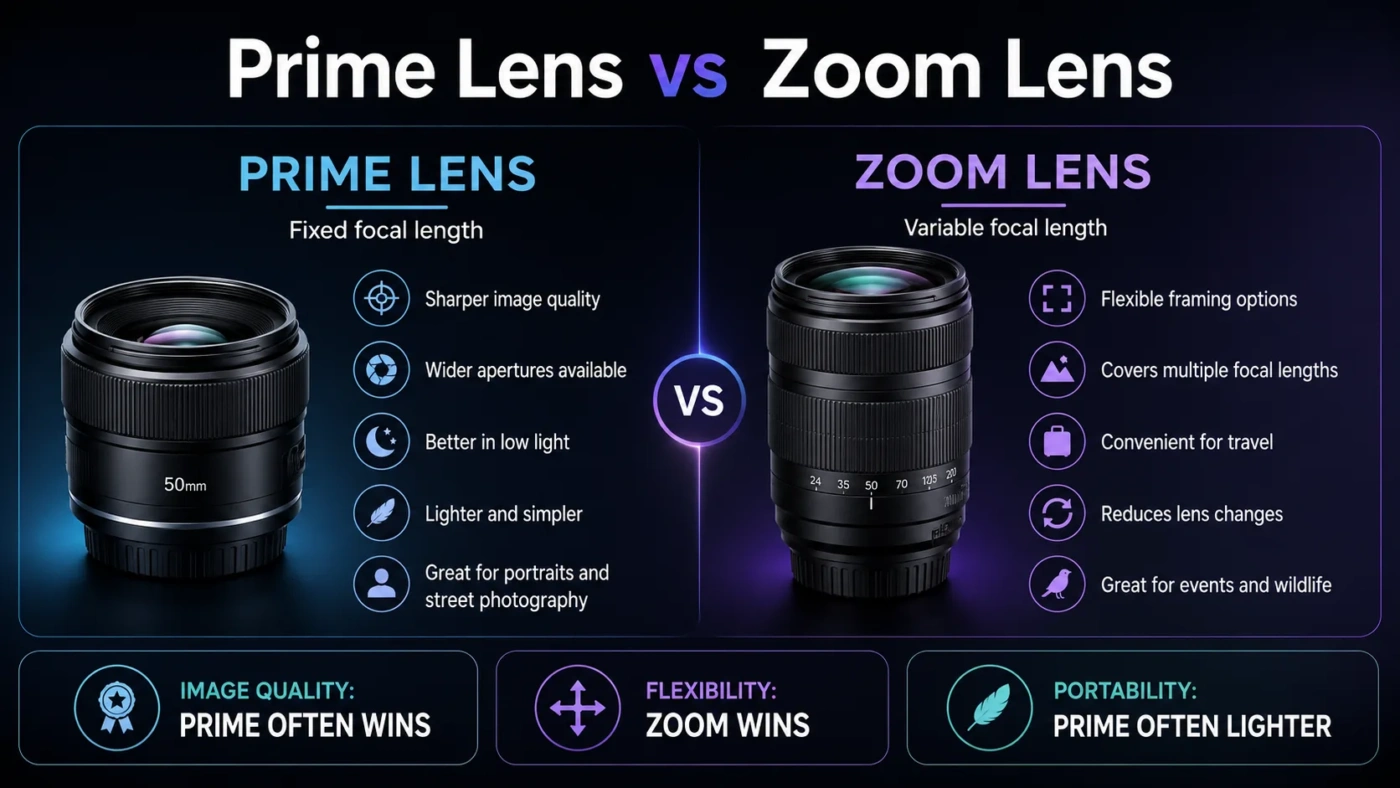
Prime lenses and zoom lenses solve the same problem in different ways: they help you frame a subject, control perspective, and shape how a photo or video feels. A prime lens has one fixed focal length, such as 35mm, 50mm, or 85mm. A zoom lens covers a range, such as 24-70mm or 70-200mm. The better choice depends less on which one is “better” and more on how you shoot, how much you want to carry, how often you change scenes, and how much control you need over light, background blur, and framing speed.
- Prime Lens vs Zoom Lens: The Main Difference
- What Is A Prime Lens?
- What Is A Zoom Lens?
- Image Quality: Which One Looks Better?
- Aperture And Low-Light Performance
- Background Blur And Subject Separation
- Handling And Shooting Style
- Size, Weight, And Travel Use
- Price And Value
- When Should You Choose A Prime Lens?
- When Should You Choose A Zoom Lens?
- Common Misunderstandings About Prime And Zoom Lenses
- Prime Lenses Are Not Always Sharper
- Zoom Lenses Are Not Only For Beginners
- A Prime Lens Does Not Automatically Make Better Photos
- A Zoom Lens Does Not Replace Every Prime
- Prime Lens vs Zoom Lens For Different Uses
- Portrait Photography
- Travel Photography
- Street Photography
- Weddings And Events
- Video And Content Creation
- Wildlife And Sports
- Which One Should You Buy First?
- The Better Choice For Most People
| Feature | Prime Lens | Zoom Lens |
|---|---|---|
| Focal Length | Fixed focal length, such as 35mm or 50mm | Variable focal range, such as 24-70mm |
| Framing | You move your position to change composition | You zoom in or out without changing position |
| Low-Light Use | Often better because many primes have wider apertures | Good on higher-end models, but many zooms have narrower apertures |
| Background Blur | Usually stronger at wide apertures like f/1.4 or f/1.8 | Good on fast zooms, but usually less intense than fast primes |
| Sharpness | Often very sharp for the price | Modern zooms can be excellent, especially pro models |
| Size And Weight | Often smaller and lighter, though fast primes can be large | Usually heavier because one lens covers several focal lengths |
| Speed Of Shooting | Slower when the scene changes quickly | Faster for events, travel, sports, and changing subjects |
| Learning Value | Strong for learning composition and perspective | Strong for learning coverage and flexible framing |
| Price Range | Basic primes often start around $100-$300; premium primes cost much more | Budget zooms may be affordable; professional zooms often cost $1,000-$3,000+ |
| Best For | Portraits, street photography, low light, creative depth of field | Travel, events, weddings, wildlife, sports, general-purpose shooting |
Prime Lens vs Zoom Lens: The Main Difference
The main difference is simple: a prime lens cannot zoom, while a zoom lens can change focal length. That one design choice affects nearly everything else: size, price, image quality, aperture, handling, and the way you compose a shot.
With a prime lens, a 50mm lens stays 50mm. To make your subject larger in the frame, you move closer. To include more of the background, you step back. This makes shooting more physical, but it also trains your eye. You start noticing distance, angle, subject placement, and background shape more carefully.
With a zoom lens, you can stand in one place and change the frame by rotating the zoom ring. A 24-70mm lens can shoot wide environmental scenes at 24mm, natural-looking mid-range shots around 35-50mm, and tighter portraits near 70mm. This flexibility is the reason zoom lenses are so common among event photographers, travel photographers, journalists, and video creators.
What Is A Prime Lens?
A prime lens is a camera lens with a single focal length. Common examples include 24mm, 35mm, 50mm, 85mm, and 135mm. Each focal length has a different look. A 24mm prime feels wide and energetic. A 35mm prime works well for everyday scenes. A 50mm prime gives a natural field of view. An 85mm prime is popular for portraits because it can separate the subject from the background without forcing the photographer too far away.
Prime lenses are often known for wide maximum apertures, such as f/1.8, f/1.4, or f/1.2. A wider aperture lets in more light, which helps in dim rooms, evening streets, indoor portraits, and handheld photography. It also creates stronger background blur, often called bokeh.
Many beginner photographers buy a 50mm f/1.8 prime because it is usually affordable, light, sharp, and useful for portraits, food, products, family photos, and everyday detail shots. It is not perfect for every scene, but it teaches a lot quickly.
What Is A Zoom Lens?
A zoom lens covers more than one focal length. Instead of carrying separate 24mm, 35mm, 50mm, and 70mm lenses, you can use one 24-70mm zoom. Instead of changing lenses during a ceremony, sports match, school event, or trip, you can adjust your framing instantly.
Common zoom lenses include 18-55mm kit lenses, 24-70mm standard zooms, 70-200mm telephoto zooms, and 100-400mm wildlife zooms. Each range serves a different purpose. A wide zoom is useful for interiors and landscapes. A standard zoom handles daily photography. A telephoto zoom brings distant subjects closer.
Zoom lenses are not automatically lower quality. Modern professional zooms can be very sharp, fast to focus, weather-sealed, and reliable. The trade-off is usually cost, weight, and aperture. A high-quality 24-70mm f/2.8 lens can be large and expensive, while a small 35mm f/1.8 prime may be cheaper and better in low light.
Image Quality: Which One Looks Better?
Prime lenses often deliver excellent image quality for the money because their optical design is simpler. Since the lens only needs to perform at one focal length, manufacturers can optimize sharpness, distortion control, contrast, and aperture performance more directly.
That said, the gap is not as wide as it used to be. A premium zoom lens can produce professional results, especially when stopped down to apertures like f/4, f/5.6, or f/8. For landscapes, studio work, travel, and events, a good zoom may look nearly as sharp as a prime in normal viewing sizes.
The real difference often appears in difficult conditions. A fast prime can shoot at f/1.8 or f/1.4, giving lower ISO, faster shutter speeds, and smoother background separation. A typical kit zoom might only open to f/3.5-5.6, which means less light reaches the sensor. In dim indoor settings, that difference can matter.
Aperture And Low-Light Performance
If you often shoot indoors, at night, or without flash, a prime lens has a clear advantage. A 35mm f/1.8 or 50mm f/1.8 prime lets in much more light than many entry-level zoom lenses. This helps reduce motion blur and image noise.
For example, a child moving indoors, a dinner table scene, a small concert, or a quiet street at night can be easier to capture with a prime lens. You can use a faster shutter speed while keeping ISO lower. The image often looks cleaner and more natural.
Zoom lenses can still work well in low light, especially constant-aperture models such as 24-70mm f/2.8 or 70-200mm f/2.8. These lenses are popular among wedding and event photographers. They are bright for zooms, but they are usually larger, heavier, and more expensive than many prime lenses.
Background Blur And Subject Separation
Prime lenses usually make it easier to create strong background blur. A portrait shot at 85mm f/1.8 or 50mm f/1.4 can give a soft background and a clear subject. This look is useful for portraits, product photos, food photography, and detail shots.
Zoom lenses can also blur backgrounds, especially longer focal lengths such as 135mm, 200mm, or 400mm. A 70-200mm f/2.8 lens can create beautiful subject separation. The difference is that primes often reach wider apertures at smaller sizes and lower prices.
Background blur is not only about aperture. It also depends on focal length, subject distance, background distance, and sensor size. A zoom lens at 200mm may blur the background more than a 35mm prime, even if the prime has a wider aperture. So the best choice depends on the look you want, not only the f-number.
Handling And Shooting Style
A prime lens changes how you move. You cannot twist the lens to reframe, so you adjust your feet, angle, and distance. This can slow you down, but in a good way. It helps you build stronger composition habits and think before pressing the shutter.
A zoom lens helps when moments do not wait. At a wedding, graduation, birthday, sports event, or street scene, you may not have time to switch lenses or change position. A zoom lets you react quickly. You can capture a wide scene, then zoom in for an expression, then return to a wider frame within seconds.
For video, zoom lenses can also be easier for solo creators. A single lens can cover talking-head shots, desk shots, B-roll, product details, and outdoor clips. Prime lenses may look cleaner and brighter, but switching lenses while filming can interrupt the workflow.
Size, Weight, And Travel Use
Prime lenses are often smaller and lighter. A compact 35mm or 50mm prime can make a camera feel easier to carry all day. This matters for street photography, casual travel, family trips, and daily use.
Zoom lenses reduce the number of lenses in your bag. One 24-105mm zoom may replace several primes during travel. Even if the zoom itself is heavier, the whole kit may be simpler. You also avoid changing lenses in dusty, rainy, or crowded places.
For travel, the choice depends on your style. If you want one lens for everything, choose a zoom. If you prefer a lighter setup and do not mind working within one field of view, choose a prime. A 35mm prime is a strong travel option for people who like documentary-style images, food shots, city streets, and casual portraits.
Price And Value
Prime lenses can offer better value at the lower end. A basic 50mm f/1.8 often costs around $100-$250, depending on the camera mount and brand. A 35mm or 85mm f/1.8 may cost around $250-$700. Premium primes with f/1.4 or f/1.2 apertures can cost far more.
Zoom lens pricing varies widely. Kit zooms may come bundled with a camera or cost a few hundred dollars. A professional 24-70mm f/2.8 or 70-200mm f/2.8 often sits around $1,000-$3,000+. Long wildlife zooms can also be expensive, though they may still cost less than carrying multiple long primes.
For value, ask what problem the lens solves. A cheap prime may improve portraits and low-light photos quickly. A good zoom may save you from missing shots during travel, events, or paid work. Value is not only sharpness per dollar; it is also how often the lens helps you get the photo.
When Should You Choose A Prime Lens?
Choose a prime lens when you want better low-light performance, stronger background blur, a lighter setup, and a more deliberate shooting style.
- Choose a 35mm prime for everyday photography, street scenes, family life, cafes, travel, and environmental portraits.
- Choose a 50mm prime for portraits, products, food, details, and natural-looking compositions.
- Choose an 85mm prime for portraits, headshots, events, and clean subject separation.
- Choose a 24mm or 28mm prime for interiors, vlogging, landscapes, and wider documentary-style images.
A prime lens is also a smart first upgrade after a kit lens. It can make your photos look cleaner in low light and teach you how focal length affects perspective. If you feel your photos look flat or noisy indoors, a prime lens may fix more than a new camera body would.
When Should You Choose A Zoom Lens?
Choose a zoom lens when you need flexibility, speed, and fewer lens changes. Zoom lenses are especially useful when the subject distance changes often or when you cannot control where you stand.
- Choose an 18-55mm or 16-50mm zoom for beginner general-purpose photography.
- Choose a 24-70mm zoom for events, travel, portraits, and daily professional use.
- Choose a 24-105mm zoom for travel and all-day shooting with extra reach.
- Choose a 70-200mm zoom for portraits, sports, ceremonies, stage events, and distant details.
- Choose a 100-400mm or similar zoom for wildlife, outdoor sports, and faraway subjects.
A zoom lens is usually the safer choice when you are responsible for capturing a full event. You may need wide room shots, medium group photos, tight expressions, and detail shots without changing lenses every few minutes.
Common Misunderstandings About Prime And Zoom Lenses
Prime Lenses Are Not Always Sharper
Many primes are sharp, but not every prime beats every zoom. A high-end zoom can outperform a weak or outdated prime. Lens quality depends on optical design, aperture, sensor pairing, focus accuracy, and how you use it.
Zoom Lenses Are Not Only For Beginners
Some beginners use kit zooms, but professional photographers also rely on zoom lenses every day. Wedding, news, sports, and wildlife work often require fast framing. A zoom lens can be a practical tool, not a compromise.
A Prime Lens Does Not Automatically Make Better Photos
A prime lens can improve low-light results and background blur, but it will not fix poor light, awkward composition, missed focus, or weak timing. It gives you certain advantages; you still make the photo.
A Zoom Lens Does Not Replace Every Prime
A 24-70mm zoom covers the same focal lengths as several primes, but it usually does not match their widest apertures. If you need f/1.8, f/1.4, or very shallow depth of field, a prime still has a place.
Prime Lens vs Zoom Lens For Different Uses
Portrait Photography
For portraits, prime lenses are often the better choice if you want soft backgrounds and strong subject separation. A 50mm, 85mm, or 135mm prime can create a clean portrait look. A 70-200mm zoom is also excellent for portraits, especially when you need flexible framing during sessions or events.
Travel Photography
For travel, a zoom lens is usually easier. A 24-105mm or 18-135mm range can handle landscapes, streets, buildings, food, portraits, and details. A small 35mm prime is better if you prefer a lighter camera and a more consistent visual style.
Street Photography
Prime lenses are popular for street photography because they are compact and predictable. A 28mm, 35mm, or 50mm prime helps you learn distance and timing. A small zoom can work too, especially if you want to shoot both wide scenes and tighter details without moving too much.
Weddings And Events
Zoom lenses are usually safer for weddings and events. A 24-70mm and 70-200mm combination can cover most situations. Prime lenses are still useful for portraits, low-light receptions, and artistic detail shots, but relying only on primes can be risky when moments move quickly.
Video And Content Creation
For video, zoom lenses are easier for flexible framing. One lens can handle multiple setups. Prime lenses are better when you want a brighter aperture, softer background, or a smaller kit for a controlled scene. Many creators use both: a zoom for practical coverage and a prime for polished shots.
Wildlife And Sports
Zoom lenses usually win here because distance changes constantly. A 100-400mm, 150-600mm, or 70-200mm lens lets you adjust quickly as the subject moves. Long prime lenses can deliver excellent results, but they are often expensive and less flexible.
Which One Should You Buy First?
If you already have a kit zoom, your first upgrade should often be a prime lens. A 35mm f/1.8 or 50mm f/1.8 gives you a new look, better low-light ability, and more background blur without a huge cost. It also helps you understand focal length more clearly.
If you do not have any lens yet and want one lens for travel, family, school events, daily photography, and casual video, start with a zoom. A standard zoom gives you more coverage and fewer missed shots while you learn what focal lengths you use most.
If you shoot paid events, a good zoom is often the safer work lens. If you shoot portraits, products, food, or creative personal work, a prime may give you more visual improvement for the money.
The Better Choice For Most People
For most beginners, the best path is not prime lens or zoom lens forever. It is usually one practical zoom plus one bright prime. The zoom handles flexible everyday use. The prime handles low light, portraits, and creative blur.
Choose a prime lens if you care most about low-light shooting, background blur, smaller size, and learning composition through movement.
Choose a zoom lens if you care most about convenience, fast framing, travel flexibility, events, and covering many scenes with one lens.
If you want the simplest decision: buy a zoom when you need one lens to cover many situations. Buy a prime when you want one focal length to look better, feel lighter, and perform better in low light. Many photographers eventually keep both because each one solves a different real-world problem.