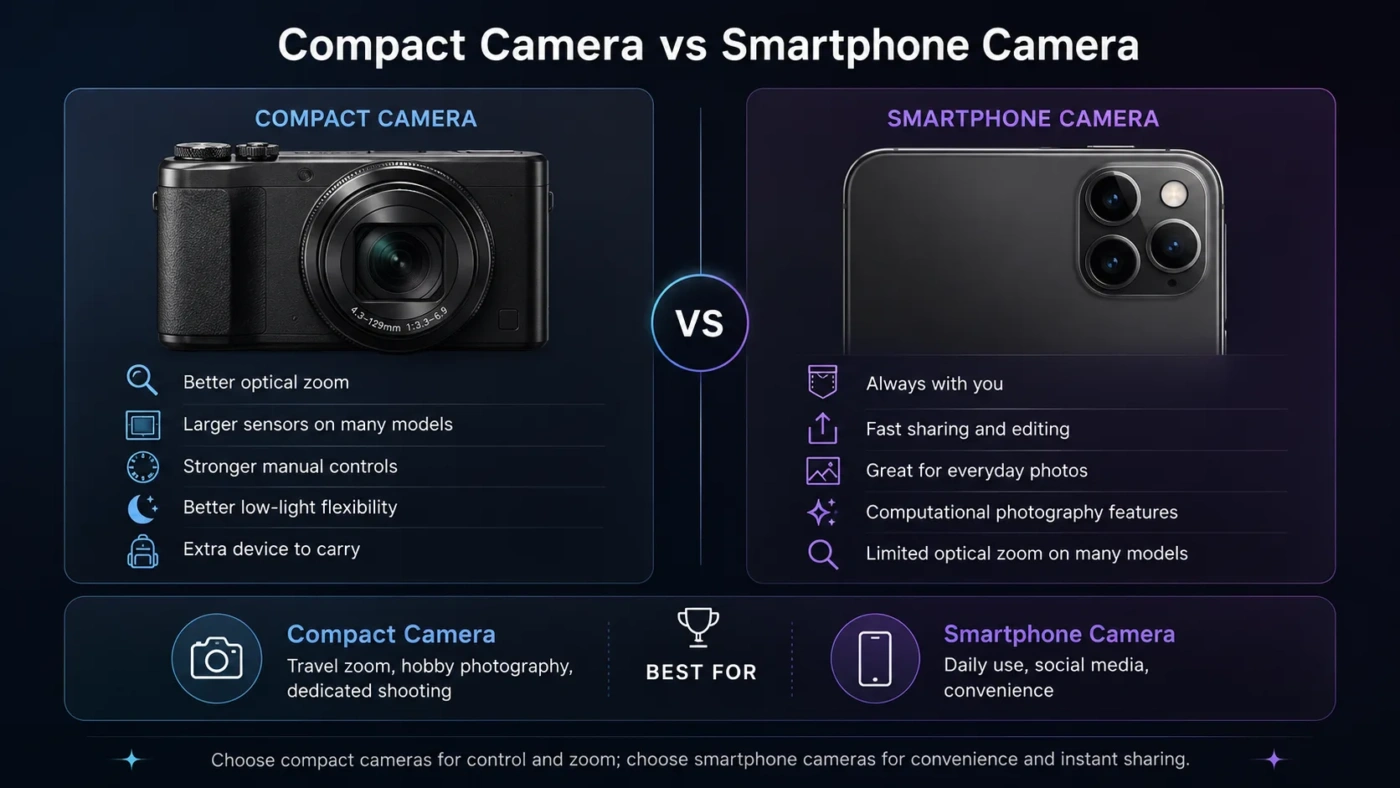
Choosing between a compact camera and a smartphone camera is less about which one is “better” and more about how you take pictures. A smartphone camera is the easiest choice for everyday photos, social sharing, quick video, and casual travel. A compact camera makes more sense when you want real zoom, better handling, stronger manual control, cleaner files, or a more focused shooting experience without phone distractions.
- Compact Camera vs Smartphone Camera: Main Difference
- What Is a Compact Camera?
- What Is a Smartphone Camera?
- Image Quality: Which One Takes Better Photos?
- Zoom: The Area Where Compact Cameras Still Matter
- Low Light and Night Photos
- Portraits and Background Blur
- Video: Convenience vs Camera Control
- Handling and Shooting Experience
- Editing and File Flexibility
- Price and Value
- When You Should Choose a Compact Camera
- When You Should Choose a Smartphone Camera
- Common Misunderstandings
- More Megapixels Do Not Always Mean Better Photos
- A Compact Camera Is Not Always Better Than a Phone
- Smartphone Zoom Is Not Always True Optical Zoom
- Portrait Mode Is Not the Same as Lens Blur
- The Best Camera Is Not Always the Most Expensive One
- Compact Camera vs Smartphone Camera for Travel
- Compact Camera vs Smartphone Camera for Beginners
- Compact Camera vs Smartphone Camera for Social Media
- Which One Should You Choose?
| Feature | Compact Camera | Smartphone Camera |
|---|---|---|
| Best For | Travel, optical zoom, family events, wildlife, street photography, learning photography | Everyday photos, social media, quick video, messaging, casual memories |
| Image Quality | Can be better on premium models with larger sensors and quality lenses | Often excellent in bright light because of computational processing |
| Zoom | Real optical zoom on many models, especially travel compacts | Usually relies on multiple small lenses, digital crop, or software sharpening |
| Low-Light Photos | Better on premium compact cameras with larger sensors and bright lenses | Very strong night modes, but results may look processed in difficult light |
| Portrait Background Blur | Natural blur if the sensor and lens are suitable | Usually software-based portrait mode with edge detection |
| Video | Good on creator-focused compacts, but varies by model | Very convenient, often with strong stabilization and easy sharing |
| Controls | Physical buttons, dials, zoom lever, exposure modes, RAW support | Simple touch controls, pro modes on some models, fast editing apps |
| Portability | Pocketable, but still another device to carry | Already in your pocket |
| Battery Use | Separate battery, does not drain your phone | Uses the same battery you need for calls, maps, messages, and travel apps |
| Learning Photography | Better for understanding aperture, shutter speed, ISO, focal length, and composition | Better for fast shooting, automatic edits, and low-effort results |
| Value | Good if you need zoom, RAW files, or a camera-first device | Best value if you already own a capable phone and mostly shoot casually |
Compact Camera vs Smartphone Camera: Main Difference
The main difference is simple: a compact camera is built around photography hardware, while a smartphone camera is built around convenience and software. A compact camera gives you a dedicated lens, physical controls, optical zoom, a camera grip, and often better control over exposure. A smartphone gives you instant access, automatic processing, editing apps, cloud backup, and sharing in seconds.
This matters because photos are not only about megapixels. Sensor size, lens quality, focal length, image processing, stabilization, shutter response, and handling all affect the final result. A phone may produce a cleaner-looking image with one tap, while a compact camera may give you a more natural file with more room to edit.
What Is a Compact Camera?
A compact camera is a small digital camera with a built-in lens. It is sometimes called a point-and-shoot camera, although modern compact cameras can be much more advanced than that name suggests. Some are simple pocket cameras for casual use. Others have large sensors, fast lenses, RAW shooting, viewfinders, manual controls, and strong video features.
There are several types of compact cameras:
- Basic point-and-shoot cameras: Small, easy to use, and often affordable, but not always better than a modern phone.
- Travel zoom cameras: Designed for long optical zoom in a pocketable body.
- Premium compact cameras: Higher image quality, larger sensors, better lenses, and more manual control.
- Creator compact cameras: Built for vlogging, video, livestreaming, and hybrid photo-video work.
A compact camera is not automatically better than a smartphone. A cheap compact with a small sensor and average lens may lose to a flagship phone in everyday shots. The compact camera starts to make more sense when it offers something your phone cannot: real zoom, a larger sensor, better grip, RAW files, or a more photography-focused workflow.
What Is a Smartphone Camera?
A smartphone camera is the camera system built into a phone. Modern phones usually include more than one lens, such as wide, ultra-wide, telephoto, and front-facing cameras. They also rely heavily on computational photography, which means the phone combines hardware, software, artificial intelligence, multi-frame capture, HDR processing, sharpening, noise reduction, and scene detection to create the final image.
This is why smartphone photos often look ready to share immediately. The phone brightens shadows, protects highlights, improves skin tones, reduces blur, and applies color processing without asking the user to adjust settings. For most people, that is a real advantage.
The trade-off is control. Smartphone images can sometimes look over-sharpened, too smooth, too bright, or slightly artificial in difficult lighting. Portrait mode can also make mistakes around hair, glasses, hands, and objects with complex edges.
Image Quality: Which One Takes Better Photos?
For everyday daylight photos, a good smartphone camera is often enough. It handles exposure quickly, balances bright skies and dark shadows, and produces a polished image without editing. For food, friends, pets, city walks, documents, and social media posts, the phone is usually the easier tool.
A compact camera can pull ahead when its hardware is better. A premium compact with a larger sensor and a sharp lens can capture more natural detail, smoother tones, and cleaner files. It may also give you better RAW files for editing. This matters if you crop photos, print them, edit color carefully, or shoot in changing light.
The important detail is the class of camera. A $150 basic compact camera may not beat a current high-end smartphone. A $700–$1,400 premium compact camera can offer a very different level of control and image character.
Zoom: The Area Where Compact Cameras Still Matter
Zoom is one of the clearest reasons to choose a compact camera. Many compact cameras use optical zoom, which means the lens physically changes focal length. This keeps more real detail than simply cropping into the image.
Smartphones have improved a lot with telephoto lenses and periscope-style camera modules, but there are limits. Many phones switch between small sensors at different focal lengths, then use software to fill gaps. At moderate zoom, the results can look good. At longer zoom, detail may become soft, painted, or over-processed.
Choose a compact camera if you regularly photograph:
- school events from the back of a hall
- children playing sports
- animals at a distance
- landmarks from far away
- concerts or stage performances where you cannot move closer
Choose a smartphone if most of your photos are taken from normal walking distance.
Low Light and Night Photos
Smartphones are very strong in low light because they use night mode. The phone captures several frames, aligns them, reduces noise, and brightens the final image. For handheld night street photos, restaurant shots, and casual indoor pictures, this can work very well.
A compact camera wins when it has the right hardware: a larger sensor, a bright lens, optical stabilization, and good high-ISO performance. It may not make the scene look as bright as a phone night mode, but the image can look more natural. Shadows may have less smeared detail, and lights may look less artificial.
There is a simple way to think about it: phones are better at rescuing difficult scenes automatically; better compact cameras are better at giving you a cleaner file when the lens and sensor are strong enough.
Portraits and Background Blur
Smartphones usually create portrait blur with software. They detect the subject, separate it from the background, and blur the background digitally. This can look convincing on a phone screen, especially with faces.
Compact cameras create blur optically when the sensor size, focal length, aperture, and subject distance work together. This kind of blur often looks more natural because it is created by the lens rather than added later.
That said, not every compact camera gives strong background blur. A small-sensor compact with a slow lens may produce very little natural separation. For portraits, a premium compact with a larger sensor and a bright lens is a better choice.
Video: Convenience vs Camera Control
Smartphones are excellent for video because they are always ready. They offer strong stabilization, fast focus, good microphones for casual use, and easy editing. You can record, trim, caption, and upload without moving files to another device.
Compact cameras can be better for longer creative work. Many creator-focused models offer flip screens, microphone inputs, better heat management, optical zoom while recording, cleaner background blur, and more control over exposure. Some also record high-quality 4K video with less aggressive processing.
For TikTok, Instagram, family clips, and quick travel videos, a smartphone is usually the better choice. For planned YouTube videos, travel films, interviews, product shots, or learning camera settings, a compact camera may be worth carrying.
Handling and Shooting Experience
This is where the difference feels bigger than the spec sheet suggests. A compact camera has a shutter button, grip, zoom control, mode dial, and sometimes a viewfinder. You can hold it more securely, frame carefully, and shoot without notifications or phone apps getting in the way.
A smartphone is faster for casual moments. You can pull it out, tap, shoot, edit, and send. But the flat shape is not ideal for stable shooting. Touchscreen controls can also be awkward in rain, bright sun, cold weather, or fast-moving situations.
If you enjoy the act of taking photos, a compact camera feels more intentional. If you only care about capturing the moment quickly, the phone feels easier.
Editing and File Flexibility
Smartphones make editing simple. Built-in apps can adjust exposure, crop, erase objects, apply filters, and sync photos across devices. For most users, this is enough.
Compact cameras can offer more flexible files, especially when shooting RAW. RAW files keep more image information for editing color, exposure, shadows, highlights, and white balance. This is useful if you want a more personal look or you edit in Lightroom, Capture One, Photoshop, or similar software.
The trade-off is time. Smartphone editing is fast. Compact camera editing is more controlled but slower.
Price and Value
A smartphone camera is often the better value if you already own a good phone. You are not buying another device, another battery, another memory card, or another charger. For casual photography, that matters.
A compact camera makes financial sense when it solves a real problem. For example, you may want long optical zoom for travel, a separate camera for school events, better RAW files for editing, or a camera your child can use without giving them a phone.
Typical price ranges vary by model and market, but the general pattern looks like this:
- Basic compact cameras: around $150–$400
- Travel zoom compact cameras: around $400–$800
- Premium compact cameras: around $800–$1,600
- Flagship smartphones: often around $800–$1,500+
If the compact camera is cheap and basic, compare it carefully with your phone before buying. If it is a premium compact with a strong lens and larger sensor, it can still offer real value.
When You Should Choose a Compact Camera
Choose a compact camera if you want a dedicated photography tool and you will actually carry it. It is the better choice when zoom, handling, and control matter more than instant sharing.
- You need optical zoom for travel, school events, animals, or distant subjects.
- You want better grip and a real shutter button.
- You prefer a device made only for photography and video.
- You want RAW files and more editing control.
- You want to learn aperture, shutter speed, ISO, exposure compensation, and focal length.
- You do not want long photo sessions to drain your phone battery.
- You want a camera for a child, family member, trip, or event without handing over a phone.
When You Should Choose a Smartphone Camera
Choose a smartphone camera if convenience is your top priority. For most everyday users, it is the better all-around choice because it removes friction from the whole process.
- You mostly take casual photos of people, food, pets, places, and daily life.
- You want photos that look good without editing.
- You share images through messages, social media, or cloud albums.
- You prefer one device instead of carrying a separate camera.
- You shoot short videos more often than still photos.
- You rely on automatic HDR, night mode, stabilization, and portrait mode.
- You do not want to manage memory cards, separate batteries, or file transfers.
Common Misunderstandings
More Megapixels Do Not Always Mean Better Photos
Megapixels affect resolution, but they do not guarantee better image quality. Lens quality, sensor size, image processing, stabilization, and light matter just as much. A 12MP or 24MP photo from a better sensor can look cleaner than a higher-megapixel image from a small sensor.
A Compact Camera Is Not Always Better Than a Phone
Older or low-end compact cameras can be outperformed by modern smartphones, especially in automatic mode. Before buying, check the sensor size, lens aperture, zoom range, autofocus, video quality, and RAW support.
Smartphone Zoom Is Not Always True Optical Zoom
Some phone zoom levels are optical, but many in-between or longer zoom levels use cropping and software. The image may look fine on a small screen, but detail can fall apart when viewed large or printed.
Portrait Mode Is Not the Same as Lens Blur
Smartphone portrait mode can look good, but it is still software-based. Natural lens blur from a suitable compact camera can look smoother, especially around hair, glasses, and detailed edges.
The Best Camera Is Not Always the Most Expensive One
The right camera is the one that fits your habits. A premium compact is wasted if you leave it at home. A phone is limiting if you often wish you had longer zoom, real controls, or cleaner files for editing.
Compact Camera vs Smartphone Camera for Travel
For travel, the decision depends on your style. If you want to pack light, move fast, and share photos during the trip, a smartphone is easier. It also helps with maps, translation, tickets, notes, and quick video.
A compact camera is better if your travel photos include distant architecture, mountains, wildlife, street scenes, or family moments from across a square or beach. A travel zoom compact can cover wide views and distant details without changing lenses.
The most practical travel setup for many people is simple: use the smartphone for quick everyday shots and the compact camera for zoom, planned photos, and moments where image quality matters more.
Compact Camera vs Smartphone Camera for Beginners
A smartphone is easier for beginners because it hides technical settings. You tap the subject, adjust brightness if needed, and shoot. The phone handles most of the work.
A compact camera is better for beginners who want to learn photography. It teaches you why shutter speed affects motion, why aperture changes background blur, why ISO affects noise, and why focal length changes perspective. A compact with manual controls can be a gentle step before mirrorless or DSLR cameras.
Compact Camera vs Smartphone Camera for Social Media
For social media, the smartphone usually wins. The image is already on the device, apps are ready, and vertical video is simple. Stabilization, front cameras, captions, and editing tools make phones very efficient for short-form content.
A compact camera can improve the look of planned content, especially product photos, travel reels, interviews, and creator videos. But you need to transfer files, edit them, and manage a slower workflow. That extra step is worth it only if the visual difference matters to your content.
Which One Should You Choose?
Choose a smartphone camera if you want the easiest option for daily life. It is the better pick for most users because it is always with you, fast, smart, and ready to share. It handles casual photos and video with very little effort.
Choose a compact camera if you feel limited by your phone. The clearest reasons are optical zoom, better handling, separate battery life, RAW files, manual controls, and a more focused shooting experience. A compact camera is not necessary for everyone, but it is still useful for people who want more than automatic phone photography.
For most buyers, the decision is practical: use your smartphone if convenience matters most; buy a compact camera if zoom, control, and a dedicated camera experience matter more.