A tripod and a monopod both support a camera, but they solve different problems. A tripod gives you stable, hands-free framing for slow shutter speeds, video interviews, landscapes, product shots, and planned setups. A monopod gives you lighter support when you need to move fast, follow action, or reduce arm fatigue without carrying a full three-legged stand.
- Tripod vs Monopod: The Main Difference
- What Is a Tripod?
- Common Tripod Types
- What Is a Monopod?
- Common Monopod Types
- When a Tripod Is the Better Choice
- Choose a Tripod for Low Light and Long Exposure
- Choose a Tripod for Video Interviews and Static Shots
- Choose a Tripod for Careful Composition
- When a Monopod Is the Better Choice
- Choose a Monopod for Sports and Wildlife
- Choose a Monopod for Events and Crowds
- Choose a Monopod for Travel and Walking
- Stability and Sharpness
- Speed and Handling
- Space, Safety, and Location Rules
- Price and Value
- Common Misunderstandings
- A Monopod Is Not Just a Smaller Tripod
- A Tripod Is Not Always the Professional Choice
- Image Stabilization Does Not Replace Every Support
- Heavier Does Not Always Mean Better
- Which One Should You Choose?
- Simple Buying Checklist
| Feature | Tripod | Monopod |
|---|---|---|
| Stability | Highest stability because it stands on three legs | Moderate stability; still needs your hand for balance |
| Best Use | Long exposure, landscapes, video, portraits, studio work | Sports, wildlife, travel, events, telephoto shooting |
| Speed | Slower to set up and reposition | Fast to move, raise, lower, and carry |
| Hands-Free Use | Yes, when placed on a level surface | No, it normally needs one hand on the camera or support |
| Low Light Performance | Better for slow shutter speeds and night scenes | Helps reduce shake, but not ideal for very slow shutter speeds |
| Weight and Portability | Heavier and bulkier | Lighter, slimmer, and easier to pack |
| Space Needed | Needs room for three legs | Works better in crowds and narrow spaces |
| Video Use | Better for locked-off shots, interviews, and controlled framing | Useful for mobile video, quick pans, and run-and-gun shooting |
| Typical Value | Better if stability matters more than speed | Better if mobility matters more than full stability |
Tripod vs Monopod: The Main Difference
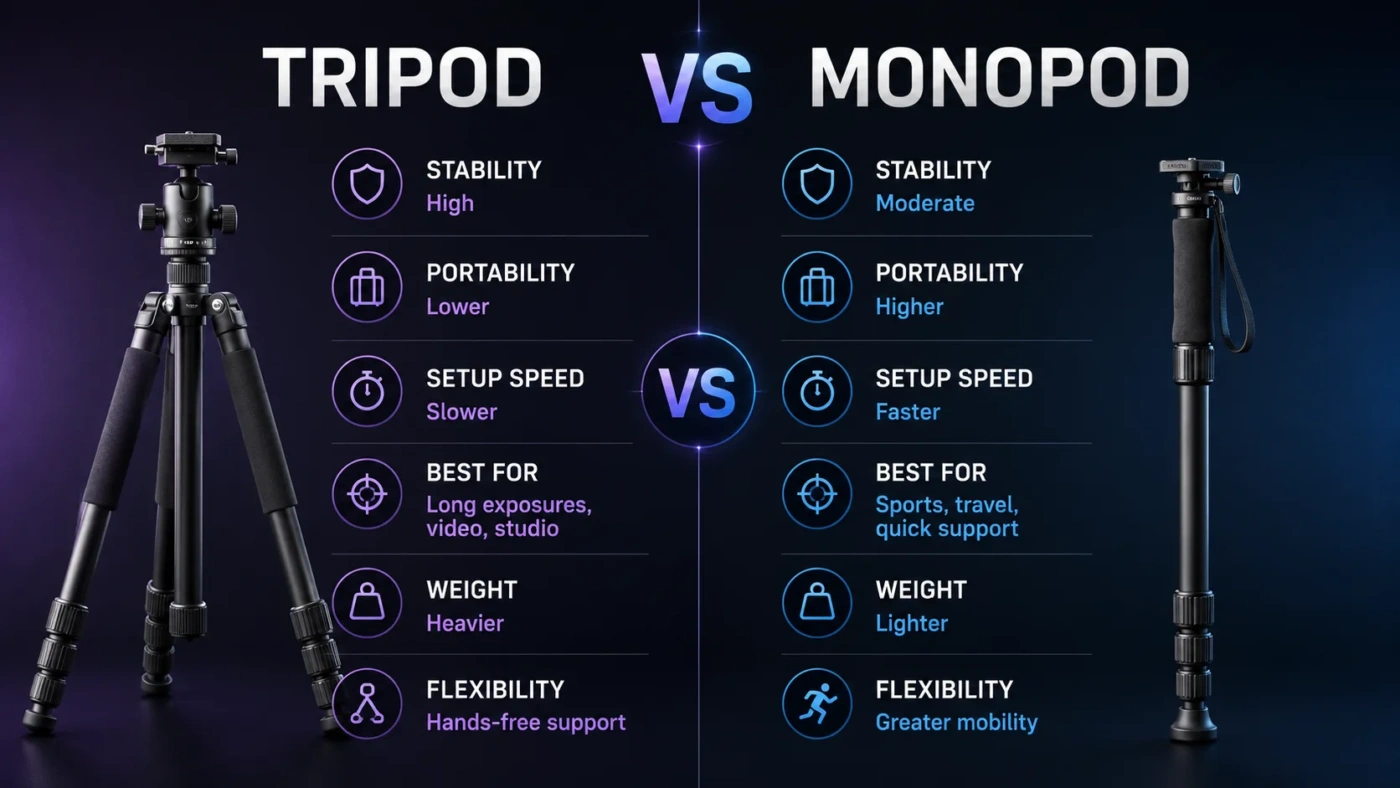
The main difference is simple: a tripod is made to stand by itself, while a monopod is made to support weight while you control it. That one difference changes almost everything about how they feel in real use.
A tripod is the better choice when the camera must stay fixed in one position. It removes most hand movement, lets you frame carefully, and allows longer exposure times. A monopod is better when you want support but still need to react quickly. It does not lock the camera in place the same way, but it helps steady heavy lenses and reduces fatigue during long sessions.
What Is a Tripod?
A tripod is a three-legged camera support designed to hold a camera, phone, spotting scope, light, or video rig in a stable position. Most tripods include adjustable legs, a center column, and a head for tilting, panning, and framing.
Tripods are common in photography and video because they make controlled shooting easier. For example, if you are taking a night city photo, a waterfall image with motion blur, a product photo, or a talking-head video, a tripod gives the camera a fixed base.
Common Tripod Types
- Travel Tripods: Smaller and lighter, useful for trips and outdoor walks.
- Studio Tripods: Heavier and more stable, better for indoor work.
- Video Tripods: Often paired with fluid heads for smoother movement.
- Tabletop Tripods: Compact supports for phones, small cameras, or desk setups.
What Is a Monopod?
A monopod is a single-legged support that attaches to a camera or lens. It does not stand securely on its own in most cases, but it carries part of the camera’s weight and helps reduce vertical movement.
Monopods are popular with sports, wildlife, event, and travel photographers. They are useful when a tripod would be too slow, too bulky, or not allowed in the space. A monopod can also make a heavy telephoto lens easier to use for longer periods.
Common Monopod Types
- Standard Monopods: Simple single-leg supports for cameras and lenses.
- Video Monopods: Often have small feet at the bottom for smoother movement.
- Compact Monopods: Lighter models for travel and casual use.
- Heavy-Duty Monopods: Built for large lenses and professional camera bodies.
When a Tripod Is the Better Choice
Choose a tripod when the shot depends on stillness, careful composition, or repeated framing. It gives you the most control and the best chance of sharp results when shutter speed is slow.
Choose a Tripod for Low Light and Long Exposure
If you shoot at night, indoors, at sunrise, at sunset, or with neutral density filters, a tripod is usually the safer choice. It lets the camera stay steady during longer exposures. A monopod can help, but it cannot fully replace a stable three-legged base.
Choose a Tripod for Video Interviews and Static Shots
For video, a tripod is better when the camera should stay locked on a subject. Interviews, product demos, lessons, food videos, and indoor recordings often look cleaner when the frame does not drift.
Choose a Tripod for Careful Composition
Landscape, architecture, macro, and product photography often require small adjustments. A tripod lets you set the frame, check the edges, adjust focus, and wait for the right moment without holding the camera the whole time.
When a Monopod Is the Better Choice
Choose a monopod when you need support but cannot slow down. It works well when the subject moves, the location is crowded, or your gear feels heavy after a while.
Choose a Monopod for Sports and Wildlife
Sports and wildlife often require fast movement. A monopod supports a long lens while still allowing you to track a subject. You can rotate, lift, and reposition much faster than with a tripod.
Choose a Monopod for Events and Crowds
At weddings, ceremonies, stage events, or busy public places, a tripod can take up too much room. A monopod needs less floor space and is less likely to block people around you.
Choose a Monopod for Travel and Walking
If you are walking for hours, every bit of weight matters. A monopod is easier to carry than a tripod and can still improve steadiness compared with handheld shooting. Some models can also double as a walking support, depending on design.
Stability and Sharpness
A tripod wins for maximum stability. It supports the camera from three points and can stand without your hands. This makes it better for slow shutter speeds, precise framing, exposure bracketing, focus stacking, and time-lapse work.
A monopod improves sharpness compared with handheld shooting, especially with heavy lenses. Still, it does not remove side-to-side movement as well as a tripod. For fast shutter speeds, that may be enough. For long exposures, it usually is not.
Speed and Handling
A monopod is faster in almost every mobile situation. You can collapse it, move it, angle it, and reposition it quickly. This makes it practical for subjects that do not wait.
A tripod takes more time. You need to spread the legs, adjust height, level the camera, and make sure it is stable. That slower setup is not a flaw; it is part of what makes a tripod dependable for planned shots.
Space, Safety, and Location Rules
Tripods need more floor space. In tight locations, busy streets, museums, viewing decks, and event venues, they may be inconvenient or restricted. The legs can also become a tripping risk if people are moving nearby.
Monopods are less intrusive. They take up a smaller footprint and are easier to manage in narrow spaces. Still, they are not invisible; you should use them carefully around people, equipment, and uneven ground.
Price and Value
Both tripods and monopods come in budget, mid-range, and professional versions. Entry-level models can be affordable, while carbon fiber supports, fluid heads, and heavy-duty designs cost more.
For value, the better choice depends on your main use:
- Buy a tripod first if you shoot landscapes, video, products, night scenes, or indoor content.
- Buy a monopod first if you shoot sports, wildlife, events, or use a heavy telephoto lens often.
- Own both if you switch between planned work and fast-moving subjects.
Common Misunderstandings
A Monopod Is Not Just a Smaller Tripod
A monopod does not do the same job with fewer legs. It is a different tool. It supports weight and reduces shake, but it does not give the same hands-free stability.
A Tripod Is Not Always the Professional Choice
A tripod can be the right tool, but not always. For sideline sports, fast wildlife, and crowded events, a monopod may be more useful because it lets you react quickly.
Image Stabilization Does Not Replace Every Support
Camera and lens stabilization help a lot, but physical support still matters. Stabilization can reduce small movements, while a tripod or monopod changes how much effort your body must provide.
Heavier Does Not Always Mean Better
A heavier tripod may be steadier, but it is not helpful if you avoid carrying it. A lighter monopod may get used more often. The best support is the one that fits your real shooting habits.
Which One Should You Choose?
Choose a tripod if your main goal is stability. It is the better option for long exposure photography, controlled video, studio work, macro shots, product images, landscapes, and any situation where the camera should remain fixed.
Choose a monopod if your main goal is mobility. It is the better option for sports, wildlife, event coverage, travel, and long handheld sessions with heavier gear.
For most beginners, a tripod is the more flexible first purchase because it opens up more shooting styles. For photographers who already know they shoot moving subjects or carry heavy lenses, a monopod may be the smarter first support.
Simple Buying Checklist
- For a tripod: Check maximum height, folded size, load capacity, leg locks, head type, and weight.
- For a monopod: Check load capacity, grip comfort, collapsed length, foot design, and how quickly it extends.
- For video: Look for smoother panning support, especially with a fluid head or video-ready design.
- For travel: Balance weight and stability instead of choosing only the lightest model.
If you want the safest all-around answer, choose a tripod. If you want support that moves with you, choose a monopod. The tripod keeps the camera still; the monopod keeps you moving.