Mirrorless and DSLR cameras can both produce sharp, professional-looking photos. The better choice depends less on image quality alone and more on how you shoot: fast subjects, travel, video, battery life, lens budget, viewfinder preference, and whether you want a newer camera system or a proven used-market option.
- Main Differences Between Mirrorless and DSLR Cameras
- What Is a Mirrorless Camera?
- Common Strengths of Mirrorless Cameras
- Common Weaknesses of Mirrorless Cameras
- What Is a DSLR Camera?
- Common Strengths of DSLR Cameras
- Common Weaknesses of DSLR Cameras
- Image Quality: Is Mirrorless Better Than DSLR?
- Autofocus and Moving Subjects
- Viewfinder Experience: Electronic vs Optical
- Mirrorless Electronic Viewfinder
- DSLR Optical Viewfinder
- Battery Life and Long Shooting Days
- Video and Content Creation
- Lens Choices and System Growth
- Price and Value
- When You Should Choose a Mirrorless Camera
- When You Should Choose a DSLR Camera
- Common Misunderstandings About Mirrorless and DSLR Cameras
- “Mirrorless Always Has Better Image Quality”
- “DSLR Cameras Are Obsolete”
- “Mirrorless Cameras Are Always Small”
- “DSLR Battery Life Is Always Better”
- “You Need the Newest Camera to Take Good Photos”
- Mirrorless vs DSLR for Beginners
- Mirrorless vs DSLR for Travel
- Mirrorless vs DSLR for Portraits
- Mirrorless vs DSLR for Sports and Wildlife
- Mirrorless vs DSLR for Video
- Which One Should You Choose?
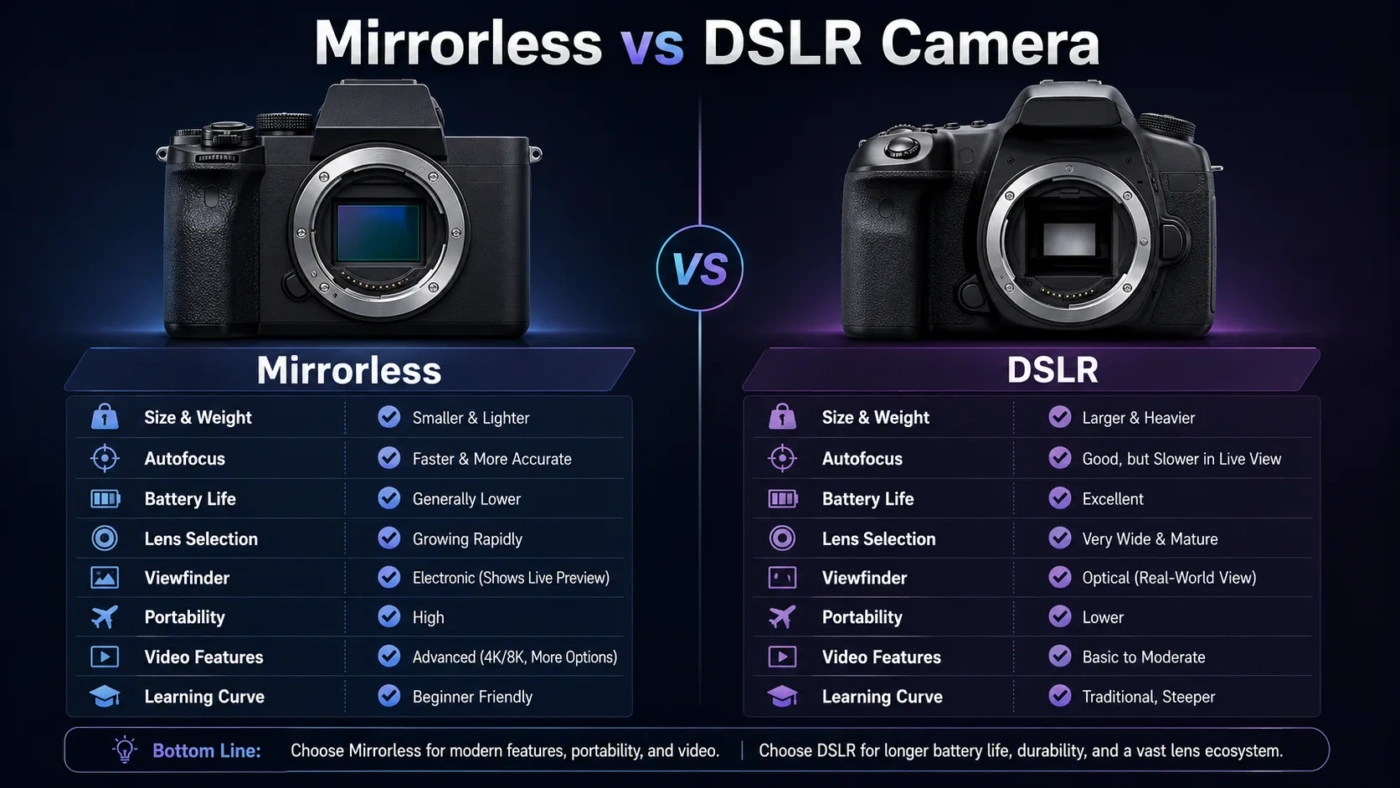
| Feature | Mirrorless Camera | DSLR Camera |
|---|---|---|
| Viewfinder | Electronic viewfinder or rear screen preview | Optical viewfinder using a mirror and prism system |
| Size and Weight | Usually smaller and lighter, especially with compact lenses | Usually larger because of the mirror box and optical viewfinder |
| Autofocus | Strong for face, eye, animal, vehicle, and video tracking on newer models | Reliable for still photos, but older systems can be weaker in live view and video |
| Battery Life | Usually shorter because the screen or EVF is always active | Usually longer when using the optical viewfinder |
| Video | Usually better for 4K, autofocus, stabilization, and creator-style shooting | Usable, but many DSLRs feel dated for modern video needs |
| Lens Options | New lens systems are growing fast; adapters can expand choices | Large used lens market, often with strong value |
| Shooting Preview | Shows exposure, white balance, and picture style before you take the shot | Shows the scene optically, not the final exposure result |
| Best For | Travel, video, hybrid creators, sports, wildlife, beginners who want smart autofocus | Photography-focused users, long sessions, optical viewfinder fans, budget lens buyers |
| Typical Value | Better long-term system choice for most new buyers | Good value if buying used or already owning DSLR lenses |
Main Differences Between Mirrorless and DSLR Cameras
The main difference is how each camera lets you see and focus on the scene. A DSLR uses a mirror inside the camera body. Light enters through the lens, reflects upward, and reaches an optical viewfinder. When you press the shutter, the mirror flips up and the sensor captures the image.
A mirrorless camera removes that mirror. Light goes straight to the image sensor, and the camera shows a digital preview through an electronic viewfinder or the rear screen. This design allows a smaller body, faster on-sensor autofocus, silent shooting modes, and better video features.
For everyday buyers, the practical difference is simple: mirrorless cameras feel more modern and flexible, while DSLR cameras feel more traditional and battery-efficient.
What Is a Mirrorless Camera?
A mirrorless camera is an interchangeable-lens camera that does not use a reflex mirror. The sensor receives light all the time, then sends a live digital image to the screen or electronic viewfinder.
This live preview is one of the biggest advantages. Before taking a photo, you can often see the effect of exposure, white balance, color style, depth of field preview, and focus tracking. For beginners, that makes learning easier because the camera shows what the final image will roughly look like.
Common Strengths of Mirrorless Cameras
- Smart autofocus: Many newer models detect eyes, faces, animals, birds, cars, and moving subjects.
- Better video tools: Mirrorless cameras usually offer stronger 4K recording, smoother video autofocus, and cleaner screen-based shooting.
- Compact bodies: The camera body can be smaller because there is no mirror system inside.
- Silent shooting: Electronic shutter modes can be useful for weddings, events, classrooms, museums, and quiet places.
- Live exposure preview: You can see brightness and color before pressing the shutter.
Common Weaknesses of Mirrorless Cameras
- Battery drains faster: The EVF and screen need constant power.
- Some lenses are expensive: New mirrorless lens mounts can cost more than older DSLR options.
- EVF feel is different: Some photographers prefer a direct optical view instead of a digital screen.
- Small bodies are not always better: A tiny camera with a large lens can feel front-heavy.
What Is a DSLR Camera?
A DSLR camera is a digital single-lens reflex camera. It uses a mirror and optical viewfinder to show the scene directly through the lens. This gives a natural, real-time view without screen lag, digital noise, or electronic preview effects.
DSLRs dominated serious photography for many years, so the used market is full of capable bodies and lenses. A well-kept DSLR can still be a smart choice for portraits, landscapes, school events, product photography, and general still photography.
Common Strengths of DSLR Cameras
- Long battery life: Using the optical viewfinder consumes much less power than a live electronic display.
- Comfortable handling: Many DSLR bodies have deep grips and balanced controls.
- Optical viewfinder: You see the real scene directly, which some photographers find more natural.
- Used lens value: DSLR lenses are widely available, often at lower prices than newer mirrorless lenses.
- Still-photo reliability: For controlled photography, many DSLRs remain very capable.
Common Weaknesses of DSLR Cameras
- Larger bodies: The mirror system adds size and weight.
- Weaker video experience: Many DSLRs are less convenient for modern video autofocus and creator work.
- Older autofocus behavior: Viewfinder autofocus can be strong, but live view autofocus on older DSLRs is often slower.
- Less future-focused: Most major camera development has moved toward mirrorless systems.
Image Quality: Is Mirrorless Better Than DSLR?
Not automatically. Image quality depends on sensor size, lens quality, exposure, processing, and the photographer’s skill. A full-frame DSLR with a good lens can easily outperform a cheap mirrorless camera with a weak kit lens. A modern mirrorless camera with a strong lens can also outperform an older DSLR.
The camera type alone does not decide sharpness, color, background blur, or low-light performance. Sensor size matters more. A full-frame camera usually gathers more light than an APS-C camera. A good prime lens can make a bigger difference than switching from DSLR to mirrorless.
For most buyers, the real image-quality question should be: Which camera gives me the best lens and sensor combination for my budget?
Autofocus and Moving Subjects
Mirrorless cameras usually have the advantage for modern autofocus. Because focusing happens directly on the image sensor, many models can track subjects across a wide area of the frame. Eye autofocus, face detection, animal tracking, and subject recognition can make portraits, pets, children, sports, and wildlife easier to capture.
DSLR autofocus can still be fast and dependable through the optical viewfinder, especially on higher-end models. The issue is that older DSLRs often focus differently when using the rear screen or recording video. That can make them feel less smooth for hybrid photo-video work.
Choose mirrorless if you regularly photograph movement and want the camera to help with tracking. Choose DSLR if you mainly shoot still subjects and prefer a more traditional focusing experience.
Viewfinder Experience: Electronic vs Optical
The viewfinder changes how a camera feels in your hands.
Mirrorless Electronic Viewfinder
An electronic viewfinder shows a digital version of the scene. It can display exposure preview, focus peaking, histograms, grid lines, level indicators, and playback without removing your eye from the camera. This is useful for learning and for difficult lighting.
The trade-off is that it feels like a tiny screen. In very dark scenes, it may show noise. In fast action, some older EVFs can feel less direct than an optical finder.
DSLR Optical Viewfinder
An optical viewfinder shows the real scene through the lens. It does not need power, does not refresh like a screen, and feels natural to many photographers. For long photo walks, events, and daylight shooting, this can be pleasant.
The trade-off is that you do not see the final exposure before taking the shot. If the image is too dark, too bright, or has the wrong white balance, you usually notice after reviewing the photo.
Battery Life and Long Shooting Days
DSLR cameras usually last longer on one battery when you use the optical viewfinder. This matters for weddings, school events, travel days, hiking, wildlife waiting sessions, and long documentary-style shooting.
Mirrorless cameras can still handle full-day use, but many users carry one or two spare batteries. That is not a deal-breaker, but it is part of the real cost. If you buy a mirrorless camera for travel or event work, add extra batteries to your budget.
Video and Content Creation
Mirrorless is the safer choice for most video users. Modern mirrorless cameras often offer better 4K quality, stronger video autofocus, subject tracking, in-body stabilization, flip screens, headphone or microphone options, and cleaner HDMI output.
DSLRs can record good video, but many models feel older in use. Autofocus may hunt, 4K may be cropped or missing, and screen-based shooting can feel less responsive. If you plan to make YouTube videos, reels, interviews, online lessons, travel videos, or product clips, mirrorless is usually the better buy.
Lens Choices and System Growth
Lens choice can matter more than the camera body. A camera is not just a one-time purchase; it is a system.
Mirrorless systems are where most new camera bodies and lenses are being developed. This means better long-term growth, more modern autofocus lenses, and stronger compatibility with future bodies. Some mirrorless systems also let you adapt older DSLR lenses, though performance depends on the adapter, lens, and camera brand.
DSLR systems have a different advantage: value. Used DSLR lenses are easy to find, and many are optically excellent. A photographer on a tighter budget may build a strong DSLR kit for less money than a new mirrorless kit.
Price and Value
Mirrorless cameras are often the better long-term purchase, but DSLR cameras can offer better short-term value, especially used.
- Used DSLR body: Often around $250–$900 depending on model, condition, and sensor size.
- Beginner mirrorless kit: Often around $600–$1,100 with a starter lens.
- Advanced mirrorless body: Often $1,500 or more before adding lenses.
- Used DSLR lenses: Often cheaper than newer mirrorless lenses in the same class.
If you are starting from zero and want a camera for the next several years, mirrorless is usually the cleaner path. If you want the lowest cost for strong still photos, a used DSLR kit can be a smart buy.
When You Should Choose a Mirrorless Camera
Choose a mirrorless camera if you want a camera that feels current, flexible, and easier to use across both photos and video.
- You shoot video as well as photos.
- You want strong eye autofocus for portraits.
- You photograph children, pets, wildlife, sports, or moving subjects.
- You prefer a smaller camera body for travel.
- You want to see exposure preview before taking the shot.
- You plan to buy into a system that will keep growing.
- You want silent shooting for quiet places.
For most beginners buying new, mirrorless is the better default choice. It is easier to learn, better for hybrid use, and more aligned with current camera development.
When You Should Choose a DSLR Camera
Choose a DSLR if you care mainly about still photography, long battery life, comfortable handling, and used-market value.
- You mostly shoot photos, not video.
- You prefer an optical viewfinder.
- You want longer battery life without carrying many spares.
- You already own DSLR lenses.
- You want a lower-cost used camera setup.
- You like larger camera bodies with deep grips.
- You shoot landscapes, portraits, products, school events, or travel photos at a relaxed pace.
A DSLR is not “bad” because it is older technology. It can still be an excellent photography tool. The main question is whether its strengths match the way you shoot.
Common Misunderstandings About Mirrorless and DSLR Cameras
“Mirrorless Always Has Better Image Quality”
Not true. Sensor size, lens quality, and technique matter more. A good DSLR with a strong lens can create better images than an entry-level mirrorless camera with a weak lens.
“DSLR Cameras Are Obsolete”
DSLRs are no longer the main direction of new camera development, but many are still useful. For still photography, a good DSLR can remain reliable for years.
“Mirrorless Cameras Are Always Small”
The body may be smaller, but full-frame lenses can still be large and heavy. A mirrorless travel kit is only light if the lenses are also compact.
“DSLR Battery Life Is Always Better”
Usually, yes, when using the optical viewfinder. But battery life also depends on screen use, video recording, image review, stabilization, temperature, and flash use.
“You Need the Newest Camera to Take Good Photos”
No. A better lens, better light, and better composition often improve results more than buying a newer body.
Mirrorless vs DSLR for Beginners
Beginners usually benefit from mirrorless cameras because the live preview makes exposure easier to understand. Seeing brightness and color before taking the photo reduces guesswork. Eye autofocus also helps beginners get sharper portraits without learning every focusing mode right away.
A DSLR can still be a good beginner choice if the price is right. It teaches fundamentals well and can be paired with affordable used lenses. But if the prices are close, a beginner should usually choose mirrorless.
Mirrorless vs DSLR for Travel
Mirrorless is usually better for travel because the body is smaller, video features are stronger, and silent shooting is useful in quiet indoor spaces. A compact mirrorless camera with a small prime lens or travel zoom is easy to carry all day.
A DSLR can still work well for travel if you value battery life and a comfortable grip. The downside is size. A DSLR plus multiple lenses can become heavy quickly.
Mirrorless vs DSLR for Portraits
Both camera types can make excellent portraits. Lens choice matters most. A 50mm, 85mm, or similar portrait lens will usually affect the final look more than the camera style.
Mirrorless cameras have an advantage with eye autofocus. This is helpful when shooting at wide apertures, where a small focusing error can make the eye soft. DSLR cameras can still produce beautiful portraits, especially when used carefully with good lenses.
Mirrorless vs DSLR for Sports and Wildlife
Modern mirrorless cameras are often better for sports and wildlife because of subject detection, wide autofocus coverage, fast burst modes, and silent shooting. Tracking a bird, athlete, pet, or vehicle can be easier when the camera recognizes the subject and follows it across the frame.
Higher-end DSLRs can still perform well, especially with good telephoto lenses. Used DSLR sports bodies may also offer strong value. But for a new buyer who wants the most helpful autofocus tools, mirrorless is usually the stronger choice.
Mirrorless vs DSLR for Video
For video, choose mirrorless. The difference is clear for most users. Mirrorless cameras are generally better for autofocus during recording, screen-based framing, 4K options, stabilization, and hybrid shooting.
A DSLR can work for simple video, but it is rarely the best choice today unless you already own one and only need occasional clips.
Which One Should You Choose?
Choose mirrorless if you are buying new, want both photos and video, need reliable subject tracking, travel often, or want a camera system with a stronger future. It is the better choice for most beginners, creators, families, travelers, and hybrid shooters.
Choose DSLR if you mainly shoot still photos, want longer battery life, enjoy an optical viewfinder, already own DSLR lenses, or want the best value from the used market. It is still a practical choice for portraits, landscapes, events, and learning photography on a tighter budget.
If the prices are close, buy mirrorless. If a used DSLR kit gives you a much better lens setup for the same money, the DSLR may be the wiser buy. The camera that fits your shooting style, lens budget, and daily use will serve you better than the one that only looks better on a spec sheet.