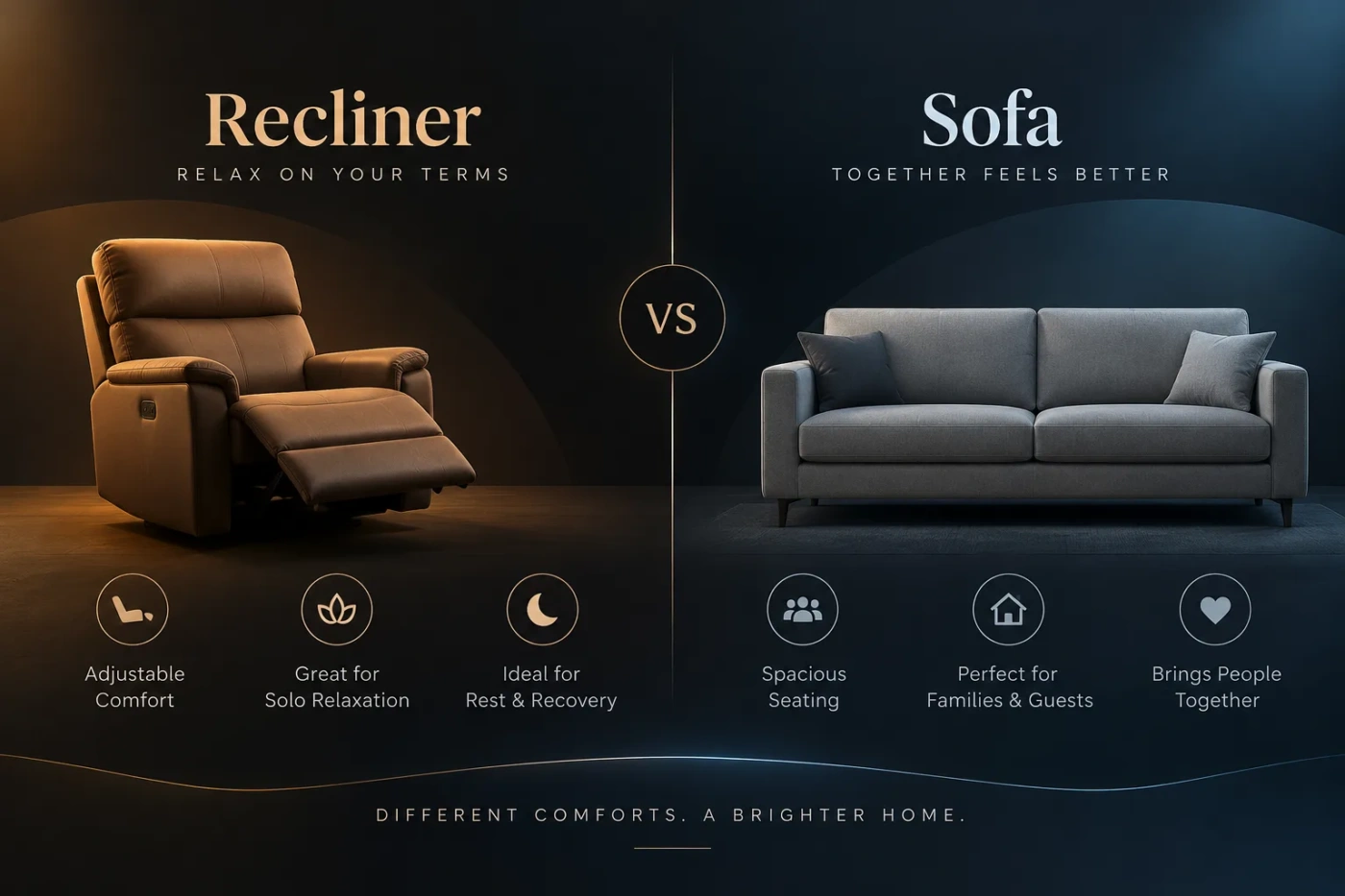
A recliner concentrates comfort into one adjustable seat, while a sofa uses its space to seat several people and support more varied social use. If the room is mainly for one person watching TV, reading, resting, or putting their feet up, a recliner can make better use of the seat itself. If the same floor area needs to accommodate couples, children, guests, conversation, or casual lounging, a sofa usually earns its space more effectively.
- The Room Layout Usually Decides Before Comfort Does
- One Adjustable Seat Versus Several Flexible Seats
- A Recliner Controls Your Position; A Sofa Lets You Create Your Own
- Reclining Mechanisms Add Convenience and Ownership Friction
- Moving Day Favors the Furniture That Comes Apart Easily
- Guests Change the Value Equation Quickly
- A Reclining Sofa Creates a Middle Ground
- Check These Details Before Buying Either One
- For a Recliner
- For a Sofa
- The Better Fit Comes Down to Who Uses the Seat
The Room Layout Usually Decides Before Comfort Does
A recliner may look smaller than a sofa, but its usable footprint is not limited to the dimensions you see when it is upright. Traditional reclining chairs need room behind them, in front of them, or both as the back tilts and the footrest extends. Placing one too close to a wall, coffee table, walkway, or another chair can prevent it from opening properly.
Wall-hugger recliners reduce the amount of rear clearance needed by moving the seat forward as it reclines. They can work better in tighter rooms, although the extended footrest still occupies floor space.
A standard sofa is larger as a single piece of furniture, yet its footprint usually stays fixed. That makes room planning more predictable. You can position a coffee table at a consistent distance, use the area behind the sofa for a console, and arrange other furniture without leaving operating clearance around moving parts.
One Adjustable Seat Versus Several Flexible Seats
The biggest practical difference is not simply size. It is how each piece distributes that space.
A recliner dedicates much of its structure to one seating position. The seat, padded back, armrests, footrest, frame, and reclining mechanism all serve the person sitting in that chair. The payoff is individual control. Depending on the model, the user may be able to raise the legs, lean backward, stop at different reclining angles, or use separate powered adjustments.
A sofa uses its width differently. Most of the structure is devoted to a long seating surface that several people can share. One person can also stretch across it, sit sideways, change positions, use pillows, or lie down without operating a mechanism.
| Use Case | Recliner | Sofa |
|---|---|---|
| One person watching TV | Adjustable back and leg position | Comfortable, but usually fixed-position |
| Several people sitting together | Usually seats one | Designed for shared seating |
| Stretching out | Supported through the reclining mechanism | Can allow sideways lounging or lying down |
| Changing sitting position | Back and legs can move on many models | More freedom to shift across the cushions |
| Stable furniture layout | Needs operating clearance | Keeps a fixed footprint |
A Recliner Controls Your Position; A Sofa Lets You Create Your Own
These are different approaches to comfort.
In a recliner, the furniture determines much of your posture. Your hips remain centered in the seat, your back follows the backrest, and the footrest supports your lower legs. Being able to change the back angle can make long periods of television viewing or reading more comfortable for someone who likes a supported, semi-reclined position.
A sofa offers less mechanical adjustment but more freedom of movement. You can sit upright in one corner, lean against an armrest, place your feet on an ottoman, curl up, or lie across several cushions. For people who constantly change position rather than remaining in one supported posture, that flexibility may be more useful than a reclining mechanism.
Cushion construction matters on both. A deep, soft sofa can feel completely different from a shallow, firm sofa, just as a compact recliner can feel different from an oversized model with a tall back. Furniture type alone does not determine comfort.
Reclining Mechanisms Add Convenience and Ownership Friction
A conventional sofa is mechanically simple. Its frame, suspension, cushions, upholstery, and sometimes removable legs make up most of what can wear or require attention.
A recliner adds hinges, linkages, a footrest assembly, handles or pull cables on some manual designs, and potentially motors, switches, wiring, transformers, or control panels on powered models. Those components make adjustment possible, but they also create more parts that can eventually need service.
Manual recliners avoid dependence on electricity and are relatively straightforward to operate. Power recliners can provide smoother adjustment and may offer more control over seating position, but placement can depend on access to an outlet unless the particular model supports a compatible battery solution.
This difference becomes more important when furniture is expected to stay in the home for many years. Upholstery wear affects both types; mechanical wear is an additional consideration for a recliner.
Moving Day Favors the Furniture That Comes Apart Easily
Neither category is automatically easy to move. Large sofas can be difficult to turn through staircases, narrow halls, apartment doors, or elevators because of their length. A recliner is shorter, but many models are bulky, dense, and heavier than their visual size suggests because of the internal frame and mechanism.
Some recliners have removable backs, which can make transport much easier. Some sofas have detachable legs, modular sections, or separate pieces. Others are effectively one large unit.
Before buying either piece for an apartment or an awkward room, measure the route into the room rather than only the final destination. Door width, hallway corners, stair landings, elevator dimensions, and removable furniture components can matter more than the listed room dimensions.
Guests Change the Value Equation Quickly
A recliner is easy to justify when it belongs to a person who uses it often. The chair can provide a preferred seat every evening without requiring the rest of the room to be arranged around group seating.
The trade-off becomes obvious when more people arrive. One recliner still provides one prime seat. Two recliners provide two seats but can consume a surprising amount of floor area because each needs its own width, armrests, and reclining clearance.
A sofa packs people together more efficiently. It also supports uses that are difficult for a single recliner to replace: sitting beside another person, accommodating children, hosting visitors, lying horizontally, or using one surface for different activities throughout the day.
For a living room that serves as the household’s main shared space, those advantages usually outweigh the absence of built-in leg support.
A Reclining Sofa Creates a Middle Ground
The categories do not have to remain separate. A reclining sofa combines multi-person seating with one or more reclining positions, which can suit households where several people want leg support without replacing the main sofa with individual chairs.
It also inherits some of the recliner’s limitations. The mechanism adds weight and moving parts, reclining sections need clearance, and the furniture can be deeper or bulkier than a conventional sofa. Some designs also divide the seating surface into more defined individual positions, so lying across the sofa may feel different from lying on a conventional uninterrupted cushion arrangement.
Another practical arrangement is a standard sofa plus one recliner. That setup keeps shared seating while giving one person an adjustable chair. It works especially well when the room is large enough to preserve walking space after the recliner is fully extended.
Check These Details Before Buying Either One
For a Recliner
- Measure its fully reclined depth, not only its closed dimensions.
- Check how much wall clearance the mechanism needs.
- Make sure the footrest will not collide with a table or walkway.
- Confirm whether adjustment is manual or powered.
- For powered models, consider outlet placement and cord routing.
- Try the seat with your feet on the footrest and your head against the backrest.
For a Sofa
- Check usable seating width rather than judging only by total width.
- Compare seat depth with the way you normally sit.
- Decide whether you want attached or removable cushions.
- Measure doorways and turns along the delivery route.
- Consider whether anyone regularly lies down on the sofa.
- Check whether the room needs two, three, or more practical seats.
The Better Fit Comes Down to Who Uses the Seat
For a single primary user who spends long periods reading, watching television, gaming, or relaxing in the same chair, a recliner can justify the extra mechanism and operating clearance. Its main advantage is not that it is universally more comfortable; it is that the seating position itself can change without requiring an ottoman or additional cushions.
A sofa makes more sense when the furniture has to serve the room rather than one person. Shared seating, flexible lounging positions, easier social use, and a predictable footprint make it the more practical centerpiece for many living rooms.
In a room with enough space, the strongest arrangement may be both: use the sofa for shared seating and the recliner as the dedicated adjustable seat. If only one piece will fit, count the people who need to sit there before comparing cushions—the answer often becomes obvious once one adjustable seat is weighed against several usable seats.