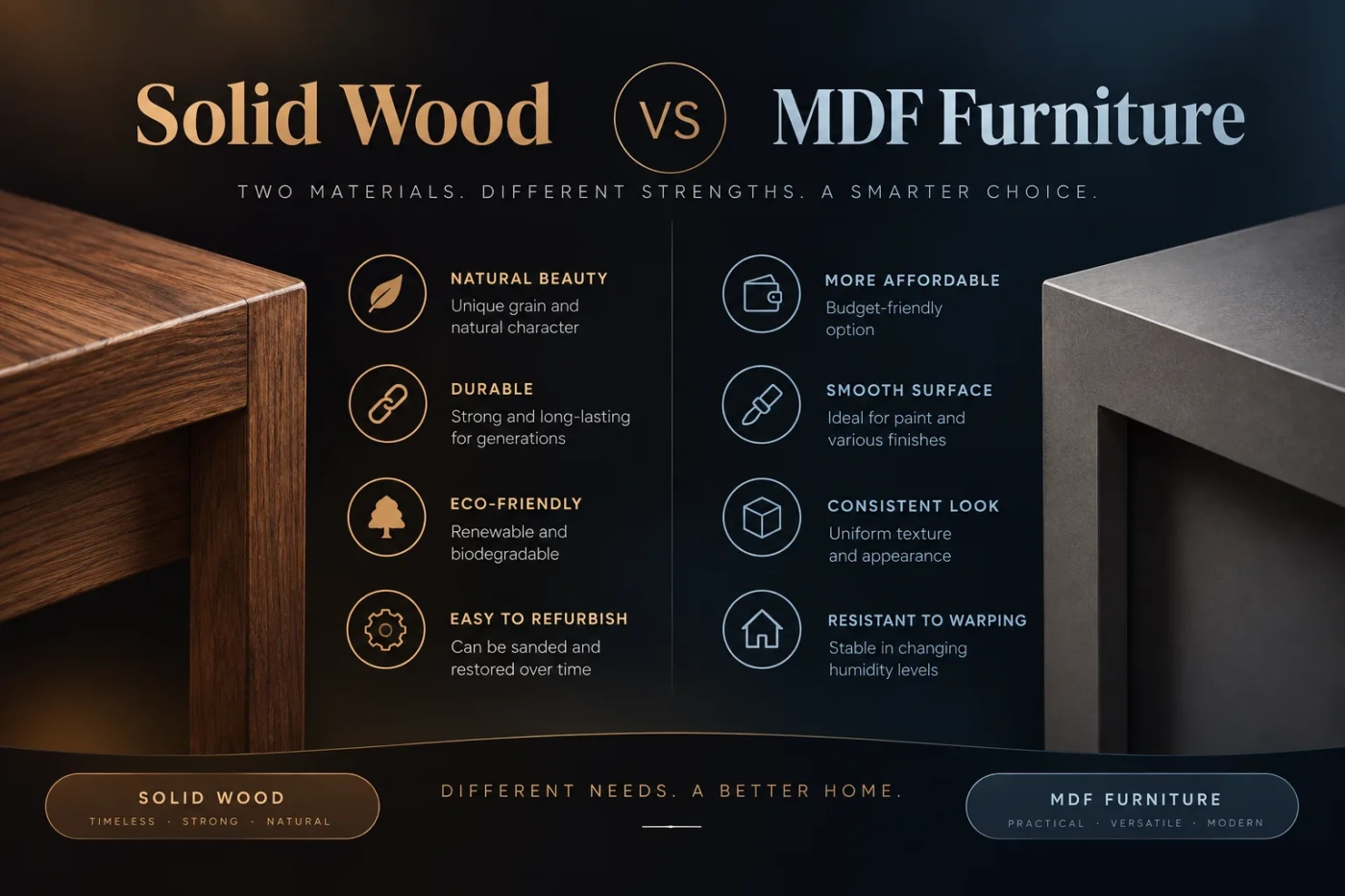
Solid wood and MDF can both make good furniture, but they solve different ownership problems. Solid wood is usually the stronger choice for furniture expected to survive decades, tolerate repairs, and develop character with age. MDF works well when the priorities are a smooth painted finish, stable flat panels, detailed routed shapes, and a lower purchase price. The better material changes with the piece: a dining table, painted cabinet door, bookshelf, and bathroom vanity do not place the same demands on the material.
- The Difference Is More Than Real Wood Versus Engineered Wood
- Tables, Chairs, and Bed Frames Put More Pressure on the Material
- Painted Cabinet Doors Are Where MDF Becomes Especially Attractive
- Water Damage Creates a Very Different Failure Pattern
- Solid Wood Gives You More Options After Years of Damage
- MDF Is Not Necessarily the Lighter Option
- Low Price Is Only One Reason Manufacturers Use MDF
- Check the Exact Parts That Carry Loads and Encounter Water
- Which Material Fits the Furniture You Are Buying?
| Decision Point | Solid Wood | MDF |
|---|---|---|
| Structural strength | Well suited to load-bearing frames, legs, rails, and frequently moved furniture | Better suited to panels, doors, shelving, and components designed around its properties |
| Painted finish | Grain and natural movement can remain visible through some finishes | Very smooth, uniform surface with no visible grain |
| Moisture exposure | Can move, swell, shrink, or warp as humidity changes | Standard MDF can swell badly after water reaches unsealed fibers |
| Repair and refinishing | Can often be sanded, repaired, refinished, and altered repeatedly | Surface repairs are possible, but deep damage is harder to restore invisibly |
| Weight | Varies greatly by species and construction | Typically dense and surprisingly heavy for its appearance |
| Cost | Usually more expensive, especially with premium hardwoods | Often reduces material cost in painted or panel-heavy furniture |
| Natural appearance | Real grain, knots, color variation, and species-specific character | Designed to be painted, veneered, laminated, or otherwise covered |
The Difference Is More Than Real Wood Versus Engineered Wood
Solid wood furniture uses timber cut from trees, although the exact species and grade can vary widely. Pine, oak, maple, walnut, beech, rubberwood, and many other species behave differently. A lightweight softwood cabinet and a dense hardwood table should not be treated as identical simply because both carry a solid-wood label.
MDF, or medium-density fiberboard, is manufactured from wood fibers combined with binders and pressed into dense, uniform sheets. It has no natural grain direction across the panel, which gives manufacturers an exceptionally flat surface for paint, laminate, veneer, and routed decorative profiles.
That uniformity is one of MDF’s strongest advantages. It is also the source of several limitations. MDF does not behave like a plank of timber when screws are repeatedly removed, edges are damaged, or water enters the board.
A furniture listing marked “solid wood” does not always mean every hidden component is solid timber. Drawer bottoms, cabinet backs, interior panels, decorative sections, or door inserts may use plywood, MDF, hardboard, or another sheet material. The construction of the actual piece matters more than the marketing label alone.
Tables, Chairs, and Bed Frames Put More Pressure on the Material
Furniture with legs, joints, rails, and repeated physical loads generally favors solid wood. Dining chairs are pulled backward, leaned on, and subjected to twisting forces. Bed frames carry weight through joints every night. Tables may be dragged, bumped, disassembled, and reassembled.
Solid timber performs well in these roles because joints can be cut directly into the wood, fasteners can often obtain strong holding power, and damaged areas may be repairable. Traditional joinery such as mortise-and-tenon construction also works naturally with solid wood.
MDF can carry substantial loads when properly engineered, but it is not simply a cheaper substitute for solid timber in every structural location. Fasteners near edges require more care, repeated screw removal can weaken the same hole, and unsupported spans may sag depending on thickness, load, and shelf length.
For a heavily used dining table, chair, workbench, or long-term bed frame, solid wood usually has the more attractive ownership profile. For a cabinet carcass or decorative panel that stays largely stationary, MDF can make much more sense.
Painted Cabinet Doors Are Where MDF Becomes Especially Attractive
A natural wood grain is desirable when the furniture is stained, oiled, or finished transparently. Under opaque paint, however, that visual advantage disappears.
MDF provides a smooth face without knots, grain variation, or seasonal grain patterns telegraphing through the finish. It can also be machined into recessed panels and decorative profiles without exposing contrasting grain directions. These characteristics explain why MDF appears frequently in painted cabinetry, wardrobes, media units, and decorative furniture fronts.
Solid wood doors bring a different set of benefits, particularly where buyers value natural material, repairability, and traditional construction. Yet wood naturally responds to changes in humidity. Wider components may expand and contract across the grain, which furniture makers must allow for in the design.
Water Damage Creates a Very Different Failure Pattern
Neither material should be treated as waterproof.
Solid wood absorbs and releases moisture as its environment changes. Excess water or poor humidity control can cause swelling, cupping, splitting, joint movement, or warping. The outcome depends heavily on species, grain orientation, construction, finish, and the amount of exposure.
Standard MDF has another weakness: once liquid penetrates an unprotected edge or damaged surface, the fibers can absorb moisture and expand. A swollen MDF edge often does not return to its original clean shape after drying. This makes exposed edges, screw holes, sink cutouts, floor-level panels, and damaged coatings especially important.
Moisture-resistant MDF products also exist and can improve performance in humid interior environments, but “moisture resistant” should not be read as “safe for continuous water exposure.” The furniture’s sealing, edge treatment, installation, and intended environment still matter.
For a bedroom dresser, the difference may rarely become relevant. Around sinks, wet floors, poorly ventilated bathrooms, or other places where spills are expected, construction details deserve much closer inspection.
Solid Wood Gives You More Options After Years of Damage
The ownership difference becomes clearer after the furniture has accumulated dents, scratches, loose hardware, or finish wear.
A solid wood tabletop can often be sanded and refinished. A damaged edge may be reshaped. Screw holes can sometimes be repaired. Surface color can be changed with another finish, and an experienced repairer may be able to restore furniture that looks badly worn.
MDF furniture can also be repaired, especially when damage is limited to paint or hardware, but there is less material available for repeated sanding and reshaping. Deep chips may expose a fuzzy fiber structure beneath the finished surface. Swollen areas are particularly difficult to return to their original factory profile.
This matters most when buying furniture you expect to keep through moves, room redesigns, hardware changes, and several rounds of refinishing. Solid wood usually provides more recovery options rather than merely more initial strength.
MDF Is Not Necessarily the Lighter Option
MDF furniture sometimes looks lightweight because it is associated with flat-pack construction and lower-cost products. The board itself can be quite dense. A large MDF wardrobe, bookcase, desktop, or entertainment unit may be heavy to lift even though its construction is relatively simple.
Solid wood has no single weight profile. Pine can feel relatively light, while dense hardwoods can produce very heavy furniture. Panel thickness and overall design also affect the finished piece.
Weight matters during delivery and moving, but there is another practical issue: heavy furniture experiences substantial forces around fasteners when dragged rather than lifted. With MDF furniture, repeated relocation and disassembly deserve particular attention because connectors may depend on precisely positioned holes in the board.
Low Price Is Only One Reason Manufacturers Use MDF
MDF is often less expensive than high-quality solid hardwood, but treating it solely as a cost-cutting material misses why it is useful. Manufacturers also choose it because large sheets remain flat, surfaces are consistent, machining can be predictable, and painted finishes can look very clean.
Solid wood costs more in many furniture categories because the material itself may be more expensive and because timber selection, drying, grain matching, joinery, finishing, and construction can require more work. Even so, the material label alone does not determine furniture quality.
Poorly dried or badly joined solid wood can produce disappointing furniture. Well-designed MDF cabinetry with properly sealed edges and suitable hardware can remain useful for years. Construction quality, panel thickness, support placement, hardware, finish quality, and intended use all deserve attention.
Check the Exact Parts That Carry Loads and Encounter Water
A material percentage tells you less than a component-by-component inspection. Before buying, identify where each material is actually being used.
- Dining tables: inspect the top, legs, apron, extension mechanism, and attachment points.
- Bookcases: check shelf thickness, shelf span, back-panel construction, and whether long shelves receive center support.
- Wardrobes: examine hinges, door weight, shelf supports, back panels, and areas around connectors.
- Bathroom vanities: pay close attention to exposed edges, plumbing cutouts, floor contact, and sealing around the sink area.
- Desks: look at desktop support, screw locations, monitor-arm attachment areas, and whether the desk may be repeatedly assembled and dismantled.
- Chairs and beds: focus on the structural frame and joints rather than decorative panels.
For heavy clamp-on accessories such as some monitor arms, check the desktop construction rather than assuming the visible surface tells you what is underneath. A thin panel, hollow section, unsupported area, or damaged MDF edge may require a different mounting approach.
Which Material Fits the Furniture You Are Buying?
Solid wood is usually the more suitable option when the furniture must handle repeated structural stress, remain repairable for many years, show natural grain, or tolerate future sanding and refinishing. It is particularly appealing for tables, bed frames, chairs, benches, and pieces intended for long ownership.
MDF earns its place where flatness, a smooth painted surface, detailed profiles, and cost control matter more than natural grain or repeated structural repair. Painted cabinet doors, wardrobe panels, built-in units, media cabinetry, and many interior furniture components can use it effectively.
Mixed construction is often the most practical arrangement. A manufacturer might use solid wood for legs and structural rails while using MDF for painted panels or flat door sections. Using two materials in the same piece is not automatically a quality problem; the important question is whether each material is placed where its properties make sense.
For furniture that will be moved, repaired, refinished, and kept for decades, solid wood deserves the stronger preference. For stable indoor cabinetry with a painted finish and limited exposure to water or repeated disassembly, well-made MDF can deliver exactly what the furniture requires.