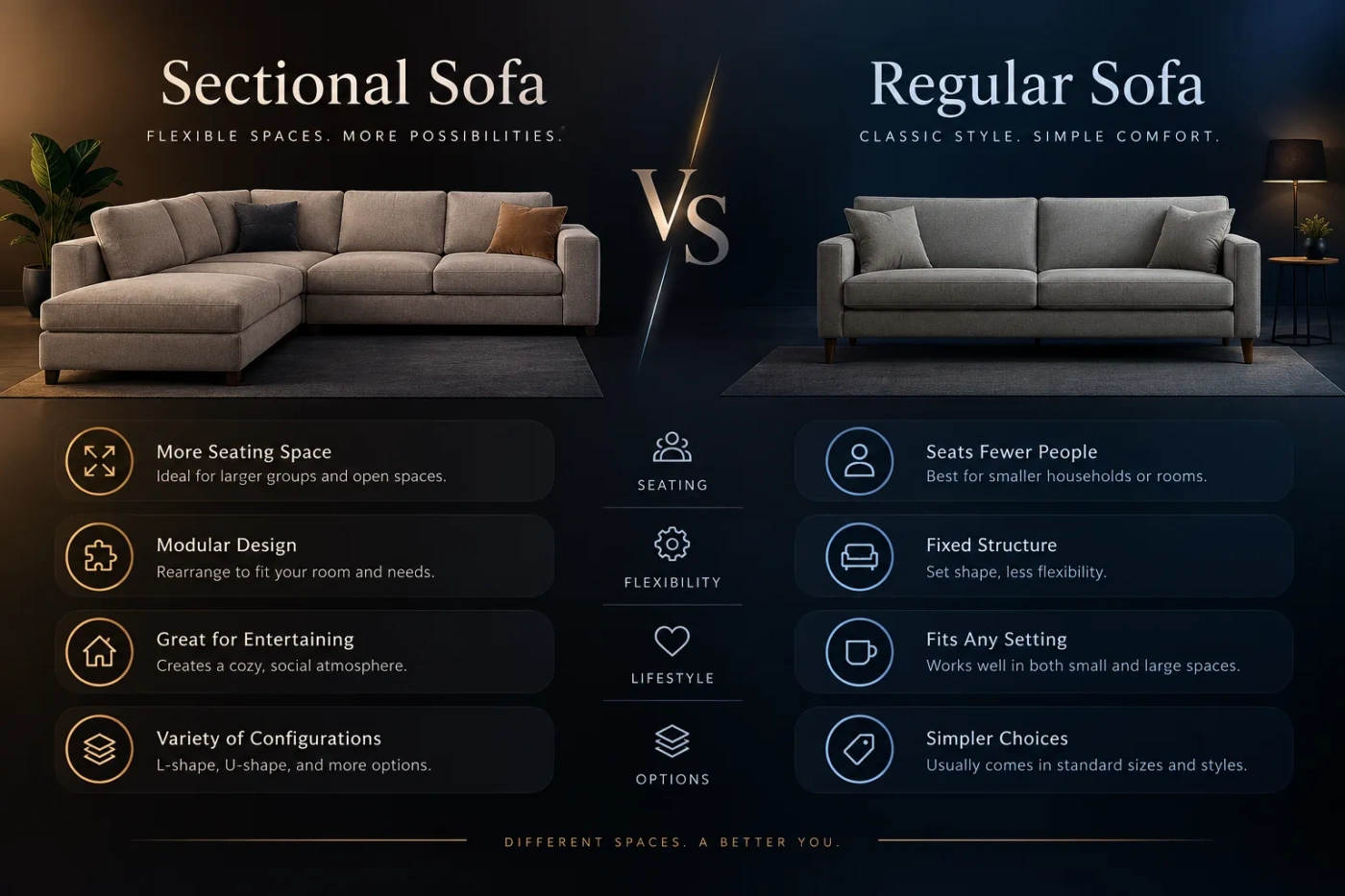
Sectional sofas make the strongest case when seating capacity, lounging space, and a defined conversation area matter more than layout flexibility. A regular sofa takes up less visual and physical space, works with more room shapes, and is usually easier to move or rearrange. The deciding issue is often not comfort alone, but how much of the room one piece of furniture should control.
- A Sectional Uses the Room Differently
- The Corner Seat Is Both an Advantage and a Constraint
- Measure the Chaise Direction, Not Just the Sofa Width
- Large Rooms Do Not Automatically Require a Sectional
- Small Rooms Reward Flexibility
- Moving Day Can Change the Value of a Sectional
- Cleaning and Wear Are Distributed Differently
- Price Depends on What the Sectional Replaces
- The Better Fit Comes Down to How Fixed the Room Is
A Sectional Uses the Room Differently
A regular sofa is essentially one straight seating unit. A sectional combines multiple connected sections, commonly forming an L shape, U shape, or a sofa with an extended chaise. That difference changes more than the number of seats.
With a regular sofa, unused floor space remains available for chairs, side tables, storage, or circulation. The sofa can sit against a wall, float near the center of the room, or move to another wall without redesigning the entire seating arrangement.
A sectional occupies a larger continuous footprint. In the right room, that can be useful: one piece can furnish a corner and provide enough seating for several people without requiring multiple separate chairs. In the wrong room, the extended section can interfere with a doorway, narrow a walkway, or divide the space in an awkward place.
| Decision Point | Sectional Sofa | Regular Sofa |
|---|---|---|
| Continuous seating | Usually provides more connected seating and lounging space | Usually provides fewer seats in one piece |
| Small-room flexibility | Can dominate the usable floor area | Leaves more room for separate furniture |
| Rearranging the room | Depends heavily on sectional shape and configuration | Generally easier to reposition |
| Lounging | Chaise or corner sections can support stretched-out seating | May require an ottoman for similar leg support |
| Moving to another home | More pieces, but the completed layout may not suit the next room | Simpler shape works in a wider range of layouts |
The Corner Seat Is Both an Advantage and a Constraint
The corner is one of the features that makes a sectional attractive. Instead of leaving the junction between two sofas unused, a sectional turns that area into seating. It can also create a comfortable place to recline, watch television, read, or sit with your legs up.
Yet corner seating is not equivalent to adding the same number of independent seats. People seated close to the inside corner may have less personal space, and some positions are better for lounging than for upright conversation. A large sectional advertised with several seating positions may therefore feel different from a regular sofa paired with two separate chairs.
This distinction matters in homes where adults frequently entertain guests. Separate seats allow people to face one another, adjust their position, and maintain more personal space. For a household that mainly watches movies together, the continuous layout of a sectional may be more useful.
Measure the Chaise Direction, Not Just the Sofa Width
A sectional can fit along a wall and still be wrong for the room. The section extending outward from the main sofa is often the deciding measurement.
An L-shaped sectional may have a left-facing or right-facing return, and terminology can vary between sellers. Reversible and modular designs offer more freedom, but fixed sectionals do not necessarily allow the chaise or return to switch sides. Buying the correct overall width while choosing the wrong orientation can leave the extended portion blocking a doorway, balcony entrance, fireplace, cabinet, or natural walking route.
Before buying a sectional: mark its complete footprint on the floor rather than measuring only the wall behind it. Include the depth of the chaise or return and check the path people will actually use to cross the room.
A standard sofa is less demanding in this respect. Depth and width still matter, but its rectangular footprint produces fewer layout surprises.
Large Rooms Do Not Automatically Require a Sectional
A sectional can make a large living room feel anchored because it creates a single, clearly defined seating zone. This works especially well in open-plan spaces where the back of the sectional can visually separate the living area from a dining or kitchen area.
There is another approach. A regular sofa combined with armchairs, accent chairs, or a second sofa can create the same overall seating capacity while allowing the seats to face each other. That arrangement often suits conversation-oriented rooms better and makes future rearrangement easier.
So the question for a large room is not simply whether a sectional will fit. Consider whether you want one continuous lounging zone or several independent seating positions.
Small Rooms Reward Flexibility
A sectional can occasionally make clever use of an otherwise difficult corner, but bigger seating capacity does not necessarily mean better use of a small living room.
One large piece limits what can change around it. A compact regular sofa can be combined with a movable chair, ottoman, or pouf when extra seating is needed. Those smaller pieces can be shifted out of the way later. That flexibility is valuable in apartments where the same area may serve as a living room, workspace, dining area, and route between other rooms.
Visual scale matters too. Deep seats, tall backs, broad arms, and a long chaise can make a sectional feel much larger than its basic measurements suggest. Two sofas with similar widths can affect a room very differently once depth and the return section are considered.
Moving Day Can Change the Value of a Sectional
Sectionals are often made from detachable pieces, which can make individual sections easier to carry through a home than one oversized sofa. That does not make them automatically easier to own after a move.
The problem appears at the destination. A sectional selected for a particular corner may not fit the orientation of a new living room. A fixed right-hand chaise cannot simply become a left-hand chaise unless the design specifically supports reconfiguration.
Modular sectionals reduce this problem because individual units can often be rearranged. They may also allow additional sections to be added or removed later. The exact possibilities depend on the model, so “modular” is worth checking at the component level rather than assuming every section can occupy every position.
A regular sofa has fewer layout dependencies. For renters, frequent movers, or anyone unsure about the shape of a future home, that adaptability can outweigh the extra seating offered by a sectional.
Cleaning and Wear Are Distributed Differently
Both sofa types require similar basic care when they use comparable upholstery, cushions, and construction. A sectional simply creates more junctions, corners, and potentially hidden areas where crumbs, pet hair, toys, or other debris can collect.
Removable sections can help with access, although pulling a large sectional apart for cleaning may be inconvenient. Chaise cushions and favorite corner positions can also receive concentrated use because household members repeatedly choose the same lounging spots.
With a regular sofa and separate chairs, wear is distributed across independent pieces. One chair can also be replaced or reupholstered without changing the main sofa. A sectional behaves more like a coordinated system: damage to one visible section may be harder to address if matching upholstery or replacement modules are no longer available.
Price Depends on What the Sectional Replaces
Sectionals often cost more than a regular sofa from a comparable product range because they contain more seating, upholstery, cushions, and structural components. Comparing purchase prices alone can be misleading, though.
If a sectional provides all the seating the room needs, it may eliminate the need for additional armchairs or an ottoman. A less expensive regular sofa can lead to a higher total furnishing cost if several other pieces must be purchased around it.
The opposite can also happen. A household that rarely needs more than three seats may pay for a large amount of sectional space that goes unused every day. In that situation, the regular sofa preserves both money and floor area for other purposes.
The Better Fit Comes Down to How Fixed the Room Is
A sectional makes sense when the room has enough uninterrupted floor area, the seating arrangement is unlikely to change often, and several people regularly lounge or sit together. It is particularly useful when a corner or open-plan boundary naturally matches its shape.
A regular sofa is the more adaptable option for smaller spaces, renters, frequent movers, rooms with several doors or walkways, and layouts that benefit from separate chairs. It also makes sense when seating needs change from day to day rather than remaining permanently high.
The most practical test happens before style or upholstery enters the decision: map the full sectional footprint and its walking paths on the floor. If that shape improves the room rather than merely fitting inside it, the sectional earns its extra space; if the room works better with movable pieces around a central sofa, the regular sofa is the stronger fit.