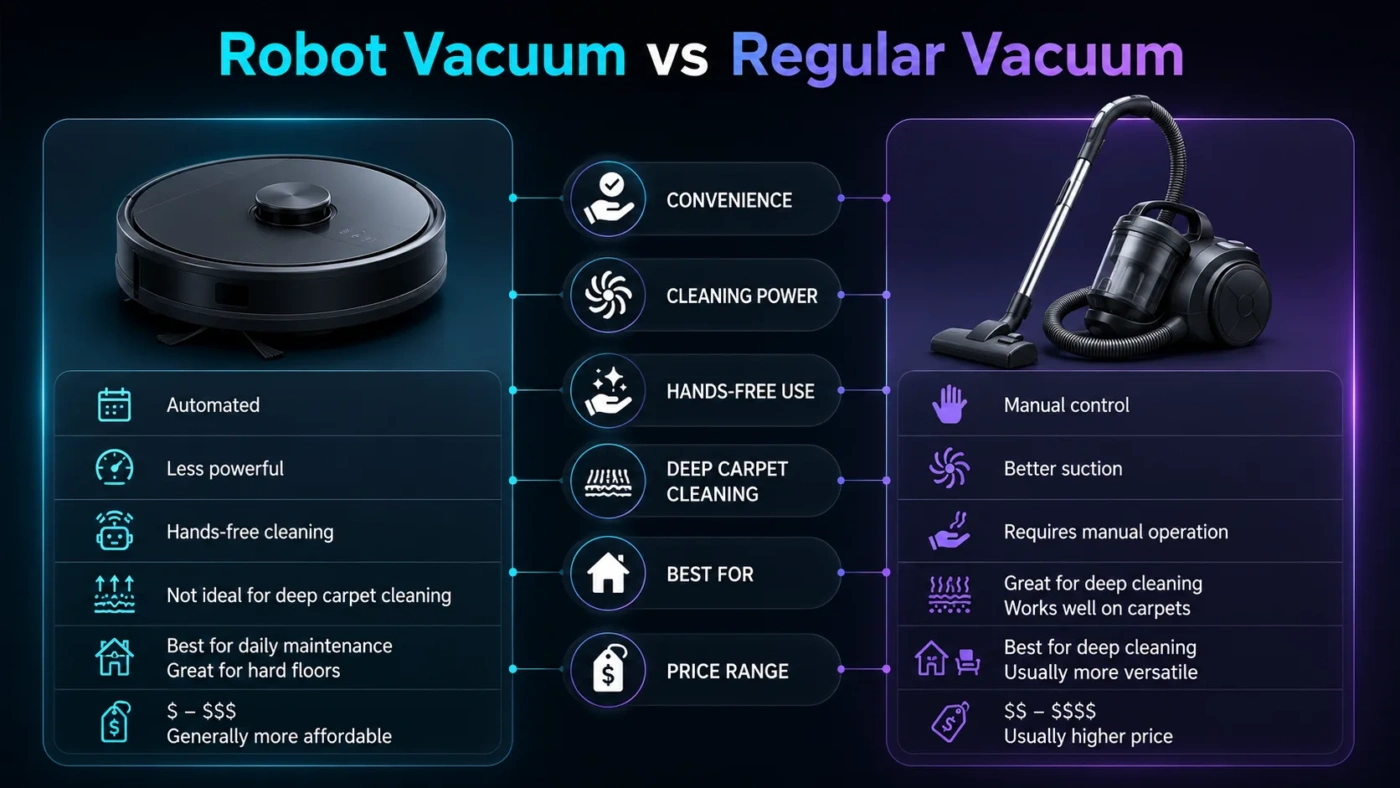
Choosing between a robot vacuum and a regular vacuum is not really about which one is “better.” It is about how your home gets dirty, how often you want to clean, and how much control you need over the job. A robot vacuum is best for frequent, low-effort floor maintenance. A regular vacuum is better for deep cleaning, stairs, thick carpets, upholstery, and targeted messes. For many homes, the smartest choice is not one or the other, but a robot for daily upkeep and a regular vacuum for heavier weekly cleaning.
- Robot Vacuum vs Regular Vacuum: The Main Difference
- What Is a Robot Vacuum?
- Where a Robot Vacuum Works Best
- What Is a Regular Vacuum?
- Where a Regular Vacuum Works Best
- Cleaning Performance: Which One Cleans Better?
- On Hard Floors
- On Carpet
- For Pet Hair
- Convenience and Time: The Robot Vacuum Advantage
- Control and Flexibility: The Regular Vacuum Advantage
- Price and Value: Which One Gives More for the Money?
- Maintenance: Which One Is Easier to Live With?
- When You Should Choose a Robot Vacuum
- A Robot Vacuum Makes More Sense If:
- When You Should Choose a Regular Vacuum
- A Regular Vacuum Makes More Sense If:
- Big Misunderstandings About Robot Vacuums and Regular Vacuums
- “A Robot Vacuum Fully Replaces a Regular Vacuum”
- “Regular Vacuums Are Always Better Because They Have More Power”
- “Robot Vacuum Suction Numbers Tell the Whole Story”
- “Mopping Robots Replace Real Mopping”
- “A Regular Vacuum Is Always More Work”
- Best Choice by Home Type
- Small Apartment With Hard Floors
- House With Thick Carpet
- Home With Pets
- Home With Stairs
- Busy Household With Kids
- Allergy-Focused Cleaning
- Robot Vacuum vs Regular Vacuum: Which Should You Choose?
| Feature | Robot Vacuum | Regular Vacuum |
|---|---|---|
| Best Use | Daily floor maintenance with little effort | Deep cleaning and targeted cleaning |
| Cleaning Control | Automated, app-based, scheduled | Fully manual and precise |
| Carpet Performance | Good on low-pile carpet, weaker on thick carpet | Usually stronger on medium and thick carpet |
| Hard Floor Performance | Very useful for dust, crumbs, hair, and daily debris | Very effective, especially with proper hard-floor attachments |
| Pet Hair | Great for daily fur control, brush tangles may need attention | Better for deep pet hair removal from carpets, sofas, and stairs |
| Stairs | Cannot clean stairs | Can clean stairs, especially canister and cordless models |
| Furniture and Upholstery | Not suitable for sofas, curtains, mattresses, cars, or shelves | Works well with hose tools, crevice tools, and upholstery brushes |
| Maintenance | Small bin, sensors, brushes, mop pads, dock bags, filters | Dust cup or bag, filters, brush roll, belt or battery depending on type |
| Noise | Often quieter while cleaning, but auto-empty docks can be loud | Usually louder during use, but cleaning time is shorter |
| Price Range | Often about $150–$1,500+ depending on mapping, dock, and mopping features | Often about $80–$900+ depending on type, suction, filtration, and accessories |
| Best For | Busy homes, hard floors, pet hair maintenance, routine cleaning | Homes with carpet, stairs, allergies, large messes, and mixed cleaning needs |
Robot Vacuum vs Regular Vacuum: The Main Difference
The biggest difference is simple: a robot vacuum cleans often, while a regular vacuum cleans harder.
A robot vacuum is designed to reduce the amount of dust, crumbs, hair, and everyday debris that builds up between proper cleaning sessions. It moves around the floor on its own, follows a mapped route or sensor-based pattern, and returns to its dock when finished. Better models can divide rooms, avoid some obstacles, clean specific zones, empty their dustbin into a dock, and lightly mop hard floors.
A regular vacuum is the hands-on tool. It gives you direct control over suction, angle, pressure, attachments, and where you clean. That makes it better for rugs, thick carpets, baseboards, stairs, corners, upholstery, mattresses, curtains, cars, and heavy dirt. It is not as convenient, but it is more flexible.
So the real question is not “Which vacuum is stronger?” The better question is: Do you need automatic maintenance or deeper manual cleaning?
What Is a Robot Vacuum?
A robot vacuum is a small, self-moving floor cleaner that vacuums without needing you to push it. Most models use wheels, side brushes, a main brush roll, sensors, and a suction motor. More advanced models use laser navigation, cameras, room mapping, object detection, no-go zones, carpet detection, and self-emptying docks.
Robot vacuums are usually best at keeping floors from getting messy in the first place. They can run every day or several times a week, which matters more than many buyers expect. Even if one pass is not as strong as a manual vacuum session, repeated cleaning can keep visible debris under control.
Where a Robot Vacuum Works Best
- Open floor plans with fewer loose items on the floor
- Hard floors such as tile, vinyl, laminate, and sealed wood
- Low-pile carpet and thin area rugs
- Homes with pets that shed lightly or moderately
- Busy households where vacuuming is often delayed
- People who want scheduled cleaning while they work or sleep
The best robot vacuum experience depends heavily on the home layout. If your floors are covered with cables, socks, toys, rug tassels, or narrow chair legs, the robot may need help. If your home has clear paths and mostly hard flooring, a robot can feel like a quiet background helper.
What Is a Regular Vacuum?
A regular vacuum is a manual cleaning machine that you operate yourself. This category includes upright vacuums, canister vacuums, corded stick vacuums, cordless stick vacuums, handheld vacuums, and wet-dry utility vacuums. In everyday comparison, “regular vacuum” usually means an upright, canister, or stick vacuum used for home cleaning.
Regular vacuums are built for control. You decide where to clean, how slowly to move, which attachment to use, and when to repeat an area. That makes a major difference on carpets, around baseboards, under sofa cushions, and in places a robot cannot reach.
Where a Regular Vacuum Works Best
- Medium-pile and high-pile carpets
- Stairs and landings
- Sofas, chairs, mattresses, and curtains
- Cars, closets, shelves, and tight corners
- Large spills such as cereal, soil, sand, or tracked-in dirt
- Homes that need strong filtration and deeper dust removal
A regular vacuum is also easier to use for “I need this clean now” situations. A robot can be scheduled, but it may take longer, miss a specific pile of debris, or need a clear floor first. A manual vacuum is faster when the mess is obvious and local.
Cleaning Performance: Which One Cleans Better?
For raw cleaning performance, a regular vacuum usually wins. It often has a larger motor, stronger airflow, bigger dust capacity, more aggressive brush agitation, and better attachment options. On carpets, that matters. Dirt does not only sit on top of carpet fibers; it settles lower, especially in busy walkways and under furniture.
A robot vacuum can still be very effective, but in a different way. It wins through frequency. Running a robot daily can prevent crumbs, fine dust, and pet hair from collecting into heavier messes. That is why many people with hard floors feel a robot vacuum makes the home look cleaner with less effort.
On Hard Floors
Robot vacuums are often very useful on hard floors. Dust, crumbs, hair, and light debris sit on the surface, so the robot does not need to dig through carpet fibers. Side brushes can pull debris from edges, although robots may still leave a little dirt in sharp corners.
A regular vacuum also performs well on hard floors, especially with a soft roller, suction-only floor head, or hard-floor mode. It gives you better control around furniture legs, baseboards, and heavier debris.
On Carpet
Regular vacuums usually have the advantage on carpet. Upright vacuums and strong canister vacuums can press the cleaning head into the carpet and agitate fibers more deeply. This helps with embedded dust, pet hair, and fine grit.
Robot vacuums can handle low-pile carpet and thin rugs, but they may struggle with plush carpet, high thresholds, black rugs, rug tassels, and uneven surfaces. Some models automatically boost suction on carpet, but suction alone does not replace strong brush agitation.
For Pet Hair
For pet hair, the answer depends on the surface. A robot vacuum is excellent for daily hair control on hard floors and low rugs. It can run often enough that fur never becomes a large visible layer. That is a real advantage for pet owners.
A regular vacuum is better for deep hair removal from carpet, pet beds, sofa fabric, stairs, and car seats. If your pet sheds heavily, look for a regular vacuum with a strong brush roll, good sealing, and washable or replaceable filters. For a robot, pay close attention to anti-tangle brushes, bin size, dock bags, and how easy the brush roll is to clean.
Convenience and Time: The Robot Vacuum Advantage
The strongest reason to buy a robot vacuum is convenience. You can schedule it to clean while you are working, cooking, sleeping, or away from home. That changes the cleaning habit from “I need to vacuum” to “the floor gets handled regularly.”
Some robot vacuums also support room-by-room cleaning. For example, you can send the robot to the kitchen after dinner or to the entryway after people come home. Higher-end models may include auto-empty docks, mop washing, hot-air mop drying, automatic water refill, and dirt detection. These features add cost, but they reduce hands-on work.
Still, a robot is not fully hands-free. You may need to:
- Pick up cables, toys, socks, and loose items
- Clean hair from the brush roll
- Replace filters, side brushes, mop pads, bags, or rollers
- Empty or maintain the dock
- Move the robot between floors if your home has stairs
- Fix maps when furniture changes or the robot gets confused
That is the trade-off. A robot vacuum saves effort during cleaning, but it asks for setup and occasional maintenance.
Control and Flexibility: The Regular Vacuum Advantage
A regular vacuum gives you control a robot cannot match. You can slow down over a dirty rug, angle the nozzle into a corner, vacuum a sofa cushion, clean a staircase, or reach behind furniture. You can also react instantly when something spills.
This matters most in homes with mixed cleaning needs. If you have children, pets, carpeted bedrooms, stairs, upholstered furniture, and a car that needs cleaning, a regular vacuum is more useful as the only vacuum in the house.
Regular vacuums also avoid one common robot problem: they do not depend on navigation. A robot must understand the room, avoid obstacles, and find its dock. A regular vacuum only needs power and a person using it.
Price and Value: Which One Gives More for the Money?
Robot vacuums usually cost more when you want smarter features. Basic models may start around $150 to $300, but they often have simpler navigation and smaller dustbins. Mid-range models often sit around $300 to $700 and may include better mapping, app control, room cleaning, and stronger suction. Premium robot vacuum-mop systems can cost $700 to $1,500+ when they include self-emptying, mop washing, object avoidance, and advanced docks.
Regular vacuums cover a wider value range. A basic upright or corded stick vacuum can be much cheaper than a smart robot. Better cordless sticks, sealed canisters, and high-filtration uprights can move into the $300 to $900+ range. The price depends on suction, battery quality, filtration, floor heads, bagged versus bagless design, and included tools.
For value, choose based on what problem you are solving:
- Choose a robot vacuum if the main problem is dust and hair returning every day.
- Choose a regular vacuum if the main problem is deep dirt, carpet cleaning, stairs, or furniture.
- Choose both if you want cleaner floors day to day without giving up deeper cleaning power.
Maintenance: Which One Is Easier to Live With?
A robot vacuum looks easier because it cleans by itself, but the machine has more parts that need attention. Brushes collect hair. Sensors get dusty. Small bins fill quickly. Mop pads need washing or replacing. Auto-empty docks need bags. Combo robot vacuum-mops may also need clean water, dirty water emptying, and dock cleaning.
A regular vacuum has simpler maintenance in many cases. You empty the bin or replace the bag, clean or change the filter, remove hair from the brush roll, and check for clogs. Cordless vacuums also require battery care. Bagged models usually keep dust contained better when emptying, while bagless models avoid bag costs but can release more dust during emptying.
If allergies matter, do not only look at suction. Look for sealed filtration, quality filters, easy dust disposal, and clean maintenance habits. A vacuum that leaks fine dust back into the room is less helpful, even if it picks up visible debris.
When You Should Choose a Robot Vacuum
Choose a robot vacuum if you want cleaner floors with less daily effort. It is the better choice when the mess is predictable: dust, crumbs, hair, and light debris that appear again and again.
A Robot Vacuum Makes More Sense If:
- Your home has mostly hard floors or low-pile rugs.
- You want scheduled cleaning without pushing a vacuum.
- You have pets and want to control hair before it builds up.
- Your rooms have open paths and limited floor clutter.
- You are comfortable using an app, maps, zones, and cleaning schedules.
- You do not expect one machine to handle stairs, sofas, cars, or thick carpets.
A robot vacuum is also a good choice for people who already own a regular vacuum but use it less often than they should. In that case, the robot does not need to replace the main vacuum. It fills the gap between deeper cleaning sessions.
When You Should Choose a Regular Vacuum
Choose a regular vacuum if you want one machine that can handle more surfaces and heavier messes. It is the safer first purchase for many homes because it can clean floors, carpets, stairs, furniture, edges, and above-floor areas.
A Regular Vacuum Makes More Sense If:
- You have wall-to-wall carpet or thick area rugs.
- You need to clean stairs often.
- You want strong suction and brush agitation for deeper dirt.
- You have upholstered furniture, pet beds, mattresses, or car interiors to clean.
- You prefer direct control instead of app-based automation.
- You want a lower-cost cleaning tool with fewer smart parts.
If you can only buy one vacuum and your home has carpets, stairs, or pets on furniture, a regular vacuum is usually the more complete choice.
Big Misunderstandings About Robot Vacuums and Regular Vacuums
“A Robot Vacuum Fully Replaces a Regular Vacuum”
For most homes, it does not. A robot vacuum can reduce how often you manually vacuum, but it cannot clean stairs, couches, curtains, car seats, or deep carpet as well as a good regular vacuum.
“Regular Vacuums Are Always Better Because They Have More Power”
More power helps, but cleaning frequency also matters. A regular vacuum used once every two weeks may leave floors dirtier than a robot that runs daily. The best result often comes from combining routine automation with occasional manual cleaning.
“Robot Vacuum Suction Numbers Tell the Whole Story”
Suction numbers can be useful, but they do not tell the full cleaning story. Brush design, airflow, floor contact, navigation pattern, bin design, filter sealing, edge cleaning, and obstacle handling all affect real use.
“Mopping Robots Replace Real Mopping”
Robot mopping is useful for light dust and surface smudges on hard floors. It is not the same as scrubbing dried spills, sticky residue, grout lines, or heavily soiled floors by hand.
“A Regular Vacuum Is Always More Work”
Not always. For one pile of crumbs, a cordless stick vacuum may be faster than opening an app, sending a robot to a zone, and waiting for it to finish. Robot vacuums save effort over repeated cleaning, not every tiny mess.
Best Choice by Home Type
Small Apartment With Hard Floors
A robot vacuum is often the better everyday choice, especially if the layout is simple. Add a small cordless or handheld vacuum if you need to clean furniture, shelves, or tight spaces.
House With Thick Carpet
Choose a regular vacuum first. A robot can help with surface debris, but deep carpet cleaning needs stronger agitation and better floor contact.
Home With Pets
The best setup is often both. Use a robot vacuum for daily fur control on floors, then use a regular vacuum for carpets, sofas, stairs, pet beds, and deeper dust removal.
Home With Stairs
A regular vacuum is the better primary choice. A robot can clean one floor at a time, but it cannot climb or vacuum stairs. If you still want a robot, use it as a floor-maintenance tool, not as your only cleaner.
Busy Household With Kids
A robot vacuum can help if toys, cords, and small items are picked up regularly. If the floor is often cluttered, a cordless regular vacuum may be more practical for fast cleanup.
Allergy-Focused Cleaning
A regular vacuum with sealed filtration and strong carpet cleaning is usually the better main tool. A robot vacuum can help by reducing dust buildup between sessions, but it should not be your only allergy-cleaning tool if you have carpets, pets, or fabric surfaces.
Robot Vacuum vs Regular Vacuum: Which Should You Choose?
Choose a robot vacuum if your main goal is easier daily floor maintenance. It is the better pick for hard floors, light debris, pet hair control, busy schedules, and people who want floors cleaned often without thinking about it.
Choose a regular vacuum if your main goal is deeper cleaning and full-home flexibility. It is the better pick for carpets, stairs, upholstery, cars, heavy debris, and homes where one machine needs to handle many surfaces.
Choose both if your budget allows and your home gets dirty quickly. The robot handles the everyday layer of dust, crumbs, and hair. The regular vacuum handles the areas that need power, precision, and attachments. That pairing gives most homes the cleanest result with the least frustration.
If you want one clear rule, use this: buy a regular vacuum first if you need one dependable cleaner for everything; buy a robot vacuum first if your floors are mostly hard, your layout is simple, and your biggest problem is keeping up with daily debris.