A smart plug is usually the easier choice for lamps, small appliances, fans, coffee makers, and renters. A smart switch is usually the better choice for ceiling lights, built-in fixtures, multi-bulb rooms, and homes where you want the wall control to stay simple for everyone. The real question is not “Which one is smarter?” It is what do you want to control: a plug-in device or the wiring behind a wall switch?
- Smart Plug vs Smart Switch: The Main Difference
- What Is a Smart Plug?
- Where a Smart Plug Works Well
- Where a Smart Plug Feels Limited
- What Is a Smart Switch?
- Where a Smart Switch Works Well
- Where a Smart Switch Feels Limited
- Installation: Plug-In Convenience vs Wired Control
- Daily Use: Which One Feels Better?
- Choose a Smart Plug for Flexible Control
- Choose a Smart Switch for Natural Control
- Performance and Reliability
- Price and Value
- Smart Plug vs Smart Switch for Lights
- Smart Plug vs Smart Switch for Appliances
- Privacy, Ecosystem, and App Control
- When You Should Choose a Smart Plug
- A Smart Plug Makes More Sense If:
- When You Should Choose a Smart Switch
- A Smart Switch Makes More Sense If:
- Common Misunderstandings
- A Smart Plug Does Not Make Every Appliance Fully Smart
- A Smart Switch Is Not Always Compatible With Every Wall Box
- Energy Monitoring Is Not Automatic
- Smart Switches and Smart Bulbs Need Careful Planning
- Cheapest Is Not Always Best
- Best Choice by User Type
- Buying Checklist Before You Decide
- Before Buying a Smart Plug
- Before Buying a Smart Switch
- Smart Plug vs Smart Switch: Which One Should You Choose?
| Feature | Smart Plug | Smart Switch |
|---|---|---|
| Best For | Plug-in lamps, fans, coffee makers, small appliances, holiday lights, chargers, and floor lamps | Ceiling lights, recessed lighting, wall fixtures, porch lights, bathroom lights, and room lighting circuits |
| Installation | Plugs into an existing outlet; usually no tools needed | Replaces a wall switch; may require wiring work and electrical knowledge |
| Renter Friendly | Very renter friendly because it can be removed in seconds | Less renter friendly because it changes the wall switch hardware |
| Manual Control | Manual button is usually on the plug, which may be behind furniture | Manual control stays in the normal wall switch location |
| Works When Device Switch Is Off? | No. The connected lamp or appliance must stay switched on | Yes, for the circuit it controls, as long as the switch is installed correctly |
| Lighting Experience | Good for single lamps and decorative lights | Better for main room lighting and multiple fixtures |
| Energy Monitoring | Common on many models, but not guaranteed | Available on some models, but less common than basic on/off or dimmer control |
| Typical Cost | Often lower per device, usually around $8–$30 for basic indoor models | Often higher once dimming, multi-way wiring, or professional installation is considered |
| Best Smart Home Role | Small automation, appliance scheduling, energy tracking, and temporary setups | Permanent lighting control, family-friendly automation, and cleaner smart home design |
| Main Limitation | Only controls what is plugged into it | Installation depends on wiring, switch type, load type, and sometimes a neutral wire |
Smart Plug vs Smart Switch: The Main Difference
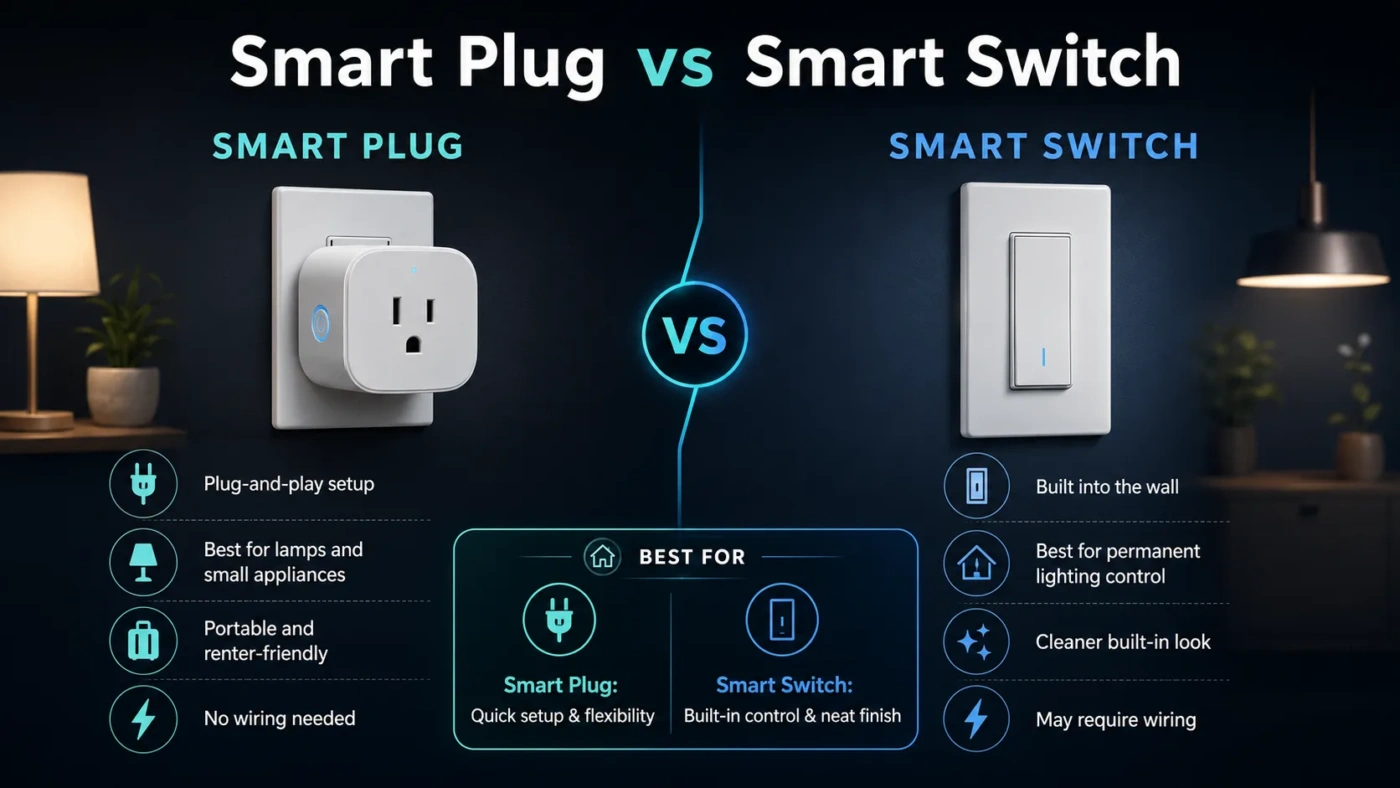
A smart plug sits between the outlet and the device. It turns power on or off to whatever is plugged into it. That makes it practical for a bedside lamp, desk fan, aquarium light, holiday decoration, or a coffee maker with a simple mechanical power switch.
A smart switch replaces a traditional wall switch. It controls the electrical circuit connected to that switch. That makes it better for ceiling lights, recessed lights, porch lights, bathroom lights, and rooms where several bulbs are controlled from one wall plate.
Here is the cleanest way to think about it:
- Choose a smart plug when the device has a plug and you want a fast setup.
- Choose a smart switch when the light is controlled by the wall and you want the switch to remain useful.
This difference sounds simple, but it affects daily use more than specs do. A smart plug can be perfect in one room and annoying in another. A smart switch can feel natural in a hallway but unnecessary for a single table lamp.
What Is a Smart Plug?
A smart plug is a small connected adapter that goes into a standard electrical outlet. You plug a device into it, then control that device through an app, voice assistant, schedule, timer, automation, or physical button on the plug.
Most smart plugs connect through Wi-Fi, Bluetooth, Zigbee, Z-Wave, Thread, or Matter, depending on the model and ecosystem. Some need only a phone app. Others work best with a hub, smart speaker, or home automation controller.
Where a Smart Plug Works Well
A smart plug is useful when the device already behaves well with simple power on/off control. For example, a lamp with a physical switch can stay in the “on” position while the smart plug controls power. The same idea works for some fans, decorative lights, dehumidifiers, and basic coffee makers.
Good smart plug uses include:
- Turning a floor lamp on at sunset
- Scheduling a fan during sleeping hours
- Switching holiday lights on and off automatically
- Cutting standby power to an entertainment setup
- Monitoring energy use on a device that supports power reporting
- Creating a simple “away” lighting routine
Where a Smart Plug Feels Limited
A smart plug cannot press buttons, change modes, or control advanced settings on most appliances. If a device does not turn back on after power is restored, a smart plug will not magically make it smart. Many modern appliances have digital buttons, safety resets, or electronic controls that do not resume operation when power returns.
It also may be awkward when the outlet is hidden behind a sofa, cabinet, bed, or TV stand. Yes, app control still works, but the physical button becomes harder to reach.
What Is a Smart Switch?
A smart switch is a connected wall control that replaces a standard light switch. It can turn a circuit on or off, dim compatible lights, run schedules, work with motion sensors, and respond to voice commands or automations.
The biggest benefit is everyday usability. People can still walk into the room and press the switch like they always have. The automation lives behind that familiar habit. That matters in shared homes, guest rooms, kitchens, hallways, and bathrooms.
Where a Smart Switch Works Well
A smart switch is the cleaner option when one wall switch controls the lighting people use every day. It avoids the common smart bulb problem where someone turns the wall switch off and disables the smart lighting.
Good smart switch uses include:
- Ceiling lights in bedrooms, kitchens, and living rooms
- Porch lights and exterior entry lighting
- Hallway lights that need schedules or motion-based routines
- Bathroom fans or lights, when the model is rated for that load
- Rooms with several bulbs controlled by one switch
- Lighting that multiple people use without opening an app
Where a Smart Switch Feels Limited
A smart switch is not always a simple swap. Some models need a neutral wire. Some homes have older wiring that may not support every smart switch model. Three-way and four-way lighting setups can also require compatible companion switches or special wiring instructions.
There is also the load type to consider. A switch made for basic lighting may not be right for a fan motor, heater, outlet circuit, or high-load device. Dimmer switches need compatible dimmable bulbs. If the bulb and dimmer do not work well together, you may get flicker, buzzing, limited dimming range, or random shutoffs.
Installation: Plug-In Convenience vs Wired Control
Installation is one of the clearest decision points.
A smart plug is usually a five-minute setup: plug it in, open the app, connect it to your home network, name the device, and add any schedule or automation. For renters, students, temporary rooms, and people who do not want to touch wiring, this is the safer and easier route.
A smart switch requires more care. You may need to turn off power at the breaker, remove the wall plate, identify wires, check line/load connections, confirm the neutral wire if the model needs one, and fit the switch into the wall box. In some cases, the wall box is crowded or too shallow for the smart switch body.
If wiring makes you unsure, the practical answer is simple: use a smart plug or hire a qualified electrician for the switch. Smart home convenience is not worth guessing inside a live electrical box.
Daily Use: Which One Feels Better?
Smart plugs are great when one person controls one device. Smart switches are better when many people use the same room.
Think about a living room lamp beside your favorite chair. A smart plug works well because the setup is personal, simple, and easy to move. Now think about kitchen ceiling lights. A smart plug cannot help there. A smart switch makes more sense because everyone expects the wall switch to control the lights.
Choose a Smart Plug for Flexible Control
A smart plug feels best when you want a low-commitment upgrade. You can move it from the bedroom to the living room, use it for seasonal decorations, or test automations before buying more smart home gear.
It also works well when you want device-level control. For example, you can schedule only one lamp, track one appliance’s electricity use, or turn off a charger station overnight.
Choose a Smart Switch for Natural Control
A smart switch feels better when lighting should behave like normal lighting. The wall control remains in the expected place. Voice control and app control become extras, not requirements.
This is why smart switches often feel more polished in permanent spaces. Guests do not need instructions. Children do not need an app. Nobody has to ask which plug controls which lamp.
Performance and Reliability
Performance depends on wireless connection, ecosystem support, and the quality of the device. Both smart plugs and smart switches can be reliable when matched with the right network and setup.
Wi-Fi models are easy to start with, but many devices on a crowded router can lead to delays. Zigbee, Z-Wave, and Thread models may work better for larger smart homes because they can use mesh-style communication through compatible hubs or controllers. Matter support can also make setup and ecosystem mixing easier, although features still vary by product and platform.
For basic on/off control, both devices can respond quickly. For dimming, multi-way lighting, motion routines, or energy reporting, the smart switch or plug model matters more than the category itself.
Price and Value
Smart plugs are usually cheaper to buy and easier to expand. A two-pack or four-pack can handle several lamps or small devices without changing your home’s wiring. Basic indoor models often sit around $8–$30 each, while outdoor-rated or energy-monitoring models may cost more.
Smart switches often cost more per location. A basic on/off switch may be affordable, but dimmers, motion-sensing switches, no-neutral models, outdoor-rated controls, or multi-way setups can raise the total cost. If you pay for installation, that cost may exceed the device price.
The better value depends on the job:
- One lamp: smart plug is usually better value.
- Four ceiling lights on one circuit: smart switch is usually better value.
- Seasonal lights: smart plug is easier and cheaper.
- Main room lighting: smart switch feels cleaner over time.
Smart Plug vs Smart Switch for Lights
For lighting, the answer depends on the type of light.
Use a smart plug for plug-in lights: table lamps, floor lamps, LED strips with plug-in adapters, decorative lights, and holiday lights. The lamp should stay switched on so the smart plug can control power.
Use a smart switch for wired lighting: ceiling fixtures, recessed lights, vanity lights, porch lights, and wall sconces connected to a switch.
If you use smart bulbs, the decision changes. Smart bulbs need constant power to stay connected. A normal wall switch can cut that power. In that case, you may want a smart switch designed for smart bulbs, a wireless scene controller, or a setup that keeps the bulbs powered while controlling scenes through software.
Smart Plug vs Smart Switch for Appliances
A smart plug can work with some small appliances, but you need to be careful with load rating, device behavior, and safety. The connected appliance must stay within the plug’s rated amperage and wattage. It should also be the kind of device that can safely resume when power is restored.
A smart plug may be reasonable for:
- A basic lamp
- A small fan within the rated load
- A coffee maker with a mechanical switch
- A holiday light string
- A media center power strip, if the smart plug is rated for the load
Be cautious with heaters, air conditioners, refrigerators, pumps, large kitchen appliances, and anything with high startup current. Some devices draw more power when starting than they do while running. A plug that looks fine on paper may still be a poor match for a motor-heavy or heat-producing appliance.
A smart switch is usually not the right tool for plug-in appliances. It is built for a wired circuit, not for controlling random devices around the home.
Privacy, Ecosystem, and App Control
Both smart plugs and smart switches may use a manufacturer app, cloud service, local network connection, or hub-based system. Before buying either one, check whether it works with your preferred setup: Apple Home, Google Home, Amazon Alexa, Samsung SmartThings, Home Assistant, or another platform.
A few practical details matter:
- Does it need a hub?
- Does it support Matter, Thread, Zigbee, Z-Wave, or only Wi-Fi?
- Can it run schedules locally if the internet goes down?
- Does the app require an account?
- Can it share control with family members?
- Does it support energy monitoring, dimming, or scene control if you need those features?
Do not buy only by the “works with” badge. A device may support basic on/off control in one ecosystem but not expose every feature everywhere. Energy reports, advanced automations, adaptive lighting, and button actions can vary by platform.
When You Should Choose a Smart Plug
Choose a smart plug if you want a fast, low-risk, movable smart home upgrade. It is the better pick when the device is already plugged into an outlet and simple power control is enough.
A Smart Plug Makes More Sense If:
- You rent your home and cannot change wall wiring
- You want to control a lamp, fan, or small plug-in device
- You want the lowest setup effort
- You need a temporary or seasonal automation
- You want to test smart home routines before buying switches
- You want energy monitoring for one device
- The outlet is visible or easy to reach
A smart plug is also the better starter choice. You can learn how schedules, voice control, scenes, and automations work without touching electrical wiring.
When You Should Choose a Smart Switch
Choose a smart switch if you want permanent, room-level lighting control. It is the better pick when the thing you want to automate is already controlled by a wall switch.
A Smart Switch Makes More Sense If:
- You want to control ceiling lights or built-in fixtures
- You want the wall switch to remain useful
- Several people use the same room
- You want a cleaner setup with no visible plug adapter
- You have multiple bulbs on one lighting circuit
- You want dimming from the wall, if the switch and bulbs support it
- You own the home or have permission to change the switch
A smart switch is often the better long-term choice for kitchens, hallways, bathrooms, bedrooms, garages, porches, and living rooms with wired lighting.
Common Misunderstandings
A Smart Plug Does Not Make Every Appliance Fully Smart
A smart plug controls power. It does not choose a wash cycle, change a heater mode, start a digital air fryer, or press a soft-touch button. If the appliance needs a manual restart after power loss, a smart plug may only turn electricity back on without starting the appliance.
A Smart Switch Is Not Always Compatible With Every Wall Box
Some switches need a neutral wire. Some need more depth in the wall box. Some multi-way setups need matching companion switches. Some dimmers only work well with certain bulb types. Before buying, check the wiring and the load type.
Energy Monitoring Is Not Automatic
Many smart plugs include energy monitoring, but many do not. Some smart switches can report energy use, but basic light switches often focus only on control. If energy tracking matters, choose a model that clearly lists power or energy reporting.
Smart Switches and Smart Bulbs Need Careful Planning
Smart bulbs usually need constant power. If a wall switch cuts power to them, they lose connectivity. A smart switch can solve or create problems depending on whether it is designed for smart bulbs, dimming, relay control, or scene control.
Cheapest Is Not Always Best
For anything connected to mains electricity, cheap should not mean careless. Look for the correct voltage, amperage, load type, plug shape, indoor or outdoor rating, and recognized safety certification for your region.
Best Choice by User Type
| User Situation | Better Choice | Why It Fits |
|---|---|---|
| Renter | Smart Plug | No wiring changes, easy to remove, simple to move between rooms |
| Homeowner Upgrading Main Lights | Smart Switch | Cleaner permanent control for ceiling lights and wall-controlled fixtures |
| Bedroom Lamp User | Smart Plug | Fast setup for one plug-in lamp without changing the wall switch |
| Kitchen Or Hallway Lighting | Smart Switch | Everyone can still use the normal wall control |
| Holiday Light Setup | Smart Plug | Temporary scheduling is easy and low cost |
| Multiple Ceiling Fixtures On One Circuit | Smart Switch | One switch can control the whole lighting group |
| Energy Tracking For One Device | Smart Plug | Energy-monitoring plugs are common and easy to place on one appliance |
| Guest-Friendly Smart Home | Smart Switch | Visitors can use the room without learning an app or voice command |
Buying Checklist Before You Decide
Before Buying a Smart Plug
- Check the plug’s maximum wattage and amperage.
- Confirm whether it is indoor-only or outdoor-rated.
- Make sure the connected device turns back on after power is restored.
- Check whether energy monitoring is included if you need it.
- Make sure it will not block the second outlet.
- Check compatibility with your smart home platform.
Before Buying a Smart Switch
- Confirm whether your wall box has a neutral wire if the switch needs one.
- Check whether the switch is single-pole, three-way, or multi-way compatible.
- Match the switch to the load: on/off light, dimmable light, fan, or other circuit.
- Confirm bulb compatibility if you are buying a dimmer.
- Check the wall box depth.
- Use professional installation if the wiring is unclear.
Smart Plug vs Smart Switch: Which One Should You Choose?
Choose a smart plug if you want the easiest path. It is cheaper, removable, renter friendly, and perfect for plug-in devices. It is the right choice for lamps, fans, decorations, simple appliances, and small automation experiments.
Choose a smart switch if you want a cleaner and more permanent lighting upgrade. It is better for ceiling lights, recessed lights, porch lights, shared rooms, and any space where people expect the wall switch to work normally.
The best smart home setup often uses both. Smart plugs handle movable devices. Smart switches handle built-in lighting. If you are choosing only one today, start with the thing you actually want to control. If it plugs into an outlet, pick a smart plug. If it is controlled from the wall, pick a smart switch.