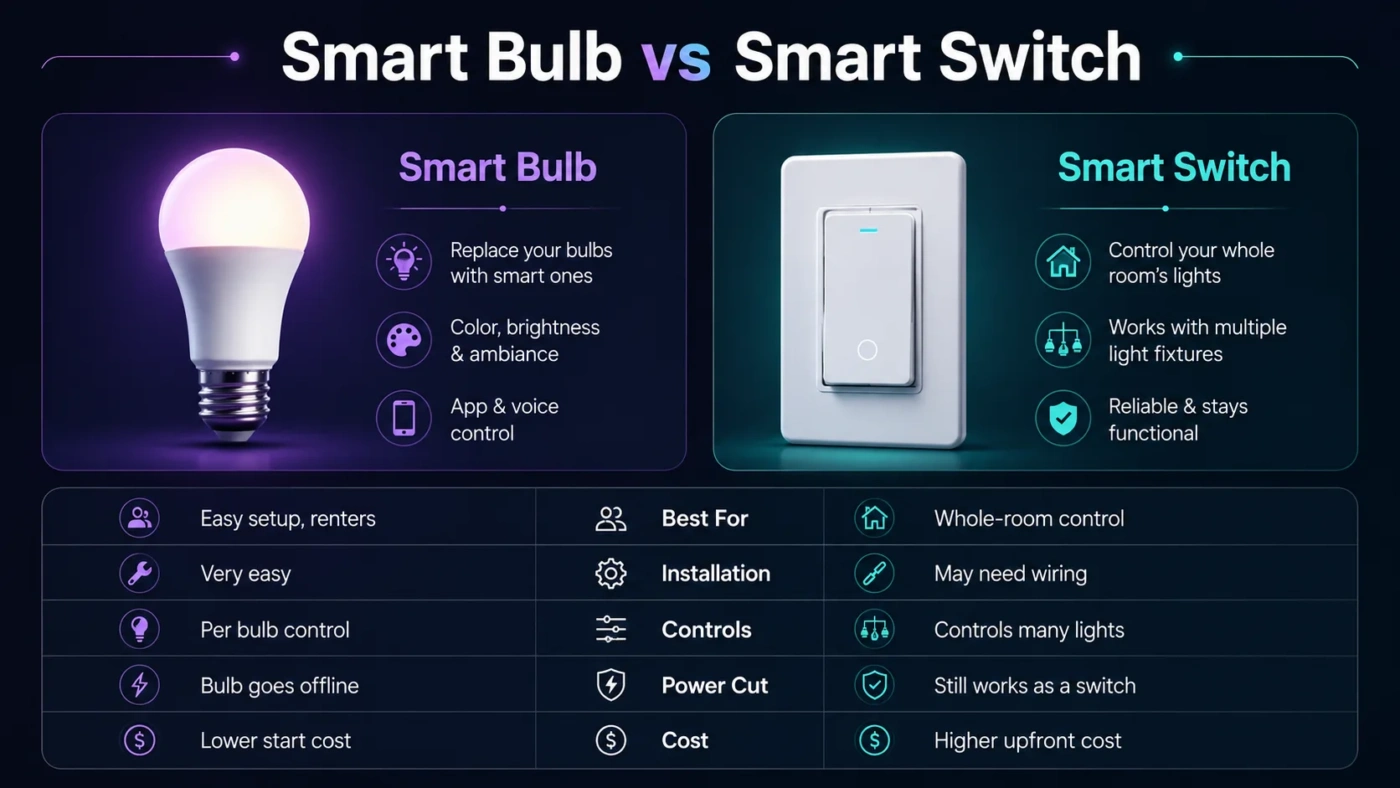
Choosing between a smart bulb and a smart switch is not really about which one is “smarter.” It is about where you want the intelligence to live: inside the bulb itself or inside the wall control. A smart bulb is usually better when you want color, renter-friendly setup, or control over a single lamp. A smart switch is usually better when you want the wall switch to keep working normally, especially for ceiling lights, multi-bulb fixtures, hallways, kitchens, and shared rooms.
- Smart Bulb vs Smart Switch: The Short Decision
- What Is a Smart Bulb?
- What Smart Bulbs Do Well
- What Is a Smart Switch?
- What Smart Switches Do Well
- Main Differences Between Smart Bulbs and Smart Switches
- Control Location
- Color and Ambience
- Installation Difficulty
- Neutral Wire and Wiring Compatibility
- Manual Control
- Multi-Bulb Rooms
- Reliability and Network Load
- When a Smart Bulb Is the Better Choice
- You Want Color or Tunable White Light
- You Rent or Do Not Want Electrical Work
- You Are Starting Small
- You Want Individual Bulb Control
- When a Smart Switch Is the Better Choice
- You Want the Wall Switch to Keep Working Normally
- You Have Ceiling Lights or Built-In Fixtures
- You Have Several Bulbs on One Circuit
- You Want a More Permanent Upgrade
- Price and Value: Which One Costs Less?
- Performance Differences in Real Use
- Response Time
- Automation Behavior
- Power Outage Behavior
- Voice Assistant Experience
- Smart Bulb Misunderstandings
- “A Smart Bulb Works Fine Even If the Wall Switch Is Off”
- “All Smart Bulbs Need a Hub”
- “Smart Bulbs Are Only for Color Effects”
- Smart Switch Misunderstandings
- “A Smart Switch Gives Any Bulb Color Control”
- “Any Smart Switch Works in Any Home”
- “Smart Switches Are Always Better Than Smart Bulbs”
- Can You Use a Smart Bulb and a Smart Switch Together?
- Room-by-Room Recommendation
- Choose a Smart Bulb If
- Choose a Smart Switch If
- Which One Should You Choose?
- FAQ About Smart Bulb vs Smart Switch
- Is a Smart Bulb Better Than a Smart Switch?
- Do Smart Bulbs Use Power When Off?
- Do Smart Switches Work With Regular Bulbs?
- Do I Need a Neutral Wire for a Smart Switch?
- Can a Smart Switch Control Smart Bulbs?
- Which Is Better for Renters?
- Which Is Better for a Kitchen?
- Which Is Better for a Bedroom?
| Feature | Smart Bulb | Smart Switch |
|---|---|---|
| Best Use Case | Single lamps, bedrooms, mood lighting, color scenes, renters, and small setups | Ceiling lights, multi-bulb fixtures, kitchens, hallways, bathrooms, and shared spaces |
| Main Control Point | The bulb itself connects to an app, hub, or voice assistant | The wall switch controls power and smart features for the light circuit |
| Installation | Very easy: screw in the bulb and pair it in the app | More involved: replaces the wall switch and may need correct wiring |
| Neutral Wire Need | Usually not relevant at the wall switch because the bulb gets power from the fixture | Many models need a neutral wire, though some no-neutral models exist |
| Color Control | Strong option for RGB color, tunable white, warm-to-cool lighting, and scenes | Usually controls on/off or dimming only; it does not add color to normal bulbs |
| Manual Wall Switch Problem | If someone turns the wall switch off, the bulb loses power and smart control stops | The physical switch remains useful, so guests and family can control lights normally |
| Multi-Bulb Fixtures | Can become costly because each bulb may need to be smart | Often better value because one switch can control several regular bulbs |
| Typical Cost Pattern | Often about $8–$35 per bulb, depending on color, brand, protocol, and features | Often about $15–$70 per switch, depending on dimming, wiring type, and ecosystem |
| Dimming | Handled inside the smart bulb through the app, automation, or voice control | Requires a smart dimmer model and compatible dimmable bulbs or fixtures |
| Best For Renters | Usually the safer and easier choice because it avoids electrical work | Less ideal unless the renter has permission and can restore the original switch |
| Best For Whole-Room Control | Good only when every bulb in the room is smart and always powered | Usually better because it controls the room from the wall like a normal switch |
| Long-Term Convenience | Great for flexible lighting, but can be annoying if people keep using old switches | More natural for daily use because it fits normal household habits |
Smart Bulb vs Smart Switch: The Short Decision
Choose a smart bulb if you want simple setup, color lighting, tunable white light, lamp control, or a renter-friendly smart home upgrade. It is the cleaner choice when you only need to automate one or two bulbs and you do not want to touch wiring.
Choose a smart switch if you want smart control for a ceiling fixture, several bulbs at once, or a room where people still expect the wall switch to work. It is usually the better long-term choice for kitchens, bathrooms, hallways, dining rooms, garages, entryways, and shared living spaces.
The easiest rule is this: smart bulbs are best for changing the light itself; smart switches are best for changing how the room is controlled.
What Is a Smart Bulb?
A smart bulb is a light bulb with built-in wireless control. Depending on the model, it may connect through Wi-Fi, Bluetooth, Zigbee, Thread, Matter, or a brand hub. Once paired, you can turn it on or off, dim it, schedule it, group it with other lights, or control it with a voice assistant.
Smart bulbs are popular because they are easy to understand. You remove the old bulb, install the smart bulb, open the app, and pair it. No wall plate removal. No wire checking. No circuit work. For many people, that is the whole appeal.
What Smart Bulbs Do Well
- They add color lighting without changing the wall switch.
- They work well in lamps, bedside lights, desks, and accent lighting.
- They let you create scenes such as warm evening light, bright work light, or soft night lighting.
- They are easy to move from one room to another.
- They are usually the simplest smart lighting upgrade for renters.
The trade-off is power. A smart bulb needs constant electricity so its wireless radio can stay connected. If someone turns off the regular wall switch, the bulb becomes unavailable in the app until power returns. This is the most common daily annoyance with smart bulbs.
What Is a Smart Switch?
A smart switch replaces a regular wall switch. Instead of making each bulb smart, it makes the wall control smart. The switch can turn the light circuit on or off, dim lights if it is a dimmer model, run schedules, connect to voice assistants, and respond to automations.
This approach feels more natural in a house because the wall switch still behaves like a wall switch. A guest can walk into the room and press it. A child can use it. Someone who does not care about apps can still control the light normally.
What Smart Switches Do Well
- They control several bulbs from one place.
- They keep physical control simple for everyone in the home.
- They are usually better for ceiling lights and built-in fixtures.
- They avoid the “someone turned off the switch” problem that affects smart bulbs.
- They can be more cost-effective in rooms with many bulbs.
The trade-off is installation. A smart switch may need a neutral wire, a ground wire, correct box depth, a compatible load type, and safe wiring. Some homes, especially older ones, may not have a neutral wire in every switch box. No-neutral smart switches exist, but compatibility still matters.
Main Differences Between Smart Bulbs and Smart Switches
Control Location
A smart bulb puts control inside the bulb. A smart switch puts control at the wall. That sounds simple, but it changes the whole user experience.
With a smart bulb, the bulb must stay powered. The app, automation, and voice assistant talk to the bulb. With a smart switch, the switch stays powered and controls the lighting circuit. For daily use, this often makes smart switches feel closer to normal lighting.
Color and Ambience
Smart bulbs win for color. If you want RGB lighting, warm-to-cool white tuning, reading scenes, movie scenes, or softer bedroom lighting, a smart bulb gives you more creative control.
A smart switch does not magically turn regular bulbs into color bulbs. It can only control the power or dimming behavior of the bulbs attached to the circuit. For color scenes, you need smart bulbs or smart fixtures designed for color control.
Installation Difficulty
Smart bulbs are easier. You install them like normal bulbs and pair them in an app. That makes them a good first smart home device.
Smart switches require electrical work. You need to turn off power at the breaker, remove the old switch, check the wiring, connect the new switch correctly, and test it. Many homeowners can do this safely if they understand wiring, but not everyone should. If you are unsure, hiring a qualified electrician is the safer route.
Neutral Wire and Wiring Compatibility
Smart bulbs usually avoid the neutral-wire question because the bulb connects at the fixture, not inside the switch box. Smart switches are different. Many wired smart switches need a neutral wire so the switch can power its electronics even when the light is off.
No-neutral smart switches can solve this in some homes, but they may have limits with certain LED bulbs, minimum loads, dimming behavior, multi-way circuits, or fixture types. Before buying a smart switch, check:
- whether your switch box has a neutral wire,
- whether the circuit is single-pole, three-way, or four-way,
- whether the switch supports dimming,
- whether your bulbs are compatible with that dimmer,
- whether the wall box has enough room for the smart switch body.
Manual Control
This is where smart switches usually win. In most homes, people naturally use wall switches. If you install smart bulbs but keep the old switch, someone may turn the switch off. Then your smart bulb cannot receive commands.
You can solve this with smart buttons, switch guards, wireless remotes, or “smart bulb mode” on some advanced switches. Still, that adds planning. A smart switch avoids the issue by making the wall control itself smart.
Multi-Bulb Rooms
If a dining room fixture has six bulbs, buying six smart bulbs can cost more than installing one smart switch. A smart switch can control all six normal LED bulbs together.
But if you want each bulb to show a different color or brightness, smart bulbs are the better fit. Smart switches control the group. Smart bulbs can control each light point separately.
Reliability and Network Load
A home with many Wi-Fi smart bulbs can add many devices to the router. That may be fine on a strong modern network, but weaker routers can feel crowded. Hub-based bulbs using Zigbee, Thread, or another low-power mesh setup may reduce Wi-Fi clutter.
A smart switch can be simpler from a network point of view because one device controls several bulbs. For a ceiling fixture with multiple lights, that can mean fewer connected devices, fewer app entries, and easier automation.
When a Smart Bulb Is the Better Choice
You Want Color or Tunable White Light
If your main goal is atmosphere, choose a smart bulb. Color bulbs and tunable white bulbs can shift from cool task lighting during the day to warm light at night. That is useful in bedrooms, gaming rooms, reading corners, home offices, and living rooms.
A smart switch can dim compatible bulbs, but it cannot create blue, green, amber, or warm-to-cool white changes from a basic bulb.
You Rent or Do Not Want Electrical Work
Smart bulbs are usually the better fit for renters. You can install them without changing the property’s wiring. When you move, you take the bulbs with you and put the original bulbs back.
A smart switch may still be possible in a rental, but it usually needs permission. It also requires restoring the original setup later, which adds effort.
You Are Starting Small
If you want to test smart lighting in one lamp or one bedroom, a smart bulb is the simplest path. You can learn the app, try schedules, test voice control, and decide whether you like smart lighting before changing wall switches.
You Want Individual Bulb Control
Smart bulbs let you control each bulb separately. That is useful when one lamp should stay dim while another stays bright, or when you want one side of a room warmer than the other.
Smart switches are usually better for group control, not individual bulb control.
When a Smart Switch Is the Better Choice
You Want the Wall Switch to Keep Working Normally
If people in your home use wall switches out of habit, a smart switch is usually the cleaner choice. The app remains useful, but nobody has to learn a new routine just to turn on a light.
This matters more than many buyers expect. Smart lighting should reduce friction, not create a small argument every time someone flips the “wrong” switch.
You Have Ceiling Lights or Built-In Fixtures
Smart switches are often better for ceiling fixtures, recessed lights, bathroom lights, hallway lights, and garage lights. These are lights people expect to control from the wall. They also often have multiple bulbs or fixed fixtures where changing every bulb is not ideal.
You Have Several Bulbs on One Circuit
One smart switch can control a group of regular bulbs. That can make the total cost lower and the setup easier to manage.
For example, a kitchen with eight recessed lights may be more practical with one smart dimmer than eight separate smart bulbs. You get app control, schedules, voice control, and physical dimming without managing eight devices.
You Want a More Permanent Upgrade
Smart switches feel like a home upgrade rather than a gadget added to a bulb socket. They stay in place, keep the wall control familiar, and can make the lighting system easier for future users of the home.
Price and Value: Which One Costs Less?
A single smart bulb is usually cheaper than a single smart switch. For one lamp, the bulb wins on price and effort.
The math changes when one switch controls many bulbs. A smart switch that controls four, six, or eight normal LED bulbs can be the better value. You buy one connected device instead of many.
| Setup Type | Better Value Choice | Why It Usually Makes Sense |
|---|---|---|
| One Table Lamp | Smart Bulb | Low cost, no wiring, easy to move, simple app setup |
| Two Bedroom Lamps | Smart Bulb | Individual control, dimming, warm light scenes, renter-friendly setup |
| Four-Bulb Ceiling Fixture | Smart Switch | One switch controls the whole fixture without buying four smart bulbs |
| Kitchen Recessed Lights | Smart Switch | Better wall control and lower device count for many lights |
| Color Mood Lighting | Smart Bulb | Color and tunable white features come from the bulb, not the switch |
| Shared Hallway | Smart Switch | Everyone can still use the wall switch normally |
Performance Differences in Real Use
Response Time
Both smart bulbs and smart switches can respond fast when the network is healthy. The bigger difference is not speed; it is reliability of access. A smart bulb that has been switched off at the wall cannot respond at all. A smart switch usually remains available because it is designed to stay powered.
Automation Behavior
Smart bulbs are excellent for scenes: “dim the lamp to 20%,” “turn the bedroom warm white,” or “make the desk light cool white.” Smart switches are better for room behavior: “turn off the hallway at midnight,” “turn on the porch light at sunset,” or “turn off all ceiling lights when leaving.”
Power Outage Behavior
After power returns, some smart bulbs may turn on based on their power-on settings. Many modern bulbs let you choose what happens after a power loss, but the options vary by brand and model.
Smart switches usually behave more like a regular wall switch after power returns, though app state, schedules, and automations may depend on the switch model and platform.
Voice Assistant Experience
Both can work well with Alexa, Google Home, Apple Home, SmartThings, or other smart home systems, depending on the device. For voice control, the question is not only “Does it work?” but also “Will the light still be reachable?”
If a smart bulb loses power because the wall switch is off, voice control fails until someone turns the switch back on. A smart switch avoids that common issue.
Smart Bulb Misunderstandings
“A Smart Bulb Works Fine Even If the Wall Switch Is Off”
No. A smart bulb needs power. If the wall switch cuts power, the bulb cannot stay connected to the app or voice assistant. This is the main reason smart bulbs can be frustrating in shared rooms.
“All Smart Bulbs Need a Hub”
Not always. Some smart bulbs connect directly through Wi-Fi or Bluetooth. Others use a hub or bridge through Zigbee, Thread, or a brand ecosystem. Hub-based systems can be better for larger lighting setups, while Wi-Fi bulbs can be easier for small setups.
“Smart Bulbs Are Only for Color Effects”
No. Many smart bulbs are plain white or tunable white. They can still be useful for schedules, dimming, sunrise routines, night lighting, and remote control. Color is optional, not required.
Smart Switch Misunderstandings
“A Smart Switch Gives Any Bulb Color Control”
No. A smart switch can turn lights on or off and may dim compatible bulbs. It cannot make a regular white LED bulb change color. For color control, you need a color-capable smart bulb or smart fixture.
“Any Smart Switch Works in Any Home”
No. Wiring matters. Some smart switches require a neutral wire. Some work only with certain load types. Some are made for single-pole circuits, while others support three-way setups. Always match the switch to your wiring and fixture type.
“Smart Switches Are Always Better Than Smart Bulbs”
Not always. A smart switch is often better for room control, but it is not the right answer for every lamp, color scene, rental room, or decorative fixture. Smart bulbs still make more sense when you want light quality control rather than wall-control control.
Can You Use a Smart Bulb and a Smart Switch Together?
Yes, but it needs the right setup. A normal smart switch that cuts power can cause problems with smart bulbs because the bulbs need constant electricity. If the switch turns off the circuit, the bulbs go offline.
Some advanced switches include a smart bulb mode, detached relay mode, or scene-control mode. In that setup, the switch can send commands to the bulbs without cutting power. This can give you the best of both worlds: color smart bulbs plus a usable wall control.
This combination is worth considering if you want color bulbs in a ceiling fixture but still want a real wall switch experience. Just make sure the switch, bulbs, hub, and platform all support the behavior you need.
Room-by-Room Recommendation
| Room or Area | Recommended Choice | Reason |
|---|---|---|
| Bedroom Lamps | Smart Bulb | Great for dimming, warm light, bedtime routines, and individual control |
| Living Room Ceiling Light | Smart Switch | Better for shared use and normal wall control |
| Kitchen | Smart Switch | Controls many lights together and keeps daily use simple |
| Home Office Desk Lamp | Smart Bulb | Useful for brightness control and warm-to-cool light changes |
| Hallway | Smart Switch | Physical control matters more than color or scenes |
| Bathroom | Smart Switch | Simple wall control is usually more practical |
| Accent Lamp | Smart Bulb | Easy setup and strong mood-lighting control |
| Porch Light | Smart Switch or Smart Bulb | Switch for fixed control; bulb if installation must stay simple |
| Garage | Smart Switch | Better for grouped lights and practical on/off control |
Choose a Smart Bulb If
- You want color, tunable white, or scene lighting.
- You are controlling a lamp rather than a ceiling circuit.
- You rent and want a removable setup.
- You want the lowest-effort installation.
- You only need one or two smart lights.
- You want individual control over each bulb.
- You do not want to open a wall switch box.
A smart bulb is the more flexible choice for lighting personality. It changes how the light looks, feels, and behaves. For bedrooms, desks, floor lamps, and accent lighting, that flexibility is often more valuable than wall-switch control.
Choose a Smart Switch If
- You want the wall switch to work normally.
- You have ceiling lights or recessed lights.
- You want to control many bulbs with one device.
- You care more about practical room control than color effects.
- You are making a more permanent smart home upgrade.
- You want fewer connected devices on your network.
- You have a shared space where guests, children, or family members use the lights.
A smart switch is the more practical choice for everyday lighting. It keeps the familiar switch experience while adding schedules, app control, automations, and voice control. For whole-room lighting, it usually creates fewer headaches.
Which One Should You Choose?
For most homes, the best answer is not one or the other. It is smart switches for main room lighting and smart bulbs for lamps, color lighting, and accent areas.
Choose a smart bulb when you want the light itself to do more: change color, shift warmth, dim gently, or create a scene. Choose a smart switch when you want the room to behave better: normal wall control, reliable access, grouped lighting, and simple use for everyone.
If you are buying your first smart lighting device, start with a smart bulb in a lamp. It is easy, low-risk, and useful. If you already know you want to automate ceiling lights or a room with several bulbs, start with a smart switch instead.
The clearest decision is this: pick a smart bulb for flexible light control; pick a smart switch for reliable room control. That one sentence solves most smart bulb vs smart switch decisions.
FAQ About Smart Bulb vs Smart Switch
Is a Smart Bulb Better Than a Smart Switch?
A smart bulb is better for color, tunable white light, lamps, and easy setup. A smart switch is better for ceiling lights, multi-bulb rooms, and homes where people still use wall switches. The better choice depends on the room and how the light is used.
Do Smart Bulbs Use Power When Off?
Yes, a smart bulb uses a small amount of standby power so it can stay connected and respond to commands. If the wall switch is turned off, the bulb loses power and cannot respond until power returns.
Do Smart Switches Work With Regular Bulbs?
Yes, many smart switches work with regular LED, incandescent, or halogen bulbs, depending on the switch model and load rating. If you want dimming, make sure both the switch and bulbs support compatible dimming.
Do I Need a Neutral Wire for a Smart Switch?
Many smart switches need a neutral wire, but not all of them. Some no-neutral models are made for older homes. Before buying, check your switch box and read the switch’s wiring requirements carefully.
Can a Smart Switch Control Smart Bulbs?
It can, but a normal smart switch may cut power to the bulbs, which can make them go offline. For the best setup, use a switch with smart bulb mode, scene control, or a detached relay feature if your ecosystem supports it.
Which Is Better for Renters?
A smart bulb is usually better for renters because it does not require wall wiring changes. It can be removed easily when moving out. A smart switch may require permission and proper restoration later.
Which Is Better for a Kitchen?
A smart switch is usually better for a kitchen because kitchens often have several ceiling or recessed lights controlled from wall switches. One smart switch can control the group while keeping normal manual control.
Which Is Better for a Bedroom?
For bedside lamps, smart bulbs are usually better because they offer dimming, warm light, and personal control. For the main ceiling light, a smart switch is often more practical.