Bluetooth 5.0 and Bluetooth 5.3 can both handle modern wireless devices, but they are not equal choices when you are buying earbuds, a phone, a smartwatch, a laptop, a keyboard, a mouse, a tracker, or a smart home device. The short answer is simple: choose Bluetooth 5.3 when the price is close, especially for newer portable devices where battery use, connection stability, and long-term compatibility matter. Choose Bluetooth 5.0 only when the device is cheaper, your needs are basic, and you do not expect the latest Bluetooth LE improvements.
- Bluetooth 5.0 vs 5.3: The Main Difference
- What Is Bluetooth 5.0?
- What Bluetooth 5.0 Does Well
- Where Bluetooth 5.0 Feels Older
- What Is Bluetooth 5.3?
- What Bluetooth 5.3 Adds In Real Use
- Performance Comparison: Speed, Range, Battery, And Stability
- Speed
- Range
- Battery Life
- Connection Stability
- Bluetooth 5.0 vs 5.3 For Headphones And Earbuds
- Bluetooth 5.0 vs 5.3 For Gaming
- Bluetooth 5.0 vs 5.3 For Smartwatches And Fitness Trackers
- Bluetooth 5.0 vs 5.3 For Smart Home Devices
- Bluetooth 5.0 vs 5.3 For Laptops, Phones, And Tablets
- Price And Value: Is Bluetooth 5.3 Worth Paying More?
- Common Misunderstandings About Bluetooth 5.0 And 5.3
- Misunderstanding 1: Bluetooth 5.3 Always Sounds Better
- Misunderstanding 2: Bluetooth 5.3 Is Always Faster Than Bluetooth 5.0
- Misunderstanding 3: Bluetooth Version Alone Determines Range
- Misunderstanding 4: Every Bluetooth 5.3 Device Uses Every 5.3 Feature
- Misunderstanding 5: Bluetooth 5.0 Is Obsolete
- When You Should Choose Bluetooth 5.0
- When You Should Choose Bluetooth 5.3
- Which One Should You Choose?
- Buyer Fit: Bluetooth 5.0 Or Bluetooth 5.3?
- Choose Bluetooth 5.0 If You Are A Budget Buyer
- Choose Bluetooth 5.3 If You Want A Newer Daily Device
- Choose Bluetooth 5.3 If Battery Life Matters
- Choose Based On The Whole Product For Audio
- Final Buying Rule
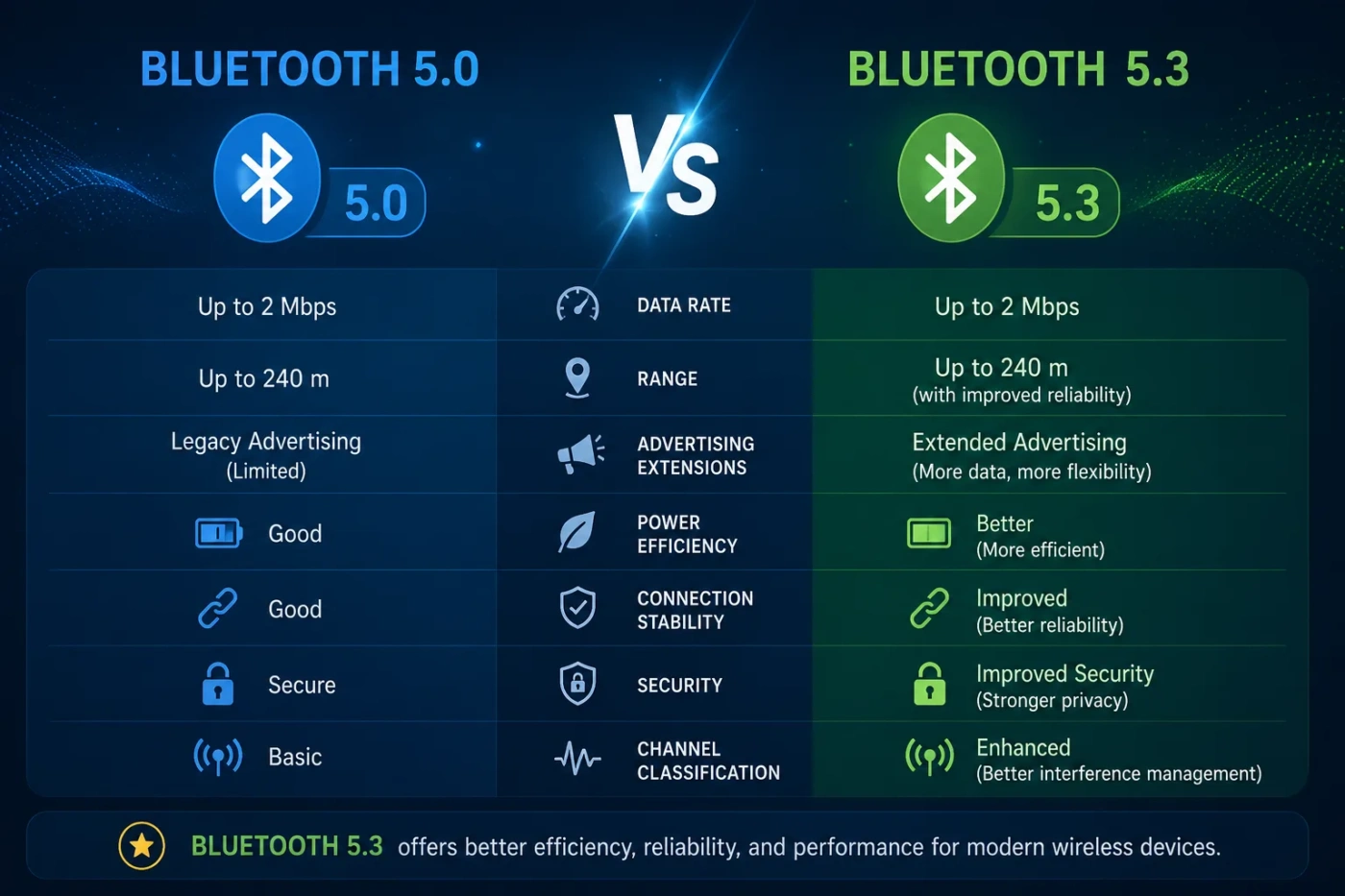
| Feature | Bluetooth 5.0 | Bluetooth 5.3 |
|---|---|---|
| Best For | Basic wireless audio, older phones, simple accessories, budget devices | Newer earbuds, wearables, sensors, smart devices, and low-power accessories |
| Release Era | Older Bluetooth 5 generation | Newer refinement within the Bluetooth 5 family |
| Maximum Bluetooth LE Speed | Up to 2 Mbps at the physical layer with LE 2M PHY | Same Bluetooth LE speed ceiling; improvements focus more on efficiency and reliability |
| Range Potential | Supports long-range Bluetooth LE through LE Coded PHY when implemented | Also supports long-range Bluetooth LE, with newer connection management improvements |
| Battery Efficiency | Good, especially compared with older Bluetooth versions | Usually better for supported low-power use cases because of improved connection handling |
| Connection Stability | Good in normal conditions | Better potential in crowded 2.4 GHz environments due to channel classification improvements |
| Audio Quality | Not automatically worse; depends on codecs, device tuning, antenna design, and profiles | Not automatically better; version alone does not guarantee better sound |
| LE Audio Readiness | Not the best buying target for newer LE Audio-focused devices | More suitable for modern Bluetooth LE products, depending on actual device support |
| Backward Compatibility | Works with many older and newer Bluetooth devices | Works with older Bluetooth devices, but advanced features require support on both sides |
| Value Today | Acceptable when the product is low-cost and simple | Better default choice for most new purchases |
Bluetooth 5.0 vs 5.3: The Main Difference
The main difference is not raw speed. Bluetooth 5.0 introduced major Bluetooth LE upgrades, including faster LE data transfer, longer-range options, and better advertising capacity compared with older Bluetooth versions. Bluetooth 5.3 builds on that base with cleaner connection behavior, better energy handling, and improved reliability tools for supported devices.
That means Bluetooth 5.3 is not a dramatic “more Mbps” upgrade over Bluetooth 5.0. It is a more polished version for real devices: earbuds that need to wake quickly, wearables that must save battery, sensors that send small packets, and accessories that operate near Wi-Fi routers, laptops, phones, and other 2.4 GHz devices.
For a buyer, the practical difference is this: Bluetooth 5.3 is the safer choice for newer products, while Bluetooth 5.0 is still usable for simple needs.
What Is Bluetooth 5.0?
Bluetooth 5.0 is an older member of the Bluetooth 5 family. It was a major step for Bluetooth Low Energy because it added support for faster LE transfer through LE 2M PHY and longer-range communication through LE Coded PHY, when those features are included in the device.
In plain language, Bluetooth 5.0 helped Bluetooth LE move beyond very basic low-power accessories. It made room for better sensors, improved device discovery, stronger smart home use cases, and faster small data transfers.
What Bluetooth 5.0 Does Well
- It can support 2 Mbps Bluetooth LE physical-layer speed when both devices support LE 2M PHY.
- It can support longer Bluetooth LE range through LE Coded PHY.
- It works well for many headphones, speakers, keyboards, mice, trackers, watches, and controllers.
- It is widely supported across older phones, laptops, tablets, and accessories.
- It is often cheaper because many Bluetooth 5.0 products are older or more budget-focused.
Where Bluetooth 5.0 Feels Older
Bluetooth 5.0 can still be fine, but it lacks some later refinements that help devices manage connections more efficiently. You may not notice this on a basic Bluetooth speaker. You may notice it more on small battery-powered devices such as earbuds, medical accessories, smart tags, wearables, and wireless sensors.
Another important point: a product saying “Bluetooth 5.0” does not mean it supports every Bluetooth 5.0 feature. Some devices include the version number but skip certain optional capabilities. The chip, firmware, antenna, software profile, codec support, and product design all affect real use.
What Is Bluetooth 5.3?
Bluetooth 5.3 is a newer update within the Bluetooth 5 family. It keeps the core strengths of Bluetooth 5.0 but adds improvements that help supported devices use less energy, avoid poor channels more intelligently, and switch connection behavior more smoothly.
Bluetooth 5.3 is especially relevant for Bluetooth LE devices. That includes earbuds, hearing assistance products, fitness trackers, smartwatches, health sensors, smart locks, beacons, remotes, and other devices that need to stay connected without wasting battery.
What Bluetooth 5.3 Adds In Real Use
- Connection Subrating: Helps a device move between low-power and higher-activity connection states more efficiently.
- Channel Classification Enhancement: Allows better handling of radio conditions, which can help reliability in some environments.
- Periodic Advertising Enhancement: Helps devices avoid extra processing of repeated broadcast data.
- Encryption Key Size Control Improvements: Improves how certain Bluetooth Classic devices handle encryption key size control.
- Cleaner Bluetooth LE Behavior: Useful for devices that send small amounts of data often or stay connected for long periods.
These changes are not always visible as a simple speed test result. They often show up as smoother pairing behavior, better battery life in supported use cases, fewer small connection problems, or better performance in busy wireless areas.
Performance Comparison: Speed, Range, Battery, And Stability
Speed
Bluetooth 5.0 and Bluetooth 5.3 can both support the same headline Bluetooth LE physical-layer speed of up to 2 Mbps through LE 2M PHY. So if you are asking, “Is Bluetooth 5.3 faster than 5.0?” the honest answer is: not by version number alone.
Actual transfer speed depends on the device type, Bluetooth profile, signal quality, distance, firmware, phone or laptop support, and whether both sides support the same mode. For audio, the codec matters more than the version number. SBC, AAC, aptX, LDAC, LC3, and device tuning can all affect the listening experience.
Range
Bluetooth 5.0 brought stronger long-range Bluetooth LE options compared with older versions. Bluetooth 5.3 can use those same Bluetooth LE range features when the device supports them.
Still, range is not only a Bluetooth version issue. Walls, human bodies, metal surfaces, antenna placement, router interference, device power limits, and product design can change the result. A well-designed Bluetooth 5.0 device can outperform a poorly designed Bluetooth 5.3 device in range.
Battery Life
This is one of the areas where Bluetooth 5.3 can matter more. Bluetooth 5.3 includes improvements that can help supported devices spend less time doing unnecessary work. That is useful for earbuds, smartwatches, trackers, hearing assistance devices, and small sensors.
Bluetooth 5.0 is already efficient compared with older Bluetooth generations, but Bluetooth 5.3 is usually the better target when battery life is part of the buying decision.
Connection Stability
Bluetooth 5.3 has a clear advantage in supported Bluetooth LE connections because it improves how devices can classify wireless channels. In a busy home, office, gym, airport, or apartment building, many devices compete in the 2.4 GHz band. Better channel information can help reduce packet issues in some cases.
That does not mean Bluetooth 5.0 is unstable. It simply means Bluetooth 5.3 gives newer devices better tools for keeping a clean connection when radio conditions are not ideal.
Bluetooth 5.0 vs 5.3 For Headphones And Earbuds
For headphones and earbuds, Bluetooth 5.3 is usually the better choice if the price difference is small. It is more aligned with modern low-power audio products, newer chips, and newer device ecosystems.
But do not buy earbuds based only on the Bluetooth version. Audio quality depends on several other details:
- Bluetooth codec support
- Driver quality
- Microphone tuning
- Noise cancellation processing
- Antenna design
- Phone compatibility
- App and firmware support
- Battery size and charging case design
A well-built Bluetooth 5.0 headphone can sound better than a cheap Bluetooth 5.3 headphone. Still, when two products are close in build quality and price, Bluetooth 5.3 is the smarter pick.
Bluetooth 5.0 vs 5.3 For Gaming
Bluetooth is not always the best option for low-latency gaming, regardless of version. Many gaming headsets, mice, and controllers use a dedicated 2.4 GHz wireless dongle because it can offer lower latency and more predictable performance.
For casual gaming, Bluetooth 5.3 is the better choice because it belongs to a newer generation of devices and may offer better connection behavior. For competitive gaming, check for:
- Dedicated 2.4 GHz mode
- Low-latency codec support
- USB-C dongle support
- Polling rate for mice and keyboards
- Console compatibility
If the product is only Bluetooth and you care about delay, Bluetooth 5.3 is preferable, but the full product design still matters more than the version label.
Bluetooth 5.0 vs 5.3 For Smartwatches And Fitness Trackers
Bluetooth 5.3 is the better fit for smartwatches and fitness trackers. These devices often maintain long-running phone connections, sync health data, show notifications, control music, and switch between quiet and active states throughout the day.
Connection subrating and related Bluetooth LE improvements can help devices handle these changing states more efficiently. That can support smoother behavior and better battery use when the hardware and software are designed well.
Bluetooth 5.0 can still work fine for basic watches and trackers, especially if you only need step tracking, occasional syncing, and simple alerts. For a new device you plan to wear daily, Bluetooth 5.3 is the better buying target.
Bluetooth 5.0 vs 5.3 For Smart Home Devices
For smart locks, sensors, beacons, remote controls, lighting accessories, and small home devices, Bluetooth 5.3 is more attractive. Many of these products send small data packets, stay idle for long periods, and need reliable low-power communication.
Bluetooth 5.0 is still common in budget smart home products, but Bluetooth 5.3 gives manufacturers newer tools for energy management and connection reliability. If you are building a newer smart home setup, Bluetooth 5.3 offers better long-term value.
Bluetooth 5.0 vs 5.3 For Laptops, Phones, And Tablets
For phones, tablets, and laptops, Bluetooth 5.3 is the better option when buying new hardware. These devices connect to many accessories: earbuds, keyboards, mice, speakers, controllers, watches, styluses, car systems, and file-transfer accessories.
A newer Bluetooth version can help with compatibility over time, especially as more accessories use modern Bluetooth LE features. Bluetooth 5.0 is not a deal-breaker on an older laptop or phone, but it is less appealing on a new device unless the price is very low.
Price And Value: Is Bluetooth 5.3 Worth Paying More?
Bluetooth 5.3 is worth paying more for when the price difference is small, especially on devices you use every day. For example, if two earbuds are only $10–$20 apart and the Bluetooth 5.3 model also has better battery life, better microphones, or newer app support, choose the Bluetooth 5.3 model.
Bluetooth 5.0 can still make sense when the discount is large. A simple Bluetooth 5.0 speaker, keyboard, mouse, or budget headphone can be a good buy if it works well and you do not need newer Bluetooth LE behavior.
Use this simple value rule:
- Small price gap: Choose Bluetooth 5.3.
- Large discount: Bluetooth 5.0 can be fine for basic use.
- Daily portable device: Prefer Bluetooth 5.3.
- Audio-first purchase: Check codec, tuning, battery, and reviews along with Bluetooth version.
- Gaming purchase: Look for low-latency mode or a dedicated dongle, not just Bluetooth 5.3.
Common Misunderstandings About Bluetooth 5.0 And 5.3
Misunderstanding 1: Bluetooth 5.3 Always Sounds Better
Bluetooth 5.3 does not automatically improve sound quality. The codec, speaker driver, amplifier, microphone system, noise cancellation, and tuning make a larger difference. Bluetooth 5.3 can support a newer product platform, but it is not a sound-quality guarantee by itself.
Misunderstanding 2: Bluetooth 5.3 Is Always Faster Than Bluetooth 5.0
Both can support the same headline Bluetooth LE 2 Mbps physical-layer speed. Bluetooth 5.3 is more about efficiency, connection behavior, and reliability improvements than a simple speed increase.
Misunderstanding 3: Bluetooth Version Alone Determines Range
Range depends on more than the Bluetooth version. Antenna quality, transmit power, device size, walls, interference, and body blocking all matter. A tiny earbud and a larger speaker will not perform the same just because they share a Bluetooth version.
Misunderstanding 4: Every Bluetooth 5.3 Device Uses Every 5.3 Feature
Some features are optional or depend on the product type. A device can list Bluetooth 5.3 but still not support every newer feature you expect. Always check the product details when a certain feature matters.
Misunderstanding 5: Bluetooth 5.0 Is Obsolete
Bluetooth 5.0 is older, but not useless. It is still fine for many basic accessories. The issue is value: if a Bluetooth 5.3 product costs almost the same, it usually makes more sense to choose the newer option.
When You Should Choose Bluetooth 5.0
Choose Bluetooth 5.0 when your needs are simple and the device is clearly better priced. It is still a practical choice for basic accessories that do not need advanced low-power behavior.
- You are buying a low-cost speaker for casual listening.
- You need a basic keyboard, mouse, or remote.
- The Bluetooth 5.0 product is much cheaper than the Bluetooth 5.3 option.
- You do not need newer Bluetooth LE features.
- You are using older phones, tablets, or laptops.
- The product has strong reviews and good real-world battery life.
Bluetooth 5.0 is not a bad choice when the product itself is good. It only becomes less attractive when it is priced close to a newer Bluetooth 5.3 alternative.
When You Should Choose Bluetooth 5.3
Choose Bluetooth 5.3 for most new purchases, especially when buying small battery-powered devices. It is the better option for users who want newer wireless behavior, better efficiency potential, and stronger long-term compatibility.
- You are buying new earbuds or headphones.
- You want better battery efficiency potential.
- You use devices in busy wireless environments.
- You are buying a smartwatch, tracker, sensor, or health accessory.
- You want a device that feels less dated after a few years.
- The price difference from Bluetooth 5.0 is small.
- You care about newer Bluetooth LE features.
For most people, Bluetooth 5.3 is the better default because it gives the product more room to handle modern wireless needs.
Which One Should You Choose?
Choose Bluetooth 5.3 if you are buying a new daily-use device and the price is reasonable. It is the better choice for earbuds, smartwatches, fitness trackers, phones, tablets, laptops, smart home accessories, and newer low-power devices.
Choose Bluetooth 5.0 if the device is simple, affordable, and already meets your needs. It can still be a good option for a budget speaker, keyboard, mouse, or older accessory where advanced Bluetooth LE refinements are not important.
Best overall choice: Bluetooth 5.3.
It is newer, better suited for modern low-power devices, and usually the better value when the price difference is small.
Buyer Fit: Bluetooth 5.0 Or Bluetooth 5.3?
Choose Bluetooth 5.0 If You Are A Budget Buyer
Bluetooth 5.0 is enough if you mainly want a low-cost accessory that connects reliably and does not need the latest Bluetooth LE improvements. For simple use, it can still feel smooth and dependable.
Choose Bluetooth 5.3 If You Want A Newer Daily Device
Bluetooth 5.3 is the better match for devices you use every day. Earbuds, watches, trackers, and mobile accessories benefit more from newer efficiency and connection improvements.
Choose Bluetooth 5.3 If Battery Life Matters
If you are comparing two similar devices, choose the Bluetooth 5.3 model when battery life is a priority. The Bluetooth version is not the only battery factor, but Bluetooth 5.3 gives supported products better tools for low-power operation.
Choose Based On The Whole Product For Audio
For headphones and speakers, do not judge by Bluetooth version alone. A Bluetooth 5.3 label is a good sign for newer design, but sound quality depends on codec support, acoustic tuning, microphones, noise control, and fit.
Final Buying Rule
If both products are similar in price and quality, buy the Bluetooth 5.3 device. If the Bluetooth 5.0 model is much cheaper and your needs are simple, it can still be a sensible purchase. The version number matters, but the best choice comes from matching the device to how you will actually use it.