Compost tumblers are usually easier to use if you want a cleaner, more contained system that can be turned without a fork or shovel. Compost bins are easier if you have more yard waste, more space, and prefer a low-effort pile that can sit and break down slowly. For most small homes, patios, and beginner setups, a compost tumbler feels easier day to day. For larger gardens, a compost bin is often the more practical choice.
- Main Differences
- What A Compost Bin Offers
- What A Compost Tumbler Offers
- Which One Is Easier To Use?
- Setup And Daily Use
- Odor, Pests, And Cleanliness
- Speed And Compost Quality
- Cost And Long-Term Value
- Choose A Compost Bin If
- Choose A Compost Tumbler If
- Common Misunderstandings
- A Tumbler Does Not Make Compost By Itself
- A Bin Is Not Always Harder
- Bigger Is Not Always Easier
- Both Need Brown Material
- Best Choice By User Type
- Small Glossary For Easier Composting
- FAQ
- Is A Compost Tumbler Easier Than A Compost Bin?
- Does A Compost Tumbler Work Faster?
- Can I Put Kitchen Scraps In Both?
- Which Option Is Better For A Small Yard?
- Which Option Should I Choose?
| Feature | Compost Bin | Compost Tumbler |
|---|---|---|
| Ease Of Turning | Needs a fork, shovel, or aerator tool | Rotates by hand, usually easier |
| Best For | Gardens, leaves, grass clippings, larger waste volume | Small yards, patios, kitchen scraps, cleaner handling |
| Space Needed | Needs ground space and access from above | More compact, often raised off the ground |
| Odor Control | Good if balanced, but more exposed | More contained when managed well |
| Pest Resistance | Varies by design and lid quality | Usually better because it is enclosed |
| Capacity | Often better for large batches | More limited capacity |
| Cost And Value | Usually cheaper and simpler | Often costs more, but saves turning effort |
| Best Overall Ease | Easier for passive composting | Easier for active, tidy composting |
Main Differences
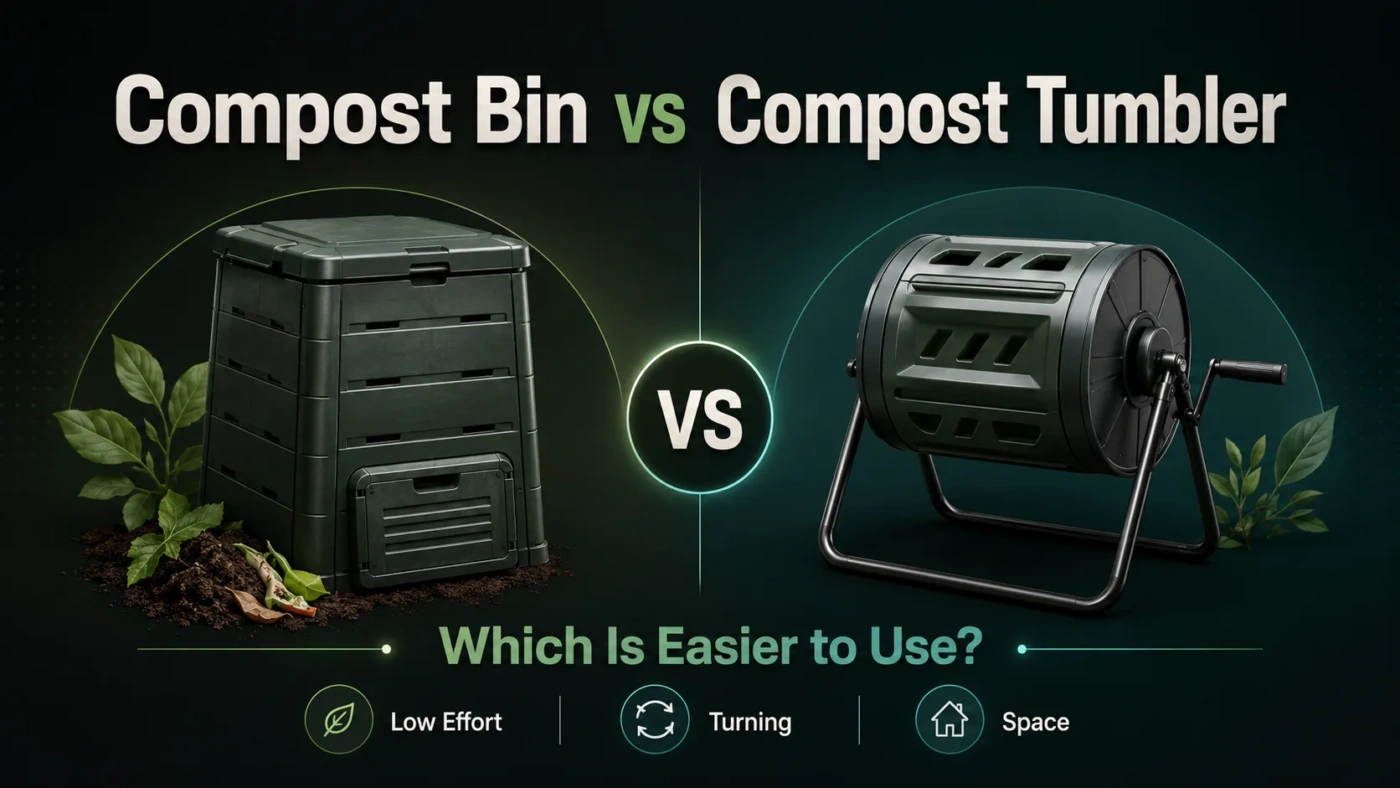
The main difference is how the compost is managed. A compost bin is usually a stationary container or open-bottom structure where organic material sits on the ground. A compost tumbler is a sealed or semi-sealed drum that rotates, allowing you to mix the contents by turning the barrel.
That one design difference changes the daily experience. With a bin, you add material and let time, air, moisture, and soil contact do much of the work. With a tumbler, you add material in smaller batches and rotate the drum to mix air through the pile.
What A Compost Bin Offers
A compost bin is the simpler option. It can be a plastic bin, wooden structure, wire enclosure, or open-bottom container. You add brown materials such as dry leaves and cardboard, green materials such as fruit peels and fresh plant waste, and enough moisture to keep the pile active.
The strongest advantage of a bin is capacity. If your yard produces bags of leaves, grass clippings, dead plants, and garden trimmings, a bin handles that volume more comfortably than most tumblers. It also allows soil organisms to move in from below when the bin sits directly on the ground.
The tradeoff is physical mixing. A bin can be left alone, but it will usually compost more slowly if you never turn it. Turning a full bin with a garden fork can be messy and tiring, especially when the material becomes heavy.
What A Compost Tumbler Offers
A compost tumbler is built around convenience. Instead of digging into a pile, you rotate the drum. This helps mix air into the material and spreads moisture more evenly. For many people, that single feature makes a tumbler feel much easier.
Tumblers are also more contained. They keep food scraps off the ground, reduce direct access for pests, and can look tidier in a small outdoor area. A raised tumbler can also be easier for people who do not want to bend over as much.
The main limitation is capacity. A tumbler works best when it is not overloaded. If the drum becomes too full, it can be hard to rotate and the material may clump instead of mixing well. Many tumblers also work better as batch systems: fill one side or one drum, let it process, then start another batch.
Which One Is Easier To Use?
A compost tumbler is easier for turning, odor control, neatness, and beginner confidence. It is the better choice when the biggest problem is keeping compost simple, clean, and manageable.
A compost bin is easier for volume, passive use, and garden-heavy households. It is the better choice when you have space and do not want to think about batch timing or drum capacity.
Setup And Daily Use
A compost bin is easy to set up if you have a level outdoor spot with soil contact, drainage, and some shade. You can keep adding materials over time, which makes it forgiving for busy households. The process is less structured: add scraps, add dry material, keep it moist, and turn when you can.
A compost tumbler needs a stable spot and enough clearance to rotate. It is usually cleaner to load, but it asks for more attention to balance. Too many wet kitchen scraps can make the contents dense and sour. Too many dry materials can slow the process. The tumbler is easy to operate, but it rewards more regular management.
Practical note: Neither option works well if the material mix is badly unbalanced. For easier composting, pair wet green scraps with dry brown material, keep the pile damp rather than soaked, and allow air to move through the mix.
Odor, Pests, And Cleanliness
For small spaces, a compost tumbler usually feels cleaner. The enclosed drum helps keep scraps contained and reduces direct contact with the ground. This can make a real difference on patios, near walkways, or in compact yards.
A compost bin can also stay clean and low-odor, but it depends more on the lid, placement, and material balance. Open bins are easier to load with bulky yard waste, but they are also more exposed. If you add too many food scraps without dry material, both systems can smell. The tumbler does not remove that basic composting rule.
Speed And Compost Quality
A tumbler can compost faster when it is loaded correctly, turned often, and kept at the right moisture level. The rotating design makes aeration easier, which can help active decomposition. That said, a tumbler is not automatic. A cold, dry, overloaded, or poorly balanced tumbler can still be slow.
A bin may take longer, especially if it is rarely turned. But it can produce good compost with less hands-on effort. For gardeners who do not need finished compost quickly, that slower pace may be perfectly acceptable.
Cost And Long-Term Value
Compost bins are usually the better budget option. They have fewer moving parts, can be larger for the money, and are often easier to repair or replace. A basic bin can last a long time if it is made from durable material and placed well.
Compost tumblers often cost more because they include a rotating drum, frame, axle, handles, vents, and sometimes dual chambers. The value comes from easier turning and cleaner handling. If those two things help you compost more often, the extra cost may be worth it.
Choose A Compost Bin If
Choose A Compost Tumbler If
Common Misunderstandings
A Tumbler Does Not Make Compost By Itself
A tumbler makes mixing easier, but it still needs the right material balance, moisture, and time. If it is filled mostly with wet food scraps, it can become dense and unpleasant.
A Bin Is Not Always Harder
A bin can be easier if you treat it as a slow, passive system. If you are not in a rush, you can add materials gradually and turn only when needed.
Bigger Is Not Always Easier
A large bin holds more, but it can be harder to turn. A large tumbler holds more than a small one, but it can become heavy when full. The easiest size is the one you can load, mix, and empty without strain.
Both Need Brown Material
Dry leaves, shredded cardboard, small twigs, and similar brown materials help absorb moisture and create airflow. This is one of the easiest ways to reduce odor and improve the final compost texture.
Best Choice By User Type
| User Type | Better Fit | Reason |
|---|---|---|
| Apartment Patio User | Compost Tumbler | Cleaner, enclosed, and easier to keep tidy in a small area. |
| Large Garden Owner | Compost Bin | Handles more leaves, grass, and seasonal plant waste. |
| Beginner | Compost Tumbler | Turning is simple, and the setup feels more controlled. |
| Budget User | Compost Bin | Usually lower cost with fewer parts to maintain. |
| Low-Effort Gardener | Compost Bin | Works well as a slower system with less frequent handling. |
| Odor-Sensitive Household | Compost Tumbler | More contained when balanced with enough dry material. |
Small Glossary For Easier Composting
FAQ
Is A Compost Tumbler Easier Than A Compost Bin?
Yes, a compost tumbler is usually easier for turning and cleaner handling. A compost bin can be easier for larger amounts of yard waste or slower, passive composting.
Does A Compost Tumbler Work Faster?
It can work faster when the mix is balanced, moist, and turned often. Speed is not guaranteed, especially if the tumbler is too full or too wet.
Can I Put Kitchen Scraps In Both?
Yes, but kitchen scraps should be balanced with dry brown material. Avoid adding too much wet food waste at once, because that can lead to odor in either system.
Which Option Is Better For A Small Yard?
A compost tumbler is usually better for a small yard because it is compact, contained, and easier to keep neat.
Which Option Should I Choose?
Choose a compost tumbler if ease of turning, cleanliness, and small-space use matter most. Choose a compost bin if you need more capacity, lower cost, and a simple system for garden waste.