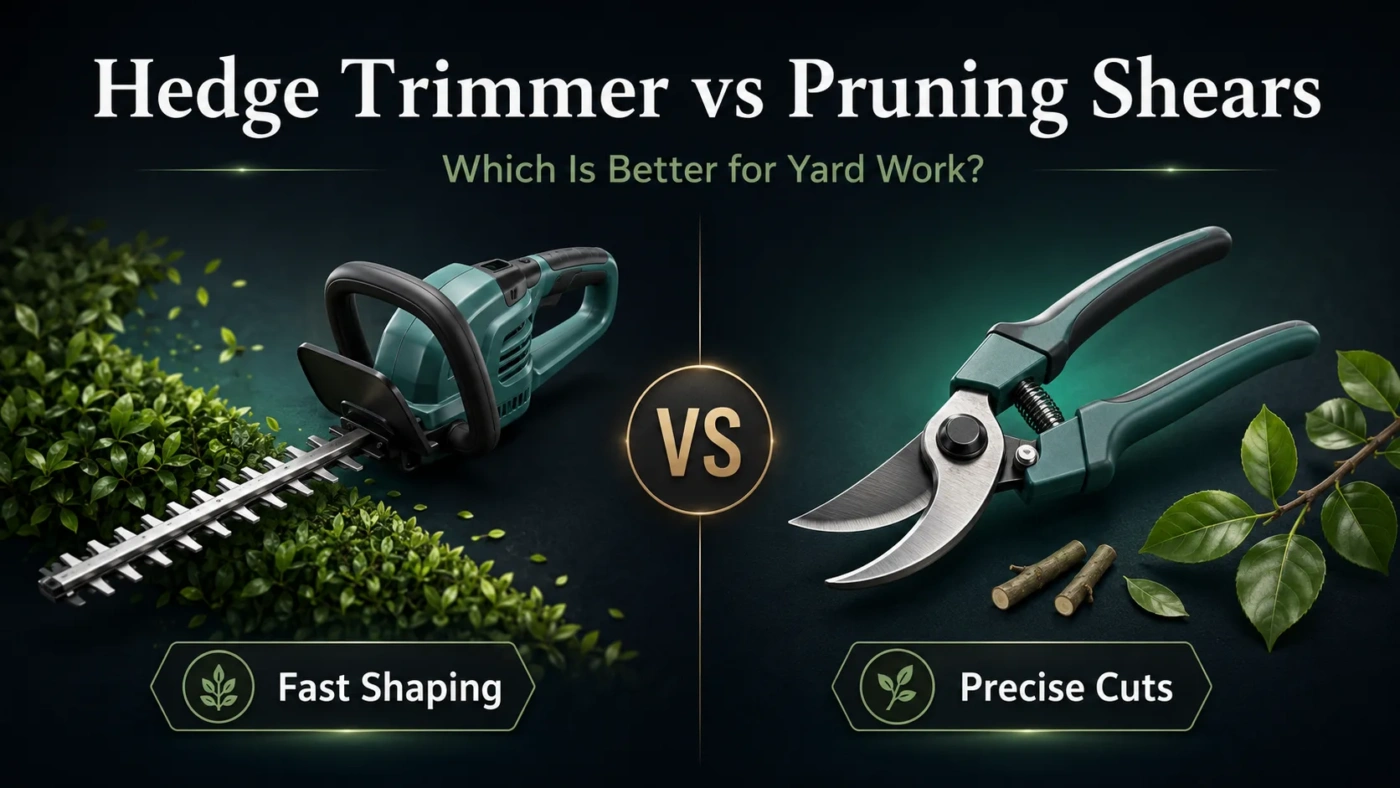
Hedge trimmers and pruning shears both cut plant growth, but they solve different yard problems. A hedge trimmer is better when you need to shape a long hedge, level a row of shrubs, or remove lots of light outer growth quickly. Pruning shears are better when you need clean, selective cuts on individual stems, flowers, small branches, or plant sections where health and control matter more than speed.
- Main Differences
- What A Hedge Trimmer Does Best
- What Pruning Shears Do Best
- Choose A Hedge Trimmer If
- Choose Pruning Shears If
- Real Yard Work Differences
- Speed And Coverage
- Cut Quality And Plant Shape
- Comfort And Effort
- Maintenance
- Decision Tree
- Best Choice By Yard Type
- Price And Long-Term Value
- Common Misunderstandings
- A Hedge Trimmer Is Not A Branch Cutter
- Pruning Shears Are Not Just For Small Gardens
- Fast Trimming Is Not Always Better Pruning
- Best Overall Choice
- Compare More Options
- FAQ
- Can A Hedge Trimmer Replace Pruning Shears?
- Are Pruning Shears Better For Plant Health?
- Can I Use Pruning Shears On Hedges?
- What Should I Use For Thick Branches?
- Which Tool Is Better For Beginners?
| Feature | Hedge Trimmer | Pruning Shears |
|---|---|---|
| Best Use | Shaping hedges, trimming shrubs, cutting many thin stems at once | Selective pruning, deadheading, cutting individual stems and small branches |
| Cutting Style | Fast surface trimming across a wide area | Precise hand cuts one stem at a time |
| Plant Health | Good for formal shaping, but less selective | Better for clean cuts and controlled plant structure |
| Speed | Much faster for hedges and large shrub faces | Slower, but more accurate |
| Branch Size | Best for thin, flexible growth; not thick woody branches | Best for small stems and branches within the tool’s cutting capacity |
| Effort | Less repetitive hand squeezing, more tool weight and vibration | Light to carry, but can tire the hand during long sessions |
| Noise | Noisier, especially powered models | Very quiet |
| Best Fit | Formal hedges, tall shrub rows, larger yard cleanup | Garden beds, roses, perennials, fruiting shrubs, detail work |
Main Differences
The main difference is surface shaping versus selective cutting. A hedge trimmer cuts across the outside of a plant, removing many small shoots at once. It is made for speed and visual uniformity. Pruning shears work one cut at a time, so they are better when you need to remove a specific stem, thin crowded growth, cut above a bud, or avoid damaging nearby branches.
For yard work, this means a hedge trimmer is usually the better tool for maintaining a straight hedge, rounded shrub, or clean property edge. Pruning shears are usually the better tool for plant care, garden detail, and cuts where placement matters.
What A Hedge Trimmer Does Best
A hedge trimmer is built for repeated cuts across a wide cutting bar. It can be electric, battery-powered, gas-powered, or manual depending on the model, but the yard role is the same: trimming a lot of light growth quickly.
It works well on formal hedges, box-shaped shrubs, privacy rows, and plants that are regularly maintained before the stems become thick and woody. If a hedge already has a clear shape and only needs a seasonal cleanup, a hedge trimmer can save a lot of time.
What Pruning Shears Do Best
Pruning shears, also called hand pruners or secateurs, are made for controlled cuts on individual stems. They are common for flowers, perennials, small shrubs, young branches, deadheading, and removing damaged or crossing growth.
Bypass pruning shears are usually preferred for living stems because the blades pass each other like scissors and can leave a cleaner cut. Anvil shears can be useful on dry or dead stems, but they may crush soft living growth if used carelessly.
Choose A Hedge Trimmer If
Choose a hedge trimmer if your main goal is a neat outer shape. It is the better fit when the yard has long hedges, many shrubs, or repeated trimming work that would take too long with hand tools.
- You want to keep hedges level, rounded, or squared off.
- You trim the same shrubs several times during the growing season.
- You need to remove lots of soft new growth quickly.
- You care more about visual shape than individual branch placement.
- You have enough space to move the tool safely around the plant.
A hedge trimmer is not the right answer for every branch. If the tool struggles, jams, bends stems instead of cutting them, or leaves ragged wood, the branch is probably too thick or too tough for that job.
Choose Pruning Shears If
Choose pruning shears if the work calls for accuracy. They are better when you are improving plant structure, removing a dead section, cutting flowers, thinning crowded stems, or working near delicate growth.
- You need to cut one stem cleanly without touching nearby growth.
- You are pruning roses, small shrubs, vines, herbs, or flowering plants.
- You want to remove dead, diseased, rubbing, or crossing stems.
- You need quiet work in a small yard or shared outdoor space.
- You prefer a light tool with no battery, cord, fuel, or motor.
Pruning shears are also easier to control around young plants. For a small garden, they may handle most routine yard work on their own.
Real Yard Work Differences
Speed And Coverage
A hedge trimmer wins on speed. It can shape a hedge face in minutes, while pruning shears would require hundreds of individual cuts. For large, repetitive trimming jobs, the time difference is obvious.
Pruning shears win when there are only a few cuts to make. Pulling out a powered trimmer for three stems is usually unnecessary. Shears are faster to grab, use, clean, and put away.
Cut Quality And Plant Shape
Pruning shears usually give better cut placement. You can cut just above a bud, remove a branch at the right point, or thin the inside of a shrub without flattening the outer surface.
A hedge trimmer gives a cleaner visual line from a distance, but it does not choose which stems should stay. Used too often on the wrong shrub, it can create a dense outer shell while the inside becomes shaded and bare. That does not make the tool wrong; it means the tool fits formal shaping better than selective plant care.
Comfort And Effort
A hedge trimmer reduces hand squeezing, but it adds weight, vibration, reach issues, and noise. Long sessions can tire the shoulders and arms, especially when trimming above chest height.
Pruning shears are light and quiet, but repetitive cutting can tire the hand and wrist. For many cuts, a comfortable grip and sharp blades matter more than extra features.
Maintenance
Both tools need clean, sharp cutting edges. Hedge trimmers also need attention to the blade bar, battery or cord safety, and moving parts. Pruning shears are simpler: clean the blades, dry them, sharpen when needed, and avoid forcing them through branches beyond their rated capacity.
Decision Tree
Best Choice By Yard Type
| Yard Situation | Better Fit | Reason |
|---|---|---|
| Formal hedge along a path | Hedge trimmer | It keeps a straight, even surface with less time. |
| Small flower garden | Pruning shears | They give better control around delicate stems. |
| Mixed shrubs with natural shapes | Pruning shears | Selective pruning keeps the plant from looking overly clipped. |
| Large privacy hedge | Hedge trimmer | It handles broad, repeated trimming work more efficiently. |
| Dead or damaged stems | Pruning shears | You can remove the exact stem without cutting healthy growth. |
| Thick branches | Neither | Use loppers or a pruning saw when branch size exceeds the tool’s capacity. |
Price And Long-Term Value
Pruning shears are usually the lower-cost option. A good pair can last for years if the blades are cleaned, sharpened, and not forced through oversized branches. They also have no battery, fuel, charger, or cord to manage.
Hedge trimmers usually cost more, but they can be worth it if your yard has enough hedge work to justify the tool. A small garden may not need one. A property with several long hedges may feel much easier to maintain with one.
Common Misunderstandings
A Hedge Trimmer Is Not A Branch Cutter
A hedge trimmer may look powerful, but it is not meant for thick woody branches. It works best on thin hedge growth. If branches are too large, forcing the tool can damage the plant, dull the blades, or create an unsafe situation.
Pruning Shears Are Not Just For Small Gardens
Even in larger yards, pruning shears still matter. They handle the cuts a hedge trimmer cannot do well: removing one bad stem, shaping a young plant, cutting flowers, or opening crowded growth.
Fast Trimming Is Not Always Better Pruning
Fast trimming can make a yard look tidy, but careful pruning can improve plant structure. The better choice depends on whether the task is about appearance, plant health, or both.
Best Overall Choice
For most yard work, the best answer is not one tool replacing the other. Choose a hedge trimmer for fast hedge shaping and large shrub cleanup. Choose pruning shears for clean, selective cuts and healthier plant structure.
If you only want one tool for a small garden, pruning shears are the more flexible first purchase. If your yard has long hedges or many shaped shrubs, a hedge trimmer becomes the more practical main tool, with pruning shears kept nearby for detail work.
Compare More Options
FAQ
Can A Hedge Trimmer Replace Pruning Shears?
Not fully. A hedge trimmer can replace pruning shears for broad hedge shaping, but it cannot match the control of shears for individual stems, deadheading, or careful pruning cuts.
Are Pruning Shears Better For Plant Health?
Often, yes. Pruning shears allow cleaner, more selective cuts, which is better when the goal is to remove specific growth without cutting the whole outer surface of the plant.
Can I Use Pruning Shears On Hedges?
Yes, especially for small hedges, touch-ups, and stray branches. For a long formal hedge, pruning shears will be much slower than a hedge trimmer.
What Should I Use For Thick Branches?
Use loppers or a pruning saw when branches are too thick for pruning shears or a hedge trimmer. Forcing the wrong tool can leave rough cuts and may damage the tool.
Which Tool Is Better For Beginners?
Pruning shears are usually easier and safer for beginners because they are quiet, light, and precise. A hedge trimmer is still beginner-friendly for simple hedge shaping, but it needs more attention to blade safety, balance, and surroundings.