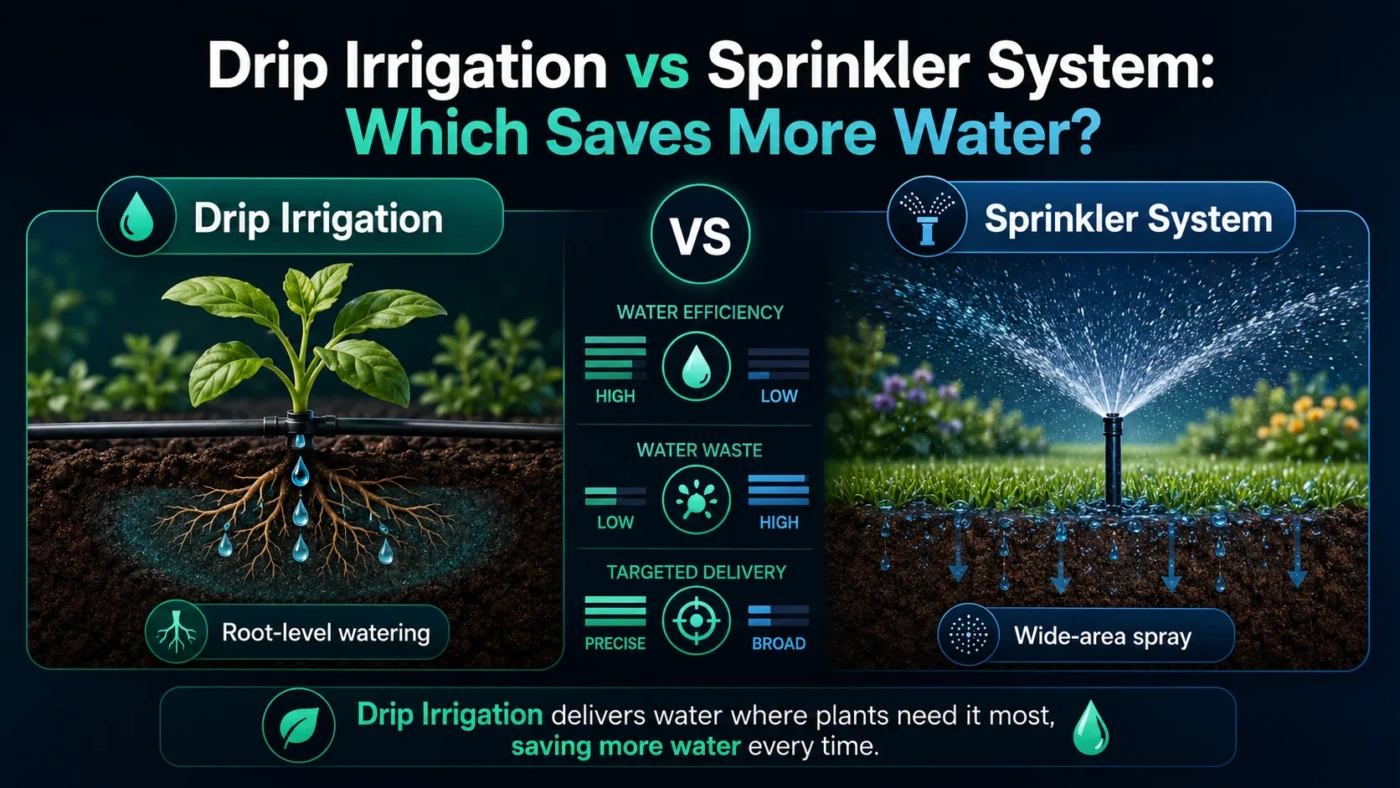
Drip irrigation usually saves more water than a sprinkler system because it sends water slowly to the soil near the plant roots instead of spraying it through the air. For vegetable beds, shrubs, hedges, containers, flower borders, and trees, drip irrigation is usually the more water-efficient choice. A sprinkler system can still make sense for lawns and wide open areas, but it loses more water to wind drift, evaporation, overspray, and runoff if it is not designed and scheduled carefully.
- Main Differences
- How Drip Irrigation Saves Water
- How Sprinkler Systems Use Water
- Water Loss In Real Use
- Choose Drip Irrigation If
- Choose A Sprinkler System If
- Setup And Maintenance
- Drip Maintenance
- Sprinkler Maintenance
- Water-Saving Score
- Simple Decision Path
- Best Choice By Yard Type
- Cost And Long-Term Value
- Common Misunderstandings
- “Sprinklers Always Waste Water”
- “Drip Irrigation Needs No Attention”
- “More Water Means Healthier Plants”
- “One System Must Handle The Whole Yard”
- Useful Terms
- Which One Should You Choose?
- FAQ
| Feature | Drip Irrigation | Sprinkler System |
|---|---|---|
| Water Efficiency | Usually higher because water goes directly to the root zone | Usually lower because water is sprayed over a wider area |
| Best Use | Garden beds, shrubs, trees, rows, containers, narrow planting zones | Lawns, broad groundcover, large open spaces |
| Water Loss Risk | Lower evaporation, less wind drift, minimal overspray | More affected by wind, sun, slope, and spray pattern |
| Soil Wetting Pattern | Localized and slow | Broad surface coverage |
| Installation | More layout planning around each plant zone | More spacing and pressure planning for even coverage |
| Maintenance | Needs filter checks, emitter checks, and occasional flushing | Needs head adjustment, nozzle checks, and leak repairs |
| Wind Sensitivity | Very low | Moderate to high, depending on spray height and weather |
| Best Water-Saving Choice | Usually yes for planted areas | Only when used for the right area and tuned well |
Main Differences
The main difference is where the water goes. Drip irrigation uses tubing, emitters, or dripline to deliver water slowly near the root zone. A sprinkler system throws water into the air through spray heads, rotors, or nozzles so it can cover a larger surface.
That difference changes daily water use. With drip irrigation, less water lands on paths, walls, bare soil, leaves, or pavement. With sprinklers, part of the water can miss the target area, blow away in wind, evaporate before reaching the soil, or run off if the soil cannot absorb it fast enough.
How Drip Irrigation Saves Water
Drip irrigation saves water by applying it slowly and close to the plant. Instead of wetting the whole surface, it creates a controlled wet zone around roots. This is useful for plants that are spaced apart, such as tomatoes, peppers, shrubs, fruit trees, hedges, and ornamental borders.
A well-planned drip system usually includes a filter, pressure regulator, tubing, emitters, connectors, and a timer. The filter helps prevent clogging. The pressure regulator keeps the flow steady. The timer prevents overwatering when the system is out of sight.
How Sprinkler Systems Use Water
A sprinkler system is built for coverage. It can water a wide area quickly, which makes it practical for lawns and larger zones where drip tubing would be awkward or uneven. Spray heads are common for smaller lawn sections, while rotors are often used for larger areas.
The trade-off is that sprinklers expose water to air, sunlight, wind, and hard surfaces. A sprinkler that runs at the wrong time of day or sprays beyond the planted area can waste water even if the system itself is working. Head spacing, nozzle type, water pressure, and run time all change the result.
Water Loss In Real Use
Choose Drip Irrigation If
Choose drip irrigation if your main goal is water savings for planted areas. It is especially useful when plants are not growing in a continuous lawn-like surface. Drip also works well when mulch covers the soil, because the water can reach below the mulch without wetting every visible surface.
- You have vegetable beds, raised beds, shrubs, vines, hedges, or trees.
- You want to water roots without soaking leaves.
- Your garden has narrow strips or irregular planting zones.
- You want less overspray near paths, walls, patios, or fences.
- You prefer slow watering with a timer and targeted zones.
Choose A Sprinkler System If
Choose a sprinkler system if you need to water a lawn or broad area where full surface coverage matters. A sprinkler system is often easier to use for grass because the roots are spread across the entire area rather than placed around separate plants.
- You need to water turf or large groundcover areas.
- You want visible coverage across a wide space.
- Your planting area changes often and fixed drip lines would be inconvenient.
- You can adjust spray heads to avoid pavement and walls.
- You are willing to schedule watering early in the morning to reduce loss.
Setup And Maintenance
Drip irrigation needs careful layout at the beginning. Emitters must match plant spacing, soil type, and water demand. Clay soil may need slower watering because it absorbs water gradually. Sandy soil may need shorter, more frequent watering because water drains faster.
Sprinkler systems need even spacing and correct pressure. If heads are too far apart, some areas stay dry. If pressure is too high, misting can waste water. If heads are tilted or blocked, coverage becomes uneven.
Drip Maintenance
- Check filters for debris.
- Flush tubing when needed.
- Inspect emitters for clogging.
- Look for cuts, leaks, or loose connectors.
- Adjust emitter placement as plants grow.
Sprinkler Maintenance
- Adjust spray direction.
- Replace damaged nozzles.
- Watch for misting from high pressure.
- Fix sunken, tilted, or blocked heads.
- Check for runoff during watering.
Water-Saving Score
Simple Decision Path
Best Choice By Yard Type
| Use Case | Better Fit | Reason |
|---|---|---|
| Vegetable Garden | Drip Irrigation | Targets rows and root zones without wetting extra soil. |
| Raised Beds | Drip Irrigation | Easy to place dripline around plants and under mulch. |
| Lawn | Sprinkler System | Covers a continuous grass area more evenly. |
| Shrubs And Hedges | Drip Irrigation | Delivers water along the planting line with little overspray. |
| Sloped Yard | Drip Irrigation | Slow application can reduce runoff when scheduled correctly. |
| Large Open Area | Sprinkler System | Broad coverage may be more practical than many drip lines. |
Cost And Long-Term Value
Drip irrigation can be affordable for small gardens, but the cost rises when a yard needs many zones, pressure regulation, filters, and long tubing runs. Sprinkler systems can cost more when installed underground, especially if they require valves, trenching, controllers, and many heads.
For long-term value, the water bill and plant health matter as much as the installation cost. Drip irrigation may pay off over time in planted areas because it wastes less water. Sprinklers can still offer good value for lawns when the system is designed well and scheduled with care.
Common Misunderstandings
“Sprinklers Always Waste Water”
A sprinkler system is not automatically wasteful. It becomes wasteful when spray hits pavement, runs too long, operates in wind, or uses the wrong pressure. A tuned sprinkler system can perform well for lawns.
“Drip Irrigation Needs No Attention”
Drip systems are efficient, but they are not maintenance-free. Emitters can clog, tubing can move, and plant needs can change through the season. A hidden leak can waste water if the system is never inspected.
“More Water Means Healthier Plants”
Too much water can create shallow roots, runoff, disease pressure, and poor soil aeration. The better target is consistent moisture at the right depth, not the longest watering time.
“One System Must Handle The Whole Yard”
Many yards work best with both systems: sprinklers for lawn areas and drip irrigation for beds, shrubs, trees, and containers. Mixed irrigation zones often save more water than forcing one method everywhere.
Useful Terms
Which One Should You Choose?
Choose drip irrigation if saving water is your main goal and you are watering plants with clear root zones, such as vegetables, shrubs, hedges, flowers, trees, or containers. It is usually the more efficient system because it applies water slowly, directly, and with less exposure to wind and sun.
Choose a sprinkler system if you are watering a lawn or large open area where broad coverage is more practical. To save water with sprinklers, water early in the morning, adjust heads away from pavement, avoid windy periods, repair leaks, and use shorter cycles if runoff appears.
For many homes, the smartest setup is not drip versus sprinkler everywhere. It is drip irrigation for planting beds and sprinklers for lawn areas. That combination usually gives the best balance of water savings, coverage, and everyday convenience.
FAQ
Does Drip Irrigation Save More Water Than Sprinklers?
Yes, drip irrigation usually saves more water for garden beds, shrubs, trees, and planted rows because it delivers water near the roots with less evaporation, wind drift, and overspray.
Is Drip Irrigation Better Than Sprinklers For A Lawn?
Usually no. Sprinklers are often more practical for lawns because grass needs broad, even coverage. Drip irrigation is better suited to planted beds and individual plant zones.
Can A Sprinkler System Be Water Efficient?
Yes. A sprinkler system can use water carefully when heads are adjusted correctly, pressure is controlled, watering happens early in the day, and run times are short enough to prevent runoff.
What Is The Main Disadvantage Of Drip Irrigation?
The main disadvantage is maintenance and layout planning. Emitters can clog, tubing can shift, and each plant zone needs the right flow rate and spacing.
Can I Use Drip Irrigation And Sprinklers Together?
Yes. Many yards use sprinklers for lawn areas and drip irrigation for beds, shrubs, trees, and containers. This often saves more water than using one method for every area.