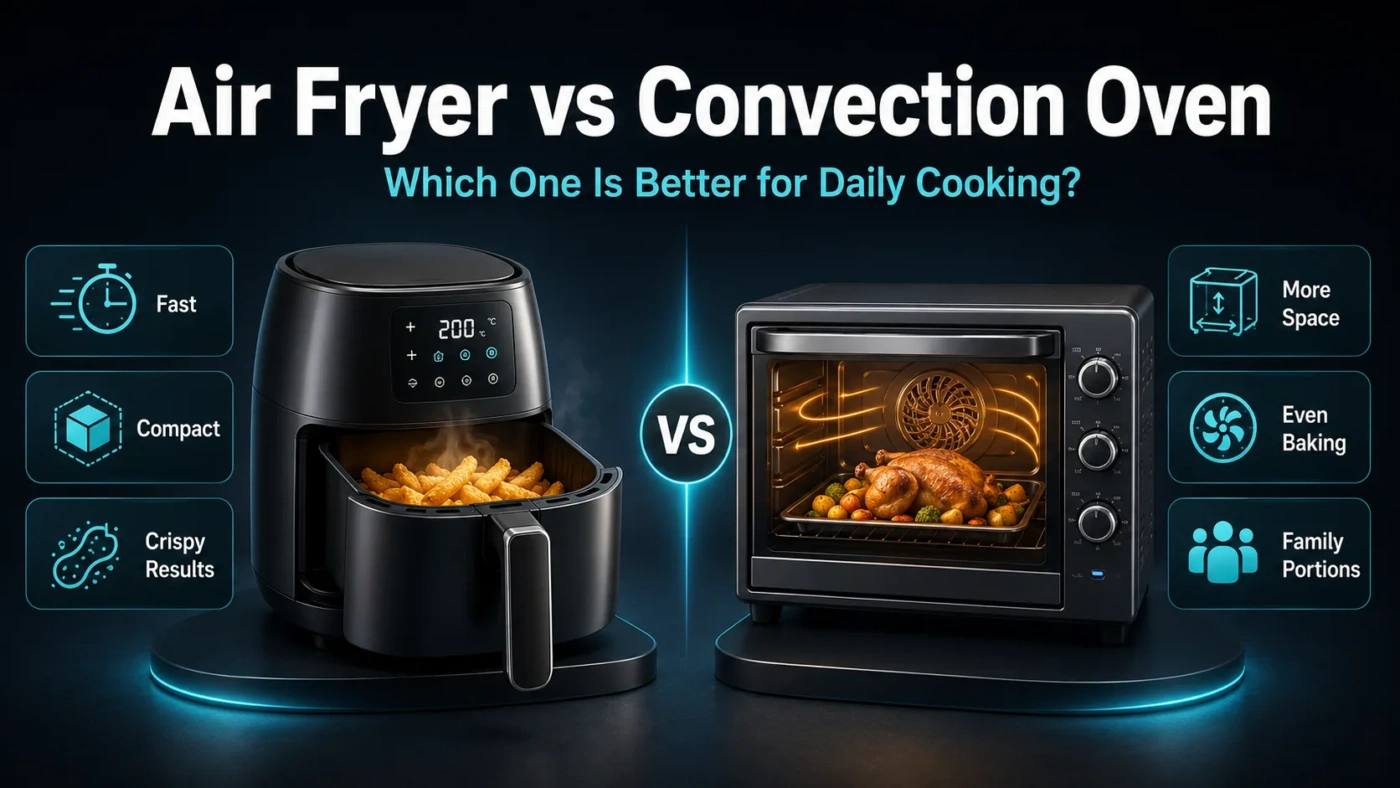
An air fryer is usually the better choice for fast daily meals, small batches, reheating, and crisp textures with less waiting. A convection oven is usually the better choice for family-size cooking, baking, roasting larger trays, and preparing several foods at once. If most of your cooking is one or two portions, choose an air fryer. If you cook full meals, bake often, or need more space, choose a convection oven.
- Fast Decision Cards
- Main Differences
- What An Air Fryer Offers
- What A Convection Oven Offers
- Choose An Air Fryer If
- Choose A Convection Oven If
- What Changes In Real Use
- Speed And Preheating
- Texture And Browning
- Capacity And Batch Cooking
- Cleaning And Maintenance
- Price And Value
- Decision Tree
- Common Misunderstandings
- An Air Fryer Does Not Truly Fry Food
- A Convection Oven Is Not Always Slower
- Bigger Is Not Always Easier
- Crispier Does Not Always Mean Better
- Best Choice By User Type
- Glossary
- FAQ
- Is An Air Fryer The Same As A Convection Oven?
- Can An Air Fryer Replace A Convection Oven?
- Can A Convection Oven Replace An Air Fryer?
- Which One Uses Less Energy?
- Which One Is Better For Healthy Cooking?
- Compare More Options
| Feature | Air Fryer | Convection Oven |
|---|---|---|
| Best For | Small portions, snacks, reheating, crisp foods | Larger meals, baking, roasting, batch cooking |
| Cooking Speed | Usually faster for small amounts | Fast once heated, but often slower for small batches |
| Capacity | Limited basket or drawer space | More tray space and better for wide foods |
| Crisping | Very strong crisping on fries, vegetables, breaded foods, and leftovers | Good crisping, but usually less intense on small portions |
| Baking | Works for small bakes, but space and airflow can limit results | Better for cakes, cookies, pastries, bread, and even tray baking |
| Counter Space | Uses counter space unless stored away | Built-in or countertop depending on type |
| Cleaning | Basket and tray need frequent cleaning | Trays are simple, but oven walls can collect splatter over time |
| Learning Curve | Easy for reheating and simple meals | More flexible, but timing and rack position matter more |
| Daily Value | Best if used often for quick meals | Best if it replaces or supports regular oven cooking |
Fast Decision Cards
Main Differences
The main difference is size and airflow. An air fryer is a compact convection cooker with a small chamber, strong air movement, and a basket or tray that exposes food to heat from multiple sides. That makes it very good at crisping small batches.
A convection oven also uses a fan to move hot air, but it usually has more interior space. That extra room helps with baking, roasting full trays, and cooking different foods at once. The tradeoff is that it may need more preheating time and can feel less efficient for a small snack or one serving of leftovers.
What An Air Fryer Offers
An air fryer is built for speed, texture, and convenience. It is not actually frying food in oil. It cooks with hot circulating air, often using a small amount of oil or no added oil depending on the food. The compact space helps heat reach food quickly, which is why an air fryer can make small portions feel crisp without long preheating.
It works well for fries, chicken pieces, tofu, vegetables, frozen snacks, fish portions, sandwiches, and leftovers. It is also useful when you do not want to heat a full oven for one tray of food.
What A Convection Oven Offers
A convection oven is a more spacious hot-air cooking appliance. The fan helps distribute heat around food, which can reduce uneven cooking compared with a still oven. It can roast vegetables, bake cookies, cook casseroles, toast, broil, and handle wider trays.
The extra room matters. A single layer of food cooks more evenly than an overcrowded basket. If you cook for a household, prepare meal prep trays, or bake often, a convection oven gives you more control over pan size, rack position, and batch size.
Choose An Air Fryer If
Choose an air fryer if your daily cooking is mostly small, fast, and texture-focused. It is especially useful for one or two people, quick lunches, after-work dinners, and reheating foods that become soggy in a microwave.
- You want crisp results without using a large amount of oil.
- You often cook one or two servings.
- You reheat fries, pizza, breaded foods, vegetables, or small portions of protein.
- You want shorter warm-up time than a full oven.
- You prefer simple controls and repeatable cooking routines.
Choose A Convection Oven If
Choose a convection oven if you need space, flexibility, and better results for baking or larger meals. It is the more practical choice when food needs to lie flat on a tray, when you cook several servings, or when pan shape matters.
- You cook for a family or prepare several portions at once.
- You bake cookies, pastries, cakes, bread, or sheet-pan meals.
- You want to roast larger cuts, whole vegetables, or multiple trays.
- You already use oven-safe pans and trays often.
- You want one appliance that can handle more cooking styles.
What Changes In Real Use
Speed And Preheating
For a small portion, an air fryer often feels faster because the chamber is small and the airflow is direct. A convection oven may take longer to preheat, but once it is hot, it can cook larger amounts without splitting food into several batches.
Texture And Browning
Air fryers tend to create crisp edges quickly. They are strong for foods with surface texture: fries, coated pieces, roasted chickpeas, vegetables, and toasted bread. A convection oven browns well too, but the larger space spreads heat across a wider area. That can be better for even baking and roasting, but less intense for a tiny batch.
Capacity And Batch Cooking
Capacity is where the convection oven wins. Overfilling an air fryer basket reduces airflow and can lead to uneven results. If you need to cook in layers or shake food several times, the speed advantage can disappear. A convection oven gives food more room, especially on a sheet pan.
Cleaning And Maintenance
An air fryer basket should be cleaned often because food crumbs, oil, and seasoning collect near the tray. A convection oven has fewer removable parts for basic tray cooking, but splatter can build up inside the oven cavity. For daily use, the easier option depends on what you cook: dry snacks are simple in an air fryer, while saucy or fatty foods may make either appliance messy.
Price And Value
Air fryers often cost less than a full convection oven, though larger or multi-function units may cost more. Countertop convection ovens can also vary widely in price depending on size and functions. The better value is the appliance you will use often. A low-cost air fryer is not a good value if it is too small for your meals, while a larger convection oven is not ideal if you only need quick snacks.
Practical note: cooking time depends on food thickness, moisture, basket crowding, tray position, and starting temperature. Frozen foods, dense vegetables, and thick proteins may need turning, shaking, or extra time in either appliance.
Decision Tree
Common Misunderstandings
An Air Fryer Does Not Truly Fry Food
An air fryer uses hot air, not deep oil. It can make many foods crisp, but it will not always match the texture of food cooked in a deep oil bath. A light coating of oil can improve browning, but the method is still hot-air cooking.
A Convection Oven Is Not Always Slower
For one small serving, it may feel slower. For a full tray or multiple portions, it can be more efficient because you avoid cooking several small batches.
Bigger Is Not Always Easier
A larger appliance gives more room, but it may take longer to heat and may use more space. A smaller air fryer is easier for quick tasks, but it can become frustrating if the basket is too small for your normal meals.
Crispier Does Not Always Mean Better
Some foods benefit from intense airflow. Others dry out if cooked too aggressively. Delicate baked goods, thin fish, and moist dishes may need lower heat, shorter time, or the wider spacing of a convection oven.
Best Choice By User Type
| User Type | Better Fit | Reason |
|---|---|---|
| Beginner Cook | Air Fryer | Simple controls and repeatable results for small meals. |
| Family Cook | Convection Oven | More space for trays, sides, and larger portions. |
| Meal Prep User | Convection Oven | Better for multiple portions and sheet-pan cooking. |
| Leftover Reheater | Air Fryer | Restores crisp texture better than many reheating methods. |
| Baker | Convection Oven | More predictable for pans, trays, rack placement, and batches. |
| Small Kitchen User | Depends | An air fryer is compact, but a countertop convection oven can replace more appliances. |
Glossary
FAQ
Is An Air Fryer The Same As A Convection Oven?
They use a similar hot-air method, but they are not the same in daily use. An air fryer has a smaller chamber and stronger focused airflow, while a convection oven usually offers more space and better tray flexibility.
Can An Air Fryer Replace A Convection Oven?
It can replace a convection oven for small meals, snacks, and reheating. It is less suitable as a full replacement if you bake often, cook for several people, or need large tray space.
Can A Convection Oven Replace An Air Fryer?
Yes, especially if it has strong airflow and a tray that allows heat to reach the food well. Still, a full convection oven may feel less convenient for one serving of fries, leftovers, or a quick snack.
Which One Uses Less Energy?
An air fryer can use less energy for small portions because it heats a smaller space for a shorter time. A convection oven can be more practical for larger meals because it cooks more food in one run.
Which One Is Better For Healthy Cooking?
Both can support lower-oil cooking. The healthier result depends more on the food, portion size, added oil, seasoning, and cooking temperature than on the appliance alone.
Compare More Options
If you want the simplest daily answer, choose an air fryer for fast small meals, crisp reheating, and easy weekday cooking. Choose a convection oven if you need more space, bake often, cook for a household, or want one appliance that handles larger and more varied meals.