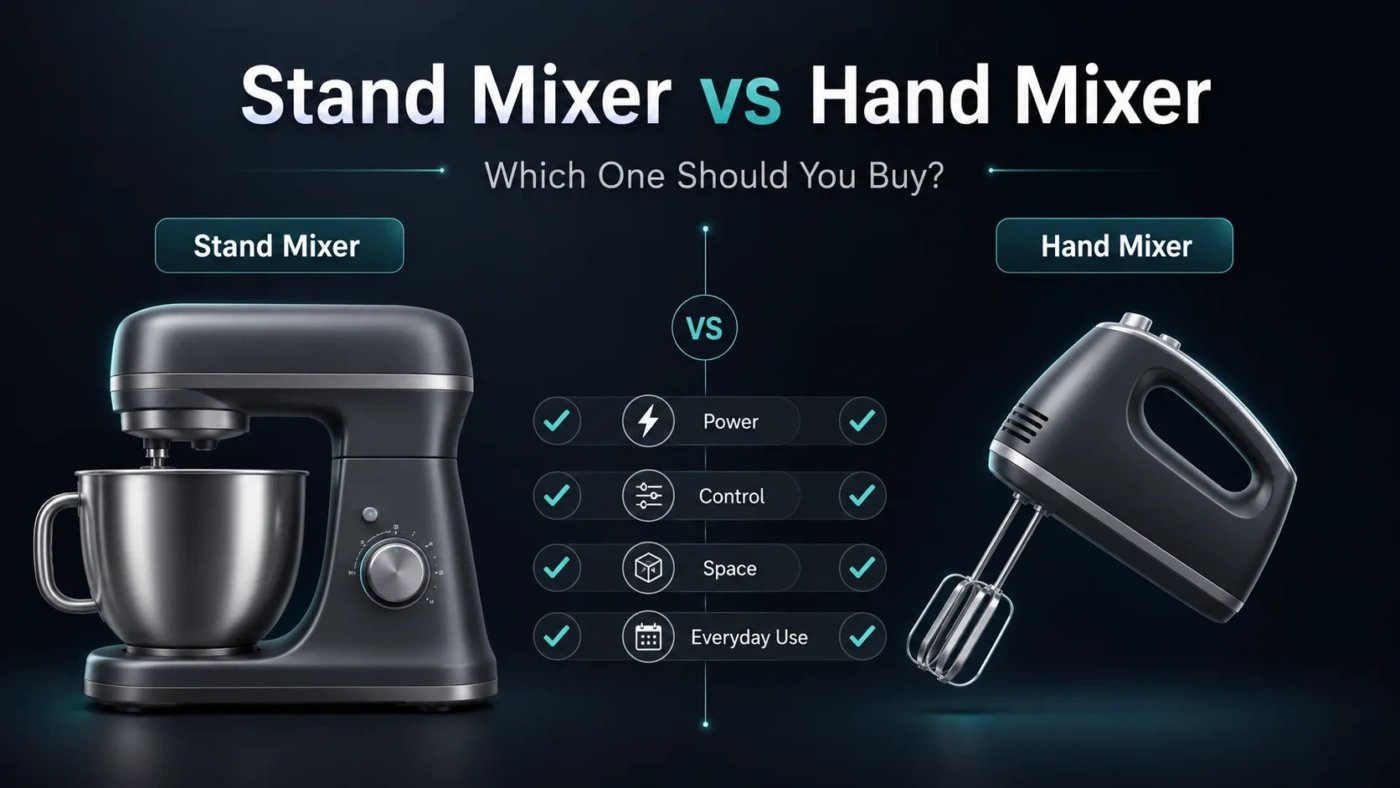
A stand mixer is the better buy if you bake often, make bread dough, prepare large batches, or want hands-free mixing. A hand mixer is the better buy if you mostly make cakes, whipped cream, frosting, pancake batter, or small everyday recipes and want something cheaper, lighter, and easier to store. The right choice depends less on which mixer is “stronger” and more on how often you bake, what you make, and how much counter space you can give up.
- Main Differences
- Stand Mixer Strengths
- Hand Mixer Strengths
- What A Stand Mixer Offers
- What A Hand Mixer Offers
- Price And Value
- Performance In Real Recipes
- Comfort And Convenience
- Decision Tree
- Choose A Stand Mixer If
- Choose A Hand Mixer If
- Best Choice By User Type
- Common Misunderstandings
- A Hand Mixer Is Not Just A Smaller Stand Mixer
- A Stand Mixer Does Not Automatically Make Better Cakes
- Dough Hooks On A Hand Mixer Have Limits
- More Speed Settings Do Not Always Mean Better Results
- Setup, Cleaning, And Storage
- Glossary
- FAQ
- Can A Hand Mixer Replace A Stand Mixer?
- Is A Stand Mixer Worth It For Occasional Baking?
- Which Mixer Is Better For Cookie Dough?
- Which Mixer Is Easier For Beginners?
- Compare More Options
| Feature | Stand Mixer | Hand Mixer |
|---|---|---|
| Best For | Bread dough, cookie dough, large cakes, frequent baking, batch prep | Whipped cream, frosting, cake batter, eggs, light mixing, occasional baking |
| Mixing Style | Hands-free mixing in a fixed bowl | Manual control in almost any bowl |
| Power With Thick Dough | Better for dense dough and long mixing sessions | Limited with heavy dough and stiff mixtures |
| Storage | Needs counter space or cabinet space | Easy to store in a drawer or small cabinet |
| Portability | Heavy and less convenient to move | Light, compact, and easy to carry |
| Price Range | Usually costs more | Usually more budget-friendly |
| Learning Curve | Takes a little more setup and attachment awareness | Simple for beginners |
| Long-Term Value | Best if used often for heavier recipes | Best if used occasionally for lighter tasks |
Main Differences
The main difference is control versus capacity. A stand mixer holds the bowl in place and uses a fixed mixing head, so it can run while you measure ingredients, prepare pans, or clean up. This makes it much easier for long mixing sessions, especially with bread dough or dense cookie dough.
A hand mixer gives you direct control. You hold it, move it around the bowl, and adjust the angle as you mix. That makes it flexible for small jobs, but it also means your hand does the work. For a few minutes of whipping cream, that is fine. For kneading heavy dough, it can feel underpowered and tiring.
Stand Mixer Strengths
- Handles thicker mixtures with less strain.
- Works well for larger batches.
- Keeps both hands free while mixing.
- Often supports extra attachments for more kitchen tasks.
Hand Mixer Strengths
- Costs less in most cases.
- Stores easily in small kitchens.
- Works with different bowls.
- Is simple enough for very casual baking.
What A Stand Mixer Offers
A stand mixer is a countertop appliance built for steady mixing power and repeatable results. It usually includes a mixing bowl and attachments such as a flat beater, whisk, and dough hook. The bowl stays fixed or locks into place, while the mixer does the physical work.
This matters most when recipes need time and force. Bread dough, pizza dough, brioche-style dough, thick cookie dough, mashed potatoes, and large cake batters are easier with a stand mixer because the machine can keep mixing without your arm getting tired.
The tradeoff is size. A stand mixer is not something most people want to lift in and out of a cabinet every day. If it lives on the counter, it takes visible space. If it lives in storage, you may use it less often than expected.
What A Hand Mixer Offers
A hand mixer is a compact electric mixer with removable beaters or whisks. It is made for lighter mixing tasks where speed and convenience matter more than heavy-duty performance.
For cakes, boxed mixes, whipped cream, buttercream, eggs, light cookie dough, and pancake batter, a hand mixer can be enough. It is also easier to clean, easier to store, and easier to justify if you bake only a few times per month.
The main limit is resistance. When a mixture gets very thick, a hand mixer can slow down, splash ingredients, or strain in your hand. Some models include dough hooks, but that does not automatically make them a good replacement for a stand mixer when dough is dense or kneading time is long.
Price And Value
A hand mixer is usually the better value for beginners and occasional bakers because it solves the most common mixing jobs at a lower cost. If your recipes are mostly light batters and whipped toppings, spending more on a stand mixer may not change your results enough to feel worth it.
A stand mixer can be the better value over time if you bake often. It saves effort, handles recipes that a hand mixer struggles with, and may reduce the need for separate tools if you use compatible attachments. The value is strongest when it stays accessible and gets used often.
Performance In Real Recipes
Comfort And Convenience
A stand mixer wins on comfort during longer recipes. Once the ingredients are in the bowl and the attachment is locked in, the machine takes over. That is useful when butter and sugar need several minutes of creaming or when dough needs steady kneading.
A hand mixer wins on convenience for short jobs. You can use your own bowl, rinse the beaters, and put the mixer away quickly. For small kitchens, dorm-style living spaces, apartments, and occasional baking, that simplicity matters.
Decision Tree
Choose A Stand Mixer If
- You bake bread or pizza dough regularly.
- You make large batches of cookies, cakes, frosting, or mashed foods.
- You want to multitask while the mixer runs.
- You have enough counter or cabinet space.
- You want a tool that can grow with more baking projects.
- You prefer repeatable mixing with less arm fatigue.
A stand mixer makes the most sense when baking is already part of your routine. It is also the better choice if you have tried using a hand mixer for thick dough and found it slow, messy, or uncomfortable.
Choose A Hand Mixer If
- You bake occasionally rather than weekly.
- You want the lower-cost option.
- You have a small kitchen or limited storage.
- You mostly make cakes, whipped toppings, eggs, or light batters.
- You want a mixer that is easy to clean and put away.
- You do not need hands-free mixing.
A hand mixer is the more practical first purchase for many households. It covers common recipes without asking for much money, space, or setup time.
Best Choice By User Type
Common Misunderstandings
A Hand Mixer Is Not Just A Smaller Stand Mixer
A hand mixer can do many of the same light tasks, but it does not replace the stability, bowl size, and dough-handling ability of a stand mixer.
A Stand Mixer Does Not Automatically Make Better Cakes
For simple cake batter, technique matters more than the mixer type. Overmixing can still happen with either tool.
Dough Hooks On A Hand Mixer Have Limits
Some hand mixers include dough hooks, but dense dough can still be difficult. If dough is a regular part of your baking, a stand mixer is usually the more comfortable option.
More Speed Settings Do Not Always Mean Better Results
Useful speed control matters more than a long list of speeds. A slow start helps reduce splashing, while stable mid-range speeds help with batters and frosting.
Setup, Cleaning, And Storage
A hand mixer is faster to clean because the removable beaters are small. The body can be wiped down, and the tool can go back into a drawer. That makes it more likely to be used for small tasks.
A stand mixer has more parts to manage: bowl, attachment, splash guard if included, and the main body. Cleaning is still simple, but the mixer itself stays on the counter or needs a dedicated storage spot. If your kitchen is tight, that can become the real deciding point.
Glossary
FAQ
Can A Hand Mixer Replace A Stand Mixer?
For light recipes, yes. For bread dough, large batches, and thick mixtures, a hand mixer is not an equal replacement.
Is A Stand Mixer Worth It For Occasional Baking?
Usually not unless you specifically make dough or large batches. Occasional bakers often get better value from a hand mixer.
Which Mixer Is Better For Cookie Dough?
A stand mixer is better for thick cookie dough. A hand mixer can work for softer dough, but it may struggle as the mixture gets dense.
Which Mixer Is Easier For Beginners?
A hand mixer is easier for most beginners because it is lighter, cheaper, and simpler to store. A stand mixer becomes easier once baking becomes more frequent.
Compare More Options
If you bake often, make dough, or want a machine that can handle heavier recipes without constant hand effort, buy a stand mixer. If you want an affordable, compact tool for cakes, frosting, eggs, whipped cream, and light everyday mixing, buy a hand mixer. For most first-time buyers, the hand mixer is the safer starting point; for regular bakers, the stand mixer is the better long-term kitchen tool.