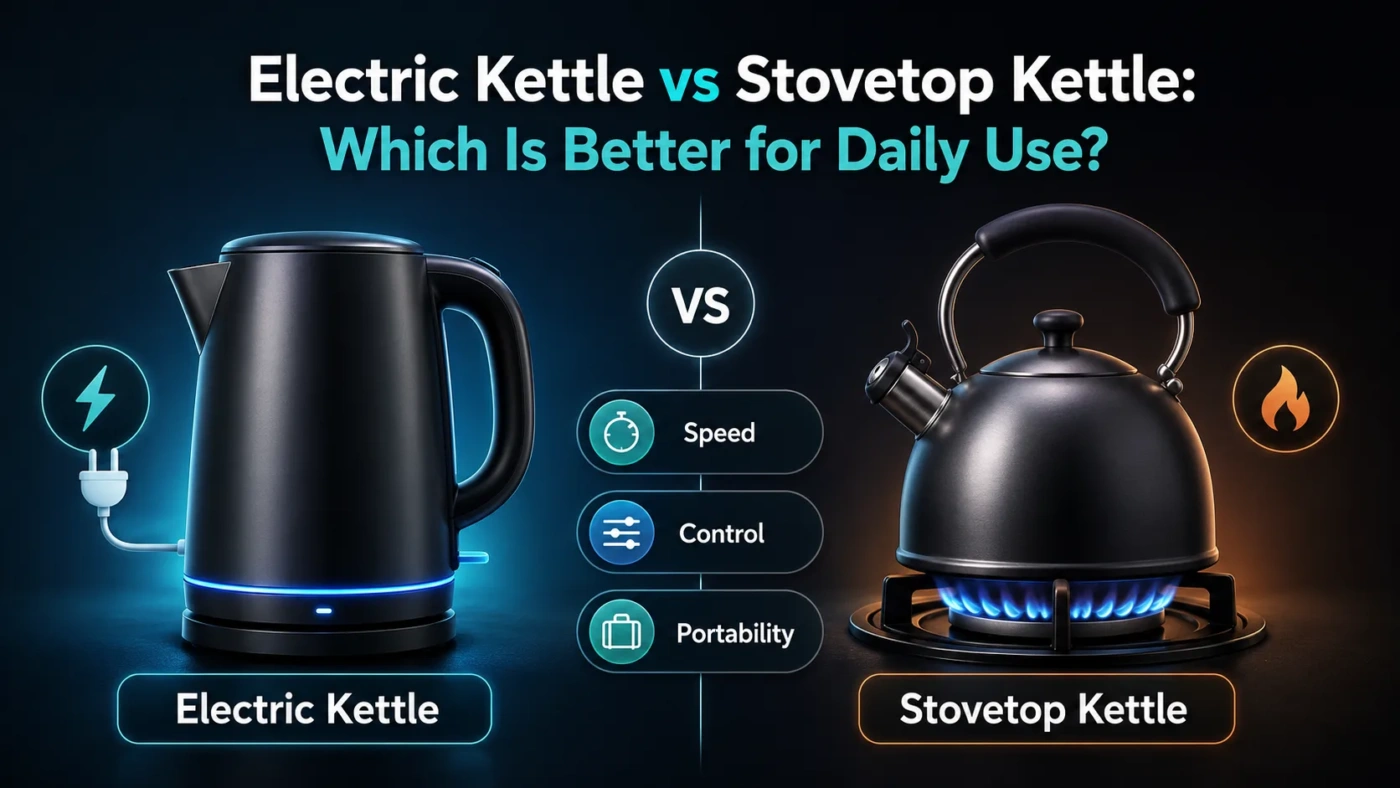
Electric kettles are usually the better choice for daily use because they boil water faster, shut off automatically, and do not require stove space. Stovetop kettles still make sense if you prefer a simple, long-lasting kettle, want a more traditional tea routine, or often heat water during camping, power outages, or in kitchens where the stove is already the main heat source.
- Main Differences
- What An Electric Kettle Offers
- What A Stovetop Kettle Offers
- Speed And Daily Convenience
- Safety And Control
- Price And Long-Term Value
- Choose An Electric Kettle If
- Choose A Stovetop Kettle If
- Decision Tree
- Common Misunderstandings
- Electric Kettles Do Not Always Use More Energy
- Stovetop Kettles Are Not Automatically More Durable
- Boiling Speed Is Not The Only Difference
- Best Choice By User Type
- Compare More Options
- FAQ
- Is An Electric Kettle Better Than A Stovetop Kettle?
- Does A Stovetop Kettle Make Water Taste Better?
- Which Kettle Is Better For Tea?
- Which Kettle Is Easier To Clean?
- Which One Should Most People Choose?
| Feature | Electric Kettle | Stovetop Kettle |
|---|---|---|
| Best daily fit | Fast boiling for tea, coffee, instant meals, and repeated use | Simple heating when speed is less important |
| Speed | Usually faster because the heating element transfers heat directly to the water | Depends on burner type, kettle base, and stove power |
| Safety | Often includes auto shutoff and boil-dry protection | Requires attention, especially after boiling starts |
| Control | Some models offer temperature presets for different drinks | Manual control only, unless paired with a thermometer |
| Kitchen space | Uses counter space and an outlet | Uses burner space but no counter appliance space |
| Power use | Efficient for boiling small to medium amounts of water | Efficiency varies by gas, electric coil, ceramic, or induction stove |
| Maintenance | Needs descaling and care around the base and cord | Needs descaling and cleaning, with fewer electrical parts |
| Long-term value | Better if used many times per day | Better if you want a low-tech kettle that can last for years |
Main Differences
The main difference is how heat reaches the water. An electric kettle has its own heating element, so it does not need a stove. A stovetop kettle sits on a burner and relies on the stove to heat the base. That one difference affects speed, convenience, safety, energy use, and where each kettle fits best.
An electric kettle feels more practical when boiling water is a small daily task you want to finish quickly. Fill it, press a button, and it turns off when the water reaches a boil. A stovetop kettle feels more hands-on. You place it on a burner, wait for the whistle or steam, then turn the heat off yourself.
What An Electric Kettle Offers
An electric kettle is a dedicated water-boiling appliance. It is designed for one job: heating water with minimal effort. For daily use, that focus is its main strength. It can sit near a mug, coffee setup, or breakfast area, so you do not need to use the stove every time you want hot water.
Many electric kettles include automatic shutoff, which stops heating once the water boils. Some also include boil-dry protection, removable filters, water level windows, keep-warm settings, or temperature presets. Those features are not necessary for everyone, but they can be useful if you drink green tea, pour-over coffee, herbal tea, or other drinks that benefit from water below a full boil.
The tradeoff is that an electric kettle is still an appliance. It needs an outlet, takes up counter space, and has electrical parts that require basic care. It should not be submerged in water, and mineral buildup still needs to be cleaned from time to time.
What A Stovetop Kettle Offers
A stovetop kettle is a non-electric vessel made to heat water on a burner. It is usually more basic than an electric kettle, which can be an advantage. There is no heating element to fail, no cord to manage, and no base to clean around. If the kettle is compatible with your stove type, it can be a durable and familiar part of the kitchen.
Stovetop kettles are often chosen for their feel as much as their function. The whistle, the slower heating process, and the visual presence on the stove can make them appealing for tea drinkers who like a more traditional routine. They also work well when counter space is limited but stove space is available.
The tradeoff is attention. A stovetop kettle usually does not turn itself off. If you walk away after the water boils, the kettle can keep heating until you return. That makes it less convenient for rushed mornings or multitasking.
Speed And Daily Convenience
For most people, speed is where the electric kettle wins. Because the heating element is built into the kettle, heat goes straight into the water. A stovetop kettle must receive heat through the burner, the kettle base, and then the water. Some induction setups can be very fast, but the result still depends on the stove and kettle design.
Convenience also favors the electric kettle. It can sit in a bedroom, office corner, dorm room, or small kitchen where a stove may not be nearby. That makes it useful for tea, instant coffee, oatmeal, noodles, baby bottle warming routines that use hot water safely, and general cooking prep.
A stovetop kettle is still convenient if you already spend time at the stove. If you are cooking breakfast and want hot water at the same time, it can feel natural. But if you only need one mug of tea, walking to the stove, waiting, and returning to turn off the burner can feel like more work than pressing a button.
Safety And Control
Safety note: Auto shutoff and boil-dry protection can reduce common everyday risks, but features vary by model. A kettle should still be used on a stable surface, filled within its marked range, and kept away from dangling cords or hot edges.
Electric kettles are usually safer for distracted daily use because many models stop automatically. This does not remove the need for care, but it does reduce the chance of leaving heat on after the water boils. For households with busy mornings, shared kitchens, or home offices, that can matter.
Stovetop kettles rely more on the user. A whistling kettle helps by making sound when the water boils, but someone still needs to turn off the burner. Handles can also become warm depending on the kettle design and burner size, so pouring may require more caution.
For temperature control, electric kettles have the advantage if they include presets. A basic electric kettle boils water only, but a variable-temperature model can heat water to lower temperatures. A stovetop kettle can do this too, but it takes more attention and often a separate thermometer.
Price And Long-Term Value
Stovetop kettles often have a lower starting price, especially basic stainless steel designs. They can also last a long time because they have fewer parts. For someone who boils water occasionally, that simple value can be enough.
Electric kettles may cost more depending on capacity, materials, controls, and safety features. A basic electric kettle is often affordable, while models with temperature presets or insulated bodies may cost more. The value improves if you boil water several times a day, because the saved time and automatic shutoff become part of the daily benefit.
For long-term use, the better value depends on your routine. If you want speed every morning, an electric kettle earns its place. If you want a kettle that stays on the stove and needs no outlet, a stovetop kettle is still a sensible buy.
Choose An Electric Kettle If
- You boil water every day for tea, coffee, oatmeal, instant meals, or cooking prep.
- You want faster boiling without using a burner.
- You like automatic shutoff for safer multitasking.
- You need hot water in an office, dorm, small apartment, or shared space.
- You want temperature settings for different drinks.
- You prefer a push-button routine over watching the stove.
Choose A Stovetop Kettle If
- You prefer simple kitchen tools without electronics.
- You do not boil water often enough to need a separate appliance.
- You want to avoid using counter space.
- You enjoy the traditional feel of heating water on the stove.
- You want a kettle that can work without an outlet.
- You already use the stove often and do not mind manual control.
Decision Tree
Common Misunderstandings
Electric Kettles Do Not Always Use More Energy
Many people assume a separate appliance must use more energy, but electric kettles can be efficient for boiling water because heat is applied directly. Actual use depends on how much water you heat, how often you reboil it, and the efficiency of your stove.
Stovetop Kettles Are Not Automatically More Durable
A simple stovetop kettle can last for years, but durability still depends on material quality, handle design, lid fit, and how it is cleaned. Thin bases, loose whistles, or poor compatibility with a stove can reduce its usefulness.
Boiling Speed Is Not The Only Difference
Speed matters, but daily comfort also includes safety, storage, pouring control, cleaning, noise, and whether the kettle fits your kitchen routine. The fastest option is not always the most enjoyable one.
Best Choice By User Type
Compare More Options
FAQ
Is An Electric Kettle Better Than A Stovetop Kettle?
For daily use, yes, an electric kettle is usually better because it is faster, easier, and often safer due to automatic shutoff. A stovetop kettle is better if you prefer simplicity and do not need fast boiling.
Does A Stovetop Kettle Make Water Taste Better?
The kettle type itself usually does not make water taste better. Taste is more affected by water quality, mineral buildup, kettle material, and how clean the kettle is.
Which Kettle Is Better For Tea?
An electric kettle with temperature control is better for tea varieties that use different water temperatures. A stovetop kettle is fine for basic black tea or any tea where exact temperature is not a priority.
Which Kettle Is Easier To Clean?
Both need descaling if used with mineral-heavy water. Stovetop kettles have fewer electrical parts, while electric kettles may have removable filters and wide openings that make cleaning easier depending on design.
Which One Should Most People Choose?
Most people should choose an electric kettle for daily hot water because it is faster and more convenient. Choose a stovetop kettle if you value simple construction, traditional use, or saving counter space more than speed.