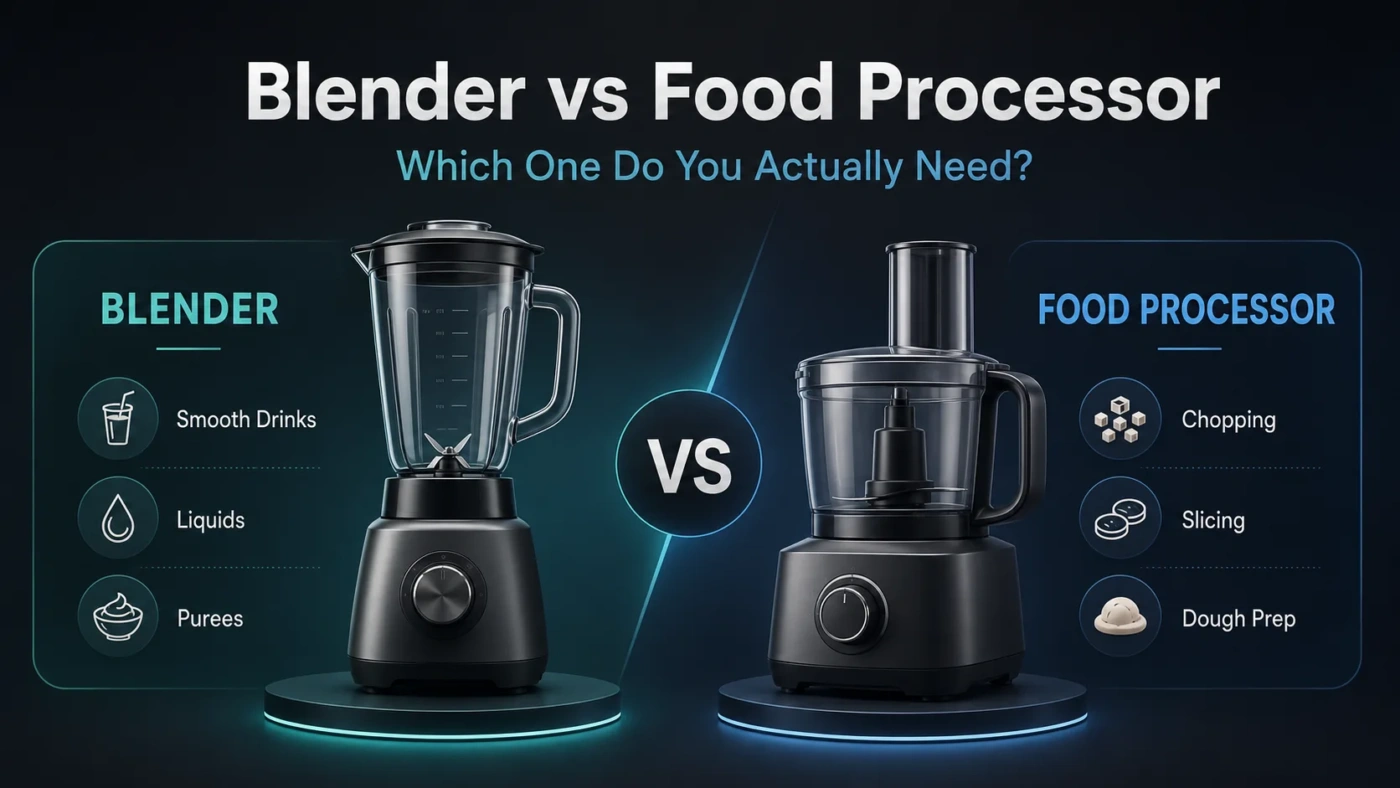
A blender and a food processor both use spinning blades, but they solve different kitchen problems. Choose a blender if you mostly make smoothies, soups, sauces, shakes, or anything that should end up smooth and pourable. Choose a food processor if you mostly chop vegetables, shred cheese, slice ingredients, make dough, prep salads, or handle thicker mixtures that need texture control.
- Main Differences
- What A Blender Does Better
- What A Food Processor Does Better
- Where Each One Fits Best
- Texture And Control
- Price And Value
- Choose A Blender If
- Choose A Food Processor If
- Decision Tree
- Score By Everyday Use
- Cleaning And Storage
- Common Misunderstandings
- A Blender Can Replace A Food Processor
- A Food Processor Can Replace A Blender
- More Power Always Means Better Results
- Bigger Is Always Better
- Best Choice By User Type
- So Which One Do You Actually Need?
- Compare More Options
- FAQ
- Can You Make Smoothies In A Food Processor?
- Can You Chop Vegetables In A Blender?
- Which Is Better For Salsa?
- Which Is Better For Soup?
- Do You Need Both A Blender And A Food Processor?
| Feature | Blender | Food Processor |
|---|---|---|
| Best For | Smoothies, soups, sauces, purees, shakes, frozen drinks | Chopping, slicing, shredding, grating, dough, chunky dips |
| Texture | Smooth, liquid, pourable, fully blended | Chopped, coarse, shredded, mixed, textured |
| Works Best With | Liquid or soft ingredients | Dry, firm, thick, or bulky ingredients |
| Container Shape | Tall jar that pulls ingredients downward | Wide bowl that spreads ingredients around the blade |
| Control | Better for smooth consistency, less control over chunks | Better control over chopped and sliced texture |
| Attachments | Usually simple blade jar, sometimes extra cups | Often includes blades and discs for slicing or shredding |
| Counter Space | Tall footprint, easy to leave out if used daily | Wider bowl and more parts to store |
| Best First Buy | Better if drinks and smooth textures are your routine | Better if meal prep and chopping take most of your time |
Main Differences
The real difference is not just the blade. It is the way each appliance moves food. A blender is built to pull ingredients into a moving vortex, which works very well when liquid can carry food down toward the blades. A food processor uses a wider bowl and different blades or discs, so it handles solid ingredients with more room and more control.
What A Blender Does Better
A blender is the better choice when the goal is a smooth texture. It can turn fruit, liquid, ice, cooked vegetables, yogurt, or soft ingredients into something drinkable or pourable. It is also easier to use for recipes where the finished result should not have visible chunks.
What A Food Processor Does Better
A food processor is better when the goal is preparation rather than liquifying. It can chop onions, slice potatoes, shred vegetables, grate firm foods, mix pastry dough, pulse nuts, and make thick dips without needing much liquid.
Where Each One Fits Best
A blender gives smoother results and handles liquid volume better.
A food processor saves time when chopping, slicing, or shredding several ingredients.
A blender is better when the soup or puree should be silky and even.
A food processor is more useful for pulsing flour, fat, and dough mixtures.
Texture And Control
If you care about texture, this is where the choice becomes easy. A blender tends to keep pushing ingredients toward a smooth result. That is perfect for a smoothie, but less helpful for chunky salsa, chopped nuts, slaw, or diced vegetables.
A food processor gives more stopping points. You can pulse briefly for coarse pieces, run it longer for finer chopping, or use a disc for slicing and shredding. It still requires attention, but it gives better control when the recipe should not become liquid.
Price And Value
Both appliances can be found in budget, mid-range, and premium versions, so price alone should not decide the purchase. A cheaper blender may still be enough for basic smoothies. A small food processor may be enough for dips and light chopping. Larger, stronger models usually cost more, but they only make sense if you will use the extra capacity or power.
Value tip: If you use the appliance several times a week, pay more attention to motor strength, bowl or jar size, cleaning ease, lid design, and storage space. If you only need it once in a while, a smaller model may be the smarter buy.
Choose A Blender If
- You make smoothies, shakes, soups, sauces, or purees often.
- You want smooth texture more than chopped texture.
- Your recipes usually include liquid.
- You want a simple appliance with fewer parts.
- You prefer fast cleanup after drink-style recipes.
- You use frozen fruit, yogurt, milk, water, broth, or cooked vegetables often.
Choose A Food Processor If
- You chop vegetables often and want to save prep time.
- You make slaws, salads, dips, dough, crumbs, or shredded ingredients.
- You want slicing and grating options.
- You need better control over chunky textures.
- You cook in batches or prepare several ingredients at once.
- You do not want to add liquid just to make the machine work.
Decision Tree
Score By Everyday Use
Cleaning And Storage
A blender usually has fewer working parts: jar, lid, blade base, and sometimes a removable cap. That can make it easier for daily drinks, especially if you rinse it soon after use. Sticky mixtures, nut butters, or dried-on ingredients can still be annoying to clean.
A food processor may take longer to wash because it can include a bowl, lid, pusher, blade, and discs. The tradeoff is speed during prep. If it saves you ten minutes of chopping, a few extra parts may be worth it.
Common Misunderstandings
A Blender Can Replace A Food Processor
Only sometimes. A blender can handle some dips, sauces, crumbs, and soft mixtures, but it often needs liquid and can over-process food quickly. It is not ideal for slicing, shredding, or controlled chopping.
A Food Processor Can Replace A Blender
Only sometimes. A food processor can puree some foods, but it usually will not create the same smooth, drinkable texture as a good blender. It is also less comfortable for liquid-heavy recipes.
More Power Always Means Better Results
Power helps, but design matters too. Bowl shape, jar shape, blade style, lid fit, speed control, and capacity all affect how the appliance feels in real use.
Bigger Is Always Better
A large machine is useful for batch cooking, but it can be awkward for small portions. If you usually cook for one or two people, size and storage should matter as much as capacity.
Best Choice By User Type
| User Type | Better Choice | Reason |
|---|---|---|
| Smoothie Drinkers | Blender | It handles liquids, frozen fruit, and smooth textures better. |
| Meal Prep Cooks | Food Processor | It speeds up chopping, slicing, shredding, and batch prep. |
| Small Kitchen Users | Depends On Routine | Choose the appliance that matches your most repeated task. |
| Beginner Cooks | Blender For Drinks, Processor For Prep | The better first buy depends on whether you drink more or cook more. |
| Frequent Home Cooks | Both | They solve different problems and reduce different kinds of effort. |
So Which One Do You Actually Need?
If your kitchen routine starts with smoothies, protein shakes, creamy soups, sauces, or blended drinks, buy a blender first. It is the cleaner match for liquid-based recipes and smooth results.
If your kitchen routine involves chopping onions, slicing vegetables, shredding ingredients, making dough, pulsing nuts, or preparing food before cooking, buy a food processor first. It will save more hands-on prep time and give you more control over texture.
For many people, the best answer is not which appliance is more powerful. It is which appliance removes the task you dislike most. If you hate chopping, choose the food processor. If you want smooth drinks and sauces without effort, choose the blender.
Compare More Options
FAQ
Can You Make Smoothies In A Food Processor?
You can blend some soft ingredients in a food processor, but a blender is usually better for smoothies because it handles liquids and creates a smoother texture.
Can You Chop Vegetables In A Blender?
You can pulse some vegetables in a blender, but the results can become uneven or watery. A food processor is better for controlled chopping.
Which Is Better For Salsa?
A food processor is usually better for chunky salsa because it gives more control. A blender is better if you want a smoother, sauce-like salsa.
Which Is Better For Soup?
A blender is usually better for smooth soups. A food processor can help with prep, but it is not the best tool for large amounts of hot liquid.
Do You Need Both A Blender And A Food Processor?
You do not need both unless you cook often and use both smooth blending and solid-food prep. If space or budget is limited, choose based on your most common recipe type.