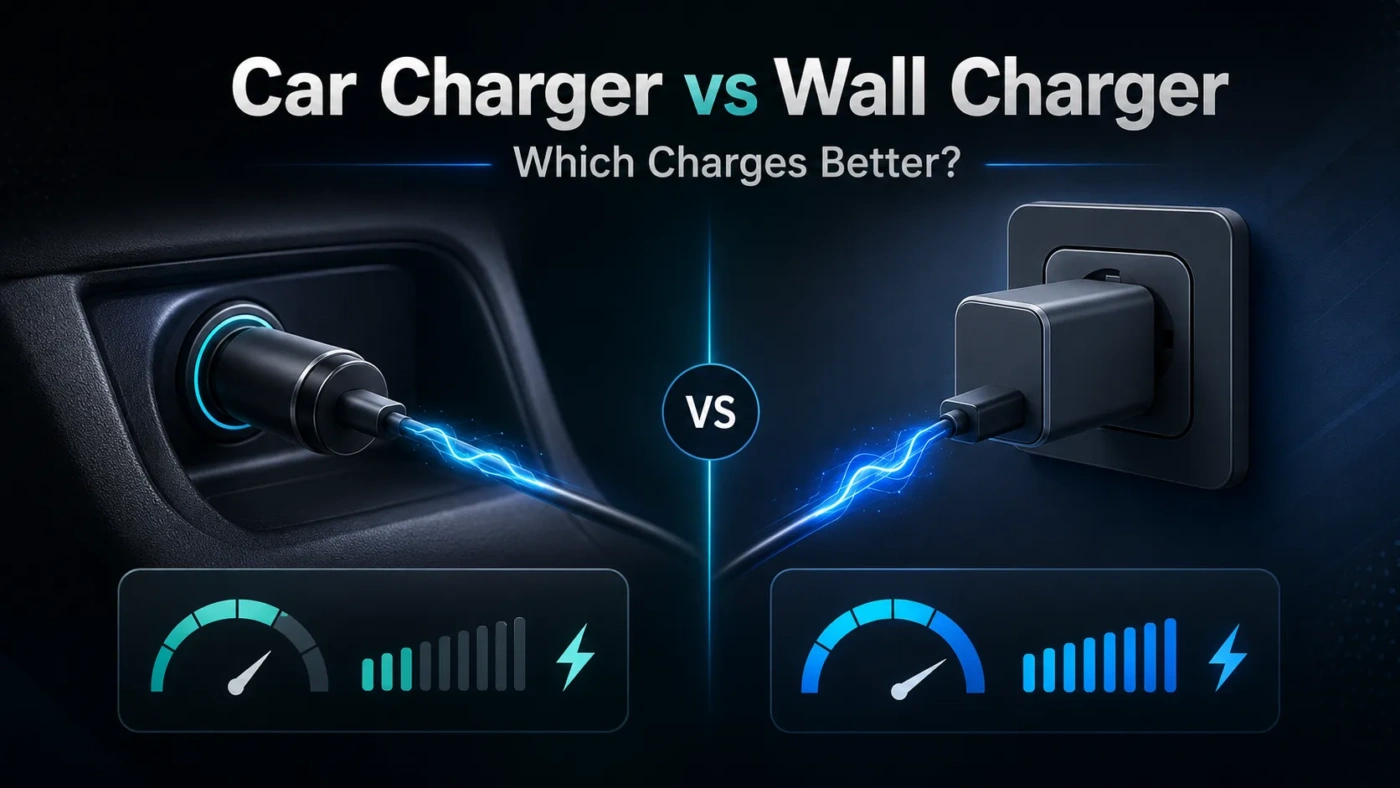
A wall charger usually charges better than a car charger because it gets steadier electricity from a home outlet, supports higher wattage more often, and is better suited for fast charging phones, tablets, laptops, and battery packs. A car charger is still the better choice while driving, but its real speed depends on the vehicle port, adapter quality, cable, device limits, and whether the engine is running.
- Main Differences
- What A Car Charger Offers
- What A Wall Charger Offers
- Speed And Charging Performance
- Choose A Car Charger If
- Choose A Wall Charger If
- Safety And Heat
- Cable And Compatibility
- Best Choice By User Type
- Common Misunderstandings
- Which One Charges Better?
- FAQ
- Is A Car Charger Bad For Phone Battery Health?
- Can A Car Charger Fast Charge A Phone?
- Can A Car Charger Charge A Laptop?
- Should I Unplug My Car Charger When The Car Is Off?
- Which Is Better For Overnight Charging?
| Feature | Car Charger | Wall Charger |
|---|---|---|
| Best Use | Charging while driving or during travel | Daily home, office, and overnight charging |
| Charging Speed | Can be fast, but varies by car outlet and adapter | Usually faster and more stable |
| Power Stability | Depends on vehicle electrical system and port quality | More consistent from a standard outlet |
| Fast Charging Support | Available on good USB-C PD models | More common, especially with USB-C PD and GaN chargers |
| Laptop Charging | Possible with higher-watt USB-C PD car chargers | Better for most laptops and high-watt devices |
| Convenience | Useful only in or near a vehicle | Works anywhere with an outlet |
| Battery Safety | Safe when using a quality charger, but cheap adapters can be unreliable | Safe and predictable with a certified charger |
| Best Overall Choice | Best as a travel backup | Best as the main charger |
Main Differences
The main difference is the source of electricity. A wall charger plugs into a household outlet and converts AC power into the DC power your device needs. A car charger plugs into a vehicle’s 12V accessory socket or built-in USB port, then converts vehicle power into usable charging output.
That difference affects speed, stability, heat, and device support. A modern wall charger can often deliver higher wattage with fewer interruptions. A car charger can also be fast, but only if the car outlet, charger, cable, and device all support the right charging standard.
What A Car Charger Offers
A car charger is made for charging devices from a vehicle’s accessory socket or built-in charging port. Basic models may provide slow USB-A charging, while better models can support USB-C Power Delivery, Quick Charge, or multi-port charging.
The best reason to use a car charger is convenience while moving. It keeps a phone alive for navigation, lets passengers charge devices, and can help during long drives. For many people, it is not the fastest charger they own, but it is one of the most useful backup accessories.
Practical note: A car charger rated for high wattage does not always deliver that full speed to every device. The phone or laptop must accept that wattage, the cable must support it, and the car’s power outlet must provide enough stable input.
What A Wall Charger Offers
A wall charger is the better everyday charging option for most people. It connects to a home or office outlet and is usually more stable than a vehicle charging setup. Modern USB-C wall chargers can charge phones quickly, refill large power banks, and support many tablets and laptops.
Wall chargers also offer more choices. You can buy small single-port chargers, multi-port desk chargers, travel chargers, or higher-watt GaN chargers. If you want one charger for several devices, a wall charger is usually the easier place to start.
Speed And Charging Performance
If both chargers are high quality and support the same fast charging standard, the speed can be similar for a phone. For example, a good USB-C PD car charger and a good USB-C PD wall charger may both fast charge a compatible smartphone.
The difference appears when charging larger devices or multiple devices. A wall charger is usually better for high-watt charging because it has access to a steadier power source. A car charger may slow down, heat up, or split available wattage between ports, especially when several devices are connected.
Choose A Car Charger If
Choose a car charger if you need charging during commutes, delivery work, rideshare driving, family trips, camping drives, or long-distance travel. It is also useful if your phone handles navigation, music, calls, hotspot sharing, or dashcam pairing while you drive.
A car charger makes the most sense when you see it as a mobility accessory. It does not need to replace your wall charger. It solves a different problem: keeping devices usable when an outlet is not nearby.
Choose A Wall Charger If
Choose a wall charger if you want the better main charger for your phone, tablet, laptop, smartwatch, earbuds, or power bank. It is the more dependable option for daily charging because it is not tied to a vehicle and usually handles higher output more easily.
A wall charger is also the better pick if you care about charging several devices from one place. Multi-port wall chargers can sit on a desk, nightstand, or travel bag and cover most charging needs without relying on a car.
Safety And Heat
Both charger types can be safe when they are well made. The bigger risk is not the category itself, but the quality of the charger. Poorly made adapters can run hot, deliver unstable output, or fail early.
Car chargers face a slightly harsher environment. They may sit in heat, cold, vibration, dust, and tight sockets. A loose car charger can disconnect while driving. A wall charger usually has a calmer job, especially when used indoors with a stable outlet.
Do not leave a device charging in a hot parked car. Heat can slow charging and may stress the device battery more than the charger type itself.
Cable And Compatibility
The cable matters more than many people expect. A fast charger with a weak cable may charge slowly. For USB-C fast charging, use a cable that supports the wattage your device needs. For laptops, that may mean a higher-rated USB-C cable, not just any cable that fits.
Compatibility also depends on charging standards. USB-C Power Delivery is widely used for phones, tablets, laptops, and power banks. Some devices may also support brand-specific fast charging systems. If the charger and device cannot agree on a fast charging mode, the device will fall back to a slower speed.
Best Choice By User Type
| User Type | Better Choice | Reason |
|---|---|---|
| Daily Phone User | Wall Charger | More reliable for regular charging at home or work. |
| Commuter | Car Charger | Keeps the phone topped up during navigation and calls. |
| Laptop User | Wall Charger | More suitable for higher-watt charging. |
| Road Trip Traveler | Car Charger | Useful when several hours pass between outlets. |
| Family Car | Both | A wall charger handles main charging, while a multi-port car charger helps passengers. |
| Power Bank Owner | Wall Charger | Better for refilling large batteries quickly and predictably. |
Common Misunderstandings
A modern USB-C PD car charger can charge many phones quickly. The weak point is usually an old adapter, a poor cable, or a low-output vehicle USB port.
An old 5W wall charger can be much slower than a newer high-watt car charger. Wattage and charging standard matter.
Your device controls how much power it accepts. A phone that accepts 25W will not charge at 65W just because the charger can provide it.
Many vehicle USB ports are made for media or basic charging. A dedicated USB-C car charger often performs better.
Which One Charges Better?
A wall charger charges better for most daily needs. It is more stable, more flexible, and more likely to support higher wattage. If you need the best charger for home, office, hotel rooms, laptops, tablets, or large power banks, choose a wall charger.
A car charger charges better only in the situation it is built for: when you are in a vehicle and need power on the move. The smartest setup is not really car charger versus wall charger. It is a good wall charger for your main charging routine and a good car charger for travel, navigation, and backup power.
FAQ
Is A Car Charger Bad For Phone Battery Health?
No, not if it is a quality charger and your phone is not exposed to too much heat. Battery stress is more likely from heat, poor accessories, or leaving the phone in a hot car than from using a car charger itself.
Can A Car Charger Fast Charge A Phone?
Yes. A USB-C PD car charger can fast charge many modern phones when paired with the right cable. The phone must also support that charging standard.
Can A Car Charger Charge A Laptop?
Some can, but not all. You need a higher-watt USB-C PD car charger, a compatible laptop, and a cable rated for that wattage. A wall charger is still the safer everyday choice for laptops.
Should I Unplug My Car Charger When The Car Is Off?
It is often a good habit, especially in older vehicles or if the socket stays powered when the engine is off. Some cars cut power automatically, while others may allow small drain over time.
Which Is Better For Overnight Charging?
A wall charger is better for overnight charging because it is more stable, easier to place safely, and not affected by vehicle temperature or battery state.