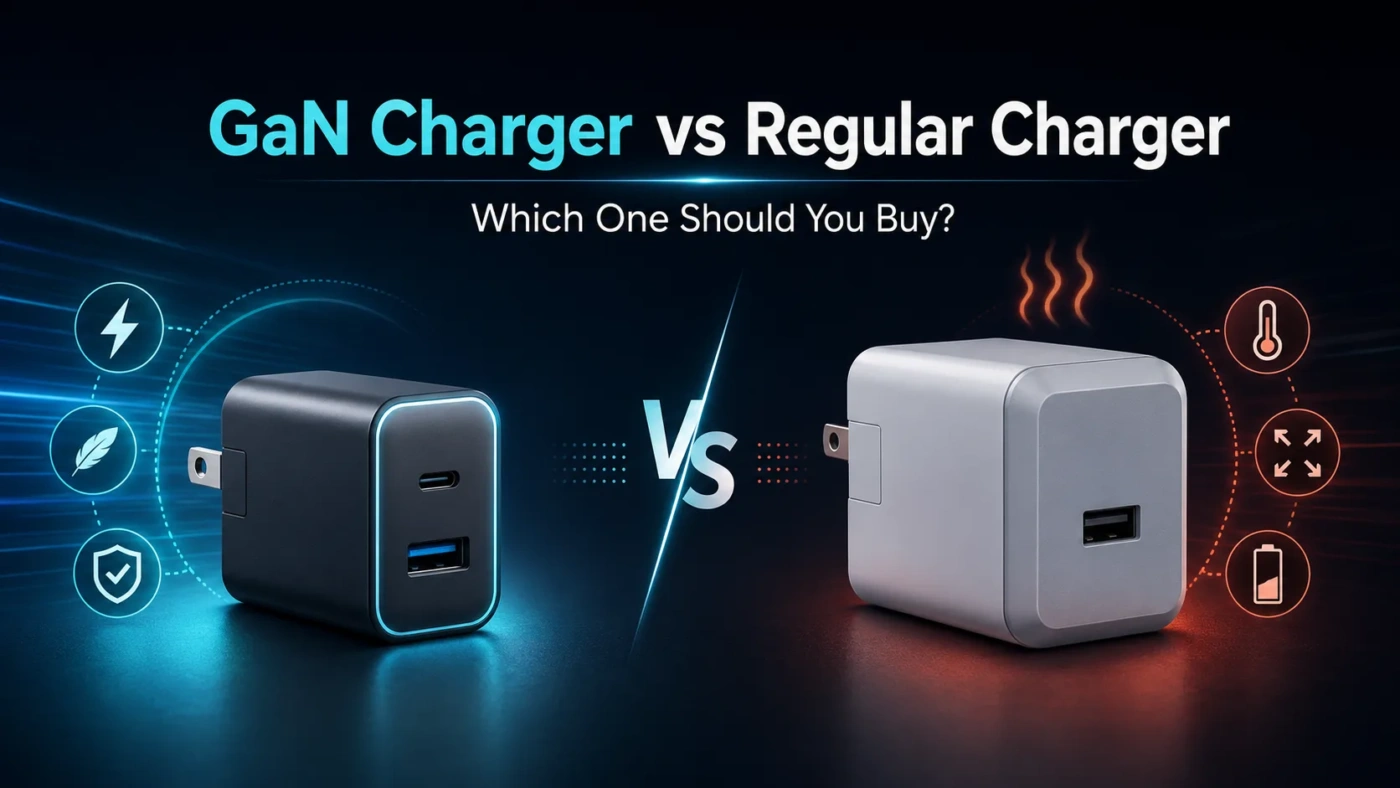
If you want one charger for a phone, tablet, laptop, earbuds, and travel bag, a GaN charger is usually the better buy. It is smaller, runs cooler at higher wattages, and often supports more modern USB-C charging setups. A regular charger still makes sense if you only need a cheap, low-power adapter for one device and do not care about size or multi-device charging.
- Main Differences
- What A GaN Charger Offers
- What A Regular Charger Offers
- Charging Speed And Device Compatibility
- Charging Speed Reality Check
- Heat, Size, And Everyday Comfort
- Price And Long-Term Value
- Choose A GaN Charger If
- You Want One Charger For Several Devices
- You Travel Often
- You Charge A USB-C Laptop
- You Care About Desk Setup
- Choose A Regular Charger If
- Decision Tree
- Safety And Quality
- Common Misunderstandings
- Best Choice By User Type
- Glossary
- FAQ
- Is A GaN Charger Worth It?
- Does GaN Charge Faster Than A Regular Charger?
- Can A GaN Charger Damage My Phone?
- Is A Regular Charger Still Good?
- What Wattage Should I Buy?
- The Better Pick For Most Buyers
| Feature | GaN Charger | Regular Charger |
|---|---|---|
| Best For | Phones, tablets, laptops, travel, and multi-device setups | Basic phone charging and low-cost replacement use |
| Technology | Uses gallium nitride power components | Usually uses traditional silicon-based components |
| Size | Often much smaller at the same wattage | Often larger, especially above 45W or 65W |
| Heat | Usually manages heat better in compact designs | Can get warmer when delivering higher power |
| Charging Speed | Fast when wattage, device, cable, and protocol match | Can also be fast if it supports the right wattage and protocol |
| Price | Usually costs more | Usually cheaper |
| Port Options | Often includes multiple USB-C and USB-A ports | Often has one port, though multi-port models exist |
| Travel Use | Better for packing light and replacing several adapters | Fine if you carry one device or already own the right adapter |
| Best Value | Better long-term value for high-power or multi-device use | Better upfront value for simple charging |
Main Differences
The main difference is not the shape of the charger. It is the material used inside the power circuitry. A GaN charger uses gallium nitride, a material that can switch power efficiently in a compact space. A regular charger usually relies on silicon-based components, which are older, widely used, and still dependable.
In real use, GaN matters most when the charger needs to deliver more power without becoming bulky. That is why many modern 45W, 65W, 100W, and higher USB-C chargers use GaN. For a small 5W or 12W phone adapter, the benefit is much less noticeable.
What A GaN Charger Offers
A GaN charger is a modern power adapter built around gallium nitride components. The main appeal is simple: it can deliver higher power from a smaller body. That makes it useful for people who want one compact charger instead of separate adapters for a phone, tablet, laptop, watch, and earbuds.
Many GaN chargers also support USB-C Power Delivery, PPS, or other fast-charging protocols. These protocols help the charger and device agree on the right voltage and current. The charger does not force maximum power into every device; a good charger negotiates what the device can safely accept.
GaN chargers are especially useful in these cases:
- You charge a USB-C laptop and phone from the same adapter.
- You want a smaller charger for travel.
- You use high-wattage devices such as tablets, handheld gaming devices, or compact laptops.
- You want one wall charger with two, three, or four ports.
- You dislike carrying several bulky adapters.
What A Regular Charger Offers
A regular charger is not automatically outdated. Many basic chargers are reliable, affordable, and perfectly fine for low-power devices. If you only charge one phone overnight, a regular USB-A or USB-C adapter may be enough.
The tradeoff appears when power demand rises. A traditional charger that delivers laptop-level wattage may be larger and warmer than a comparable GaN model. It may also offer fewer ports or less flexible charging behavior. Still, for simple everyday charging, a safe regular charger from a known brand can be a sensible purchase.
Regular chargers are a good fit when:
- You need the lowest reasonable price.
- You charge one phone or small accessory.
- You already own a charger that works well.
- You do not need fast laptop charging.
- Size and weight are not a concern.
Charging Speed And Device Compatibility
A common mistake is assuming that GaN automatically means faster charging. It does not. Charging speed depends on wattage, charging protocol, device support, cable quality, and port sharing.
For example, a 65W GaN charger can charge a compatible laptop faster than a 20W regular charger, but that is because of the wattage and USB-C Power Delivery support, not simply because it uses GaN. A 20W GaN charger and a 20W regular charger may charge the same phone at a very similar speed if both support the same protocol.
Charging Speed Reality Check
Look at the output rating before buying. A charger labeled 30W, 45W, 65W, or 100W tells you more about practical charging speed than the word GaN alone. Also check whether your cable supports the wattage you expect, especially for laptops and higher-power USB-C devices.
Heat, Size, And Everyday Comfort
Heat is one of the clearest practical differences. GaN chargers are often designed to waste less energy as heat, which helps them stay compact while delivering higher wattage. That does not mean they remain cold. Any high-power charger can feel warm during use, especially when charging a laptop or multiple devices.
The real comfort advantage is packing and placement. A small GaN charger is easier to fit behind furniture, inside a travel pouch, or next to other plugs on a power strip. Some regular chargers block nearby outlets because they need a larger case for similar output.
Price And Long-Term Value
GaN chargers usually cost more than basic regular chargers. The extra cost is easiest to justify when the charger replaces two or three adapters, supports a laptop, or makes travel simpler. A single-port low-wattage GaN charger may not be worth paying extra for if your current charger already handles your phone well.
For most buyers, value depends on wattage:
- Under 20W: A regular charger is often enough for basic phone charging.
- 20W to 35W: GaN is nice for size, but not always necessary.
- 45W to 65W: GaN becomes more attractive for tablets, ultrabooks, and travel.
- 100W and above: GaN is usually the better fit if you want compact size and multi-port flexibility.
Choose A GaN Charger If
You Want One Charger For Several Devices
A multi-port GaN charger can handle a laptop, phone, tablet, and earbuds from one wall outlet. Check the power split carefully, because the maximum wattage often changes when more than one port is used.
You Travel Often
GaN chargers are easier to pack and can reduce the number of adapters in your bag. A folding plug and compact shape make a real difference in daily carry.
You Charge A USB-C Laptop
If your laptop supports USB-C Power Delivery, a 65W, 100W, or higher GaN charger can be a clean replacement for a bulkier laptop brick. Always match the wattage range your laptop expects.
You Care About Desk Setup
A smaller charger with multiple ports can make a desk cleaner. It also helps when outlet space is limited.
Choose A Regular Charger If
Decision Tree
Safety And Quality
Whether you buy GaN or regular, quality matters more than the label. A poorly made charger can be a bad choice even if it uses modern technology. Look for clear wattage markings, device compatibility, overcurrent protection, temperature protection, and safety certification where available.
Be careful with very cheap chargers that promise unusually high wattage in a tiny body. Also check the cable. A good charger with a weak or low-rated cable may charge slowly, disconnect, or fail to deliver the expected power.
Safety note: Do not choose a charger only because it says GaN or fast charging. Buy from a reliable brand, match the wattage to your device, and use a suitable cable.
Common Misunderstandings
| Claim | What It Really Means |
|---|---|
| GaN always charges faster. | Not always. Speed depends on wattage, protocol, cable, and device support. |
| Regular chargers are unsafe. | A quality regular charger can be safe and reliable. Poor quality is the problem, not the category itself. |
| A 100W charger always sends 100W. | The device only takes what it can use. Multi-port chargers may divide power between ports. |
| Any USB-C cable works for laptop charging. | Higher wattage charging may need a cable rated for that power level. |
| A warm charger is always dangerous. | Some warmth is normal under load. Excessive heat, smell, noise, or damaged casing is not normal. |
Best Choice By User Type
| User Type | Better Choice | Reason |
|---|---|---|
| Phone-Only User | Regular Charger | A safe 20W or lower adapter may be enough for basic daily charging. |
| Laptop User | GaN Charger | Better size-to-power balance for 45W, 65W, 100W, and higher charging. |
| Traveler | GaN Charger | Smaller body and multi-port designs reduce bag clutter. |
| Budget Buyer | Regular Charger | Lower upfront cost if advanced charging is not needed. |
| Student | GaN Charger | One charger can cover a laptop, phone, and tablet between classes. |
| Desk Setup User | GaN Charger | Multi-port charging keeps outlets and cables easier to manage. |
Glossary
FAQ
Is A GaN Charger Worth It?
Yes, if you need a compact charger for a laptop, tablet, travel bag, or multiple devices. It may not be worth the extra cost for basic phone-only charging.
Does GaN Charge Faster Than A Regular Charger?
Only when the GaN charger has higher wattage or better protocol support than the regular charger. GaN itself does not override your device’s charging limit.
Can A GaN Charger Damage My Phone?
A quality GaN charger should not damage a compatible phone. The phone and charger negotiate the charging level. Use a reliable charger and a suitable cable.
Is A Regular Charger Still Good?
Yes. A safe regular charger is still a good choice for low-power devices, spare charging locations, and budget purchases.
What Wattage Should I Buy?
For phones, 20W to 30W is often enough. For tablets and small laptops, 45W to 65W is more useful. For larger laptops or multi-device charging, consider 100W or more if your devices support it.
The Better Pick For Most Buyers
For a new charger purchase, GaN is the better choice for most people who own more than one modern device. It is easier to carry, better suited to higher wattage, and more flexible for USB-C charging. Choose a regular charger when your needs are simple: one phone, low wattage, low price, and no need for a smaller multi-port adapter.