MagSafe Charger is usually the better choice if you use a compatible iPhone and want the easiest alignment, stronger accessory support, and the best wireless charging speed Apple currently offers. A Qi wireless charger is the better fit if you want wider device compatibility, lower cost, or a simple charging pad that works with many phones, earbuds, and accessories. The right choice depends less on “wireless charging” itself and more on your phone model, charging speed needs, and whether magnetic attachment matters in daily use.
- The Short Answer
- Main Differences
- MagSafe Charger
- Qi Wireless Charger
- Charging Speed and Real Performance
- Compatibility and Setup
- How The Charging Experience Feels
- Choose MagSafe Charger If
- Choose Qi Wireless Charger If
- Where Qi2 Fits
- Price and Long-Term Value
- Best Choice By User Type
- Common Misunderstandings
- Compare More Options
- FAQ
- Is MagSafe Better Than Qi Wireless Charging?
- Can A MagSafe Charger Charge Qi Devices?
- Is Qi2 The Same As MagSafe?
- Should I Buy MagSafe Or Qi2 For An iPhone?
- Does Wireless Charging Damage The Battery?
| Feature | MagSafe Charger | Qi Wireless Charger |
|---|---|---|
| Best fit | iPhone users who want magnetic alignment and faster Apple-supported wireless charging | Users with mixed devices, Android phones, earbuds, or a lower budget |
| Alignment | Magnets snap the phone into the correct charging position | Basic Qi pads rely on manual placement; Qi2 models may include magnetic alignment |
| Charging speed | Can reach higher speeds on supported iPhone models with the right USB-C adapter | Varies by charger, phone, power adapter, and Qi version |
| Compatibility | Best with iPhone 12 and newer models; can also charge some Qi-compatible devices | Works across a wider range of Qi-compatible phones and accessories |
| Accessory ecosystem | Strong for stands, mounts, wallets, car chargers, battery packs, and cases | Broad, but magnetic accessory support depends on Qi2 or special cases |
| Ease of use | Very easy: attach and charge without much adjustment | Easy, but placement can matter on flat pads and older chargers |
| Price | Often costs more, especially with an official charger and suitable adapter | Usually available in more budget-friendly options |
| Best answer | Choose it for a compatible iPhone and daily convenience | Choose it for flexibility, shared charging, and lower cost |
The Short Answer
If you are buying for an iPhone and care about convenience, MagSafe Charger is the cleaner choice. The magnets help the phone land in the right spot, which reduces the common problem of waking up to a phone that was slightly misaligned on a flat charging pad.
If you are buying one charger for several devices, a Qi wireless charger makes more sense. Qi is the wider wireless charging standard, so it can work with many phones, earbuds cases, and small accessories. Just check the charger’s wattage and certification before assuming it will charge every device at top speed.
Main Differences
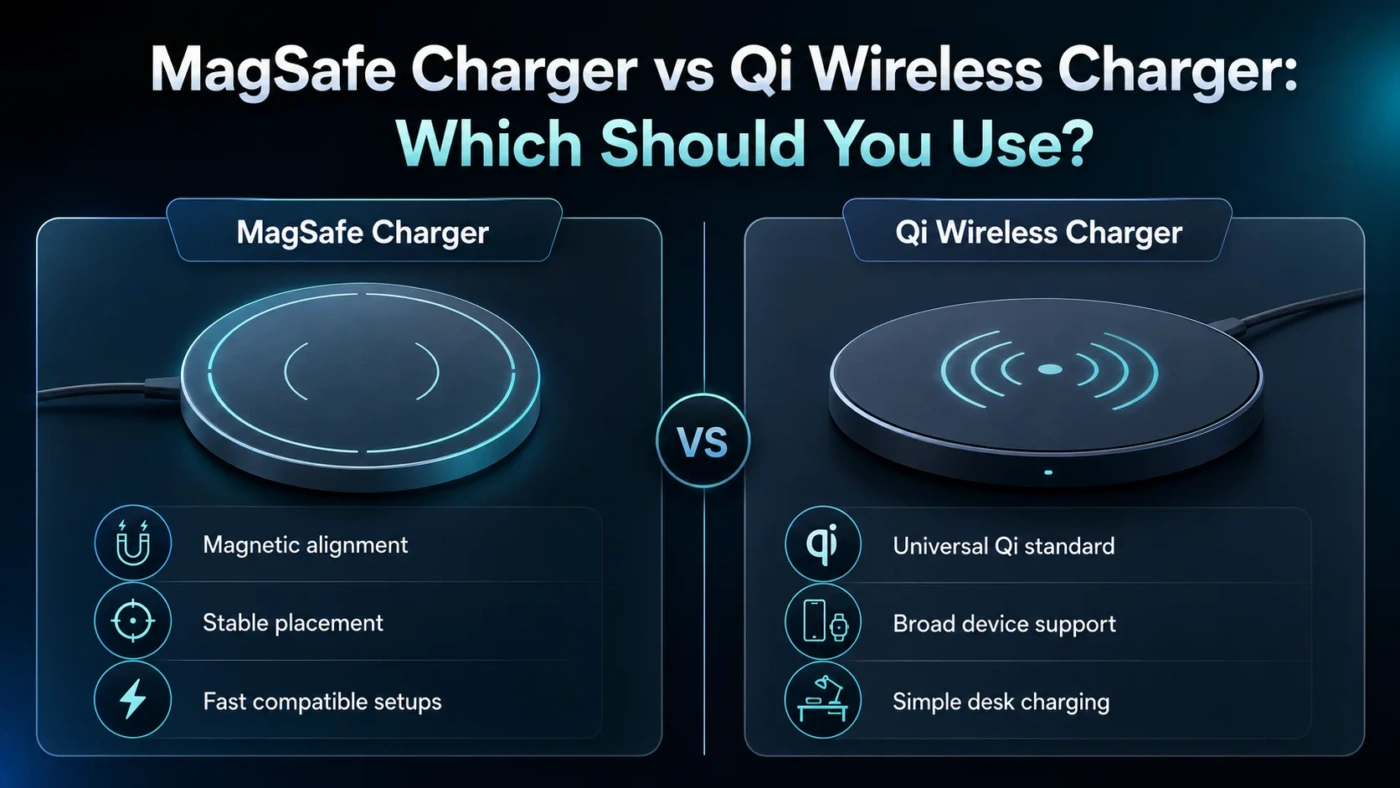
MagSafe Charger
MagSafe is Apple’s magnetic wireless charging system for compatible iPhones. Its main advantage is not only speed; it is alignment. The charger attaches to the back of the phone in the correct position, so charging starts with less fiddling.
It also connects to a larger accessory system. Desk stands, car mounts, battery packs, wallets, and cases can use the same magnetic layout. For many iPhone users, that daily ease is the real reason to choose it.
Qi Wireless Charger
Qi is the broad wireless charging standard used across many brands. A basic Qi pad charges a compatible device when its charging coil lines up with the coil inside the phone or accessory.
Qi chargers come in many forms: flat pads, stands, multi-device stations, car mounts, portable battery packs, and travel chargers. Newer Qi2 chargers may also add magnetic alignment, narrowing the comfort gap with MagSafe.
Charging Speed and Real Performance
MagSafe Charger can be faster than a basic Qi charger on supported iPhone models, especially when paired with the right USB-C power adapter. Newer Apple MagSafe hardware and compatible iPhones can reach higher peak wireless speeds than older MagSafe setups, while many older iPhones and older chargers charge at lower rates.
Qi charging speed is more varied. Some basic Qi chargers are slow and simple. Some Qi chargers support faster profiles, but the phone must support that profile too. Qi2 improves the experience with magnetic alignment and faster certified charging for supported devices, while Qi2 25W products are designed for higher wireless power where both the charger and phone support it.
Compatibility and Setup
MagSafe Charger is most useful with iPhone models that include the MagSafe magnetic ring. It can still work as a wireless charger for some Qi-compatible devices, but the magnetic snap and best charging behavior are built around compatible iPhones.
A Qi wireless charger is the safer choice when you do not know which devices will be used. It may charge an Android phone, an iPhone, wireless earbuds, or another Qi-compatible accessory. The tradeoff is that older non-magnetic Qi pads can be more sensitive to placement.
How The Charging Experience Feels
Choose MagSafe Charger If
- You use a compatible iPhone as your main phone.
- You want magnetic alignment without checking the phone position every time.
- You use MagSafe cases, stands, car mounts, or battery packs.
- You want the best Apple-supported wireless charging experience for newer iPhones.
- You prefer a charger that feels more like attaching a cable than placing a phone on a pad.
Choose Qi Wireless Charger If
- You want one charger for different phone brands and accessories.
- You charge earbuds or other small Qi-compatible devices often.
- You want a budget-friendly charging pad for a desk, guest room, or bedside table.
- Your phone does not support MagSafe.
- You do not need magnetic mounts, wallets, or snap-on battery packs.
Where Qi2 Fits
Qi2 changes the decision for many buyers. A Qi2-certified magnetic charger can offer magnetic alignment similar to MagSafe while using a shared industry standard. For newer phones that support Qi2, it may be the smarter long-term buy than an older basic Qi pad.
That said, Qi2 support is not the same on every phone. Some phones have built-in magnets, some need a magnetic case, and some only support older Qi charging. Before buying, check both sides: the phone’s wireless charging support and the charger’s certification.
Price and Long-Term Value
A basic Qi charger is usually cheaper. That makes it a good choice when speed is not the main concern, such as overnight charging or a shared charger in a spare room. It also works well when you need several charging spots around the house.
MagSafe Charger often costs more, especially when you add the right USB-C power adapter. The extra cost is easier to justify if you use your iPhone heavily, charge often during the day, or want a cleaner setup on a stand, desk, or nightstand.
Best Choice By User Type
| User Type | Better Choice | Reason |
|---|---|---|
| iPhone 12 or newer user | MagSafe Charger | Better alignment and stronger accessory support. |
| Mixed-device household | Qi Wireless Charger | Works with more phones and accessories. |
| Budget buyer | Qi Wireless Charger | More low-cost options are available. |
| Desk or bedside iPhone setup | MagSafe Charger | A stand or puck keeps the phone aligned with less effort. |
| Android user | Qi Or Qi2 Wireless Charger | Compatibility depends on the phone, case, and wireless charging standard. |
| Travel user | Depends | MagSafe is tidy for iPhone travel; Qi is better when charging several device types. |
Common Misunderstandings
Compare More Options
FAQ
Is MagSafe Better Than Qi Wireless Charging?
MagSafe is better for compatible iPhones when alignment, accessories, and Apple-supported charging behavior matter. Qi is better when you need broader compatibility or a lower-cost charger.
Can A MagSafe Charger Charge Qi Devices?
In many cases, yes. A MagSafe Charger can charge some Qi-compatible devices, but the magnetic attachment and best charging speed are designed for compatible iPhones.
Is Qi2 The Same As MagSafe?
No. Qi2 is an industry wireless charging standard that can include magnetic alignment. It was influenced by the same practical idea that makes MagSafe useful: better coil alignment. Device support still matters.
Should I Buy MagSafe Or Qi2 For An iPhone?
For a compatible iPhone, an official or certified MagSafe option is the simplest pick. A Qi2-certified magnetic charger can also be a smart option if it supports the charging speed and form factor you want.
Does Wireless Charging Damage The Battery?
Normal wireless charging is designed to be safe, but heat can affect battery comfort over time. Use certified chargers, avoid thick or metal cases, and move the phone if it becomes unusually warm.
Bottom line: choose MagSafe Charger for a compatible iPhone and the smoothest daily experience. Choose a Qi wireless charger for shared charging, lower cost, and wider device support. If you are buying new today, also check Qi2 support before choosing an older basic Qi pad.