Fast charging is worth it if you often need a useful battery boost in a short break, but a standard charger still makes sense for overnight charging, older devices, travel spares, and people who care more about low cost than speed. The better choice depends less on the charger name and more on your device, cable, wattage support, heat control, and daily charging habits.
- Choose A Fast Charger If
- Choose A Standard Charger If
- Best Middle Ground
- Main Differences
- What A Fast Charger Does
- What A Standard Charger Does
- Charging Speed In Real Use
- Battery Health And Heat
- Compatibility And Cable Fit
- Cost And Long-Term Value
- Choose A Fast Charger If
- Choose A Standard Charger If
- Common Misunderstandings
- A Higher Wattage Charger Always Charges Faster
- Fast Charging Destroys Every Battery
- Any USB-C Cable Can Fast Charge
- Wireless Fast Charging Is The Same As Wired Fast Charging
- Best Choice By User Type
- Safety Checklist Before Buying
- The Better Choice For Most People
- FAQ
- Is Fast Charging Safe For My Phone?
- Will A 65W Charger Damage A Phone?
- Do I Need A Special Cable For Fast Charging?
- Is Slow Charging Better Overnight?
- What Wattage Is Best For A Phone?
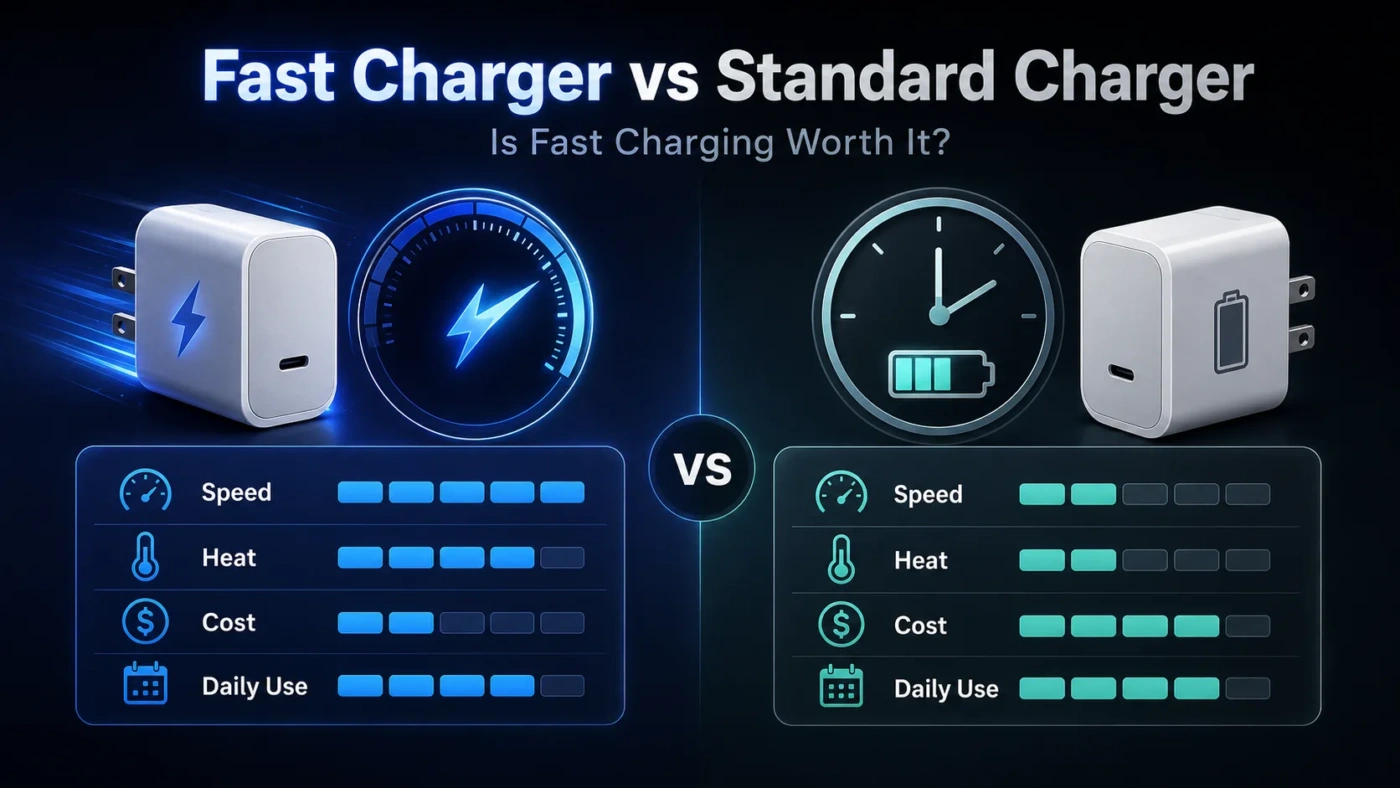
| Feature | Fast Charger | Standard Charger |
|---|---|---|
| Typical power range | Often 18W to 45W for phones; higher for tablets and laptops | Commonly 5W to 12W for phones |
| Best use | Short charging windows, travel, workdays, heavy phone use | Overnight charging, spare chargers, basic daily use |
| Charging speed | Much faster from low battery to about 50% or 80% | Slower but steady |
| Battery heat | Can create more heat, especially with poor cables or warm rooms | Usually cooler during normal use |
| Compatibility | Needs device support, the right cable, and the right charging protocol | Works with most USB-powered devices, usually at slower speeds |
| Price | Usually costs more, especially multi-port or high-wattage models | Usually cheaper and easier to replace |
| Best overall choice | Better for most modern smartphone users | Better for slow overnight charging and older devices |
Choose A Fast Charger If
You want 30 minutes of charging to make a real difference, you use your phone heavily, or you charge during short breaks instead of overnight.
Choose A Standard Charger If
You usually plug in before sleeping, your device is older, or you want the simplest low-cost charger without caring about speed.
Best Middle Ground
A certified USB-C charger around 20W to 30W is the best fit for many phones because it is fast enough without being oversized for basic use.
Main Differences
The main difference is power delivery. A standard charger sends a low amount of power to the device, so charging takes longer. A fast charger can send more power, but only when the device, cable, and charger agree on a safe charging level.
This means a 65W charger will not automatically force 65W into a phone. Modern devices negotiate the amount of power they can accept. If the phone supports only 20W charging, it will usually draw around that level even when connected to a larger charger.
What A Fast Charger Does
A fast charger increases charging speed by using higher wattage and a compatible charging protocol such as USB Power Delivery, PPS, Quick Charge, or a brand-specific system. The speed gain is most noticeable when the battery is low. Going from 10% to 50% can feel dramatically faster than the final stretch from 80% to 100%.
Fast charging is not one fixed speed. A phone, tablet, laptop, and wireless charging pad can all advertise fast charging while using very different wattage levels. The label only tells part of the story; the device’s supported charging rate matters more.
What A Standard Charger Does
A standard charger uses lower power, often enough for overnight charging or for devices with small batteries. It is slower, but that can be perfectly fine if the device has several hours to charge.
Standard chargers are also useful as backup chargers. They are cheap, simple, and less demanding on cables. For earbuds, basic phones, small accessories, and older devices, a standard charger may be all you need.
Charging Speed In Real Use
Fast charging feels most useful when your battery is low and your time is limited. A modern phone with the right charger may recover enough battery during breakfast, a commute, or a coffee break. That changes how you use the device because you no longer need to plan around a long charging session.
The advantage becomes smaller near full battery. Many devices slow charging after about 70% to 80% to manage heat and battery stress. So, if you always charge overnight to 100%, a fast charger may not feel as valuable as it looks on paper.
| Situation | Better Choice | Reason |
|---|---|---|
| Charging before leaving home | Fast charger | A short session can add a useful amount of battery. |
| Charging overnight | Standard charger | Speed matters less when the device has many hours to charge. |
| Using one charger for phone and laptop | Fast charger | A higher-wattage USB-C charger can support more device types. |
| Charging older accessories | Standard charger | Small devices often do not benefit from higher wattage. |
| Keeping a spare in a bag | Either | A compact fast charger is better for speed; a standard charger is cheaper to replace. |
Battery Health And Heat
Fast charging is not automatically bad for a battery, but heat is the part to watch. Lithium-ion batteries age faster when they spend too much time hot, especially while charging. Good devices manage this by slowing charging when the battery warms up or gets close to full.
A safe fast charging setup uses a certified charger, a suitable cable, and a device that supports the charging standard. Problems are more likely with very cheap adapters, damaged cables, poor ventilation, or charging under a pillow, in direct sun, or inside a hot car.
Compatibility And Cable Fit
The charger is only one part of the chain. To get fast charging, the device must support it, the adapter must provide the right output, and the cable must carry the required power. A weak or charge-only cable can make a fast charger behave like a slow one.
USB-C makes this easier, but it does not make every charger equal. Some phones need USB Power Delivery, some benefit from PPS, and some brands use their own fast charging method. For the best result, match the charger to your device’s stated charging support.
Cost And Long-Term Value
A fast charger costs more, but it can replace several older adapters if it has enough power and the right ports. A good 30W charger can handle many phones and tablets. A 65W or 100W USB-C charger may also charge a laptop, depending on the laptop’s needs.
A standard charger is better value only when speed is not part of the decision. If you already charge slowly overnight and rarely run out of battery, spending more for fast charging may not change your routine much.
Choose A Fast Charger If
- You often leave home with a low battery.
- You charge during short breaks rather than overnight.
- You use battery-heavy apps such as navigation, video, gaming, hotspot, or camera recording.
- You want one compact charger for multiple USB-C devices.
- Your phone, tablet, or laptop supports USB-C fast charging.
Choose A Standard Charger If
- You normally charge while sleeping.
- Your device does not support fast charging.
- You want the cheapest spare charger for occasional use.
- You charge small accessories such as earbuds, simple lamps, or basic USB devices.
- You prefer cooler, slower charging when speed is not needed.
Common Misunderstandings
A Higher Wattage Charger Always Charges Faster
Not always. The device decides how much power it can safely accept. A 100W charger may charge a phone at 20W, 25W, or another limit set by the phone.
Fast Charging Destroys Every Battery
Fast charging can add heat, but modern phones use charging controls to reduce risk. The bigger issue is poor-quality charging gear, heat buildup, and charging habits that keep the device hot for long periods.
Any USB-C Cable Can Fast Charge
USB-C describes the connector, not the full charging ability. Some cables support higher power; others do not. For laptops and higher-wattage chargers, the cable rating matters.
Wireless Fast Charging Is The Same As Wired Fast Charging
Wireless charging is convenient, but it often produces more heat and may be slower than a wired fast charger. For the fastest and most efficient charge, wired charging usually wins.
Best Choice By User Type
| User Type | Best Choice | Why |
|---|---|---|
| Heavy phone user | Fast charger | More useful battery recovery during the day. |
| Casual user | Standard charger or modest fast charger | Speed may matter only occasionally. |
| Traveler | Compact multi-port fast charger | One adapter can charge several devices with less waiting. |
| Budget buyer | Standard charger | Lowest cost when fast charging is not needed. |
| Laptop and phone user | Higher-wattage USB-C fast charger | Can reduce the number of adapters carried. |
| Overnight charger | Standard charger | The speed advantage is mostly unused. |
Safety Checklist Before Buying
- Check the maximum charging wattage your device supports.
- Prefer certified chargers from reliable brands.
- Use a cable rated for the wattage you need.
- Avoid damaged cables, loose ports, and unusually hot adapters.
- Do not cover the device while charging.
- Choose USB-C Power Delivery support if you want wider compatibility.
The Better Choice For Most People
For most modern phone users, a fast charger is worth it. The time saved is real, especially when charging from low battery. A modest fast charger is usually enough; you do not need the highest wattage unless you also charge tablets, laptops, or several devices.
A standard charger is still the smarter choice when charging speed does not affect your day. If your device charges overnight, stays cool, and rarely runs low, a simple standard charger remains practical.
FAQ
Is Fast Charging Safe For My Phone?
Yes, when the charger, cable, and device are compatible. Modern devices control how much power they receive and slow down when needed. Heat and low-quality accessories are the main concerns.
Will A 65W Charger Damage A Phone?
Usually no. A phone should draw only the power it supports. The charger’s maximum wattage is not automatically pushed into the phone.
Do I Need A Special Cable For Fast Charging?
Sometimes. For lower phone wattages, many good USB-C cables work. For higher power levels, tablets, and laptops, use a cable rated for the required wattage.
Is Slow Charging Better Overnight?
Slow charging is often enough overnight and may keep heat lower. Many modern phones also include battery protection features that delay or limit charging near full battery.
What Wattage Is Best For A Phone?
Many phones work well with a 20W to 30W USB-C charger, but the best number depends on the phone’s supported charging rate. Buying far above the phone’s limit will not always make it charge faster.