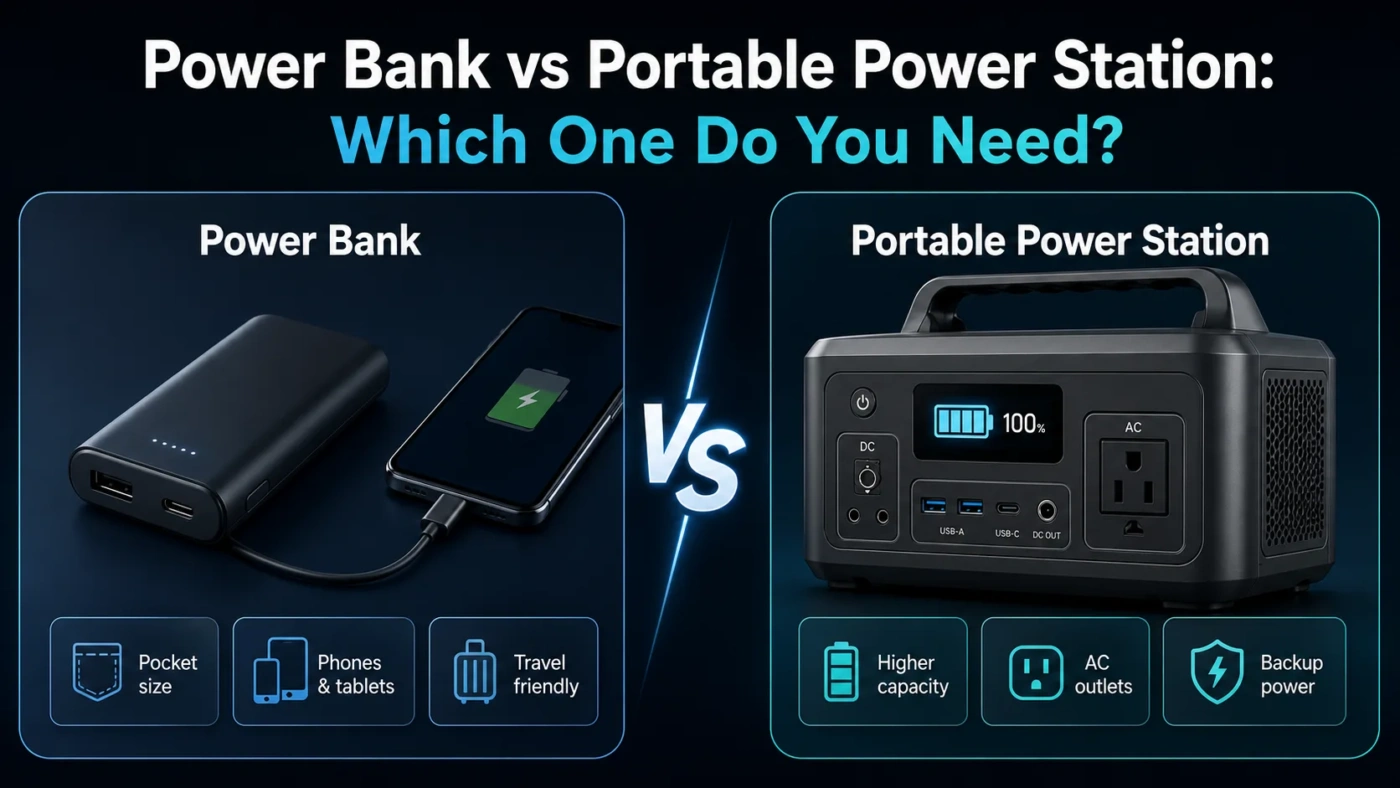
A power bank is usually the better choice for phones, tablets, earbuds, handheld gaming, and travel days when you need pocketable backup power. A portable power station is the better choice when you need AC outlets, higher capacity, camping power, emergency backup, or the ability to run larger devices. If the question is “Which one should I choose?”, start with the device you want to power: USB devices point toward a power bank, while household-style plugs and multi-hour backup needs point toward a portable power station.
- Main Differences
- What A Power Bank Offers
- What A Portable Power Station Offers
- Choose A Power Bank If
- Choose A Portable Power Station If
- Real Use Differences
- For Phones And Tablets
- For Laptops
- For Camping
- For Power Outages
- Decision Tree
- Price And Long-Term Value
- Battery Chemistry And Lifespan
- Travel And Safety
- Common Misunderstandings
- “More mAh Always Means Better”
- “Any Power Bank Can Charge A Laptop”
- “A Power Station Replaces A Generator”
- “AC Outlets Mean Unlimited Power”
- Best Choice By User Type
- Short Glossary
- Compare More Options
- FAQ
- Is A Portable Power Station Just A Big Power Bank?
- Can A Power Bank Run A Laptop?
- Can A Portable Power Station Run A Refrigerator?
- Which One Is Better For Travel?
- Which One Should Most People Buy First?
| Feature | Power Bank | Portable Power Station |
|---|---|---|
| Best For | Phones, tablets, earbuds, small USB devices, travel bags | Laptops, cameras, routers, lights, mini coolers, camping, outage backup |
| Typical Output | USB-A, USB-C, wireless charging on some models | AC outlets, USB-C, USB-A, DC ports, car socket, sometimes solar input |
| Capacity Range | Usually small to medium, often described in mAh | Medium to very large, usually described in watt-hours |
| Portability | Pocket, purse, backpack, carry-on friendly when within airline limits | Carry handle, car trunk, campsite, home storage |
| Price | Usually lower upfront cost | Usually higher upfront cost, but more capable |
| Charging Speed | Depends on USB-C PD wattage and device support | Can charge many devices at once, but recharge time varies by size and input |
| Air Travel | Often suitable if it meets airline watt-hour rules | Usually too large for normal air travel |
| Best Choice | Choose it for daily mobile charging | Choose it for larger devices and backup power |
Main Differences
The main difference is not just size. A power bank is a portable battery built around USB charging. A portable power station is a larger battery system designed to act more like a small off-grid power hub. It can often run devices that need a wall outlet, as long as the power station’s wattage and capacity match the load.
A power bank is easier to carry, easier to store, and usually cheaper. It is ideal when the problem is simple: your phone battery is low, your tablet needs another few hours, or your headphones need a quick top-up. A portable power station solves a different problem: keeping several devices working when there is no wall outlet nearby.
What A Power Bank Offers
A power bank is a compact rechargeable battery for mobile devices. Most models focus on USB output, especially USB-C Power Delivery on newer versions. The best models for current phones and laptops are not judged only by capacity; output wattage matters too. A 20,000 mAh unit with weak output may charge a phone well but struggle with a laptop. A smaller USB-C PD model with higher wattage may be more useful for a specific device.
Power banks are best when charging needs are predictable. They are simple to pack, quick to connect, and easy to share. For students, travelers, commuters, and everyday users, a good power bank often solves the problem without taking up much space.
What A Portable Power Station Offers
A portable power station is a larger battery with more output options. Many models include AC outlets, USB-C ports, USB-A ports, DC ports, and sometimes a car-style socket. Some can recharge from a wall outlet, car charger, or solar panel. This makes them useful for camping, road trips, outdoor work, photography setups, remote work, and short home backup.
The tradeoff is size and cost. A power station is not something most people carry around all day. It is more like a small power reserve that stays in a car, garage, office, RV, or campsite. If you need to run a Wi-Fi router, laptop, LED light, camera battery charger, CPAP machine, or mini cooler, a power station belongs on the shortlist.
Choose A Power Bank If
Choose a power bank if your devices already charge by USB and you do not need a wall outlet. It is also the better option if weight matters. For most people, a high-quality USB-C power bank is enough for phone charging, tablet charging, and light laptop backup.
Choose A Portable Power Station If
Choose a portable power station if the job is bigger than charging a phone. It is the better fit when you need more ports, more capacity, higher output, or solar charging support. It can cost more, but it can also replace several smaller accessories in the right setup.
Real Use Differences
For Phones And Tablets
A power bank wins for phones and tablets because it is lighter, cheaper, and faster to grab. A portable power station can charge them too, but using one just for a phone is usually more battery capacity than the task needs.
For Laptops
The choice depends on the laptop. Many modern laptops can charge through USB-C, so a high-output power bank may be enough for meetings, travel days, or study sessions. If the laptop uses a higher-wattage charger, or if you also need to run monitors, lights, or other gear, a portable power station is more suitable.
For Camping
A small power bank is enough for a solo overnight trip with a phone and earbuds. A portable power station makes more sense for family camping, camera batteries, lights, speakers, routers, fans, or a cooler. It is heavier, but the extra ports and capacity matter outdoors.
For Power Outages
A power bank can keep a phone alive during an outage. A portable power station can support a wider setup, such as a Wi-Fi router, LED lamp, laptop, and several USB devices. For emergency use, check output wattage, battery capacity, recharge options, storage temperature guidance, and battery chemistry.
Decision Tree
Price And Long-Term Value
Power banks usually cost less because they are smaller and have fewer output options. A basic model can handle phone charging, while a higher-end USB-C PD model may support tablets, handheld consoles, and some laptops. Paying more for a power bank often makes sense when it brings faster USB-C output, safer battery management, better build quality, and clear watt-hour labeling.
Portable power stations cost more because they include larger batteries, AC inverters, cooling systems, more ports, displays, and often solar charging support. The value depends on how often you use it. If it sits unused for years, a large model may be overkill. If it supports camping, remote work, camera gear, or outage backup several times a year, the higher cost can be easier to justify.
Battery Chemistry And Lifespan
Many power banks use lithium-ion or lithium-polymer batteries because they keep size and weight low. That works well for portable charging. Portable power stations may use lithium-ion, lithium-polymer, or lithium iron phosphate batteries, often called LiFePO4. LiFePO4 models are usually heavier, but they are often preferred for frequent charging cycles, home backup, and solar setups.
If you only need occasional phone charging, battery chemistry should not be the first deciding point. If you are buying a power station for long-term backup, regular camping, or daily off-grid use, battery cycle life and storage guidance deserve more attention.
Travel And Safety
Power banks are common travel accessories, but battery limits matter. Airlines often use watt-hours rather than mAh when judging whether a battery can travel in carry-on luggage. Larger batteries may require airline approval, and batteries should not be treated like ordinary checked items. Always check the airline and airport rules before flying with any high-capacity battery.
Portable power stations are usually a poor fit for air travel because many models exceed normal portable battery limits. They are better suited to car travel, RV use, campsites, outdoor work, and home storage.
Common Misunderstandings
“More mAh Always Means Better”
Not always. mAh depends on battery voltage, so it can be misleading across different product types. Watt-hours give a clearer energy comparison.
“Any Power Bank Can Charge A Laptop”
No. The power bank needs enough USB-C output wattage, and the laptop must support that charging method.
“A Power Station Replaces A Generator”
Only for some uses. It can run small electronics quietly indoors, but runtime and wattage limits still apply.
“AC Outlets Mean Unlimited Power”
An AC outlet only tells you the port type. The station’s continuous wattage, surge rating, and capacity decide what it can actually run.
Best Choice By User Type
| User Type | Better Choice | Reason |
|---|---|---|
| Commuter | Power Bank | Light, simple, and enough for phone or earbuds during the day. |
| Student | Power Bank | Works well for phone, tablet, and some USB-C laptops between classes. |
| Frequent Flyer | Power Bank | More likely to fit carry-on battery rules when capacity is checked carefully. |
| Camper | Portable Power Station | Better for lights, coolers, cameras, multiple phones, and longer trips. |
| Remote Worker | Depends | Use a power bank for laptop top-ups; use a power station for full work setups. |
| Home Backup Buyer | Portable Power Station | Better for routers, lamps, laptops, and several devices during short outages. |
Short Glossary
Compare More Options
FAQ
Is A Portable Power Station Just A Big Power Bank?
Not exactly. Both store energy, but a portable power station usually adds AC outlets, higher output, more ports, larger capacity, and sometimes solar charging support.
Can A Power Bank Run A Laptop?
Some can. Look for USB-C PD output that matches the laptop’s charging needs. Small or low-output power banks may charge phones well but fail to charge a laptop properly.
Can A Portable Power Station Run A Refrigerator?
Some models can run small fridges or certain full-size refrigerators for limited periods, but you must check continuous wattage, surge wattage, and battery capacity. Do not assume every station can handle appliance startup loads.
Which One Is Better For Travel?
A power bank is better for flights, commuting, and daily travel. A portable power station is better for car trips, RVs, campsites, outdoor work, and places where carrying a larger unit is realistic.
Which One Should Most People Buy First?
Most people should buy a good USB-C power bank first because it solves the most common battery problem at a lower cost. Choose a portable power station when you clearly need AC outlets, higher capacity, or backup power for more than small mobile devices.