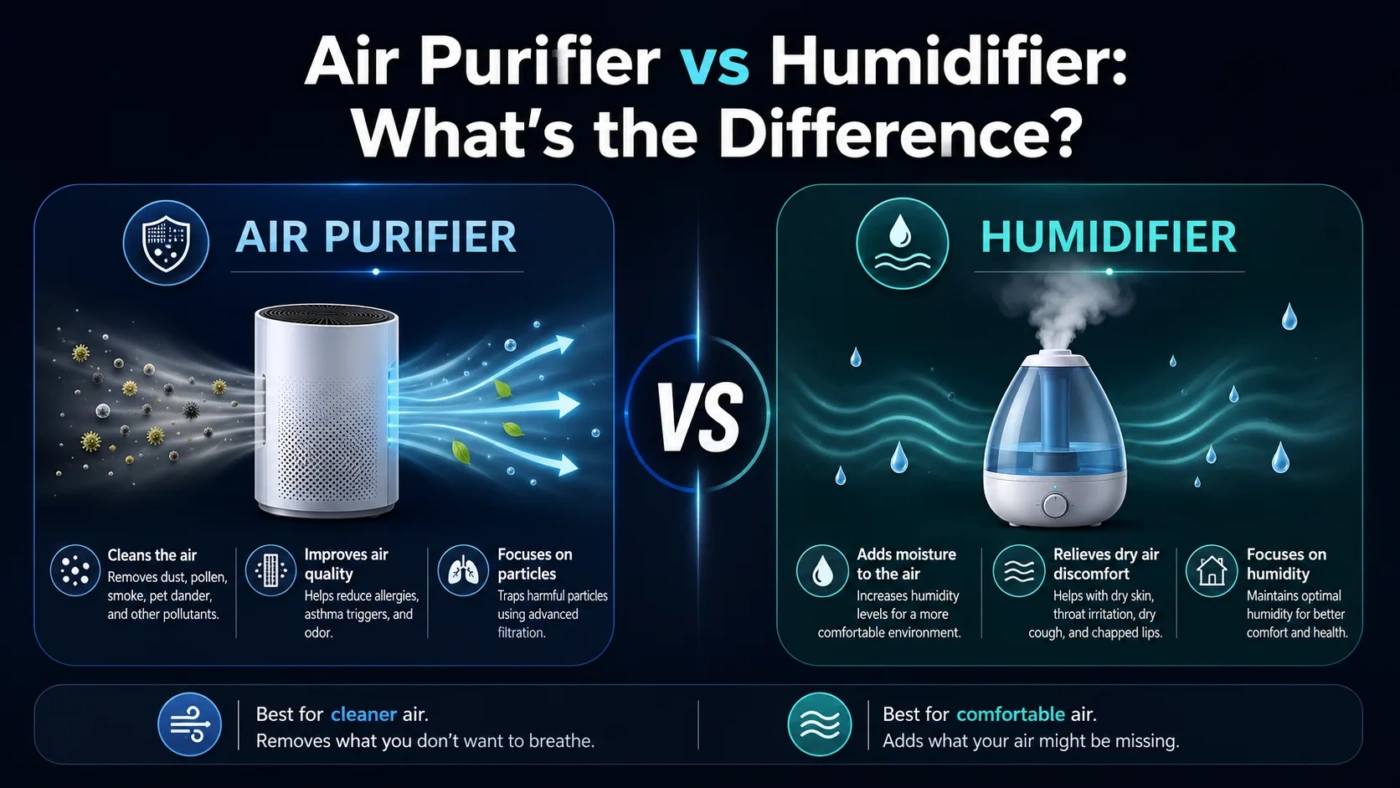
Air purifiers and humidifiers solve different indoor air problems. An air purifier is the better choice when the room feels dusty, smoky, stale, or allergy-triggering. A humidifier is the better choice when the air feels dry, your throat feels scratchy, wood furniture is shrinking, or indoor humidity drops too low. If you are choosing one device for better breathing comfort, start with the problem you can actually observe: particles in the air point toward an air purifier, while dryness in the air points toward a humidifier.
- Main Differences
- Air Purifier
- Humidifier
- What An Air Purifier Does
- What A Humidifier Does
- Setup And Daily Use
- Maintenance And Long-Term Use
- Choose An Air Purifier If
- Choose A Humidifier If
- Can You Use An Air Purifier And Humidifier Together?
- Decision Tree
- Score By Everyday Fit
- Common Misunderstandings
- A Humidifier Does Not Clean The Air
- An Air Purifier Does Not Raise Humidity
- More Humidity Is Not Always Better
- Odor Control Depends On The Filter
- Best Choice By User Type
- Price And Value
- Glossary
- FAQ
- Is An Air Purifier Better Than A Humidifier?
- Do I Need A Humidifier If I Have An Air Purifier?
- Can A Humidifier Help With Allergies?
- Can An Air Purifier Make The Air Dry?
- Should A Baby Room Use An Air Purifier Or Humidifier?
- Compare More Options
| Feature | Air Purifier | Humidifier |
|---|---|---|
| Main Job | Filters airborne particles such as dust, pollen, pet dander, smoke particles, and some odors depending on the filter type. | Adds moisture to dry indoor air to raise relative humidity. |
| Best For | Dusty rooms, allergies, pet dander, smoke, cooking smells, and cleaner-feeling air. | Dry air, dry throat, dry skin, static electricity, cracked wood, and winter heating dryness. |
| What It Does Not Do | Does not add moisture to the room. | Does not remove dust, pollen, smoke, or pet dander from the air. |
| Maintenance | Needs filter checks and filter replacement. | Needs frequent water changes, tank cleaning, and mineral buildup control. |
| Main Risk If Misused | Weak results if the filter is dirty, the room is too large, or the unit runs too little. | Too much humidity can support mold, dust mites, and damp surfaces. |
| Year-Round Use | Often useful all year, especially for allergies, pets, dust, or smoke exposure. | Often most useful in dry seasons, heated rooms, or naturally dry climates. |
| Noise | Fan noise varies by speed; low settings are usually easier for sleep. | May make a soft fan, bubbling, mist, or vibration sound depending on type. |
| Best First Buy | Choose first if dust, smoke, pollen, pet hair, or odors are the main complaint. | Choose first if the room air is dry and humidity is regularly below a comfortable range. |
Main Differences
The main difference is simple: an air purifier removes things from the air, while a humidifier adds water vapor or mist to the air. They can both improve indoor comfort, but they do it in opposite ways.
Air Purifier
An air purifier pulls room air through a filter system and sends cleaner air back out. The filter may capture particles such as dust, pollen, pet dander, lint, and smoke particles. Some units also include carbon filtration for odor control.
Humidifier
A humidifier releases moisture into the room. It does not filter air in the same way. Its value comes from helping dry indoor air feel more comfortable, especially when heating systems lower humidity.
What An Air Purifier Does
An air purifier is designed for air cleaning. It is most useful when the problem is floating particles or odors, not dryness. If sunlight reveals dust in the air, if pet dander collects quickly, or if pollen season makes a room uncomfortable, an air purifier is usually the more direct tool.
An air purifier works best when the room size matches the unit, doors and windows are managed sensibly, and the filter is replaced on schedule. A purifier that is too small for the room may still run, but the air may not cycle through it often enough to feel different.
What A Humidifier Does
A humidifier is designed for moisture control. It helps when indoor air is too dry, which often happens in cold weather, heated rooms, dry climates, or air-conditioned spaces. Dry air can make a room feel harsher even when it is clean.
A humidifier works best when it is cleaned often and used with a humidity meter. More moisture is not always better. If windows fog, walls feel damp, or the room smells musty, the humidity may be too high.
Setup And Daily Use
An air purifier is usually easier to run daily. Place it where air can move freely, turn it on, choose a fan speed, and replace the filter when needed. The main habit is keeping the unit running long enough to cycle the room air.
A humidifier takes more attention because it uses water. The tank needs refilling, emptying, and cleaning. If the water sits too long or mineral buildup collects inside, the device can become less pleasant to use. For that reason, a humidifier is not a “set it and forget it” device.
Maintenance And Long-Term Use
Air purifier maintenance mainly means filter care. A clogged filter can reduce airflow and make the purifier less useful. Replacement cost matters, especially if the unit uses several filter layers or runs every day.
Humidifier maintenance is more hands-on. The tank, base, wick, mist outlet, or tray may need regular cleaning depending on the type. If local water is mineral-heavy, white dust or scale can become annoying unless the device is cleaned well or the right water type is used.
Choose An Air Purifier If
- You see dust floating in sunlight or collecting soon after cleaning.
- You have pollen, pet dander, smoke particles, or cooking odors in the room.
- You want a device that can run quietly in the background for many hours.
- You prefer lower daily maintenance compared with a water-based device.
- Your room air feels stale, but humidity is already in a comfortable range.
An air purifier is also the more natural first choice for bedrooms, home offices, pet areas, and rooms near outdoor pollution sources. It will not make the air feel less dry, but it can make the room feel cleaner when particles are the issue.
Choose A Humidifier If
- Your indoor humidity is low, especially during heating season.
- Your throat, nose, skin, or eyes feel dry indoors.
- You notice static shocks, dry wood, or cracking in certain materials.
- The room already feels clean enough, but the air feels harsh or dry.
- You are willing to clean and refill the device often.
A humidifier is usually the better fit for dry bedrooms, nurseries, music rooms, and winter living spaces. The main rule is to add moisture only until the room feels balanced, not damp.
Can You Use An Air Purifier And Humidifier Together?
Yes, you can use both in the same room, but they should be placed apart. Do not aim mist directly at an air purifier. Moist air blowing into a filter can make the filter damp, reduce performance, or create odor problems.
A practical setup is to place the air purifier where it has open airflow and place the humidifier several feet away, aimed into open room space. Keep humidity moderate and clean the humidifier often. Used this way, the purifier handles particles while the humidifier handles dryness.
Decision Tree
Score By Everyday Fit
Common Misunderstandings
A Humidifier Does Not Clean The Air
A humidifier can make dry air feel better, but it does not remove dust, pollen, pet dander, or smoke particles. If the room is dirty or allergen-heavy, moisture alone will not fix that problem.
An Air Purifier Does Not Raise Humidity
An air purifier may make air feel fresher, but it does not add moisture. If the air is genuinely dry, a purifier cannot replace a humidifier.
More Humidity Is Not Always Better
Too much moisture can make a room feel damp and may support mold or dust mites. A humidifier should be used with restraint, especially in bedrooms and small rooms.
Odor Control Depends On The Filter
Some air purifiers are better for particles than odors. Odor reduction usually depends on carbon filtration, room size, airflow, and the source of the smell.
Best Choice By User Type
| User Or Room Type | Better Choice | Reason |
|---|---|---|
| Allergy-Prone Household | Air Purifier | Better fit for pollen, dust, and dander reduction. |
| Dry Winter Bedroom | Humidifier | Better fit when heating makes air dry overnight. |
| Pet Owner | Air Purifier | Better fit for floating dander and pet-related particles. |
| Music Or Wood Furniture Room | Humidifier | Better fit when low humidity affects wood stability. |
| Dusty Home Office | Air Purifier | Better fit for long daily use and particle control. |
| Dry Climate Apartment | Humidifier | Better fit if humidity stays low across the day. |
| Dusty And Dry Room | Both | Each device handles a different part of the problem. |
Price And Value
Both devices can be affordable or expensive depending on room size, features, and build quality. The better value is not the cheaper device; it is the one that solves the real problem.
An air purifier may cost more over time if filters are expensive or need frequent replacement. A humidifier may cost less to buy, but it requires more cleaning effort and may need replacement wicks, cartridges, or descaling care depending on design.
Glossary
FAQ
Is An Air Purifier Better Than A Humidifier?
An air purifier is better for dust, pollen, smoke particles, pet dander, and air cleaning. A humidifier is better for dry air. Neither one is better for every home because they solve different problems.
Do I Need A Humidifier If I Have An Air Purifier?
You only need a humidifier if the air is dry. If humidity is already comfortable, adding moisture may not help and could make the room feel damp.
Can A Humidifier Help With Allergies?
A humidifier may help dry-air discomfort, but it does not remove allergens from the air. If allergens are the main issue, an air purifier is usually the more direct choice.
Can An Air Purifier Make The Air Dry?
An air purifier does not remove moisture in the way a dehumidifier does. Moving air can sometimes feel cooler or drier on the skin, but the purifier itself is not designed to lower humidity.
Should A Baby Room Use An Air Purifier Or Humidifier?
For dust, pollen, smoke particles, or pet dander, an air purifier is usually the better fit. For dry air, a humidifier may help, but it must be cleaned often and used without making the room damp.
Compare More Options
If the room feels dirty, choose an air purifier. If the room feels dry, choose a humidifier. If both are true, use both carefully: filter the air, add only enough moisture, and keep the water-based device clean.