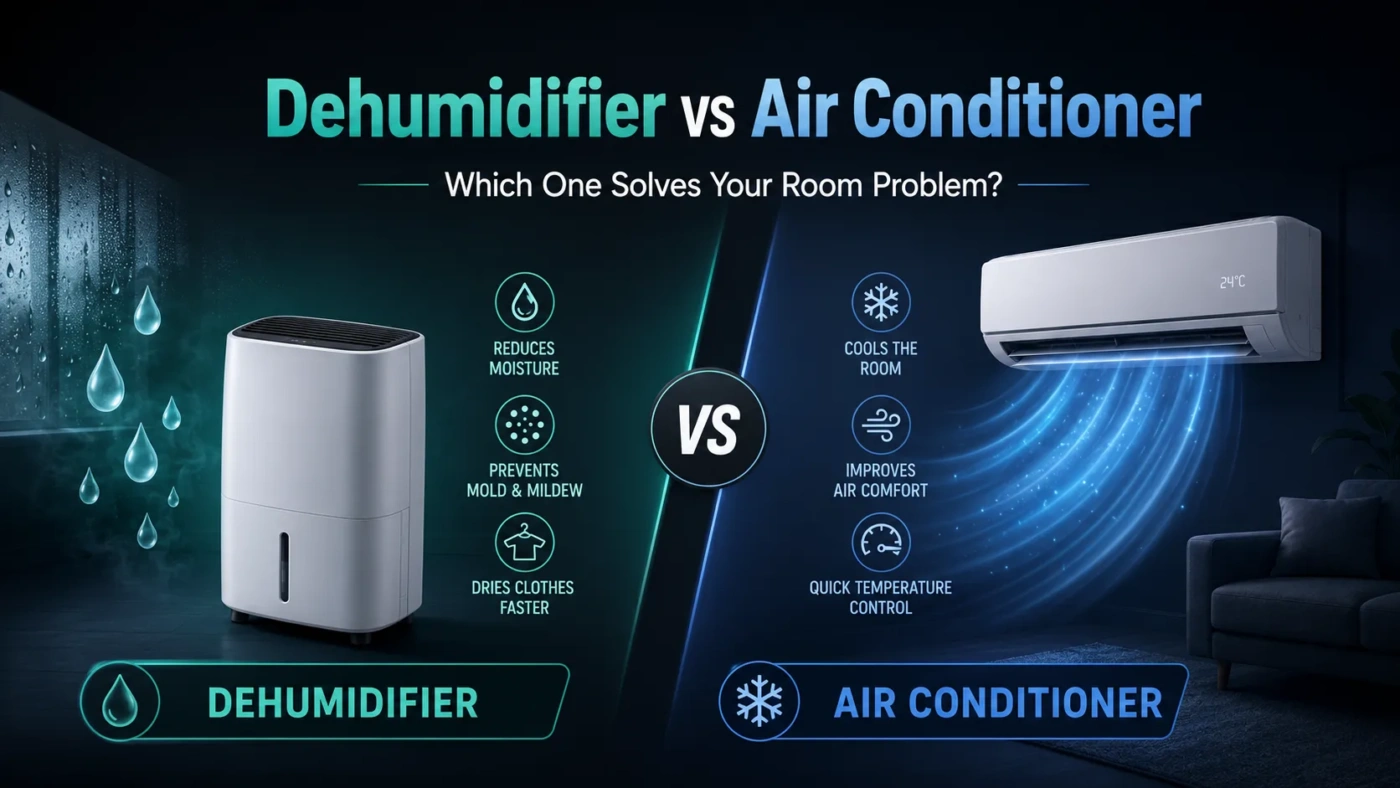
A dehumidifier and an air conditioner can both make a damp room feel better, but they solve different problems. Choose a dehumidifier if the room feels sticky, smells musty, has condensation, or stays humid without being hot. Choose an air conditioner if the room is too warm and you need real cooling. If the room is both hot and humid, an air conditioner usually fixes more of the discomfort, while a dehumidifier can help when moisture is the main issue.
- Main Differences
- What A Dehumidifier Changes
- What An Air Conditioner Changes
- Which One Solves Your Room Problem?
- Comfort, Air Feel, And Daily Use
- Choose A Dehumidifier If
- Choose An Air Conditioner If
- Cost And Long-Term Value
- Setup And Maintenance
- Common Misunderstandings
- Best Choice By User Type
- Glossary For Room Comfort
- Related Comparisons
- FAQ
- Can A Dehumidifier Cool A Room?
- Can An Air Conditioner Replace A Dehumidifier?
- Which Uses More Electricity?
- Should I Run A Dehumidifier And Air Conditioner Together?
- Which One Is Better For Mold Prevention?
| Feature | Dehumidifier | Air Conditioner |
|---|---|---|
| Main job | Removes moisture from the air | Lowers room temperature and removes some moisture |
| Best room problem | Dampness, musty smell, condensation, sticky air | Heat, sweating, poor sleep from high temperature |
| Does it cool the room? | No; it may make the room feel slightly warmer | Yes; cooling is its main purpose |
| Humidity control | Stronger moisture control for damp rooms | Moderate humidity reduction while cooling |
| Energy use | Often lower than cooling a room, but depends on size and runtime | Often higher because it actively cools the space |
| Water handling | Tank must be emptied or connected to a drain | Condensate is usually drained outside or collected by the unit |
| Best season | Humid spring, rainy periods, basements, damp climates | Hot weather and warm indoor spaces |
| Best choice when unsure | Room feels damp but not hot | Room feels hot, heavy, and uncomfortable |
Main Differences
What A Dehumidifier Changes
A dehumidifier pulls moisture out of indoor air and collects it as water. This can reduce musty odor, window condensation, damp bedding, sticky floors, and the heavy feeling that comes from high humidity.
It does not lower the air temperature like an air conditioner. In fact, because the unit releases heat while running, the room may feel a little warmer. The comfort improvement comes from drier air, not colder air.
What An Air Conditioner Changes
An air conditioner removes heat from the room and moves it outside or away from the living space. It also removes some moisture as part of the cooling process, which is why a cooled room can feel less sticky.
Its moisture removal is usually tied to cooling. If the room is already cool but damp, running an air conditioner may not be the best fit because it can overcool the space before the humidity problem is fully handled.
Which One Solves Your Room Problem?
Comfort, Air Feel, And Daily Use
Humidity changes how a room feels. A room at a moderate temperature can still feel uncomfortable when the air holds too much moisture. Clothes may feel damp, bedding may feel heavy, and air movement from a fan may not help much. This is where a dehumidifier makes sense.
Temperature changes comfort in a different way. If the room is warm enough that you are sweating, sleeping poorly, or avoiding the space during the day, an air conditioner is the more direct fix. It can also make humid air feel better because cooler air and some moisture removal work together.
Practical note: A dehumidifier can make a room feel more comfortable without cooling it, but it should not be treated as a cooling device. An air conditioner can reduce humidity while cooling, but it should not be treated as a dedicated moisture-control device for every damp room.
Choose A Dehumidifier If
A dehumidifier is also useful when you want targeted moisture control in one room. It is common in basements, storage rooms, laundry areas, and small rooms with limited airflow. The tradeoff is maintenance: the water tank needs attention unless the unit is connected to a drain.
Choose An Air Conditioner If
An air conditioner is the better choice when heat is the real problem. It can make a room usable during hot weather and can reduce indoor moisture as a side effect. The tradeoff is that cooling equipment usually costs more to buy, install, and run than a simple dehumidifier.
Cost And Long-Term Value
A dehumidifier often costs less than an air conditioner and may be cheaper to run when the goal is only moisture removal. It can also help protect furniture, stored items, clothing, and room surfaces from damp conditions. The value is strongest when humidity is the problem you face most often.
An air conditioner usually costs more because it performs a larger job: moving heat out of the room. That extra function matters when the room is hot. Paying for cooling makes sense if comfort, sleep, or daily use depends on a lower temperature.
Setup And Maintenance
A dehumidifier is usually simple to set up: place it where air can circulate, set the humidity level, and empty the tank when needed. For longer use, a drain hose can reduce maintenance. Filters should be cleaned according to the unit’s instructions so airflow stays steady.
An air conditioner needs more placement planning. Window, portable, split, and central systems each handle heat removal differently. Portable units may need an exhaust hose. Window units need a secure fit. Split and central systems require proper installation. Filters also need regular cleaning or replacement.
Common Misunderstandings
Best Choice By User Type
| User Or Room Type | Better Choice | Reason |
|---|---|---|
| Basement user | Dehumidifier | Basements often have moisture problems even when they are not hot. |
| Hot bedroom sleeper | Air Conditioner | Temperature control is the main comfort need for sleep. |
| Laundry room or storage room | Dehumidifier | Moisture removal helps reduce damp air around fabrics and stored items. |
| Small apartment in summer | Air Conditioner | Cooling usually improves the whole room faster when heat is present. |
| Room with musty odor | Dehumidifier | Odor linked to dampness usually needs moisture control and airflow improvement. |
| Room that stays hot and damp | Air Conditioner first, dehumidifier if needed | Cooling handles heat; extra moisture control may help if humidity remains high. |
Glossary For Room Comfort
Related Comparisons
FAQ
Can A Dehumidifier Cool A Room?
No. A dehumidifier removes moisture, but it does not remove heat from the room. The air may feel more comfortable because it is drier, but the room temperature will not drop like it would with an air conditioner.
Can An Air Conditioner Replace A Dehumidifier?
Sometimes, but not always. If the room is hot and humid, an air conditioner may be enough. If the room is cool but damp, a dehumidifier is usually the better fit because it targets moisture without overcooling the space.
Which Uses More Electricity?
An air conditioner often uses more electricity because it cools the room. A dehumidifier can still use a noticeable amount of power if it runs for many hours, so size, settings, and room conditions matter.
Should I Run A Dehumidifier And Air Conditioner Together?
You can, especially in a room that stays both hot and humid. In many cases, the air conditioner should run first. Add the dehumidifier if the room still feels damp or if moisture returns after cooling stops.
Which One Is Better For Mold Prevention?
A dehumidifier is often the better tool for reducing damp indoor conditions linked to mold risk. It should be paired with fixing leaks, improving airflow, and cleaning affected surfaces when needed.
If the room feels damp but not hot, choose a dehumidifier. If the room feels hot, choose an air conditioner. If the room is both hot and humid, start with cooling and add dedicated moisture control only if the damp feeling remains.