Ceiling fans and tower fans can both make a bedroom feel cooler, but they solve different problems. A ceiling fan is usually the better bedroom choice for steady overnight airflow, quiet operation, and saving floor space. A tower fan is better if you rent, want something portable, need airflow aimed at one side of the bed, or cannot install a fixture.
- Main Differences
- Ceiling Fan
- Tower Fan
- Where Each Fan Fits Best
- Comfort And Sleep Quality
- Noise And Bedroom Use
- Setup, Space, And Maintenance
- Price And Long-Term Value
- Bedroom Decision Scores
- Choose A Ceiling Fan If
- Choose A Tower Fan If
- Decision Tree For Bedrooms
- Common Misunderstandings
- A Fan Does Not Cool The Room The Same Way As Air Conditioning
- A Stronger Fan Is Not Always Better For Sleep
- Tower Fans Are Not Always Easier To Clean
- Ceiling Fans Need The Right Room Conditions
- Best Choice By User Type
- Safety And Placement Notes
- FAQ
- Is A Ceiling Fan Better Than A Tower Fan For Sleeping?
- Can A Tower Fan Cool A Whole Bedroom?
- Which Fan Is Quieter For Bedrooms?
- Which One Uses Less Space?
- Which One Should Most Bedrooms Choose?
- Compare More Options
| Feature | Ceiling Fan | Tower Fan |
|---|---|---|
| Best For | Whole-room airflow while sleeping | Personal or side-of-bed cooling |
| Installation | Requires ceiling mounting and wiring | Plug in and use |
| Bedroom Space | Uses no floor space | Needs floor space near an outlet |
| Airflow Feel | Broad, gentle, room-wide circulation | Narrower, directed airflow |
| Noise | Often very quiet when balanced well | Can create soft fan noise or higher motor sound |
| Portability | Fixed in one room | Easy to move between rooms |
| Cleaning | Blades need periodic dusting | Exterior vents collect dust and may be harder to clean inside |
| Long-Term Value | Strong if used every night in the same bedroom | Strong if flexibility matters more than permanent setup |
Main Differences
Ceiling Fan
A ceiling fan circulates air from above, which helps distribute airflow across the room instead of pushing air in one narrow direction. This makes it comfortable for sleeping, especially when two people share the same bed and do not want a fan pointed directly at one person.
Tower Fan
A tower fan stands on the floor and sends air through a vertical vent. Many models oscillate, so the airflow can sweep across part of the room. It works well when you want direct cooling near the bed, desk, reading chair, or a specific sleeping spot.
Where Each Fan Fits Best
A ceiling fan usually feels more natural overnight because the airflow is wide and less concentrated on the face, neck, or one side of the body.
A tower fan avoids installation, ceiling wiring, fixture changes, and landlord approval. It is the simpler option for temporary living spaces.
A ceiling fan saves floor space, but a tower fan may be easier if the ceiling is low, angled, or not wired for a fan.
If one person sleeps warmer than the other, a tower fan can be aimed toward that side of the room without changing airflow for everyone.
Comfort And Sleep Quality
For bedrooms, comfort is not only about airflow strength. It is also about how the air feels after several hours. A ceiling fan is often more comfortable for all-night use because it moves air evenly and does not need to sit near your head. It can also help prevent warm air from feeling trapped near the ceiling.
A tower fan can feel cooler at close range because the airflow is more focused. That is useful before sleep or during warm nights, but some people may find direct airflow too strong after a while. Oscillation, sleep mode, and lower speed settings can help soften that effect.
Bedroom cooling note: Neither option lowers the actual room temperature like an air conditioner. Both fans move air, help sweat evaporate, and make the room feel more comfortable.
Noise And Bedroom Use
A well-installed ceiling fan can be very quiet, especially at low or medium speed. The main noise risks are wobbling, loose parts, blade imbalance, or an older motor. In a bedroom, those small sounds can become noticeable at night.
Tower fans usually produce more audible airflow and motor sound. Some sleepers like that because it creates steady background noise. Others may prefer the softer movement of a ceiling fan. If the room is used for light sleeping, reading, or study, lower-speed control matters more than maximum fan speed.
Setup, Space, And Maintenance
A ceiling fan takes more effort at the start. It needs the right mounting point, enough ceiling height, and proper installation. Once installed, it stays out of the way and can become part of the bedroom’s lighting and airflow setup.
A tower fan wins on setup. It can be placed beside a bed, near a window, or in a corner. The tradeoff is floor space, cord placement, and dust buildup in the grille. In tighter bedrooms, even a slim fan can become one more object to work around.
Price And Long-Term Value
Tower fans are often cheaper upfront because they do not need installation. They are easy to replace and useful in more than one room. If you only need extra airflow during hot months, that flexibility can be the better value.
Ceiling fans may cost more at the start, especially if wiring or professional installation is needed. Over time, they can offer better value in a bedroom used every night because they are durable, space-saving, and convenient once fitted.
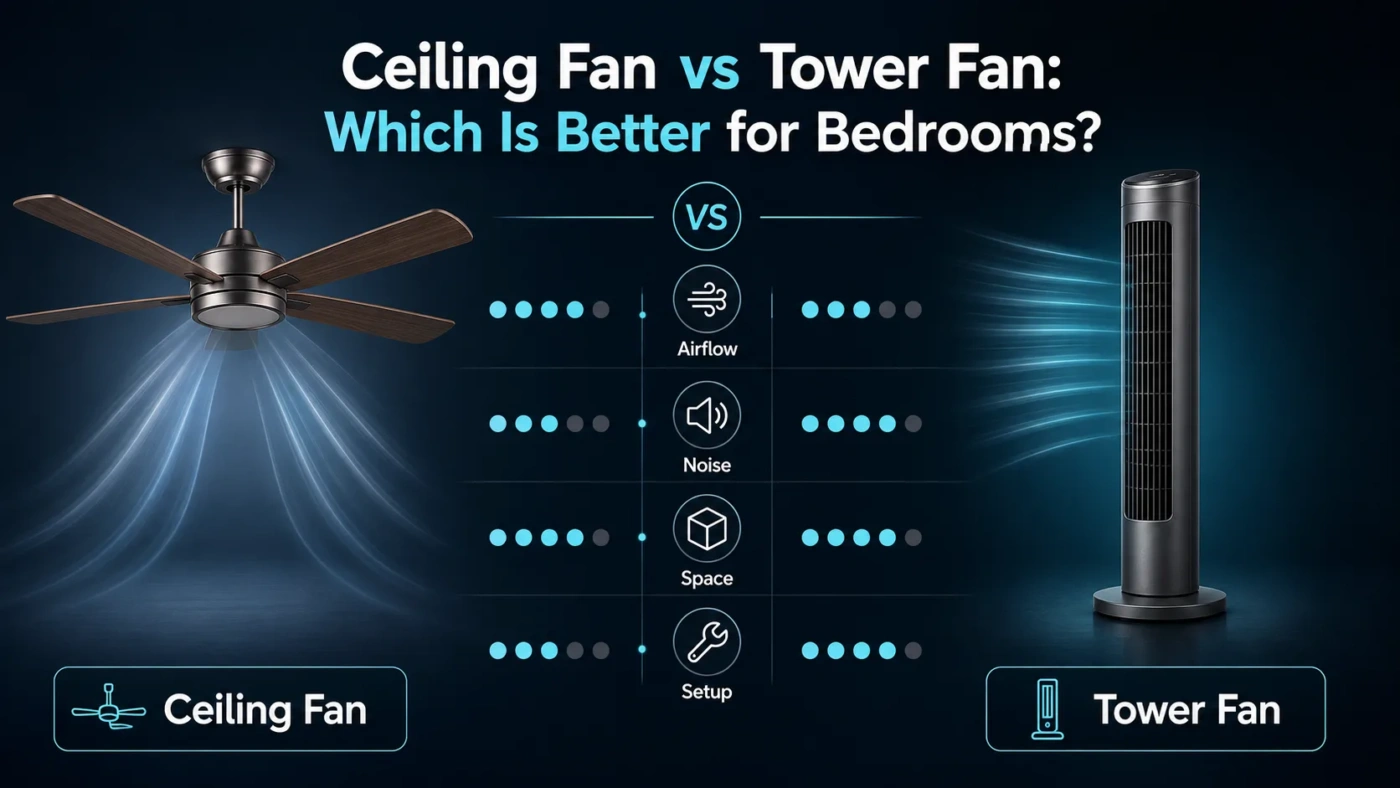
Bedroom Decision Scores
Choose A Ceiling Fan If
- You want steady airflow across the full bedroom.
- You use the same bedroom every night and want a permanent solution.
- You do not want a fan taking up floor space.
- You share the room and need airflow that feels balanced for more than one person.
- Your ceiling height, wiring, and room layout support safe installation.
Choose A Tower Fan If
- You rent or do not want to change the ceiling fixture.
- You need a fan you can move between rooms.
- You want direct airflow near one side of the bed.
- Your bedroom has a low, sloped, or unsuitable ceiling.
- You prefer a lower upfront cost and simple setup.
Decision Tree For Bedrooms
Common Misunderstandings
A Fan Does Not Cool The Room The Same Way As Air Conditioning
Fans make people feel cooler by moving air across the skin. They do not remove heat from the room. This matters because leaving a fan running in an empty bedroom usually does not make the room colder for later.
A Stronger Fan Is Not Always Better For Sleep
High airflow can feel good at first, but direct air all night may feel dry or uncomfortable for some sleepers. Bedrooms often benefit from lower speeds, wider airflow, and stable sound.
Tower Fans Are Not Always Easier To Clean
The outside of a tower fan is simple to wipe, but dust can collect inside narrow vents. A ceiling fan’s blades are more visible, which makes dust easier to notice and remove.
Ceiling Fans Need The Right Room Conditions
A ceiling fan is not automatically the better option in every bedroom. Low ceilings, weak mounting points, poor wiring, or an awkward bed position can make a tower fan the more practical choice.
Best Choice By User Type
| User Type | Better Fit | Reason |
|---|---|---|
| Light Sleeper | Ceiling Fan | Often quieter and less direct at low speed. |
| Renter | Tower Fan | No permanent installation needed. |
| Couple Sharing A Bedroom | Ceiling Fan | Airflow spreads more evenly across the room. |
| Hot Sleeper On One Side Of The Bed | Tower Fan | Can be aimed toward one sleeping area. |
| Small Bedroom Owner | Ceiling Fan | Saves floor space when ceiling setup allows it. |
| Budget-Focused Buyer | Tower Fan | Lower starting cost and no installation expense. |
Safety And Placement Notes
For ceiling fans: Use the correct mounting hardware, keep blade clearance in mind, and avoid installation on weak or unsuitable ceiling points.
For tower fans: Place the fan on a stable surface, keep cords away from walking paths, and avoid blocking the air intake with bedding, curtains, or furniture.
FAQ
Is A Ceiling Fan Better Than A Tower Fan For Sleeping?
Usually, yes. A ceiling fan is often better for sleeping because it gives broad, steady airflow without blowing directly at one spot. A tower fan is better if you want targeted airflow or cannot install a ceiling fan.
Can A Tower Fan Cool A Whole Bedroom?
It can help circulate air in a bedroom, especially with oscillation, but it usually feels more focused than a ceiling fan. For whole-room airflow, a ceiling fan often feels more even.
Which Fan Is Quieter For Bedrooms?
A balanced ceiling fan is often quieter at low speed. Tower fans vary, and some create more noticeable airflow sound. That sound can be pleasant for sleepers who like background noise.
Which One Uses Less Space?
A ceiling fan uses less usable bedroom space because it is mounted overhead. A tower fan is slim, but it still needs floor space and a nearby outlet.
Which One Should Most Bedrooms Choose?
Choose a ceiling fan for a permanent bedroom where quiet, even airflow and space saving matter most. Choose a tower fan when portability, direct airflow, rental flexibility, or simple setup matters more.