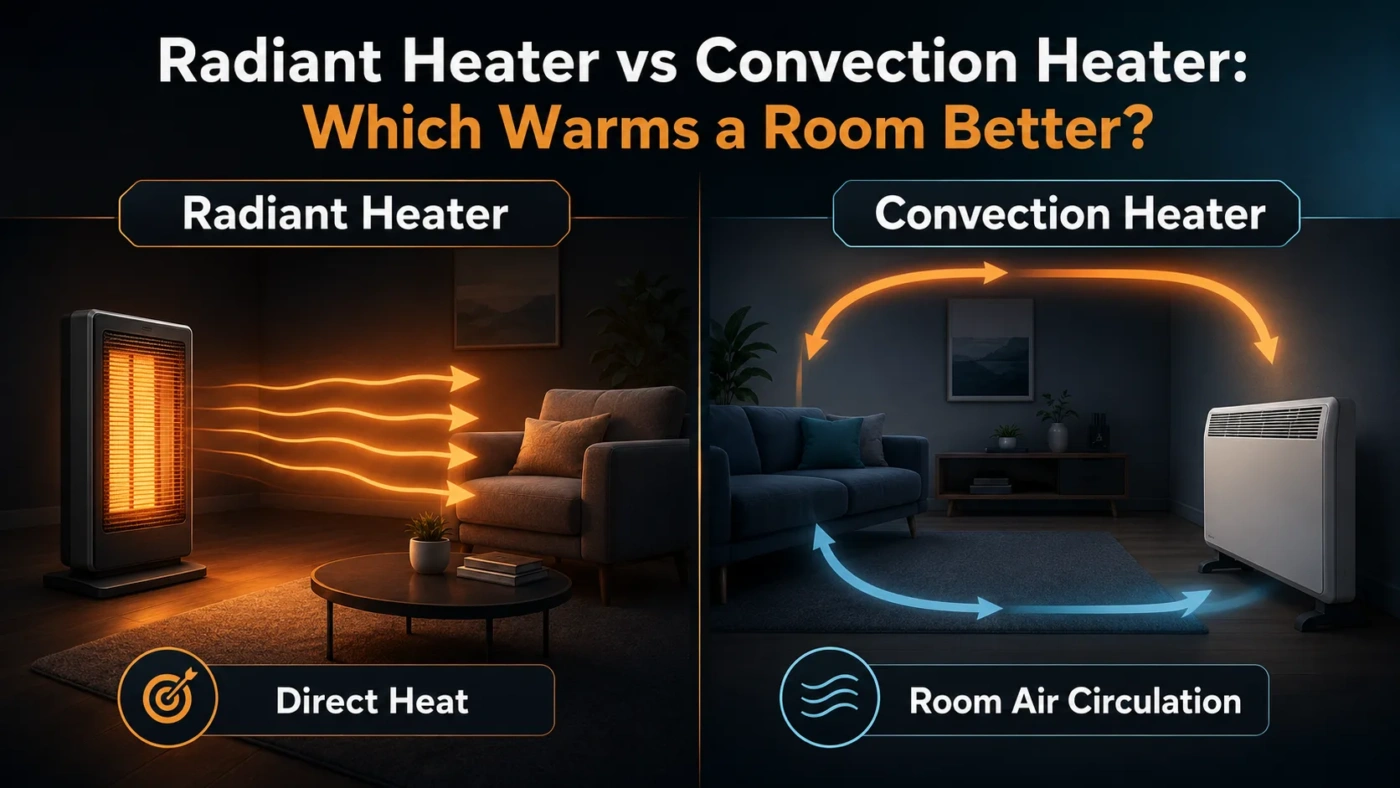
Radiant heaters and convection heaters can both make a cold room more comfortable, but they do it in different ways. A radiant heater is usually better when you want fast warmth on your body or in one focused area. A convection heater is usually better when you want the whole room to feel evenly warmer over time. If the question is “which warms a room better?”, the practical answer is: choose a convection heater for full-room heating, and choose a radiant heater for direct, near-instant comfort.
- Main Differences
- Radiant Heat
- Convection Heat
- Which Warms A Room Better?
- Room Heating Note
- What A Radiant Heater Offers
- Where Radiant Heating Feels Best
- What A Convection Heater Offers
- Where Convection Heating Feels Best
- Comfort, Speed, And Heat Spread
- Price And Long-Term Value
- Safety And Placement
- Choose A Radiant Heater If
- Choose A Convection Heater If
- Room Type Match
- Decision Path
- Common Misunderstandings
- “Radiant Heat Is Always Faster”
- “Convection Heat Is Always Better”
- “Higher Wattage Always Means Better Comfort”
- “A Fan Heater And An Oil-Filled Heater Feel The Same”
- Best Choice By User Type
- Useful Terms
- FAQ
- Is A Radiant Heater Better Than A Convection Heater?
- Is A Convection Heater Better For Bedrooms?
- Which Heater Feels Warmer Faster?
- Which Heater Is Better For A Drafty Room?
- Which One Should I Choose?
| Feature | Radiant Heater | Convection Heater |
|---|---|---|
| Heating Method | Sends infrared heat toward people, objects, and nearby surfaces | Warms the air, which then circulates through the room |
| Best Feeling | Fast, direct warmth when you sit or stand near it | Steadier background warmth across the room |
| Whole-Room Heating | Less ideal unless the room is small and the heater is well placed | Usually better for enclosed rooms |
| Drafty Spaces | Often feels better because it heats people directly | Can lose comfort faster if warm air escapes |
| Speed Of Comfort | Very fast for nearby users | Slower at first, more even after running |
| Noise | Usually quiet unless paired with a fan | Silent in oil-filled or panel types; fan models make sound |
| Best For | Desk areas, reading chairs, garages, workshops, short sessions | Bedrooms, living rooms, home offices, longer heating periods |
| Main Tradeoff | Warmth drops quickly outside the heat path | Takes more time to change the room temperature |
Main Differences
The main difference is what each heater warms first. A radiant heater warms people, objects, and surfaces in its path. It feels a little like sitting in sunlight: the air around you may still be cool, but your body feels warmth quickly.
A convection heater warms the air. As the air temperature rises, warmth spreads around the room. This usually creates a more even room temperature, especially when doors and windows are closed and the room has normal insulation.
Radiant Heat
Best when comfort is about where you are sitting. It is direct, fast, and focused.
Convection Heat
Best when comfort is about the whole room. It is slower, broader, and more even.
Which Warms A Room Better?
For a normal enclosed room, a convection heater usually warms the room better because it raises the air temperature throughout the space. This matters in bedrooms, living rooms, and home offices where people move around instead of staying in one fixed spot.
A radiant heater can feel warmer sooner, but that does not always mean the room itself is warmer. If you sit in front of it, the comfort can be immediate. If you walk across the room or move behind furniture, the warmth may feel much weaker.
Room Heating Note
Two heaters with similar wattage can use similar electrical input, but the comfort pattern can feel very different. Radiant heat gives faster local comfort. Convection heat usually gives better room-wide comfort after enough run time.
What A Radiant Heater Offers
A radiant heater is designed for direct heat transfer. Many models use infrared elements, glowing panels, ceramic plates, quartz tubes, or other heating surfaces that send warmth toward the area in front of the unit.
This makes radiant heat useful when you do not need to heat every corner. A person working at a desk, sitting in a reading chair, or doing a short task in a chilly room may prefer the immediate feel. It can also work well in spaces where air movement makes convection less effective, such as a drafty garage or a spot near an frequently opened door.
Where Radiant Heating Feels Best
- Near a desk or workbench
- Beside a chair or sofa
- In short heating sessions
- In a small zone inside a larger room
- Where direct body warmth matters more than room temperature
What A Convection Heater Offers
A convection heater focuses on air movement. Some models use a fan to push warm air into the room. Others, such as oil-filled radiators or silent panel heaters, rely on natural air circulation as warm air rises and cooler air moves toward the heater.
This style is more suitable when the goal is steady comfort across the room. It can be slower in the first few minutes, but once the air warms, the result often feels more balanced. It also tends to make more sense for longer use, especially with a thermostat that cycles the heater on and off as needed.
Where Convection Heating Feels Best
- Bedrooms during cold evenings
- Home offices used for several hours
- Small to medium living rooms
- Rooms with closed doors and windows
- Spaces where people move around
Comfort, Speed, And Heat Spread
Price And Long-Term Value
Both heater types can be found across a wide price range. Small radiant heaters are often affordable, while larger infrared panels or feature-heavy units may cost more. Convection heaters also vary widely, from basic fan heaters to oil-filled radiators and wall-style panels.
Operating cost depends mostly on wattage, run time, electricity rates, thermostat behavior, room size, insulation, and how you use the heater. A radiant heater can be economical when it lets you heat only the person or zone you use. A convection heater can offer better value when one room needs stable warmth for a longer period.
Practical value rule: choose radiant heat when you can stay close to the heater. Choose convection heat when the room itself needs to stay comfortable.
Safety And Placement
Both types need careful placement. Keep portable heaters away from bedding, curtains, paper, furniture edges, and anything that can block airflow or touch the hot surface. Use a stable floor position, avoid extension cords when the manual advises against them, and turn the heater off when it should not be left running.
Radiant heaters can have very hot front surfaces, so distance matters. Convection heaters can also become hot, especially oil-filled and panel designs, even if they feel calmer during use. Features such as tip-over protection, overheat shutoff, a thermostat, and a timer can make daily use easier, but they do not replace basic care.
Choose A Radiant Heater If
- You mainly want to warm yourself, not the full room.
- You sit in one place for work, reading, gaming, or hobby tasks.
- You want quick comfort without waiting for the air to warm.
- Your space is drafty or partly open.
- You need heat for short periods rather than all evening.
- You can place the heater safely with clear space around it.
Choose A Convection Heater If
- You want the whole room to feel warmer.
- You use the room for several hours at a time.
- More than one person needs comfort in the same space.
- You move around the room instead of sitting in one spot.
- You prefer a heater with thermostat-based cycling.
- The room is enclosed enough to hold warm air.
Room Type Match
Decision Path
Common Misunderstandings
“Radiant Heat Is Always Faster”
Radiant heat is faster for the person or object in front of it. It is not always faster at raising the room’s air temperature.
“Convection Heat Is Always Better”
Convection is usually better for room-wide warmth, but it can feel slow if you only need heat for one person in one spot.
“Higher Wattage Always Means Better Comfort”
Wattage matters, but placement, room size, insulation, thermostat settings, and heater type can change the result. A well-placed heater often feels better than a poorly placed one with similar power.
“A Fan Heater And An Oil-Filled Heater Feel The Same”
Both can be convection heaters, but the comfort pattern differs. A fan model can warm air faster and make noise. An oil-filled model is usually slower, quieter, and steadier.
Best Choice By User Type
| User Or Situation | Better Fit | Reason |
|---|---|---|
| One person at a desk | Radiant Heater | Direct warmth is more useful than heating empty space. |
| Family living room | Convection Heater | Shared spaces need broader heat coverage. |
| Bedroom | Convection Heater | Even warmth and steady cycling are usually more comfortable. |
| Short work session in a cold corner | Radiant Heater | It gives fast comfort without waiting for the whole room. |
| Long evening in a closed room | Convection Heater | It is better suited to raising and holding room temperature. |
Useful Terms
FAQ
Is A Radiant Heater Better Than A Convection Heater?
It is better for direct personal warmth. It is not usually better for evenly warming a full room.
Is A Convection Heater Better For Bedrooms?
Usually, yes. A convection heater is often more comfortable for bedrooms because it warms the air more evenly and can work well with a thermostat.
Which Heater Feels Warmer Faster?
A radiant heater usually feels warmer faster when you are close to it and facing the heat source.
Which Heater Is Better For A Drafty Room?
A radiant heater may feel better in a drafty room because it warms your body directly. A convection heater can struggle if warm air keeps escaping.
Which One Should I Choose?
Choose a convection heater if your main goal is warming the room. Choose a radiant heater if your main goal is warming yourself quickly in one area.