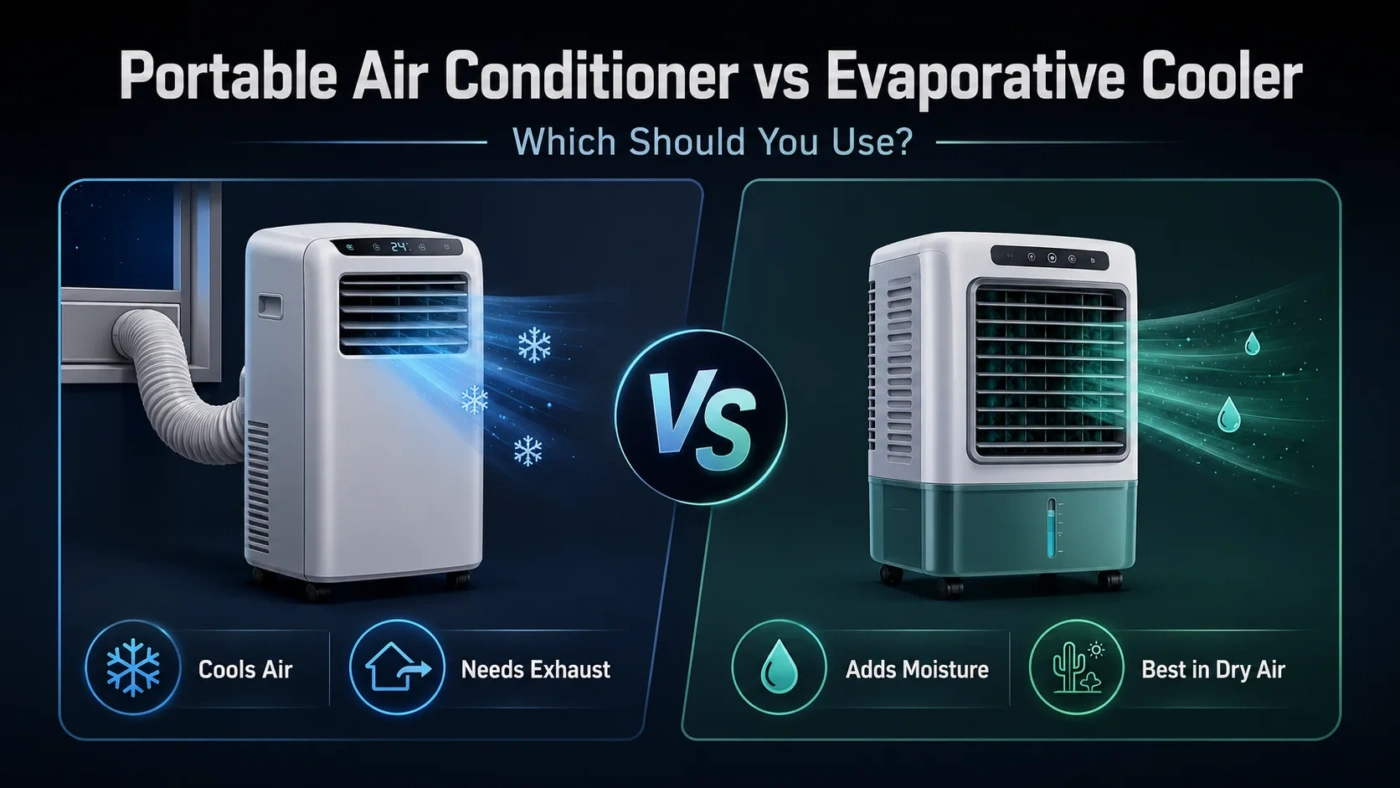
Portable air conditioners and evaporative coolers can both make a room feel more comfortable, but they solve different problems. Choose a portable air conditioner if you need real temperature reduction in a hot, humid, or sealed room. Choose an evaporative cooler if you live in a dry climate, want lower running costs, and can keep fresh air moving through the space.
- Main Differences
- How Each Option Works
- Cooling Performance
- Humidity And Air Feel
- Setup And Daily Use
- Price And Long-Term Value
- Choose A Portable Air Conditioner If
- Choose An Evaporative Cooler If
- Decision Path
- Common Misunderstandings
- An Evaporative Cooler Is Not The Same As An Air Conditioner
- A Portable Air Conditioner Still Needs Venting
- Bigger Is Not Always Better
- More Water Does Not Always Mean More Cooling
- Maintenance And Care
- Best Choice By User Type
| Feature | Portable Air Conditioner | Evaporative Cooler |
|---|---|---|
| Best Environment | Hot, humid, or enclosed rooms | Hot, dry spaces with airflow |
| Cooling Method | Uses refrigeration to remove heat from indoor air | Uses water evaporation to cool moving air |
| Humidity Effect | Often reduces indoor moisture | Adds moisture to the air |
| Ventilation Need | Needs an exhaust hose to a window or vent | Needs open airflow, not a sealed room |
| Energy Use | Usually uses more electricity | Usually uses less electricity |
| Setup | Window kit, hose placement, drainage check | Water tank fill, pad check, airflow path |
| Cooling Feel | Colder, more controlled, air-conditioned feel | Breezy, softer, more open-air feel |
| Best Choice For | Bedrooms, apartments, home offices, humid rooms | Dry-climate patios, garages, workshops, airy rooms |
Main Differences
The biggest difference is the way each device handles heat and moisture. A portable air conditioner works like a small movable cooling system: it pulls heat from indoor air, sends that heat outside through an exhaust hose, and blows cooled air back into the room. It can lower room temperature even when outdoor air is humid.
An evaporative cooler, often called a swamp cooler, works by pushing air through wet media. As water evaporates, the air temperature drops. This can feel very pleasant in dry weather, but it adds moisture to the room. If the air is already humid, evaporation slows down and the cooler may feel more like a fan than a cooling device.
Practical climate note: Evaporative cooling depends on dry air. The drier the air, the better it can work. In humid conditions, a portable air conditioner is usually the more reliable option because it does not rely on evaporation alone.
How Each Option Works
Cooling Performance
A portable air conditioner is the better fit when the main goal is to bring down the actual room temperature. It is useful for sleeping, remote work, small apartments, and rooms where heat builds up during the day. The result depends on room size, insulation, window exposure, hose setup, and unit capacity, but the cooling method is built for controlled indoor comfort.
An evaporative cooler is better described as comfort cooling. It can make moving air feel cooler, especially in dry climates, but it may not cool a sealed room the way an air conditioner can. It performs best when placed near a fresh-air source with another opening across the room, allowing air to move through rather than circulate in place.
Humidity And Air Feel
Humidity is where the decision becomes simple. If the room already feels sticky, an evaporative cooler can make the problem worse because it adds water vapor. A portable air conditioner is usually more suitable because it can remove some moisture while cooling.
In a dry room, an evaporative cooler can feel comfortable because the added moisture softens the air. This can be pleasant in arid regions, workshops, and covered outdoor areas. It is less suitable for rooms where moisture-sensitive items, poor ventilation, or damp surfaces are already a concern.
Setup And Daily Use
A portable air conditioner needs a window kit or vent opening for the exhaust hose. This setup matters. A poorly sealed window, long bent hose, or hot exhaust leakage can reduce cooling. Some units also collect condensation, so the drain system should be checked during use.
An evaporative cooler is easier to move and usually simpler to start. Fill the water tank, open a window or door, and let air pass through the room. The tradeoff is routine water care. The tank, pads, and filters need cleaning so the airflow stays fresh and the unit does not develop odor.
Price And Long-Term Value
Evaporative coolers are often less expensive to buy and run. They may be the better value if your climate is dry and you can use open airflow. They also tend to have fewer cooling-system parts, though pads and water components still need care.
Portable air conditioners usually cost more upfront and use more electricity, but they provide stronger cooling in a wider range of indoor conditions. If the room is humid, poorly ventilated, or used for sleep, the higher operating cost may be worth it because the device solves the actual heat problem more directly.
Choose A Portable Air Conditioner If
Choose An Evaporative Cooler If
Decision Path
Common Misunderstandings
An Evaporative Cooler Is Not The Same As An Air Conditioner
An evaporative cooler can lower air temperature through water evaporation, but it does not use refrigeration. It also does not remove heat from a sealed room in the same way a portable air conditioner does.
A Portable Air Conditioner Still Needs Venting
A portable AC is movable, but it is not vent-free. The hot exhaust air must go outside. Without proper venting, the unit can push heat back into the room and lose much of its cooling value.
Bigger Is Not Always Better
A portable air conditioner should match the room size and heat load. An oversized unit may cycle awkwardly, while an undersized unit may run constantly. Evaporative coolers also need enough airflow for the space, not just a large water tank.
More Water Does Not Always Mean More Cooling
For evaporative coolers, room humidity and airflow matter more than simply filling a larger tank. Once air becomes too moist, the cooling effect drops.
Maintenance And Care
Portable air conditioners need filter cleaning, hose inspection, window seal checks, and condensation management. Keeping the exhaust path short and secure helps performance. The air filter should stay clean because blocked airflow makes the unit work harder.
Evaporative coolers need more water-related care. The tank should be emptied and cleaned regularly, and cooling pads should be replaced when they become mineral-heavy, worn, or musty. Clean water and airflow are central to keeping the cooler pleasant to use.
Moisture caution: Avoid using an evaporative cooler in rooms that already have damp walls, condensation, mildew odor, or poor airflow. Added moisture can make the space less comfortable.
Best Choice By User Type
| User Or Situation | Better Fit | Reason |
|---|---|---|
| Apartment Bedroom | Portable Air Conditioner | Works in a closed space and provides stronger temperature control. |
| Dry-Climate Workshop | Evaporative Cooler | Fresh moving air and low running cost fit this use well. |
| Humid Summer Room | Portable Air Conditioner | Evaporative cooling loses effect when the air is already moist. |
| Budget Daily Cooling | Evaporative Cooler | Can cost less to run if the climate is dry enough. |
| Home Office With Electronics | Portable AirRelated Posts Ceiling Fan vs Tower Fan: Which Is Better for Bedrooms?Ceiling fans and tower fans can both make a bedroom feel cooler, but they solve different problems. A ceiling fan is usually the better bedroom…  Washable Filter vs Replaceable Filter: Which Is Better for Home Appliances?Washable filters are better when you want lower ongoing cost, less waste, and simple dust control in appliances that allow rinsing. Replaceable filters are better… |