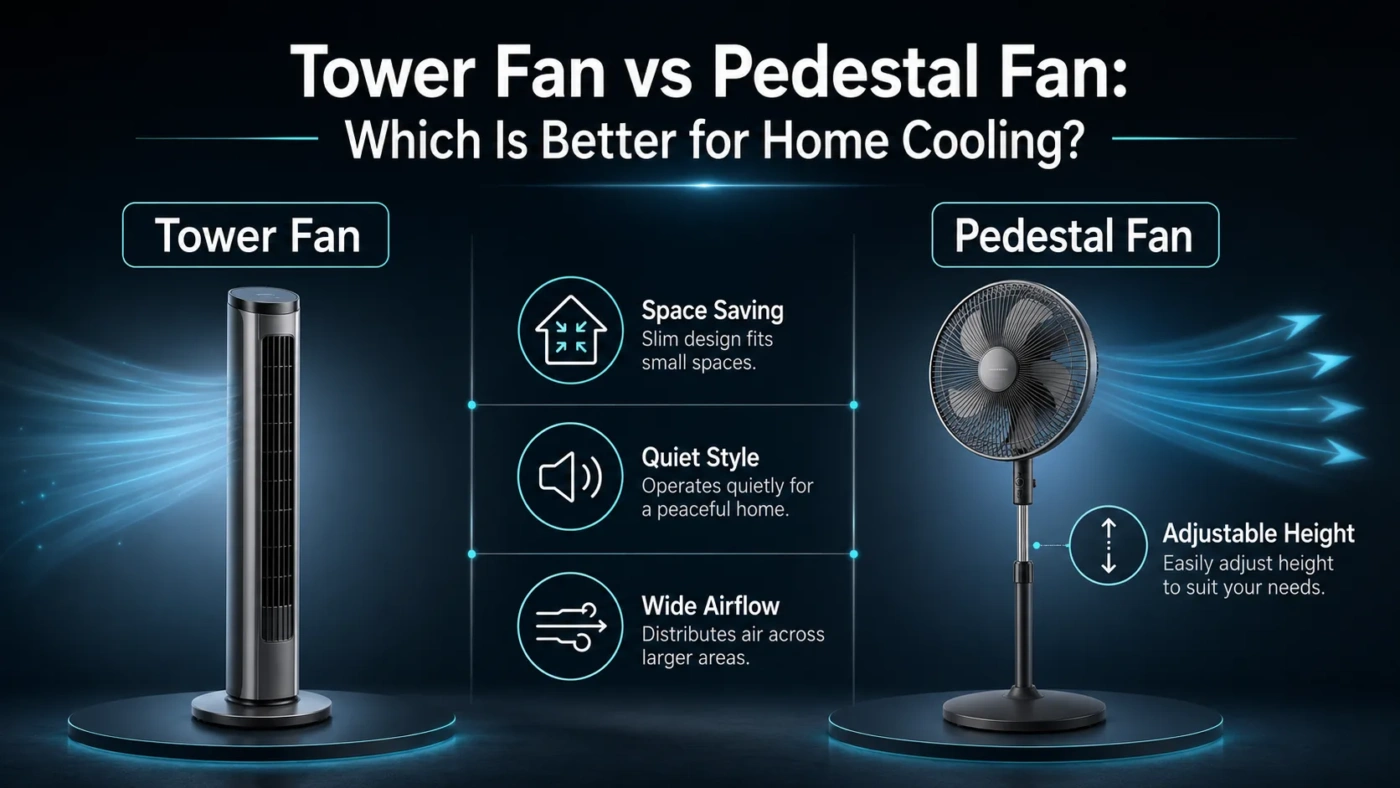
Tower fans and pedestal fans can both make a warm room feel more comfortable, but they solve the problem in different ways. A tower fan is usually better when you want a slim, quiet, modern fan for bedrooms, offices, or small living spaces. A pedestal fan is usually better when you want stronger direct airflow, adjustable height, and wider room coverage for larger areas.
- Main Differences
- What A Tower Fan Offers
- What A Pedestal Fan Offers
- Choose A Tower Fan If
- Choose A Pedestal Fan If
- Cooling Performance In Real Use
- Noise, Comfort, And Sleep
- Space, Design, And Placement
- Cleaning And Maintenance
- Price And Long-Term Value
- Best Choice By User Type
- Common Misunderstandings
- Where Each Option Fits Best
- FAQ
- Is A Tower Fan Better Than A Pedestal Fan?
- Which Fan Is Better For A Bedroom?
- Which Fan Moves More Air?
- Is A Tower Fan Easier To Clean?
- Can Either Fan Replace An Air Conditioner?
- Compare More Options
| Feature | Tower Fan | Pedestal Fan |
|---|---|---|
| Best For | Bedrooms, offices, apartments, narrow spaces | Living rooms, larger rooms, garages, open areas |
| Airflow Style | Vertical, softer, often more diffused | Stronger, more direct, easier to aim |
| Space Use | Slim and easy to place near furniture | Needs more floor space because of the base and fan head |
| Adjustability | Usually limited height adjustment | Height and tilt are usually adjustable |
| Noise Level | Often quieter on low and medium settings | Can be louder, especially at higher speeds |
| Cleaning | Can be harder to clean inside the grille | Usually easier to open and wipe |
| Cooling Feel | Comfortable background airflow | Stronger cooling sensation when aimed directly |
| Typical Value | Better for comfort, design, and quiet daily use | Better for airflow strength per dollar |
Main Differences
The main difference is airflow delivery. A tower fan usually spreads air through a tall vertical outlet, which creates a smoother breeze across part of the room. A pedestal fan uses a larger round blade and fan head, so it can push air farther and feel stronger when pointed toward a person, sofa, bed, or desk.
Space is the second major difference. A tower fan has a narrow footprint and can sit beside a bed, TV stand, desk, or sofa without drawing much attention. A pedestal fan needs more open space because its base, pole, and fan head take up more visual and physical room.
Control is another clear split. Many pedestal fans allow height and tilt adjustment, which makes them easier to aim across a bed, over a table, or toward a seating area. Tower fans often oscillate well, but they usually have less control over vertical direction.
What A Tower Fan Offers
A tower fan is built for neat placement and steady comfort. Its tall, narrow body makes it a good match for rooms where floor space is limited or where a bulky fan would look out of place. It can sit near a wall, next to a cabinet, or beside a bed without becoming the center of the room.
The airflow from a tower fan usually feels less forceful than a pedestal fan, but that can be a benefit. For sleeping, reading, working, or watching TV, a softer oscillating breeze may feel more pleasant than a direct blast of air. Many tower fans also include timers, remote controls, multiple speed levels, and airflow modes, depending on the model.
The tradeoff is cleaning and airflow reach. Because the internal fan mechanism is enclosed in a vertical body, dust can be harder to remove. A tower fan may also feel less effective in a large room, especially if the room has high ceilings, strong sunlight, or poor air movement.
What A Pedestal Fan Offers
A pedestal fan is built around airflow power and aiming control. The fan head is raised on a stand, and many models allow height adjustment, tilt adjustment, and side-to-side oscillation. This makes it easier to send air across a room, over furniture, or directly toward a seating area.
For rooms that feel hot even with windows open, a pedestal fan often gives a stronger cooling sensation. It can also help move air from one part of a room to another, especially when placed near a doorway, window, or open hallway.
The tradeoff is size and sound. A pedestal fan can look more noticeable, and the wider base may get in the way in a tight room. Stronger airflow can also mean more noise, especially at high speed. For some people, that sound is fine. For others, it may be distracting during sleep or quiet work.
Choose A Tower Fan If
Choose A Pedestal Fan If
Cooling Performance In Real Use
Neither fan actually lowers room temperature like an air conditioner. Both work by moving air across your skin, which helps sweat evaporate and makes the room feel cooler. The difference is how that moving air reaches you.
A pedestal fan usually feels cooler when you sit in its airflow path. This makes it useful for hot afternoons, workouts at home, kitchens, hobby rooms, and larger living areas. If you need airflow you can clearly feel from several feet away, a pedestal fan has the advantage.
A tower fan is better when comfort matters more than force. It can keep air moving without dominating the room. In a bedroom, a narrow tower fan placed near the bed can provide steady airflow while taking up less space than a stand fan.
Noise, Comfort, And Sleep
For bedrooms, noise can matter as much as airflow. A tower fan often produces a smoother sound on lower settings, which many people find easier to sleep with. Its airflow is also less likely to hit one part of the body too strongly during the night.
A pedestal fan can still work well for sleep, especially if you place it farther away or use a lower setting. The benefit is stronger airflow when the room is very warm. The drawback is that the larger fan head and stronger motor may create more audible blade noise.
If you are sensitive to sound, look for a fan with several speed levels, a timer, and a stable base. A lower setting that still moves enough air is often more comfortable than a powerful fan running too close to the bed.
Space, Design, And Placement
A tower fan is the easier choice when the fan will stay visible all season. Its shape is less intrusive, and it can be placed near walls or furniture without blocking walkways. This makes it useful in apartments, dorm rooms, offices, and compact bedrooms.
A pedestal fan is less discreet, but more flexible in direction. Because the head sits higher, it can move air over low furniture and toward a specific part of the room. This is useful in living rooms, shared spaces, and rooms where people sit in different places throughout the day.
Cleaning And Maintenance
Pedestal fans are usually easier to clean. In many designs, the front grille can be removed so the blades and grille can be wiped. This matters if the fan runs daily or if the room collects dust quickly.
Tower fans can take more effort to clean because dust may collect behind narrow vents. Some models allow limited access, while others mainly require vacuuming the outer grille. If easy maintenance is a priority, check how the fan opens before buying.
For both types, regular cleaning helps airflow and reduces dust buildup. A fan that looks clean but has dusty blades or vents may move less air and create more noise than it should.
Price And Long-Term Value
Pedestal fans often offer strong airflow for the money. If your main goal is to move a lot of air without paying for extra design features, a pedestal fan is usually the better value.
Tower fans can cost more when they include remote controls, timers, display panels, airflow modes, or quieter operation. The extra value comes from comfort and convenience rather than raw airflow power.
For long-term use, think about where the fan will live. A cheaper pedestal fan may be the smarter choice for a garage or large room. A quieter tower fan may feel worth the extra cost in a bedroom or office where you use it every day.
Best Choice By User Type
| User Or Room Type | Better Fit | Reason |
|---|---|---|
| Small Bedroom | Tower Fan | Slim shape, softer airflow, and better bedside placement. |
| Large Living Room | Pedestal Fan | Stronger airflow and better reach across open space. |
| Home Office | Tower Fan | Quieter background airflow and less floor clutter. |
| Budget Buyer | Pedestal Fan | Often delivers more airflow for the price. |
| Light Sleeper | Tower Fan | Lower settings often feel smoother and less direct. |
| Hot Workshop Or Garage | Pedestal Fan | Direct airflow and adjustable height are more useful. |
Common Misunderstandings
Where Each Option Fits Best
Choose a tower fan if the fan will live in a bedroom, home office, apartment, or compact room where quiet comfort and neat placement matter. It is the better fit when you want airflow that blends into daily life without taking over the space.
Choose a pedestal fan if the room is larger, hotter, or harder to ventilate. It is the better fit when you want direct airflow, height adjustment, and stronger cooling sensation from a distance.
If you are still unsure, start with the room size. For small and medium rooms where comfort matters most, pick the tower fan. For larger rooms where airflow strength matters most, pick the pedestal fan.
FAQ
Is A Tower Fan Better Than A Pedestal Fan?
A tower fan is better for small spaces, quiet use, and cleaner room design. A pedestal fan is better for stronger airflow and adjustable direction. The better choice depends on the room and how you plan to use it.
Which Fan Is Better For A Bedroom?
A tower fan is usually better for a bedroom because it takes up less space and often feels quieter on lower settings. A pedestal fan can work well if the bedroom is large or very warm.
Which Fan Moves More Air?
A pedestal fan usually moves more air because it often has a larger fan head and more direct airflow. Actual performance still depends on the specific fan design and speed setting.
Is A Tower Fan Easier To Clean?
Usually no. Pedestal fans are often easier to clean because the grille can be removed and the blades are easier to reach. Tower fans may require more careful vacuuming around the vents.
Can Either Fan Replace An Air Conditioner?
No. A fan can make you feel cooler by moving air, but it does not remove heat from the room. In very hot conditions, a fan may help comfort, but it is not the same as active cooling.